Articles | Advertisements
|
Some
notes on the names of surfing magazines. For reference purposes, see: All
Surf Magazines (magazine covers and much more, by Al Hunt); Surfbooks.com
(formerly Joe
Tabler, now Boyd Scofield); Surfwarez.com, AllAboutSurfing.com,
Surfresearch.com
(pods for primates) and Gallery
of Surf Classics (Keith Maynard Eshelman) for a large listing of
surfing magazines, posters and other items. Several book reviews are
listed on The Waterman's
Library.
Excellent guides in print include The Surfing Collectibles Guide # 1: Magazine and Poster Issue (edited by Tim DeLaVega) and 200 Years of Surfing Literature: An Annotated Bibliography (by Tim DeLaVega).
Listed below are articles published in surfing
magazines from around the world that the Paipo Research Project has
been able to obtain in our effort to document segments in the history
of paipo boarding. Articles are organized chronologically by magazine.
Contributions are welcomed.
Atlantic Surfer (ASM). Published six issues, 1978-1980. The UK's first colour surfing magazine. Atlantic Surfer
was started in Newquay by Aussie Greg Haythorpe in 1978. When Greg
resigned John Conway took over the helm in 1980, and although the mag
didn't last long, John Conway's new mag which he started in 1981, Wavelength, has gone on to be one of the top and longest lasting British surf mags.
Atlantic Surfing (ATS). First published Summer 1965, by Chapey and Gundersen. According to Surfing Collectibles Guide
author Tim De La Vega, "the "right coast" was never too far behind with
these nicely produced magazines. Sadly, their staying power was never
very long." According to an interview with the co-publishers in http://pilgrimsurfsupply.com/atlantic-surfing-magazine/, only 9 issues were published.
Australian Longboarding Magazine (ALB).
First published in Autumn 1998, last issue was the March 2012 edition.
Number of issues: 80 plus 3 specials, per Al Hunt's
allsurfmagazines.com. http://www.albmag.com.au/. More info anyone?
Australia's Surfing Life (ASL). The magazine was founded in 1985, by Peter Morrison. Still in publication (as of Jan. 2016), now known as Surfing Life.
Breakway (BKY). A Victoria-based (Australian) monthly surfing
journal published 4+ years in the 1970s, the brainchild of Ted
Bainbridge who enlisted the help of journalist-photographer Keith
Platt, another keen surfer, who in turn roped in non-surfer Tony
Murrell, supposedly for his publishing skills. It was 1973, and the
first issues were put together out back of the Trigger Bros. shop and
board factory in the Melbourne bayside suburb of Chelsea. Breakway sold
throughout Australia and New Zealand at the time surfing was
transitioning from a cottage to a corporate industry. Forty-seven
issues were published before Bainbridge, Platt and Murrell drifted off
to do other stuff. [Source: Breakway.com.au.] The first issue was published, December 1973, and the last issue, January 1978.
Competition Surf (CSM). Competition Surf, a contest-oriented
magazine, may have been doomed simply by bad timing, according to Tim
De La Vega, author of the Surfing Collectibles Guide. "With the
advent of the shortboard revolution, contests were soon to be a thing
of shame, not honor." Six issues were published.
International Surfing (ISM). (Dick Graham) In 1974, Lopez Publications dropped "International" from their name to create Surfing Magazine. The publishers noted, "When we, Richard Graham and Leroy Grannis, received word that Petersen's Surfing
magazine was no longer being published as a monthly, we began looking
around for backers to enable us to continue the magazine." This quote
from the editorial herewith sums up how the present-day Surfing Magazine started so many years ago. Vol 1 (1964) through Vol. 9 (1973). Correction: Vol. 10, No.1 (Feb/Mar 1974), was still labeled International Surfing on the cover and in the masthead "fine print."
Pacific Longboarder (PLB).
Published by Surf Media Pty Ltd, "it is dedicated to providing a
comprehensive coverage of longboarding and the surfing lifestyle."
Queensland, Australia. First published in 1998 and still in production
(July 2013).
Petersen's Surfing Magazine (PSM). Petersen published the first
Surfing Magazine in December 1963 (Vol. 1, No. 1) and the last in the
series was published November 1964 (Vol. 1, No. 8). Richard Graham made
a second run with a Petersen's surfing magazine, Surfing Action Around the World, which debuted in April 1968.
Petersen's Surfing Yearbook (PSY). The first Yearbook was published before Surfing Magazine's first issue, about the same time that Surfer published its first photo annual, according to Surfing Collectibles Guide author Tim DeLaVega. Petersen published four yearbooks, in 1963, 1965, 1966, and 1969.
South African Surfer (SAF). Harry Bold became editor of South Africa's first surfing magazine, South African Surfer,
which appeared in 1965. The magazine folded three years later, but it
played a critical role in documenting the early days of modern surfing.
"Some of the older guys, like Derek Jardine and Harry Bold, are the
proud owners of every issue - a valuable collection of memories."
Surf (SRA). Published in Australia with the basic name, Surf.
This magazine has a limited publication run of nine issues, from
October 1976 to May 1978, using a single volume numbering scheme (all
volume 1). According to Geoff Cater of SurfResearch.com.au, the editor
was Steve Core, who made surfboards in the late-1960s and was a surf
photographer and surf film maker. The magazine had a strong Cronulla
influence.
Surf Atlantique (STL). Published by the French Federation of Surfing. The publication run was limited to 3 or 4 issues, 1964-1965 (?).
Surf Guide (SG).
Bill Cleary, former editor; John Van Hamersveld, former art director;
Larry Stevenson, former publisher. While other magazines tried to coax
surfing into the sporting mainstream, Cleary preferred to see it as
loose and freewheeling, and Surf Guide soon became the genre's
smartest and at times most poetic voice. First surf magazine to put a
woman on the cover, played down the contest scene, first article to
offer real contest analysis and criticism, began using color in early
1964. Cleary went on to become an associate editor at Surfer.
Candy Calhoun, who loved paipo surfing, was on the staff and wrote
several articles. Twenty-two issues of the magazine were produced
between 1963-1965. More history is discussed here.
Surf International (SIN).
Editors: John Witzig, Paul Koller. Vol. 1, No. 1, was published
December 1967 - January 1968. An upmarket, alternative to Surfing
World. Introduced music, lifestyle, enviroment and politics. The dates
of Surf International magazines are not specified in the
publication details. Some commentators have dated this issue September
1967, yet the cover article on the Newcastle Contest notes it was won
by Russell Hughes on 10th September 1967. Given the publishing lag in
this period (up to 6 weeks), a later date seems reasonable. The
magazine's agenda was to be futher explored by Witzig in Tracks magazine. Published around 1967-1970, by Gareth Powell Associates. Information compliments of surfresearch.com.au.
Surfabout: Australasian Surfer (SAS). In August 1962, Surfabout Australasian Surfer
was published as a quarterly that would run for 24 issues until 1968.
In the debut issue, editorial staff included Jack Eden who was credited
as photographer and co-editor; Garry Birdsall was credited as
cartoonist and co-editor, and Bob Weeks was credited as photographer.
Source: Paul Scott (2005, 29 Nov-2 Dec). Australian Surfing Magazines: The First Wave (1961-1962). Refereed paper presented to the Journalism Education Conference, Griffith University.
Surfer Magazine (SMQ). Also known as The Surfer Quarterly, The Surfer Bi-Monthly, Surfer.
Founded in 1960 by surfer-artist-filmmaker John Severson; the longest
continuously published surf magazine, and sometimes referred to as the
"Bible of the sport." The long time "king of surf magazines." Severson
sold Surfer in 1972, and handed over publishing duties to
editor-writer Steve Pezman, who remained with the magazine for two
decades. (Pezman would later found the San Clemente–based Surfer's Journal.) R.I.P. Oct 4, 2020, with v61, n03. See more here: http://encyclopediaofsurfing.com/entries/surfer-magazine.
Surfer's Path, The (TSP). Started publication in 1997 in the UK. According to Wikipedia, "The Surfer's Path
is an international surfing journal which is published every two
months. Founded in 1997, the magazine is a bit of an anomaly in the
surf-publishing world. Based in the United Kingdom, the Path is
low-key and philosophical. From the start, its Caribbean-born editor,
Alex Dick-Read, aimed the mag at the environmentally and culturally
conscious global surf traveler. The magazine has its international
headquarters in Oxon in England with publishing offices in New York
City. An American edition of the magazine was formerly edited by Drew
Kampion from Washington State. The magazine's website has full
information and upates: click-surf to www.surferspath.com."
Surfing Action Around the World (SAP). Published by Petersen, 1968-1972, also known as Surfing. Petersen Publishing decided to make another go at it with this magazine, according to Tim DeLaVega, author of the Surfing Collectibles Guide.
Editor Richard Graham started off with America's first shortboard cover
in April 1968, breaking the shortboard news to the Americans. This
magazine covered quite a bit of the new counter culture movement. The
magazine barely made in into the 1970s, before Petersen finally gave up
in 1972.
Surfing East (SNE). Published by Richard S. Van Winkle, for
three years, 1965-67, and nine issues. Focused on the North East and
based out of Ridgewood, NJ. Considered to be poorly edited and focused
on contests. Balsa Bill was one of the contributing editors. Jim
Phillips also contributed as a mid-Atlantic correspondent. [Rod's Note:
It doesn't seem that bad as surfing mags of the era go.]
Surfing Illustrated (SIL). Published by Walt Phillips from
1962-1967. Photographer Leroy Grannis had a major influence on classic
covers and layouts. Phillips also produced surf films and TV shows, "Surf's Up" and "Walt Phillips' Surfing World." (Sources: Tim DeLaVega' Surfing Collectibles Guide, 2000; Matt Warshaw's Encyclopedia of Surfing; vol. 4, no. 1, June 1966.) Published by Jack Pelzer and Edited by Peter L. Dixon beginning with v4n1 (June 1966).
Surfing Life (ASL). The magazine was founded in 1985, by Peter Morrison. Formerly known as Australia's Surfing Life.
Surfing Magazine (ISM). In 1974, Lopez Publications dropped "International" from their name to create "Surfing Magazine," which has become a household name in surf mags and Surfer's primary competitor for the last 30 years. This publication should not be confused with "Petersen's Surfing," which thrived in the 1960s. Vol 10 (1974) to present.
Surfing World (ASW). Vol. 1, No. 1 was published Sept. 1962, edited by Bob Evans. First issue was titled The Surfing World Monthly and The Australian Surfing Magazine, and is also known as Australia's Surfing World.
Still published today, it was and is "a monthly magazine published in
the interests of promoting surfing in Australia and overseas." Editor
1966: Albert Falzon, others include John Witzig, Bruce Channon.
The Surfer's Journal (TSJ). Published by Steve Pezman (former publisher, Surfer Magazine) and Debbee Pezman (former Marketing Director, Surfer Magazine), the Journal was founded in 1992.
Tracks (TRK). Published since 1970 (or to 1977?). Editors: John
Witzig, Albert Falzon, John Stewart, John Grissim, Paul Holmes, Kirk
Wilcox, Neil Ridgway, Phil Jarratt, Nick CarrollIn. In 1970, Tracks
magazine had a significant impact by foregoing colour and using a
newsprint format that slashed production time from 12 to 4 weeks.
Australia.
TransWorld Surf (TWS). Published since 1999. Chris Coté, Editor-in-Chief (2010). Located in Oceanside, CA.
Wave Rider (WRP). A quarterly surfing publication that was based
in Cocoa Beach, Florida, publishing 20 issues between 1975-1982.
Founded by Gunnar Griffin and John Griffin, two brothers from the
Florida Space Coast, the publication had a successful run for nearly
seven years until the early 1980s. Wave Rider not only covered the
international surfing scene but offered more inclusive coverage of the
East Coast of the United States. Information courtesy of Craig Snyder Works.com.
Miscellaneous Magazines
(Non-surfing -- please note that some magazine articles are listed in
the bibliography and annotated bibliography rather then here.)
Articles |
Australian Longboarding Magazine (on-line
link to the magazine)
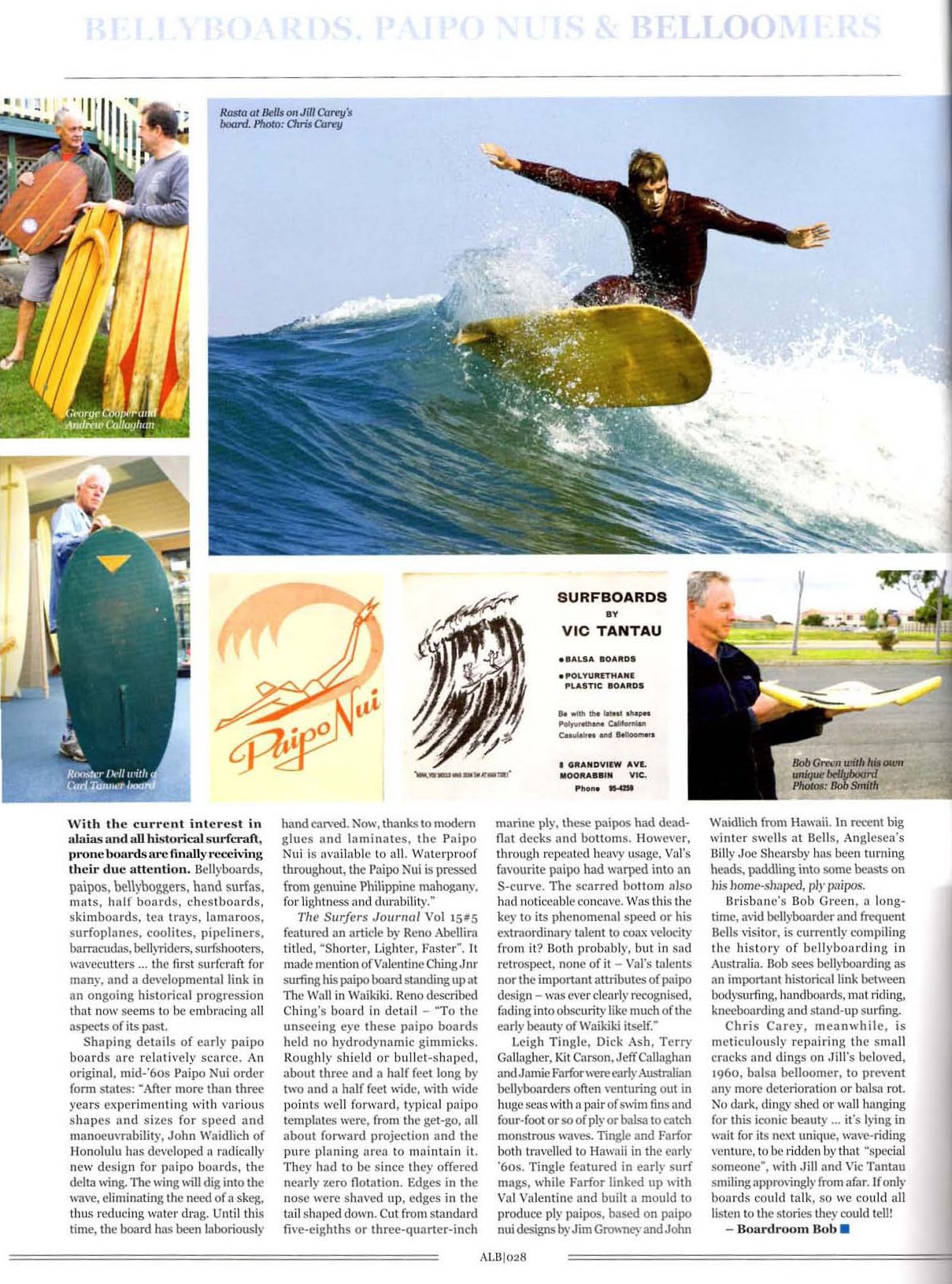
- Smith, Bob (Boardroom Bob). (2010,
November/December). Bellyboards, Paipo Nuis & Belloomers: The
history and resurgence of an ancient craft. Australian Longboarding Magazine, 72, 50-52. Article with photographs, pp. 26,28. Click on the link to the article pages here (JPG): Page 26 - Page 28

|
|
All around the
article does well until it crumbles into some of the all too customary
characterizations,
- "... a special emotional
moment for all that had Chris quietly pondering whether he could have
been a stand-up surfer after all."
- "... the first surfcraft
for many, and a developmental link in an ongoing historical progression
that now seems to he embracing all aspects of its past."
A critical reading of the
article would seem to indicate that stand-up foot riding on the paipo
is required in order to "validate" a board-type intended to be ridden
prone... for the joy of it!
Some good historical nuggets and a nice collection of boards are shown
on p. 26.
|
|
International Surfing Magazine (on-line
link to the magazine)
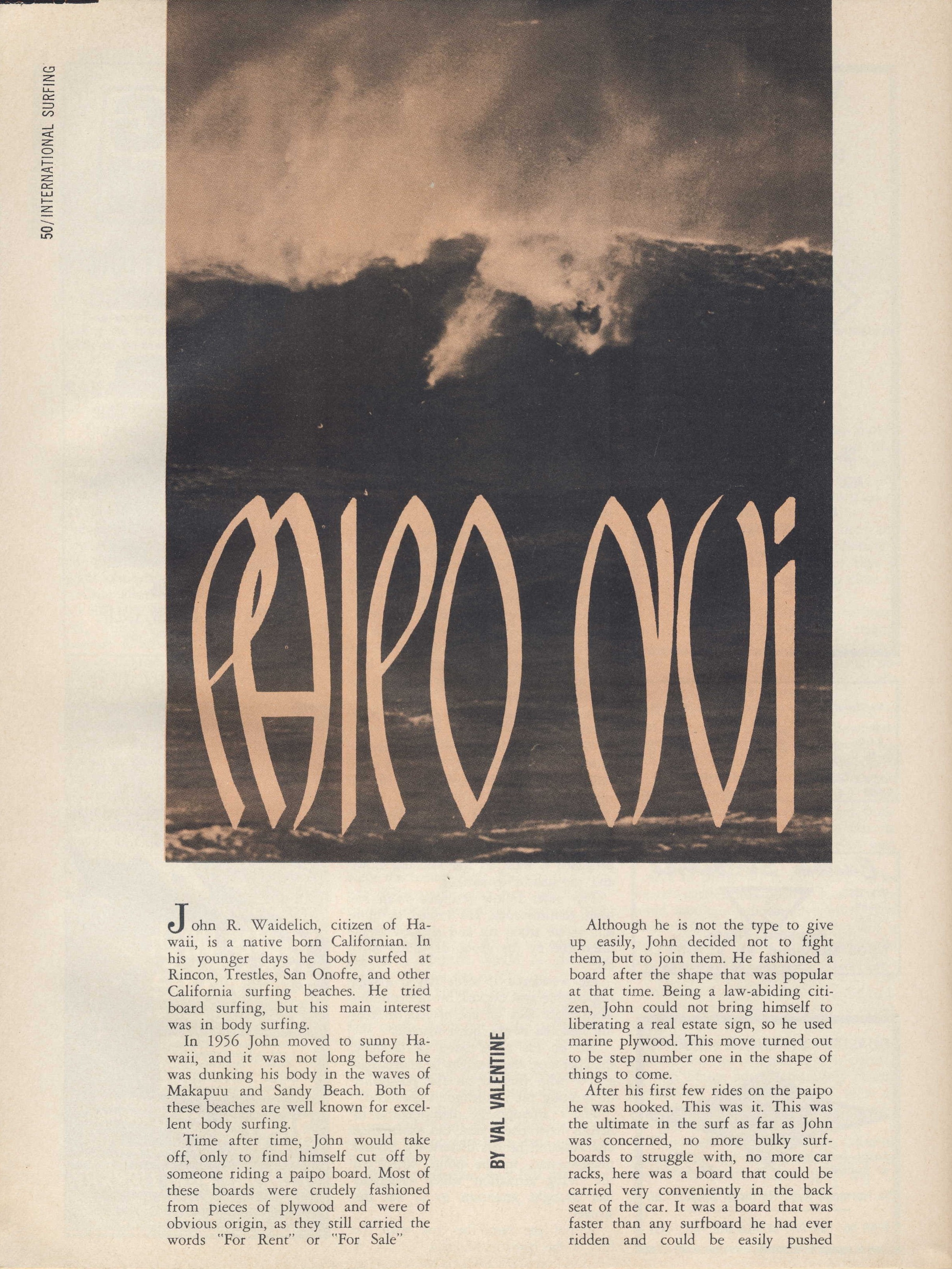
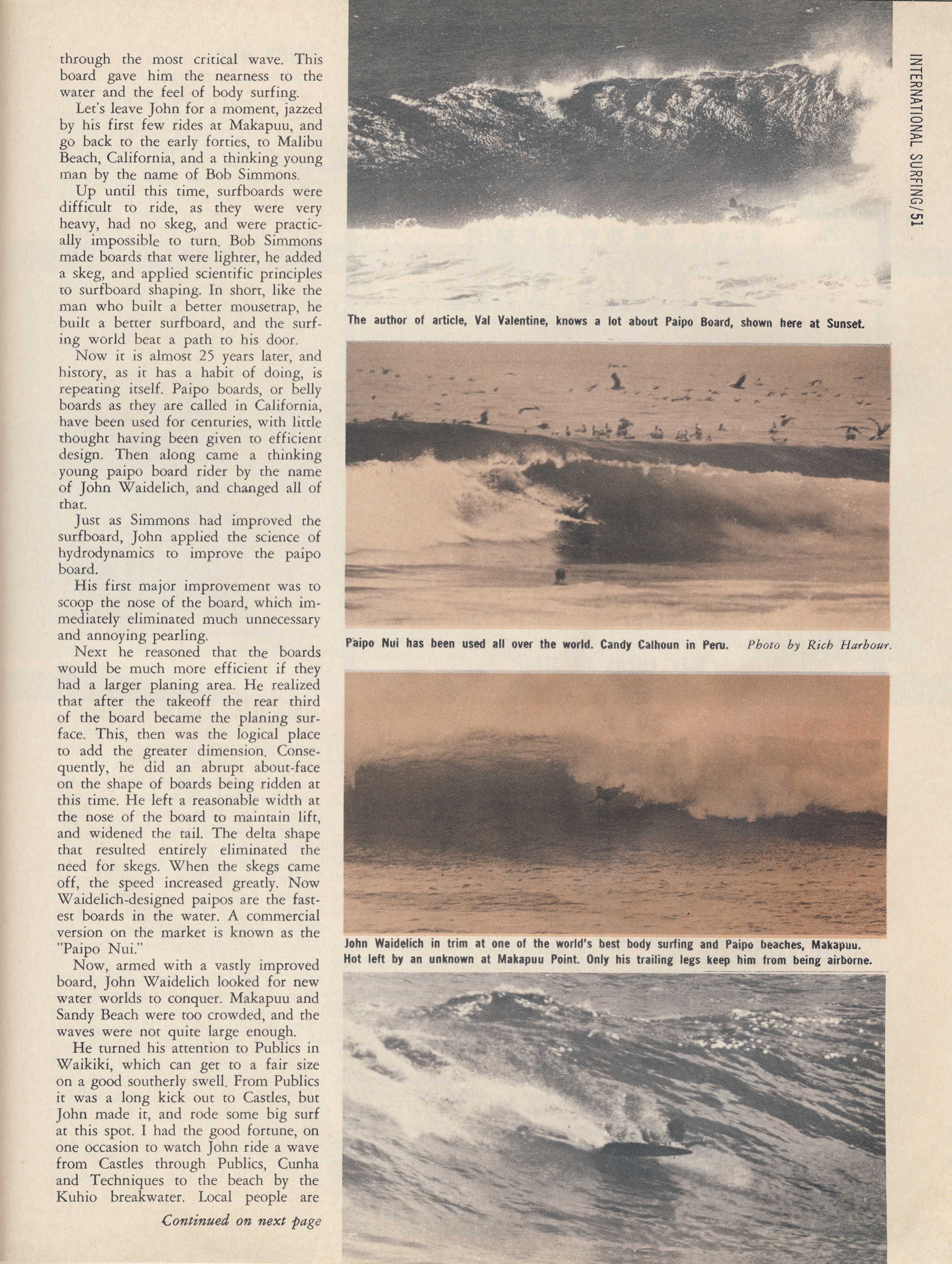
- Valentine, Val.
(1965,
October). Paipo Nui. International Surfing Magazine, 1(6), 50-52. Story
about how John Waidelich evolved from being a bodysurfer to becoming an
avid paipo boarder. He gradually improved the board from a basic slab
of marine ply to a highly articulated board with a scooped nose and a
larger planing area in the aft section resulting in a delta shape.
Commercially, this shape became known as the Paipo Nui and went on to
be ridden on the famous North Shore breaks, including Waimea Bay. Article with photographs, pp. 50-52. Click on the link to the article pages here (JPG): Page 50 - Page
51 - Page
52. See the 3-page PDF here.
Note: In the Letters to the Editor section of Vol. 2, No. 1 (Dec.
1965), p. 71, Candy
Calhoun notes an error in the caption of the photograph (middle page,
third down). She is riding a Wallace Froiseth paipo, not a Paipo Nui
board. See the letter bottom right.
 |
Calhoun, Candy.
(1965, December). Letter to Editor. International Surfing Magazine, 2(1), 71.
Correction
please!

|
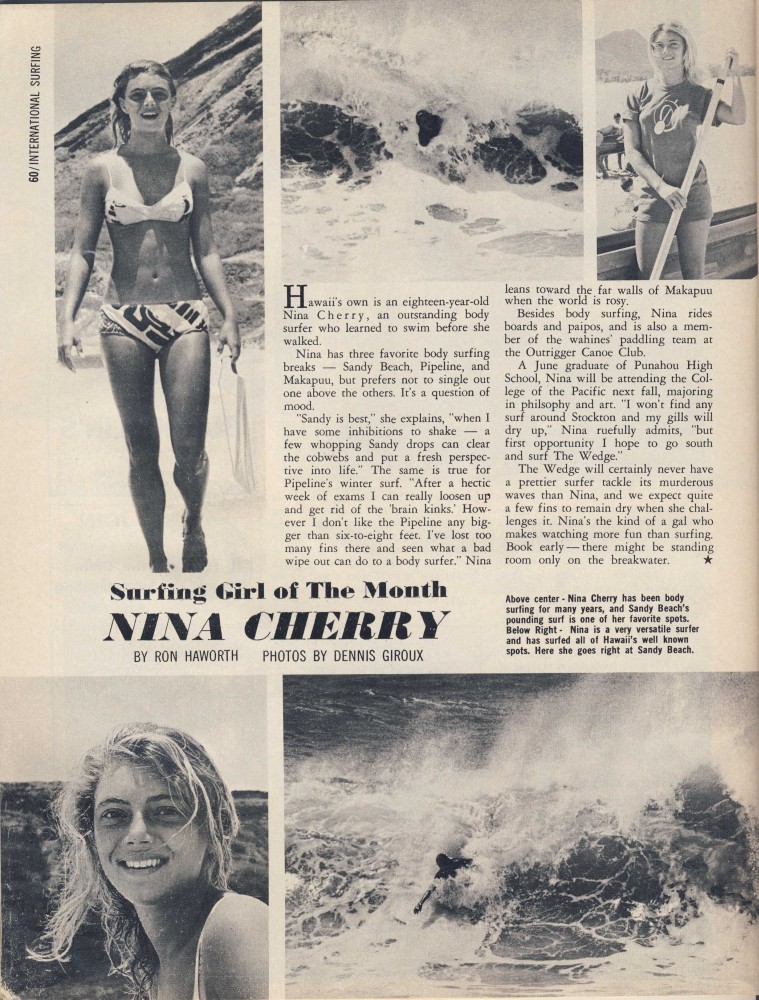
- Haworth, Ron.
(1965,
October). Surfing Girl of the Month: Nina Cherry. International
Surfing Magazine, 1(6), 60.
 |
One
page cameo on water woman Nina Cherry. An accomplished bodysurfer, she
was also a paipo rider, stand-up surfer and a member of a wahine
paddling team at the Outrigger Canoe Club. Click on the link
to the article pages here (JPG),
Page
60. |
|
Pacific Longboarder Magazine (on-line link to the magazine)
- Green, Bob. (2013, May). Paipo - What’s that? Pacific Longboarder Magazine, 16(5), 50-54.
- Wegener, Tom. (2013, May). The Secret. Pacific Longboarder Magazine, 16(5), 55-57.
The articles described in the issue's Contents: "Like the Phantom,
paipo go by many names and have remained in the shadows. "Professor of
Paipo" Bob Green shares his encyclopaedic knowledge of this simple but
highly functional surf vehicle from the past. Augmented by a piece from
Tom Wegener on the fascinating, if more than a little eccentric World
Bellyboarding Championships held every September at Chapel Porth in
England. Tom’s also making and riding some fine "modern" paipos."


|
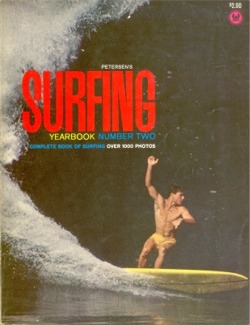
Petersen's
Surfing Yearbook
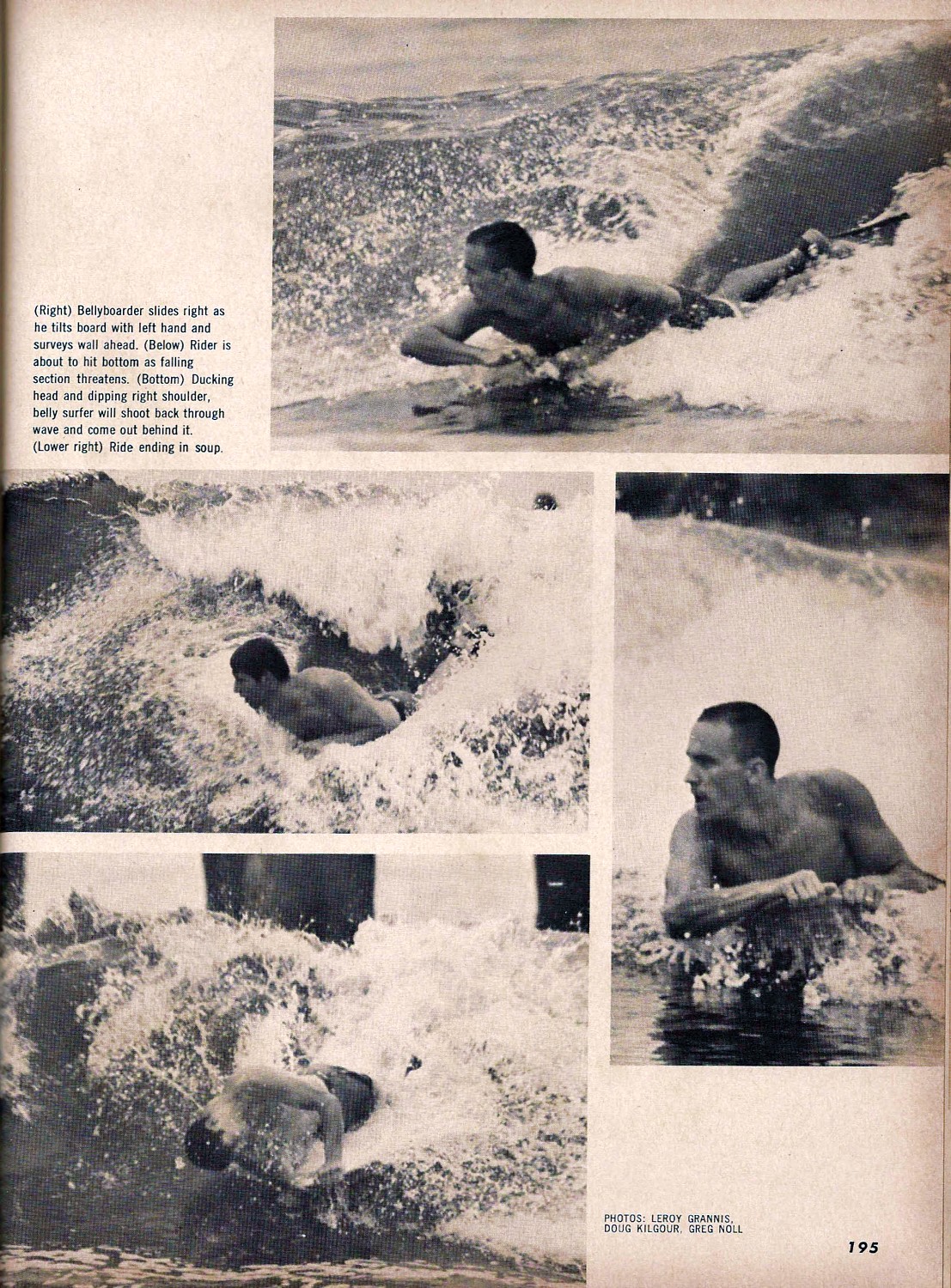
- Haworth, Ron. (1965).
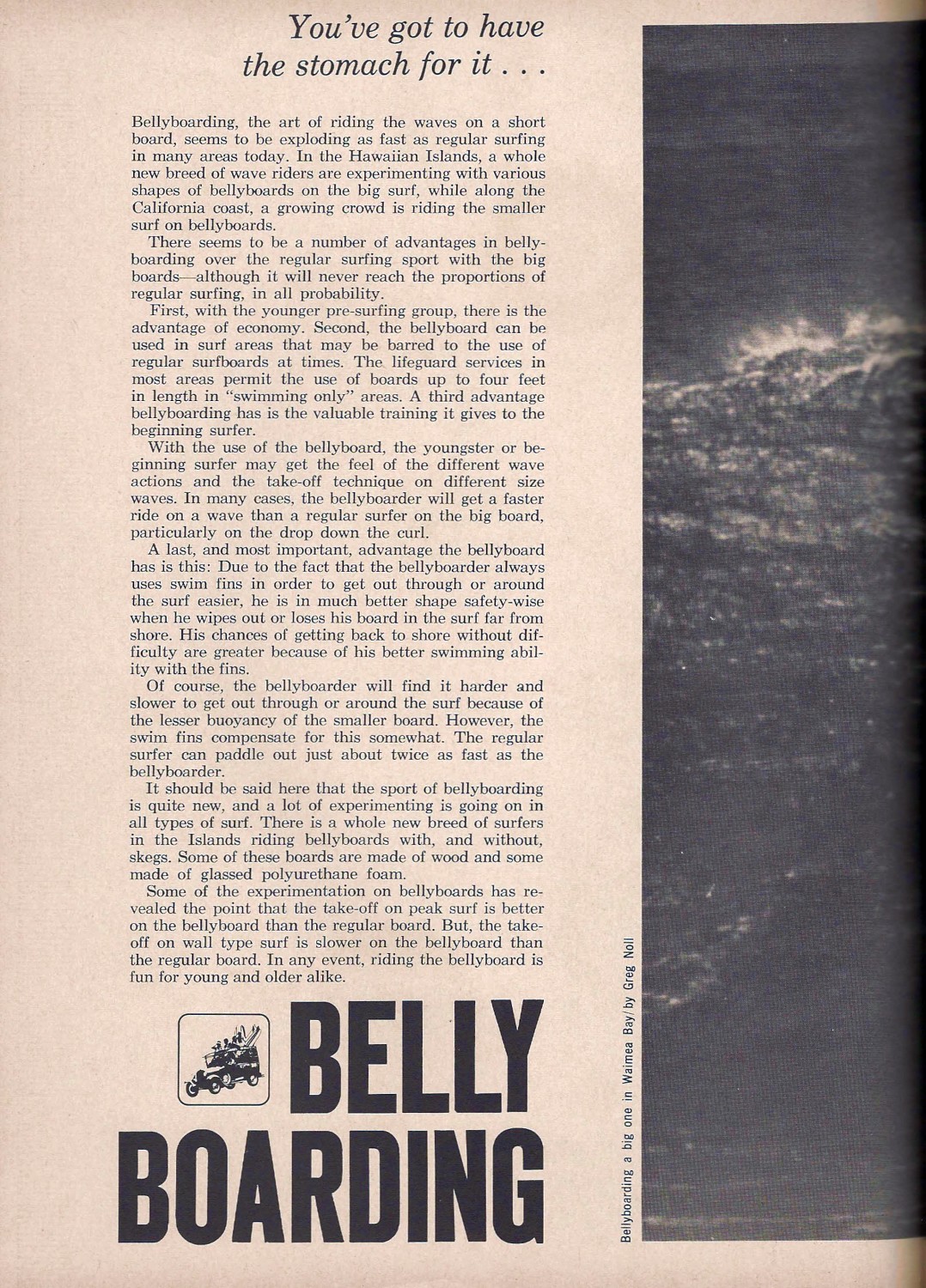
Belly Boarding: You've got to have the stomach for it... . Petersen's
Surfing Yearbook Number Two, 192-195. Los Angeles, Calif.: Petersen Publishing Co.

|
Excerpt from
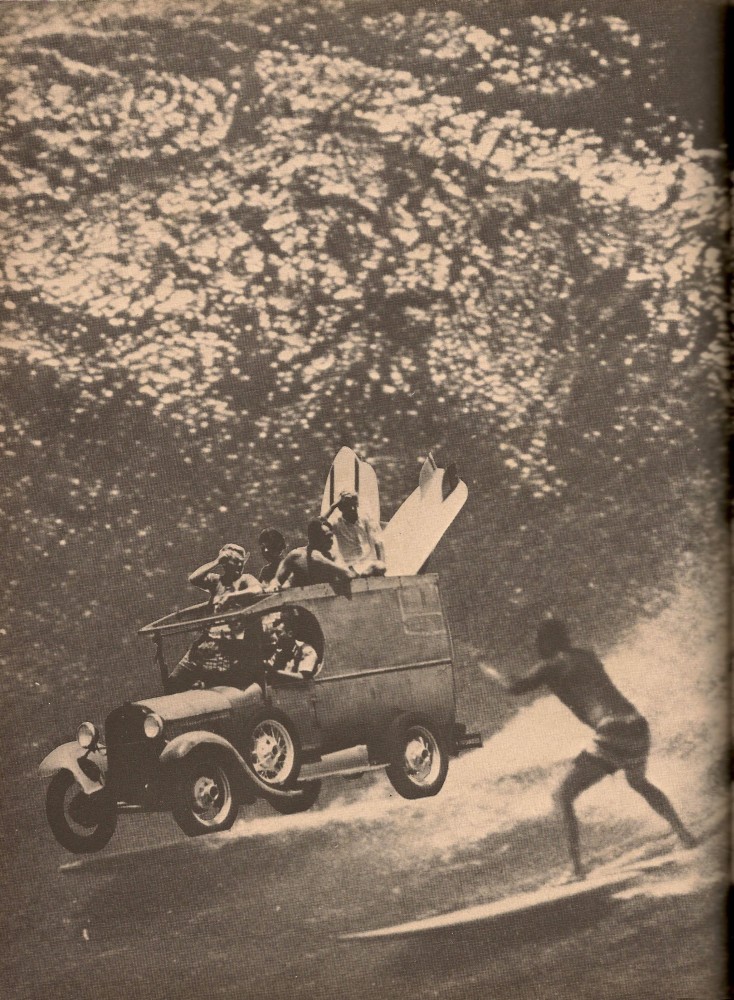
the section titled Offbeat Surfing: You name away - somebody's
already tried it. Article with photographs, pp. 190-195. Ron Haworth's authorship of the article was confirmed in
his Paipo
Interview. Photos are by Leroy Grannis, Doug Kilgour, and Greg
Noll. Some snippets from the article appear below.
|
 |
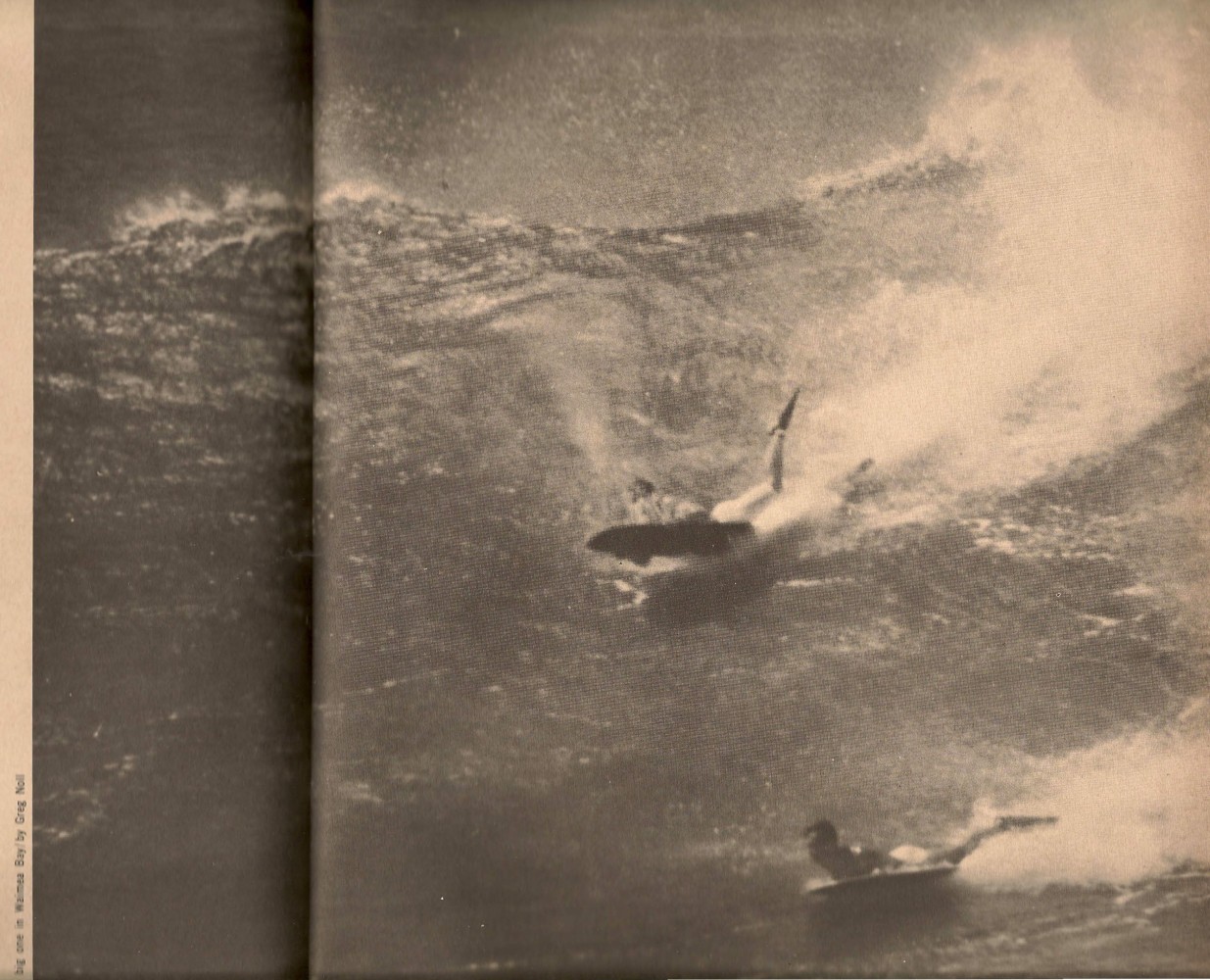
- Bellyboarding, the art of
riding the waves on a short board, seems to be exploding as fast as
regular surfing in many areas today. In the Hawaiian Islands, a whole
new breed of wave riders are experimenting with various shapes of
bellyboards on the big surf, while along the California coast, a
growing crowd is riding the smaller surf on bellyboards.
- It should be said here
that the sport of belly boarding is quite new, and a lot of
experimenting is going on in all types of sud. There is a whole new
breed of surfers in the Islands riding bellyboards with, and without,
skegs. Some of these boards are made of wood and some made of glassed
polyurethane foam.
Click on the link to the
article here
in PDF [4.5MB]. Click on page numbers for viewing: p190 | p191
| p192 | p193
| p194 | p195
|
|
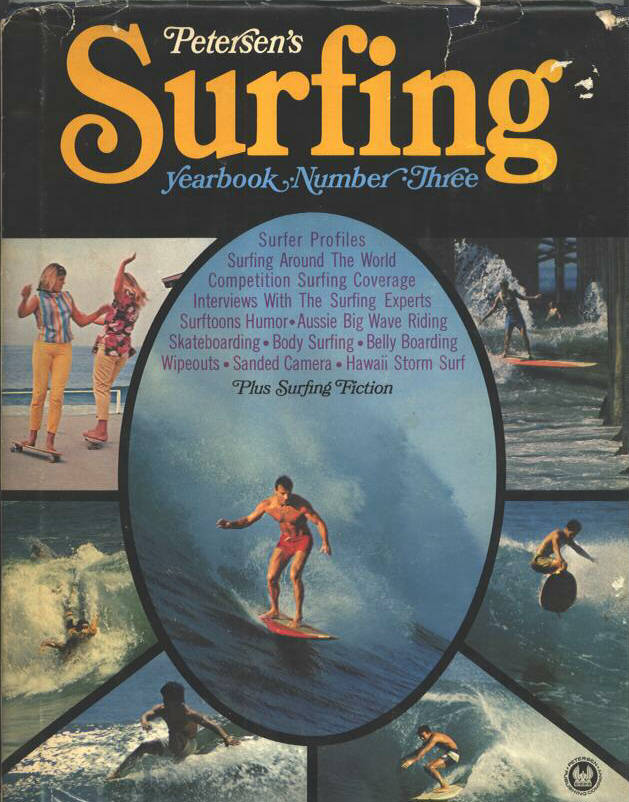
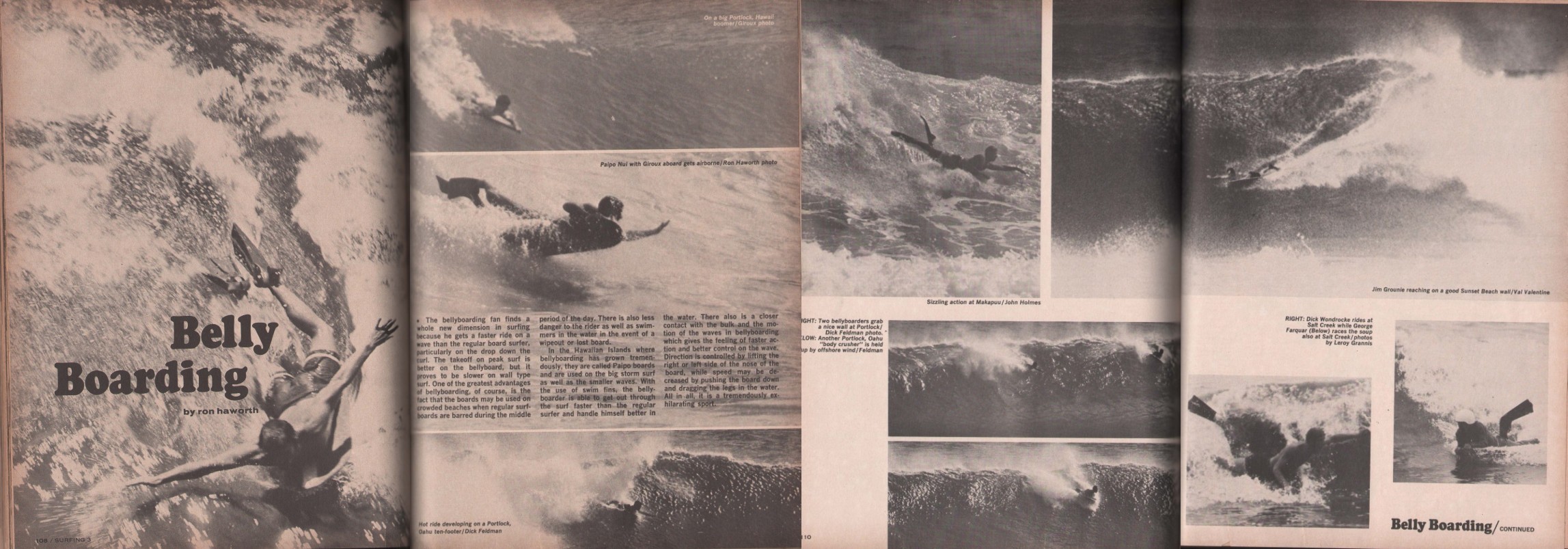
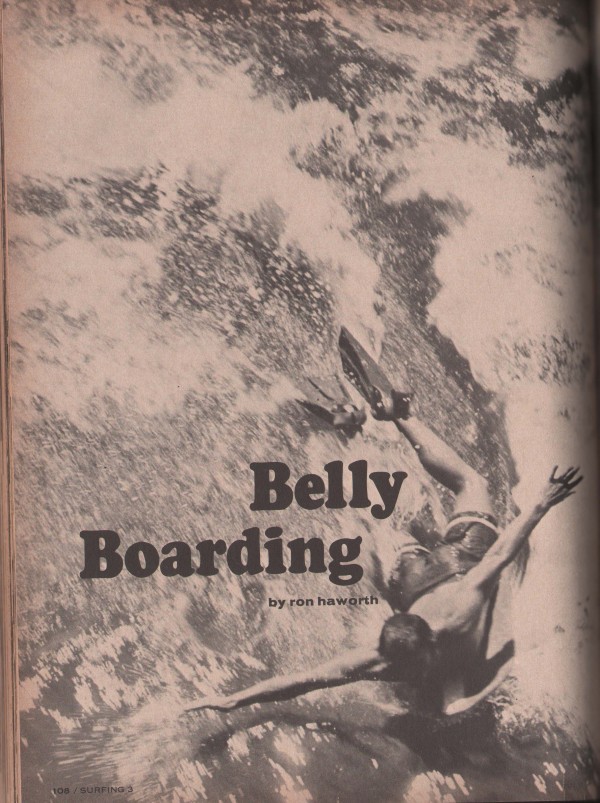
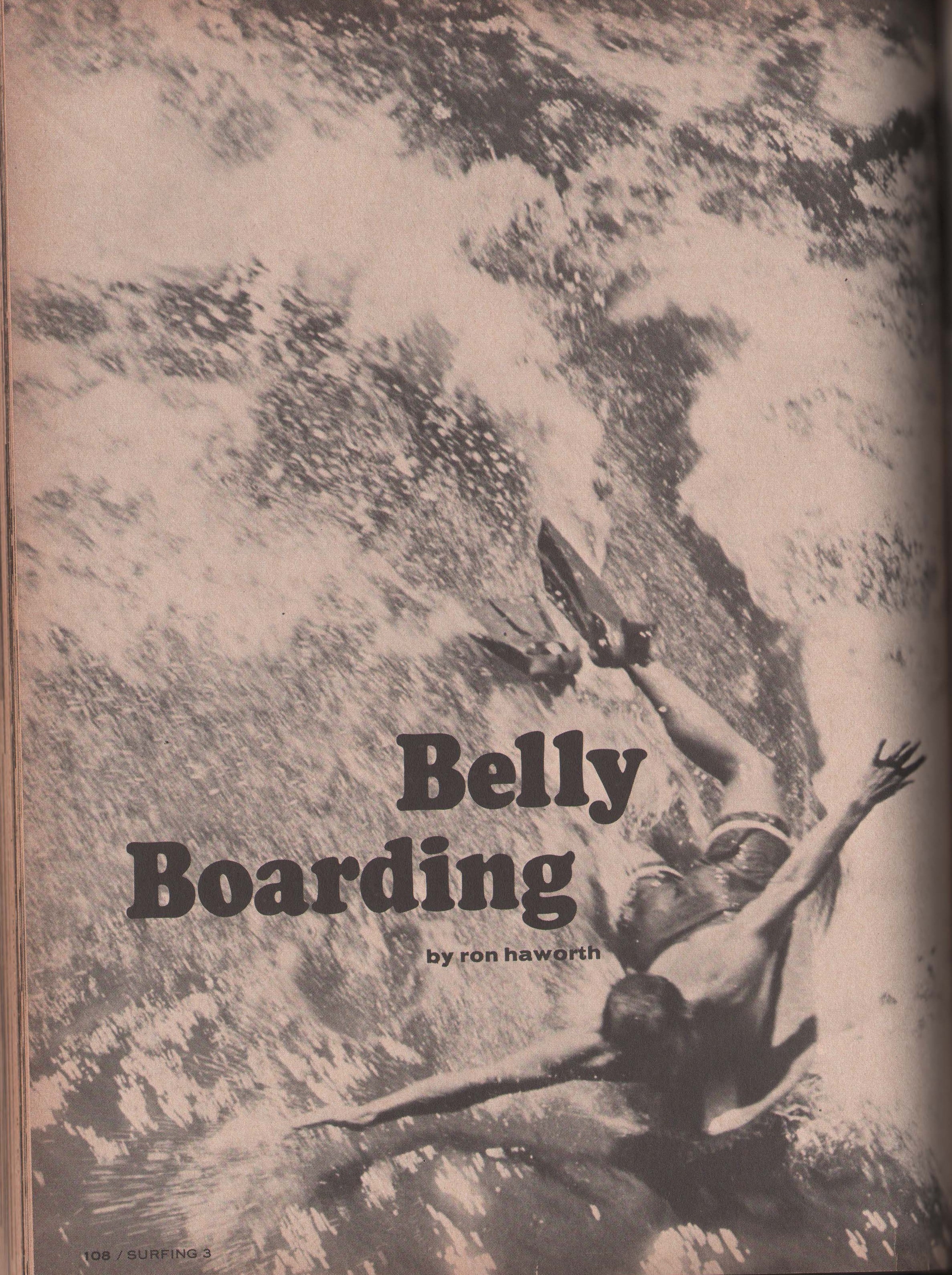
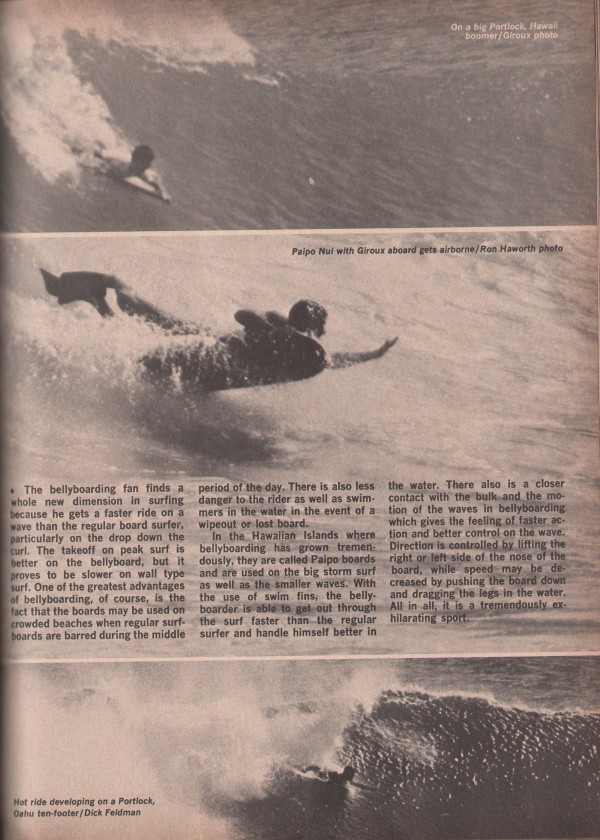
- Haworth, Ron. (1966). Belly Boarding. Petersen's
Surfing
Yearbook Number Three, 108-111. Los Angeles, Calif.: Petersen Publishing Co.

|
|

|
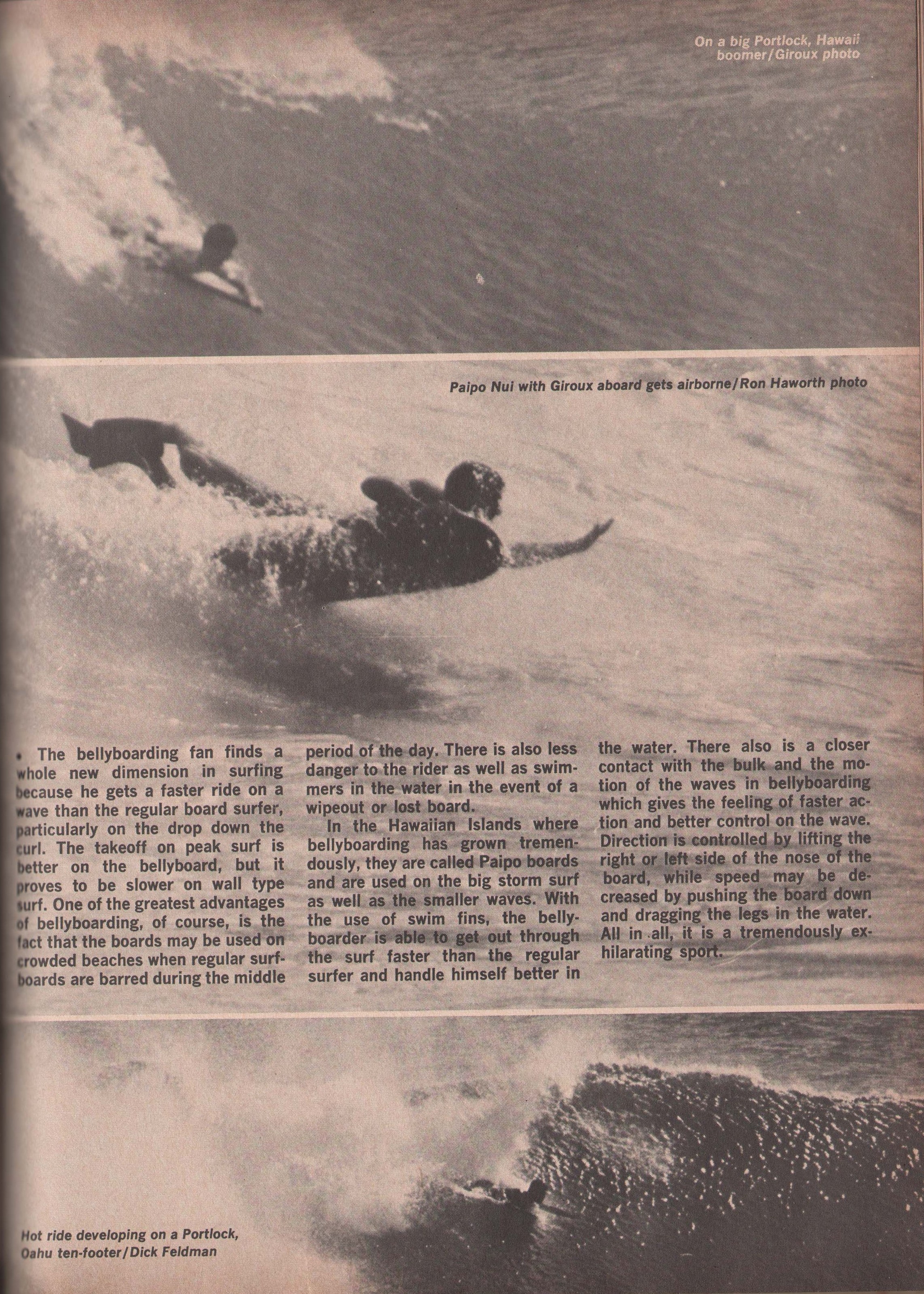
"The bellyboarding fan finds a whole new
dimension in surfing because he gets a faster ride
on a wave than a
regular board rider, particularly on the drop down the curl." Also, "In
the Hawaiian Islands where bellyboarding has grown temendously, they
are called Paipo boards and are sued on the big storm surf as well as
the smaller waves.
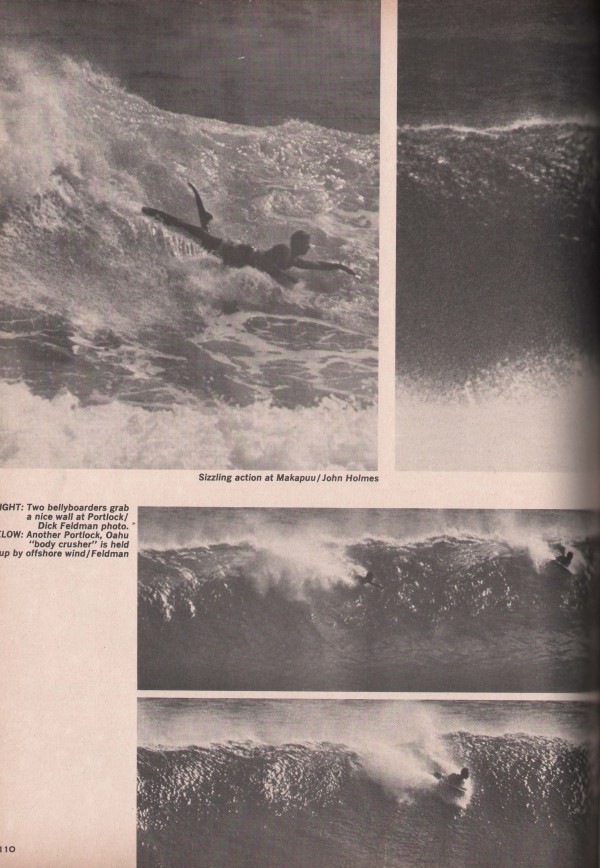
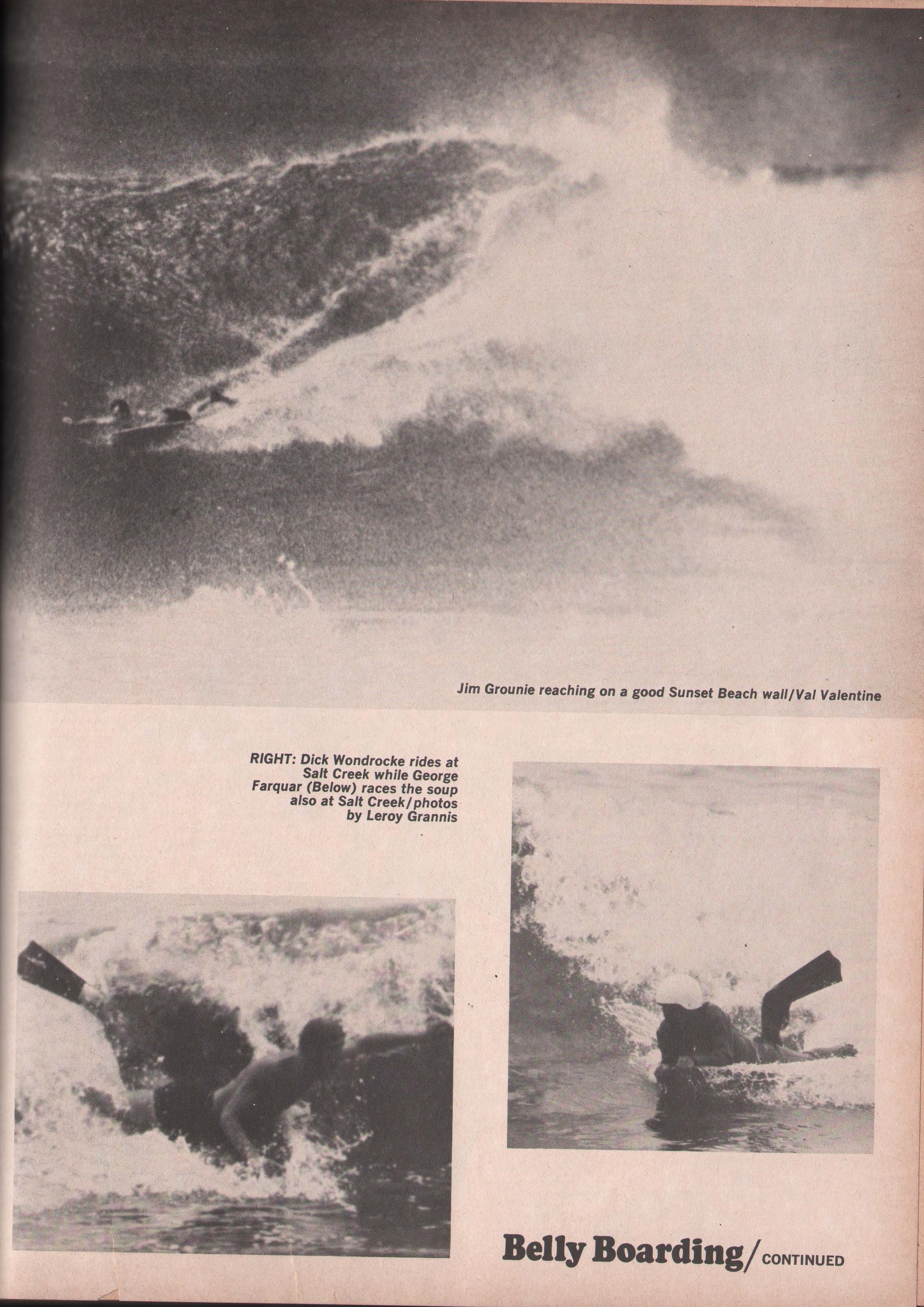
Article
with photographs, pp. 108-111.
Click on the link to the
article here
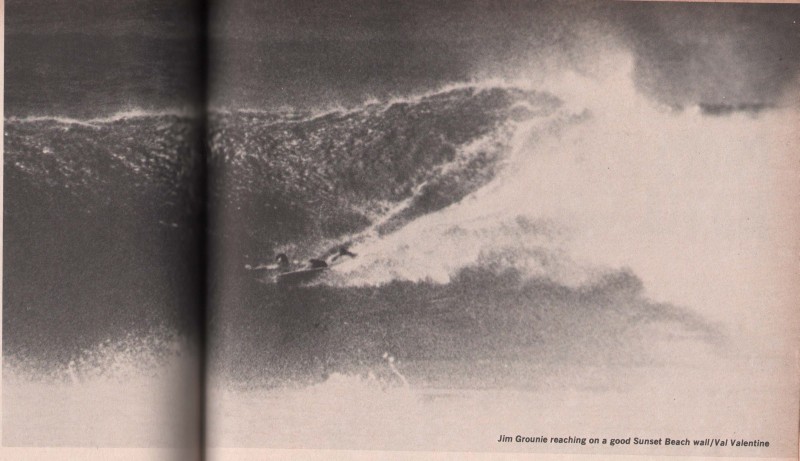
in PDF [725KB]. Click here for JPG images: p108 websized
| hi-rez;
p109 websized
| hi-rez; p110 websized
| hi-rez; p111 websized
| hi-rez; photo spread on pp110-1 websized
| hi-rez |
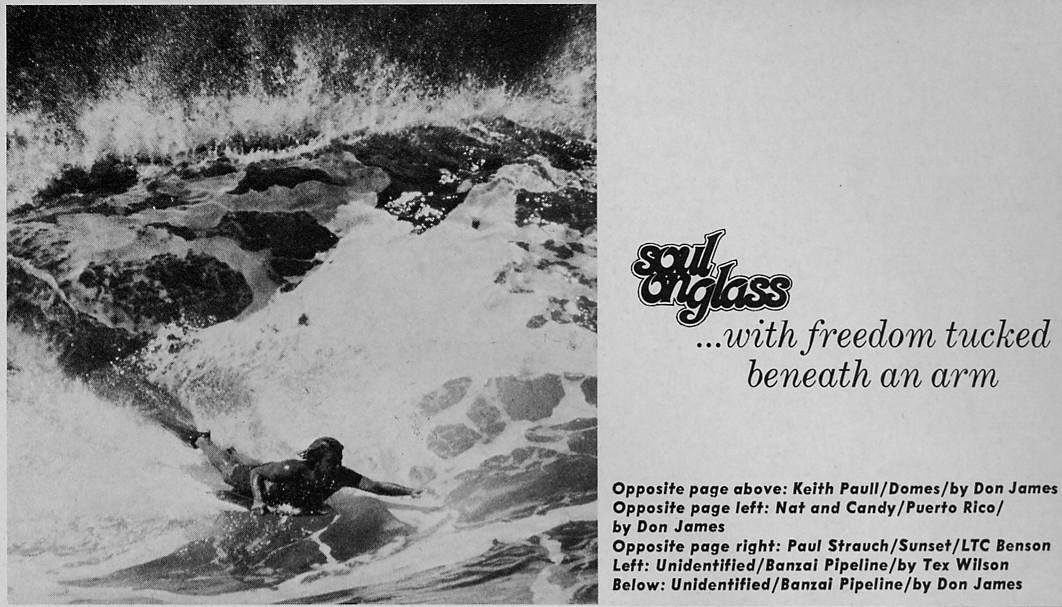
- [Photograph by Tex Wilson]. (1966). Belly Boarding. Petersen
Surfing
Yearbook No. 4, 83. Los Angeles, Calif.: Petersen Publishing Co.
No articles appeared in the
Yearbook Number Four. Pictured below is the only paipo-related item, an
unidentified rider at Pipeline. Photo by Tex Wilson.

|
South African Surfer
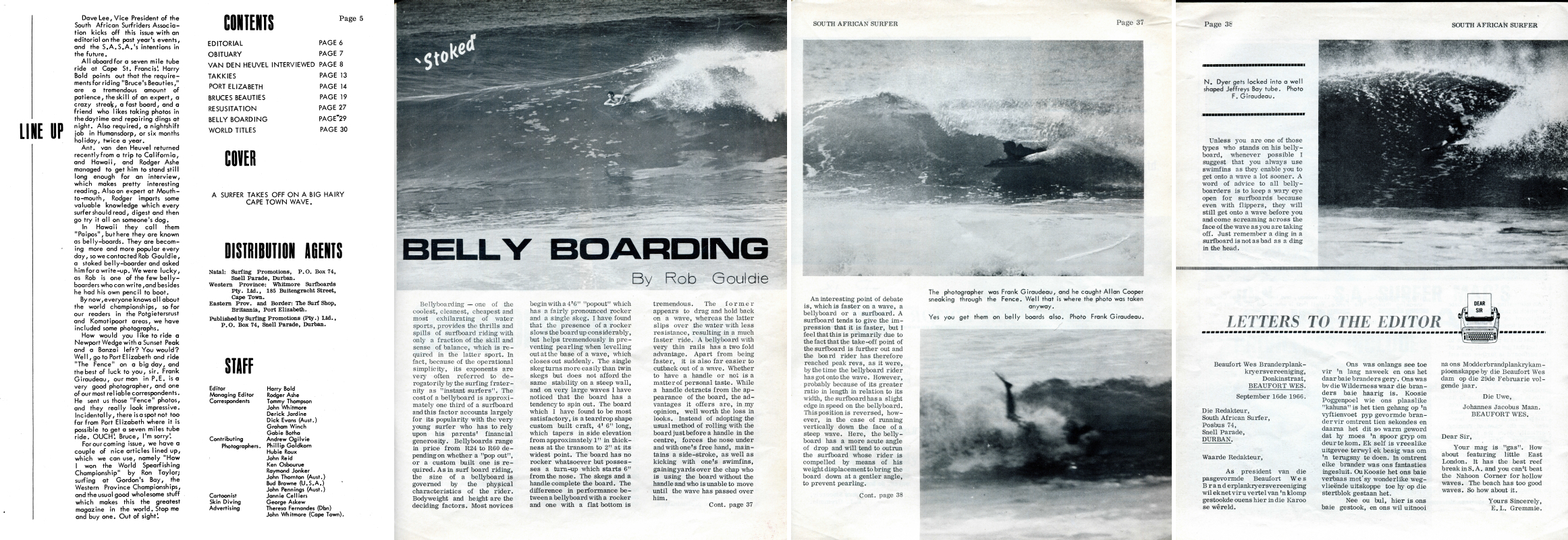
- Gouldie, Rob. (1967, no month identified). Belly Boarding. South African Surfer, 3(1), 29, 37-38. This was the
first article featuring bellyboard/paipo surfing in South African
Surfer, the first surfing magazine in South Africa. Prior issues
included advertisements, letters to the editor, photographs and other
references to belly sliding within feature articles. See the PDF here [9MB].

- The Contents page offers a
preview of the article: "In Hawaii they call them "Paipos", but here
they are known as belly-boards. They are becoming more and more popular
every day, so we contacted Rob Gouldie, a stoked belly-boarder and
asked him for a write-up." Some article excerpts are below.
- As in surf board riding, the
size of a belly board is governed by the physical characteristics of
the rider. Bodyweight and height are the deciding factors.
- Most novices begin with a 4'6" "popout" which has a fairly pronounced rocker and a single skeg.
- The board which I have found to
be most satisfactory, is a teardrop shape custom built craft, 4'6"
long, which tapers in side elevation from approximately 1" in thickness
at the transom to 2" at its widest point. The board has no rocker
whatsoever but possesses a turn-up which starts 6" from the nose. The
skegs and a handle complete the board.
- Whether to have a handle or not
is a matter of personal taste. While a handle detracts from the
appearance of the board, the advantages it offers are, in my opinion,
well worth the loss in looks.
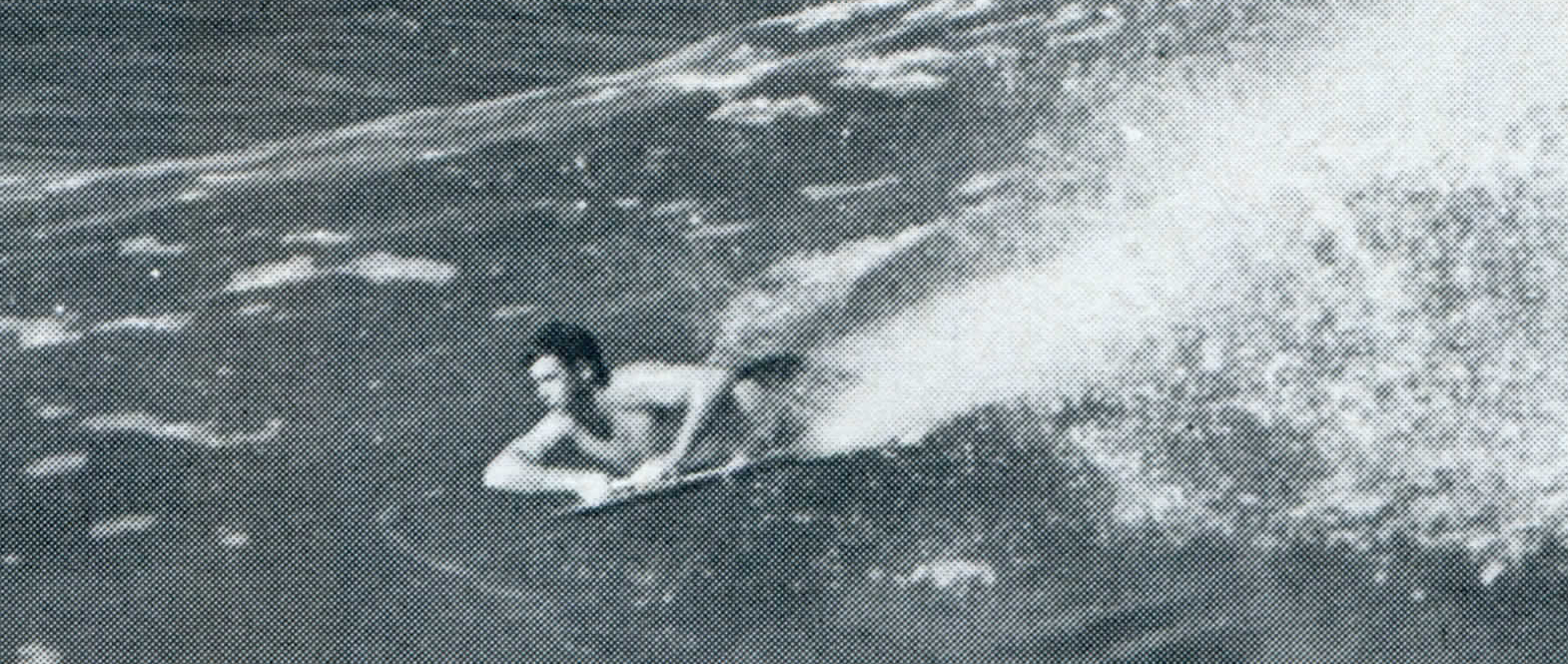
This cropped photograph from p. 29
shows some close-up detail of the rider holding on to a handle but it
is hard to determine whether the handle is made of a fixed material or
maybe a tight rope or cord. Most of the other photographs show the
riders holding on to the handle with one or both hands, although that
is unclear in the photo on p. 38.

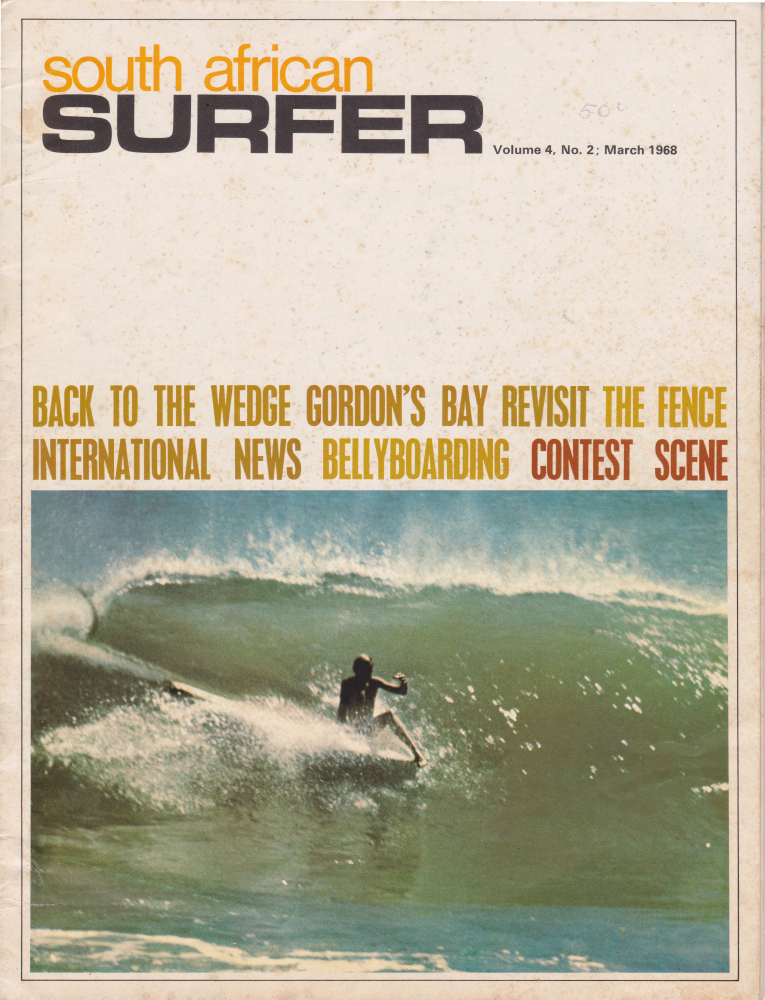
- Unknown. (1968, March). Belly-boarding: New Concepts on a New Sport. South African Surfer, 4(2), 14. A
"how to surf a belly-board" article. The author suggests a six-ply
board about 42 inches long, turned up slightly at the nose, and about 2
inches broader in the nose than the tail. The board should be about as
wide at your shoulders. Twin fins are preferable to a single fin board.
The author mentions several reasons for riding a belly-board. Clicking
on the images below will provide a larger view.

|
|

|
|
|
|
The photographs below were reprocessed to provide clearer images.
|

|
|
 |
|

|
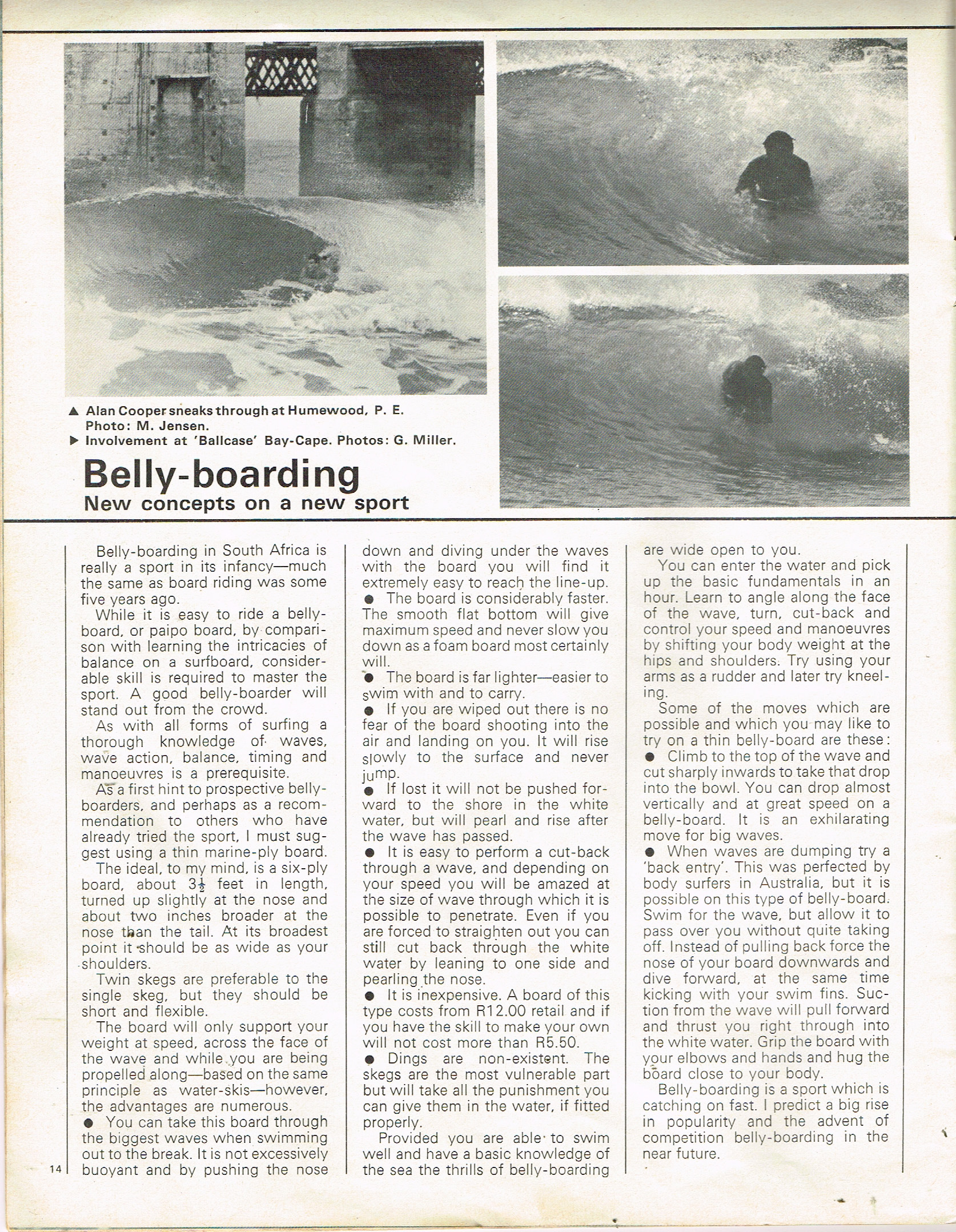
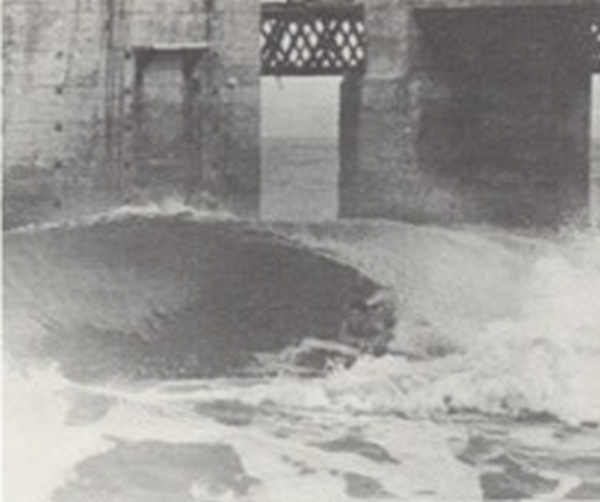
Above: Alan Cooper sneaks through at
Humewood, P.E. Photo: M. Jensen.
|
|
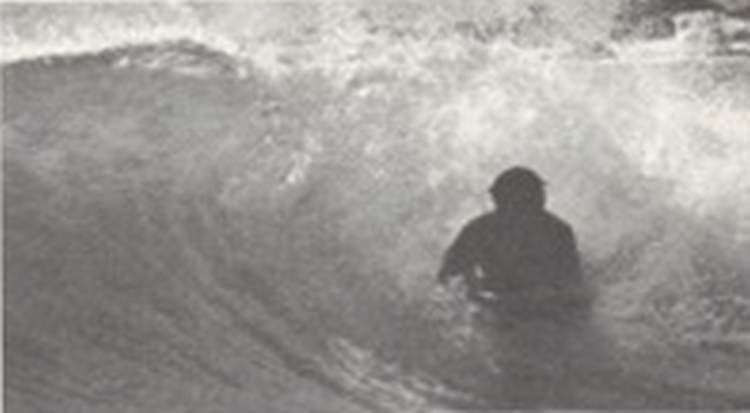
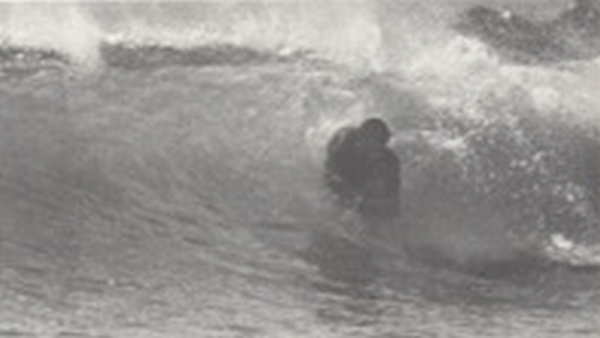
Above photos: Involvement at "Ballcase" Bay-Cape. Photos: G. Miller.
|
|
|
Surf Atlantique
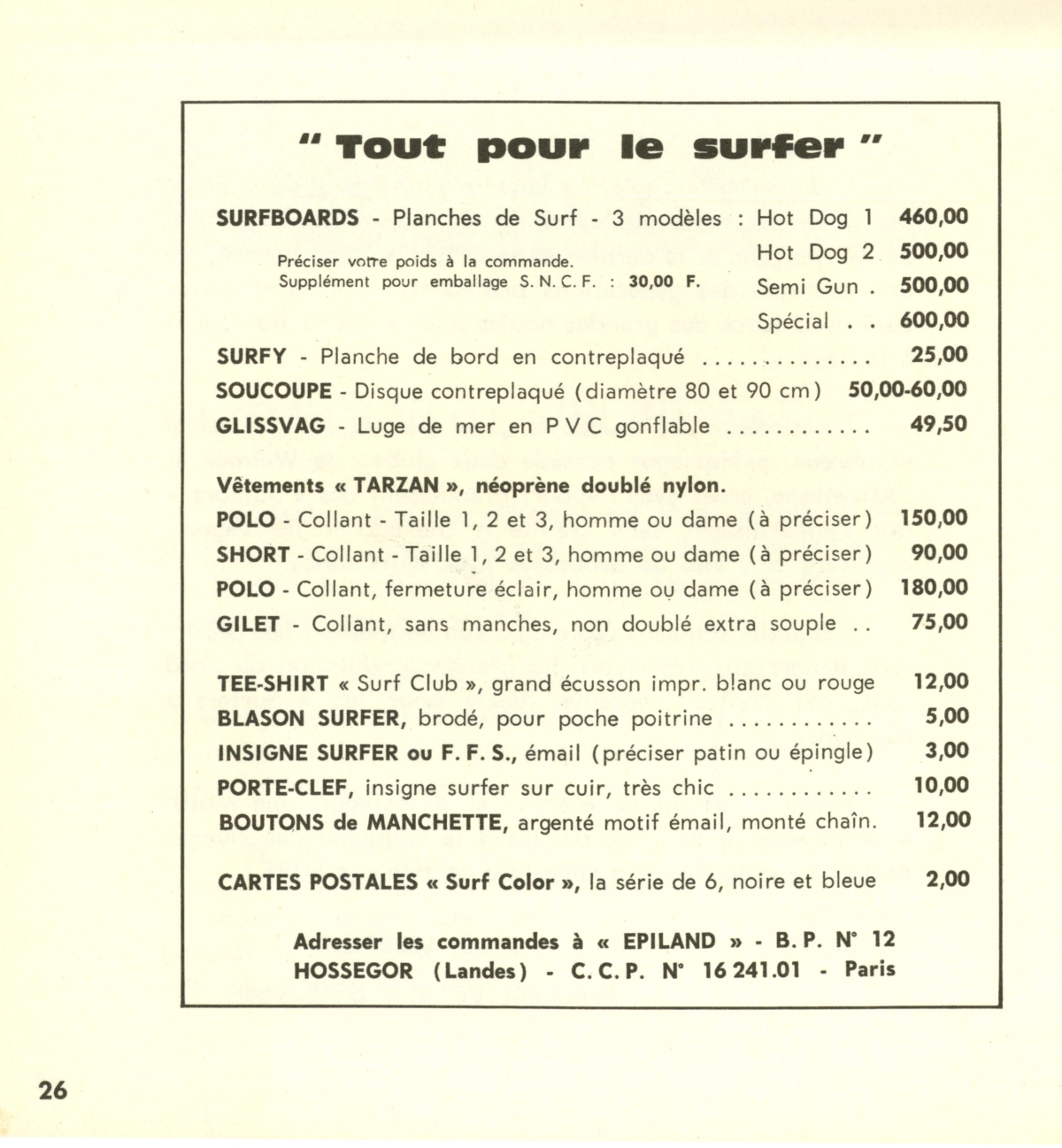
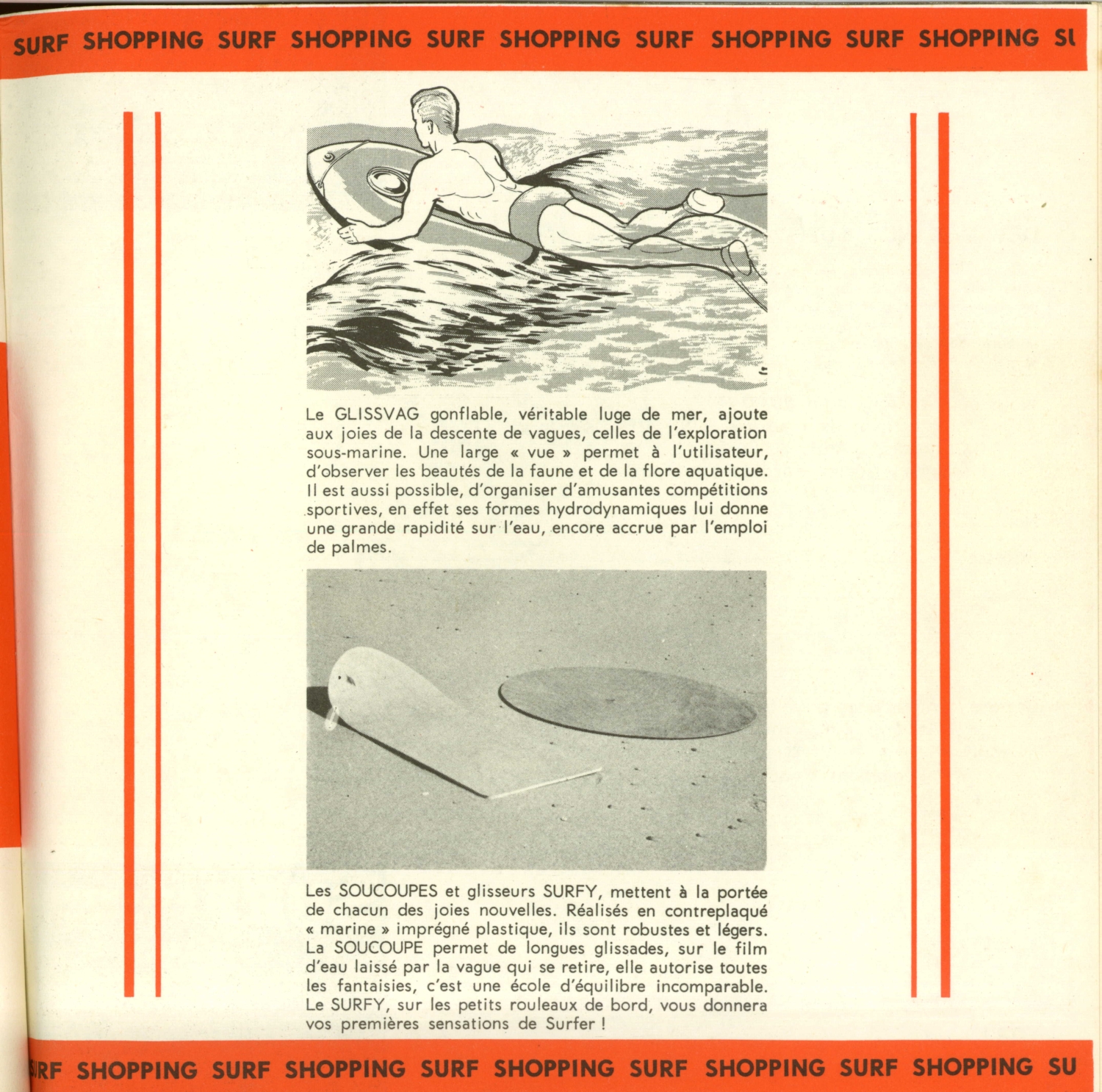
- Epiland [Advertisement]. (1964, June). Tout pour le surfer. Surf Atlantique, 1, 26-27. Epiland was a company in Hossegor, France. Surf Atlantique was a publication of the French Federation of Surfing (the publication run was limited to 3 or 4 issues).
Pictured below left is a price list that includes skimboard (Les Soucoupes) and planky (Le Surfy) advertisements. (Below right) The bottom of this advertisement states, "Sur les petits rouleaux de bord, vous donnera vos de premiers sensations de Surfer!" Roughly translated: "On small boards you will receive your first sensations of surfing!"
Figures courtesy of Guilhem Rainfray and
Philip Zibin.
|
Surf Guide
- Valentine, Val. (1965,
January). It's
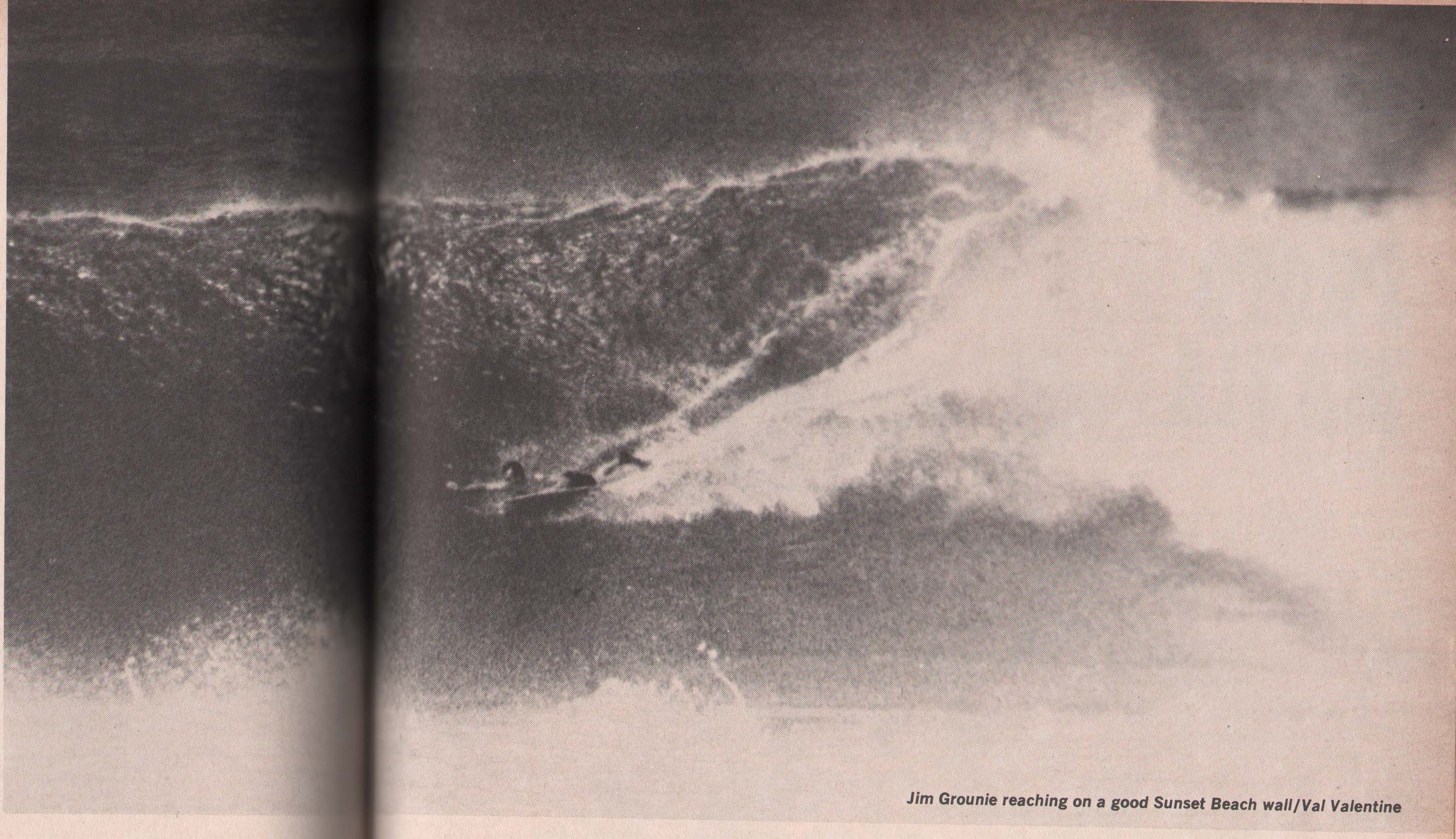
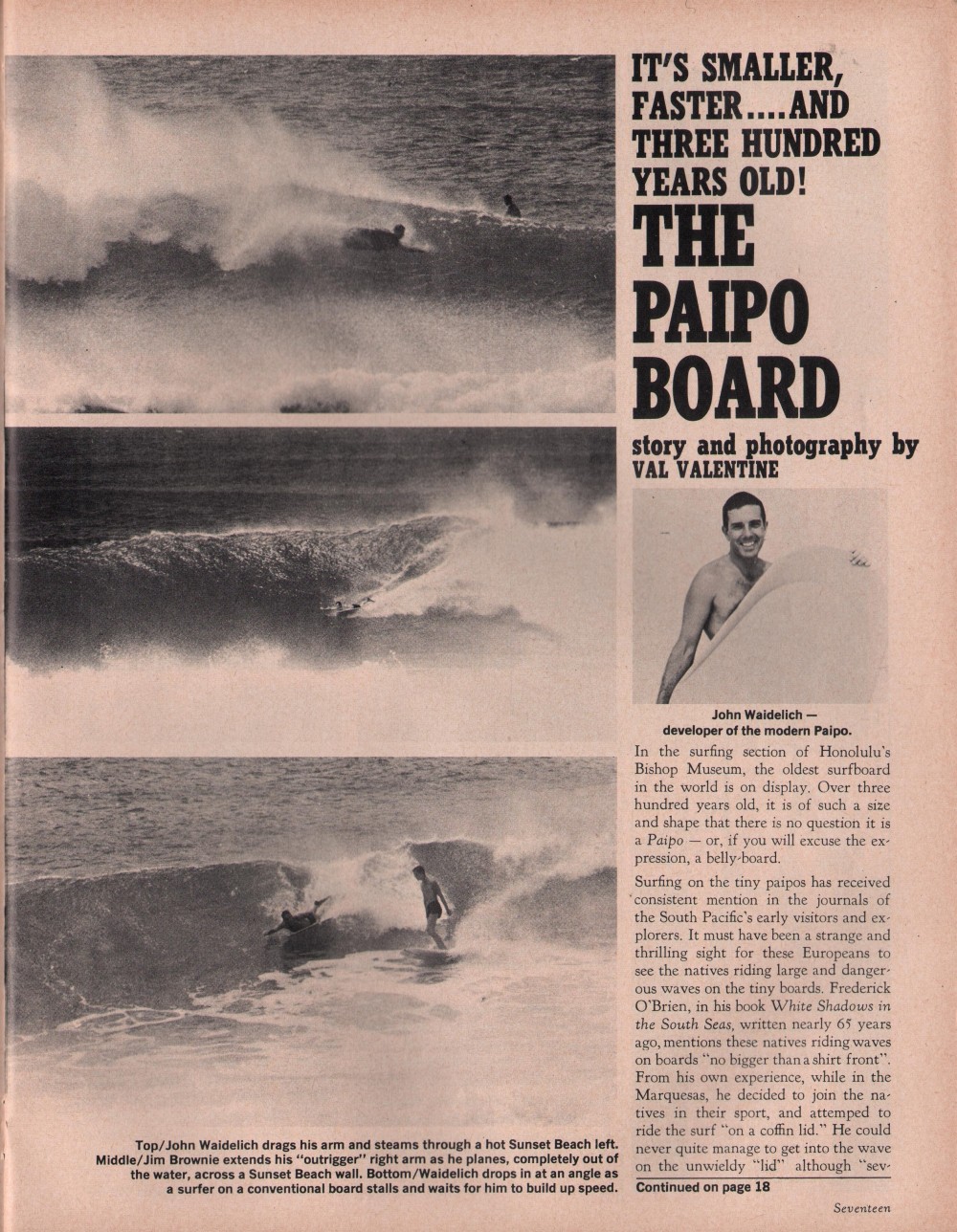
Smaller, Faster and 300 years Old: The Paipo Board. Surf Guide, 3(1), 17-19. Article
with photographs, pp. 17-19. The article touches upon the early history
of the paipo board in ancient Polynesian times up through the then
current types of paipos in Hawai`i. The article implies that all paipos
are made of wood, vary in craftsmanship from the plain plank to
sophisticated woodworkings and sealants (oil or fiberglass), and may or
may not have a skeg. There is also mention of experimentation with a
hydrofoil paipo. The article cites the recent development of the delta
shape board and a commercial version called the Paipo Nui. Also
mentions that the word paipo is not in the Hawai`ian dictionary
and speculates how the word was derived. Also noteworthy is the
infamous Val Ching foot surfing a paipo board. Click on the link to the article here in PDF [700KMB],
or JPG image files of about 450KB each [p17, p18, p19].
[Note: The caption for the
left center photograph on p. 17, incorrectly identifies Jim Growney as
Jim Brownie. In a personal email, Jim Growney said his last name was
often mistaken as Brownie. See the Jim Growney paipo interview here.]
 
Above left is a letter from Val Valentine to Bill Cleary.
Bob Feigel posting to Facebook Group "Legendary Surfers" on November
22, 2020: From the memories department of my vast, but disorganized
archives. I stumbled across these scans of letters sent by legendary
North Shore documentarian and all around good guy Val Valentine to Bill
Cleary while he was editor of Surfguide Magazine. The Larry he refers
to is Makaha Skateboard inventor and Surfguide publisher, Larry
Stevenson, but I don't know which "John" he's talking about. More to
come as I stroll down memory lane ... ??
Valentine, Val. (1964, May 18). Letter to Bill Cleary. Retrieved 2020,
11 23, from
https://www.facebook.com/groups/99148475798/permalink/10159194301515799/
|
Surf International
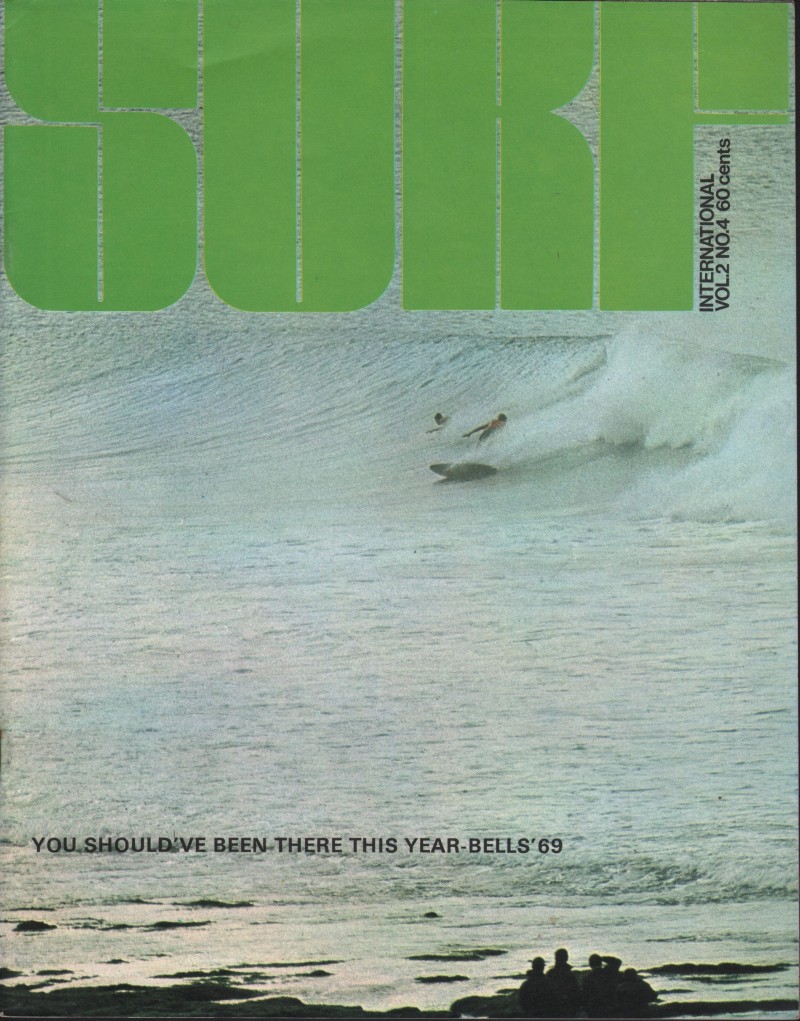
- Magazine Cover Shot. (1969).
Nat Young at Winkipop, 1969.
Surf International, 2(4), cover. Magazine cover.
 |
This issue
features a cover shot of Australian surf rider Nat Young at Winki in 1969.
The paipo rider in front of Young is Jeff Callaghan, confirmed by both
Rocky Hall and Jeff Callaghan. In a review of John Witzig's
newly published Surfing Photographs From the 1960s and '70s,
Geoff Cater of surfresearch.com.au notes that the photograph, "Nat
Young at Winkipop, 1969," was originally published in 1969 on the cover
of Witizig's Surf International
magazine (Vol. 2, No. 4) and that the bellyboardrider (riding on the
outside of Nat) has apparently been brushed out of the later version.
|
|
Surfabout: Australasian Surfer
- Unknown (1963, Winter).
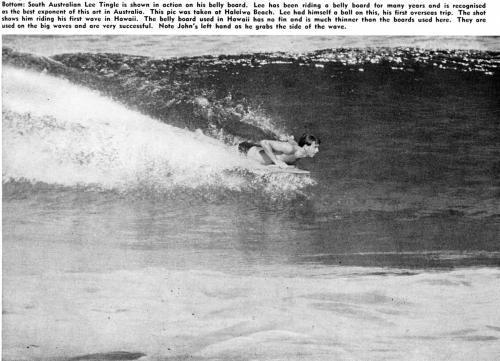
Spotlight on Hawaii, Surfabout 2(6), 13-19. The photo shown below appears on p.17. Thanks to Henry Marfleet for this contribution. (Click on image for
a larger viewing.)
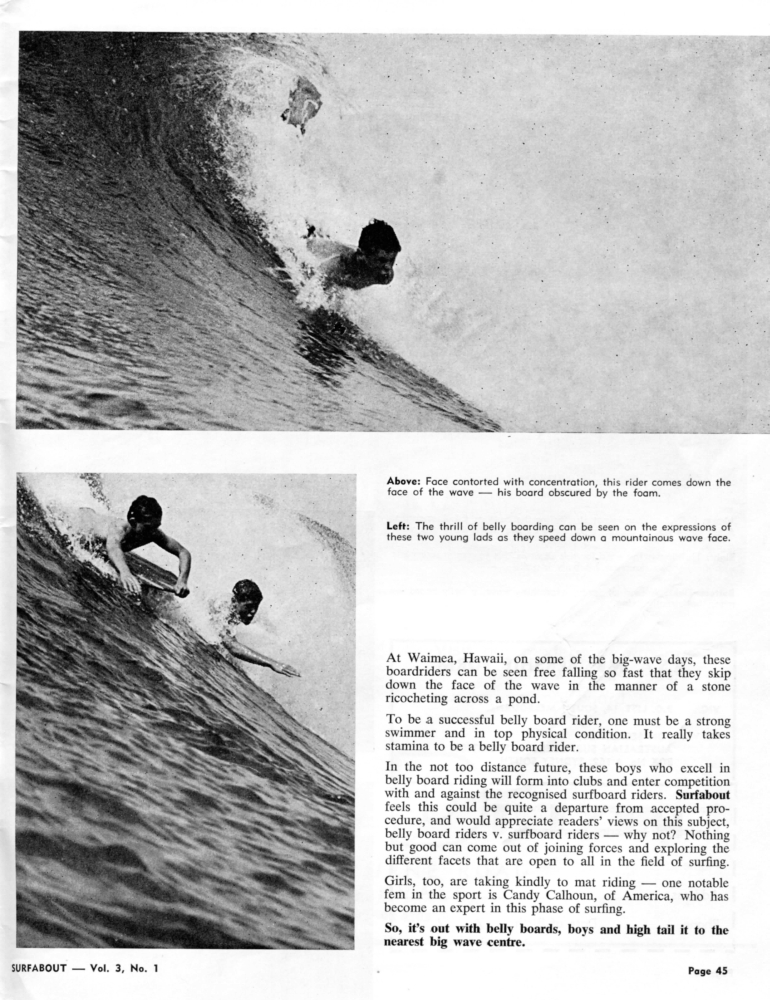
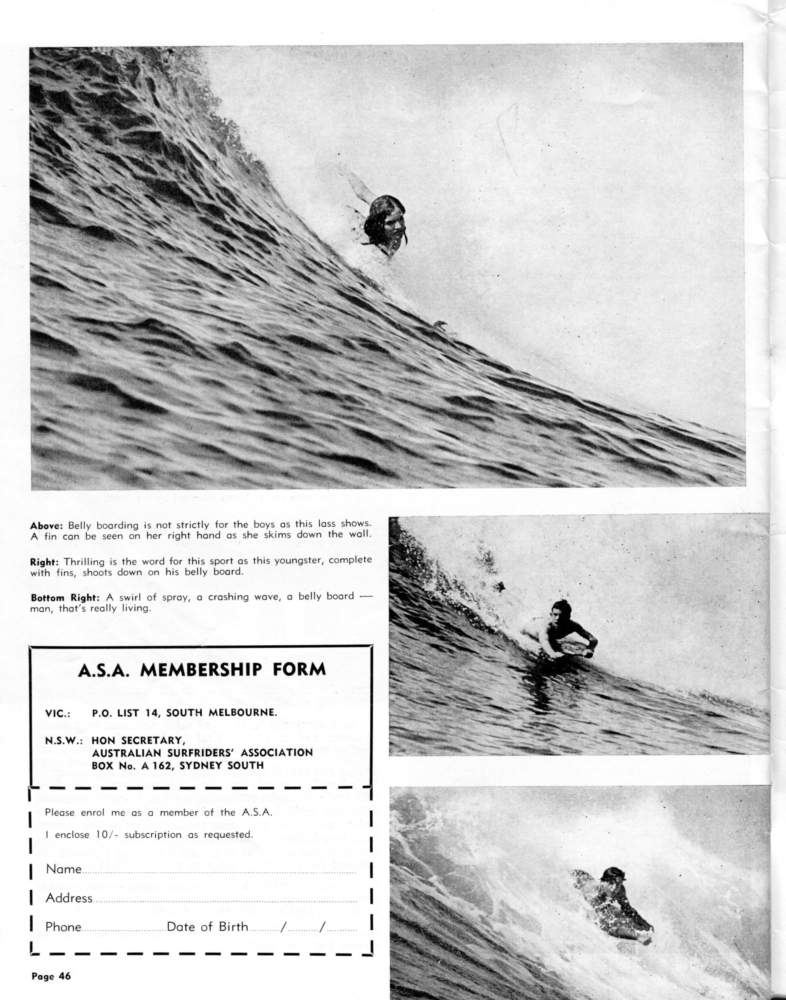
- Unknown. (1965, Summer). Belly
Boards. Surfabout:
Australasian Surfer, 3(1),
44-46. An article on
bellyboarding. Click on the link to the article here in PDF
[700KMB], or JPG image files of about 300KB each [p44,
p45,
p46].

Pictured are Lewis Cawsey bodysurfing with a hand plane and Greg
Vaughan is bellyboarding.
Jack Evans took the photos on
the cover at Cronulla Pt. He was consulting editor
by this time. Reg Millar was editor. |
General notes
and comments from the article:
- Introduction
makes a distinction between the belly board and the paipo board,
noting, "Belly boards are made of
laminated wood or foam. The size is usually 2 feet. x 3 feet and they
have two skegs. The Paipo board is at times called the belly board, but
this is incorrect." Continuing, "The Paipo is an entirely different
type
of board. Saucer-shaped, sometimes made of ply or balsa covered
with fibreglass, the name Paipo is derived from the Hawaiian word
"Paepae" which means in a slapping manner."
- More to the point, "Belly
boards or Paipos simply mean a body-planing board.
- Candy Calhoun, mat rider.
"Girls, too, are taking kindly to mat riding - one notable fern in the
sport is Candy Calhoun, of America, who has become an expert in this
phase of surfing."
- "Bozo" Griffith has
become a top belly board rider and has given up his surfboard to
concentrate on mastering this art.
- Bellyboard is spelled
with two words, "belly board."
- Belly boarders make the
cover shot! Is this the only instance of a cover?
Puurri
from the paipo forums tells us that he is the bodysurfer pictured in p.
45; the pictures were of Cronulla Point; the girl on p. 46 is Julie
Gibson and she still bodysurfs though mainly at Curl Curl; and that
Jack Eden used these photos in a book he did on Oz surfing.
Lewis Cawsey informed me in an email that he is the bodysurfer with the
hand plane and Greg Vaughan is the bellyboarder in the cover photograph
at the bottom. The photograph on p. 44, shows Lewis Cawsey (top) and
Greg Vaughan (lower) surfriding at Cronulla Point. (Personal
communication, February 25, 2014).
|

Shown on p. 44 (far left) are
Lewis Cawsey (top) and Greg Vaughan (lower) bellyboarding at Cronulla
Point. The bodysurfer in the top photograph appearing on p. 45
(middle), is Puurri. On p. 46, Julie Gibson is handplaning in the top
photo.
|
|
Surfer Magazine (on-line link to the magazine)
- de Rosnay, Joel. (1962, Spring). Le Surf.
Surfer
Magazine, 3(1), 23.

|
The article begins,
"The
"scenarist," Peter Viertel, brought the first board to Biarritz in
1956, and was met by Joel de Rosnay, avid belly-board and body-surfer.
Peter lent the board to Joel for three months; Joel becoming the first
Frenchman to surf."
Significance of this article to
paipo surfing: This is the first instance that belly/paipo surfing
appears, in word or figure, in Surfer Magazine.
|
- Dahlquist, Ron [Photographer]. (1964,
August/September). Surfer
Extra! Surfer
Magazine, 5(4), 82.

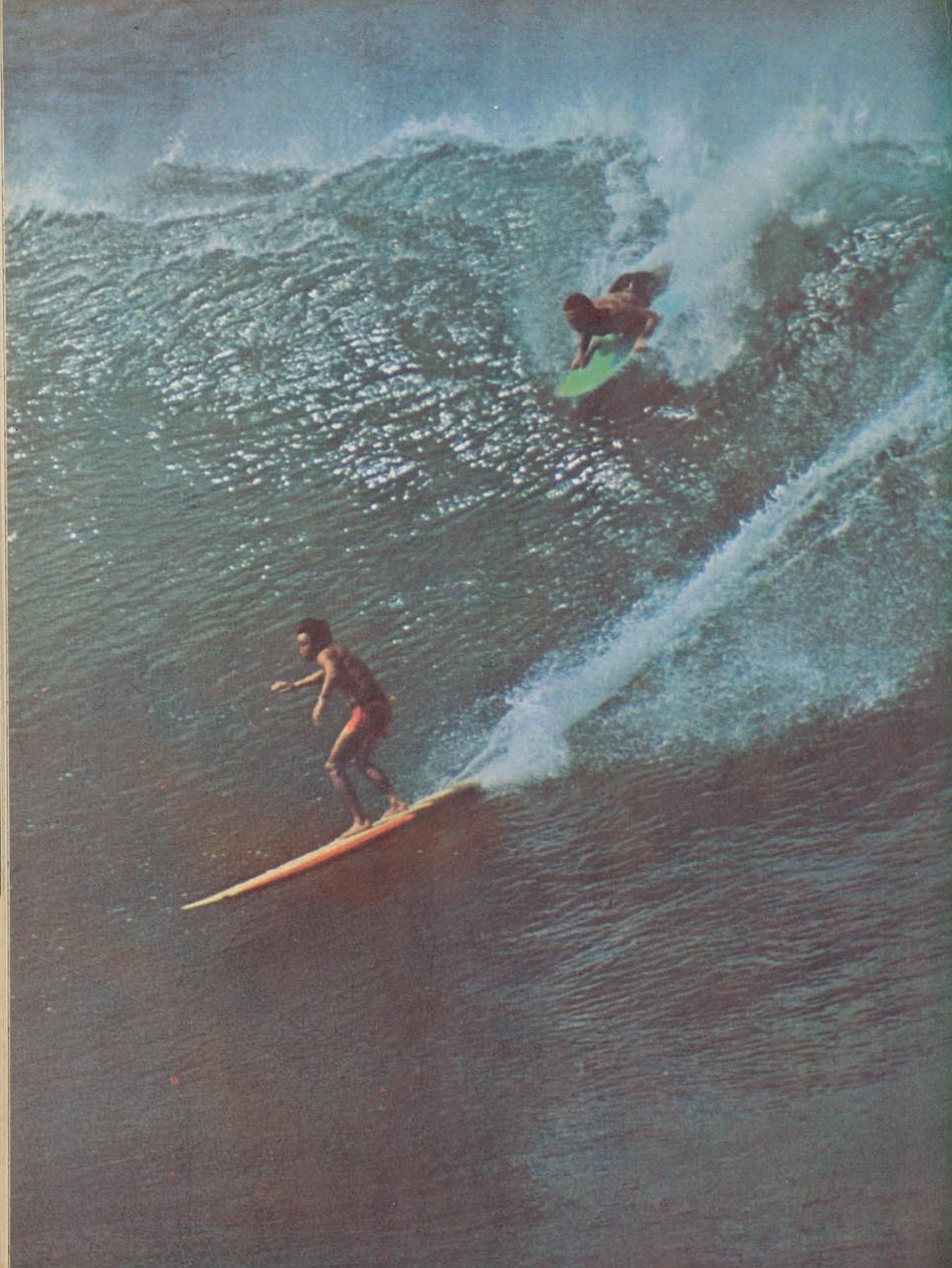
Bellyboarder George Farquhar between
a longboarder and a loose board. (See article below. the board
did hit and dent Farquhar's helmet.)
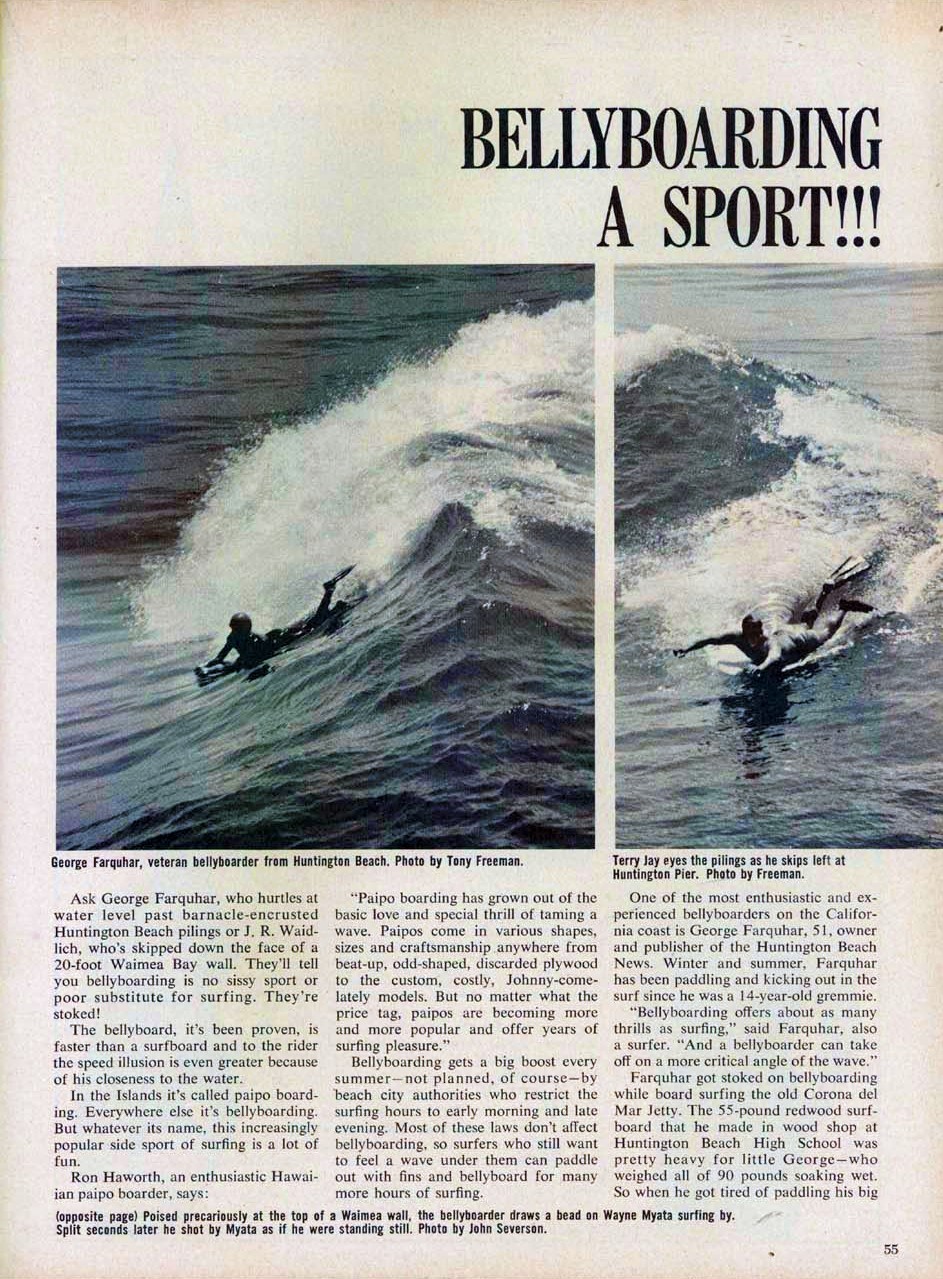
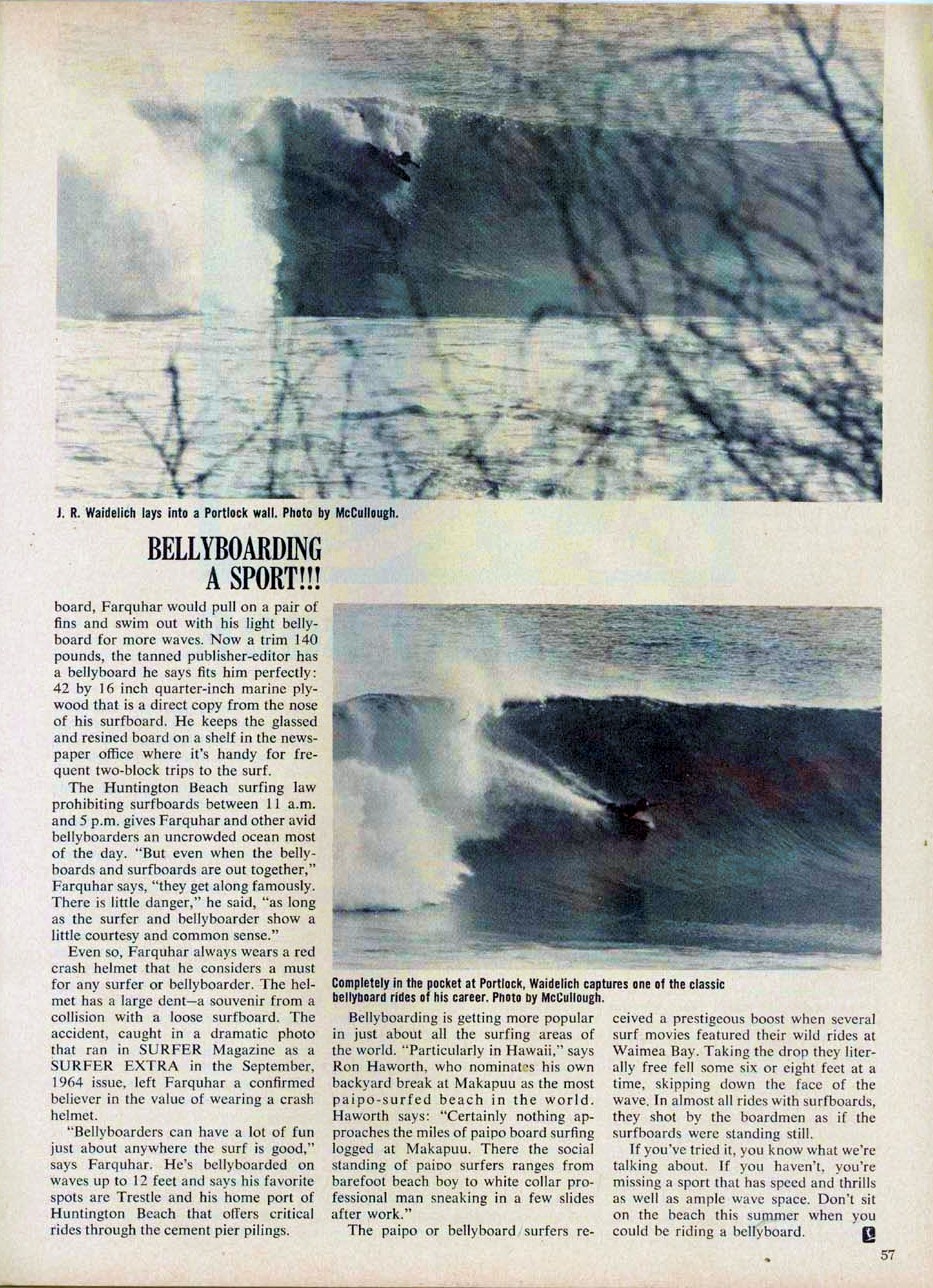
- Unknown. (1965,
August/September). Bellyboarding
a sport!!! Surfer
Magazine, 6(4), 54-55, 57.

Click on pic for a PDF
version. Hi-Rez image files: page
54, page 55, page 57.
Summary and Snippets:
- The author begins the article
asserting that Waimea bellyboard rider J.R. Waidlich and Huntington
Pier shooter George Farquhar would tell you is asked, "Bellyboarding is
no sissy sport or poor substitute for surfing. They're stoked!"
- "In the Islands it is called
Paipo boarding. Everywhere else it's Bellyboarding"
- Ron Haworth says, "Paipo
boarding has grown out of the basic love and special thrill of taming a
wave. Paipos come in various shapes, sizes and craftsmanship anywhere
from beat-up, odd-shape, discarded plywood to the custom, costly,
Johnny-come-lately models. But, no matter what the price tag, paipos...
offer years of surfing pleasure."
- Bellyboarding gets a boost
every summer during the restricted surfing hours at beaches which
largely do not apply to bellyboarding.
- Farquhar became stoked on
bellyboarding when he could swap out his 55-pound surfboard for a light
bellyboard -- a big deal of a 90-pound kid. As an adult he rides a 42
by 16 inch, quarter-inch marine plywood board a direct copy of the nose
of his surfboard. It is glassed and resined.
- Ron Haworth nominated Makapu`u
as the most paipo-surfed beach in the world.
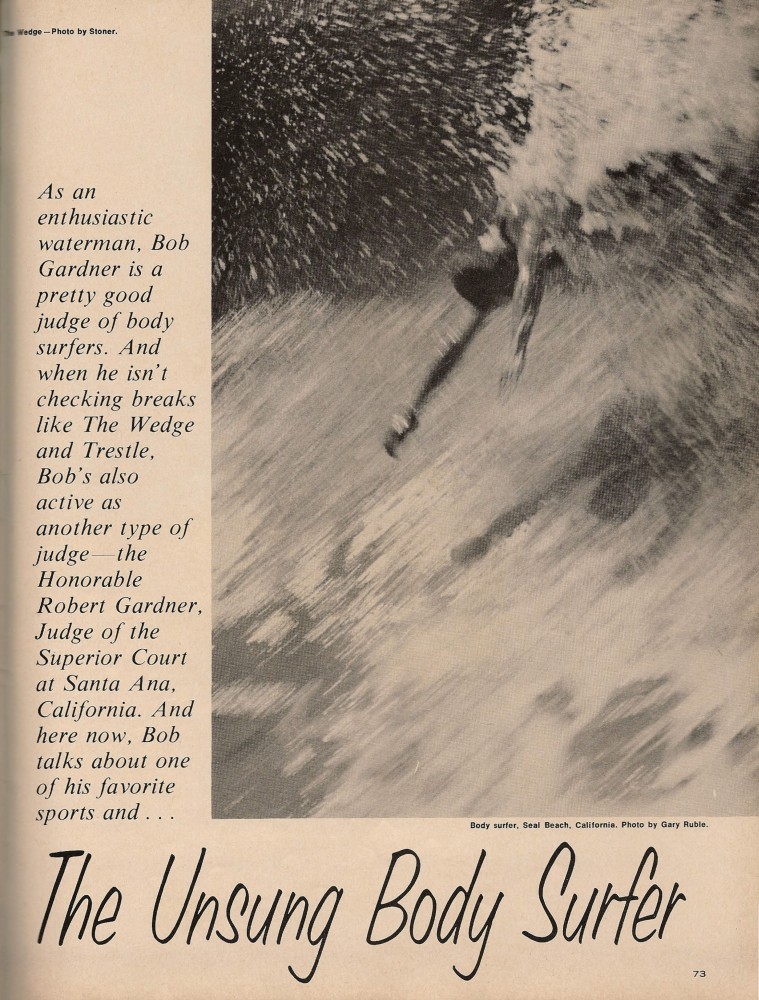
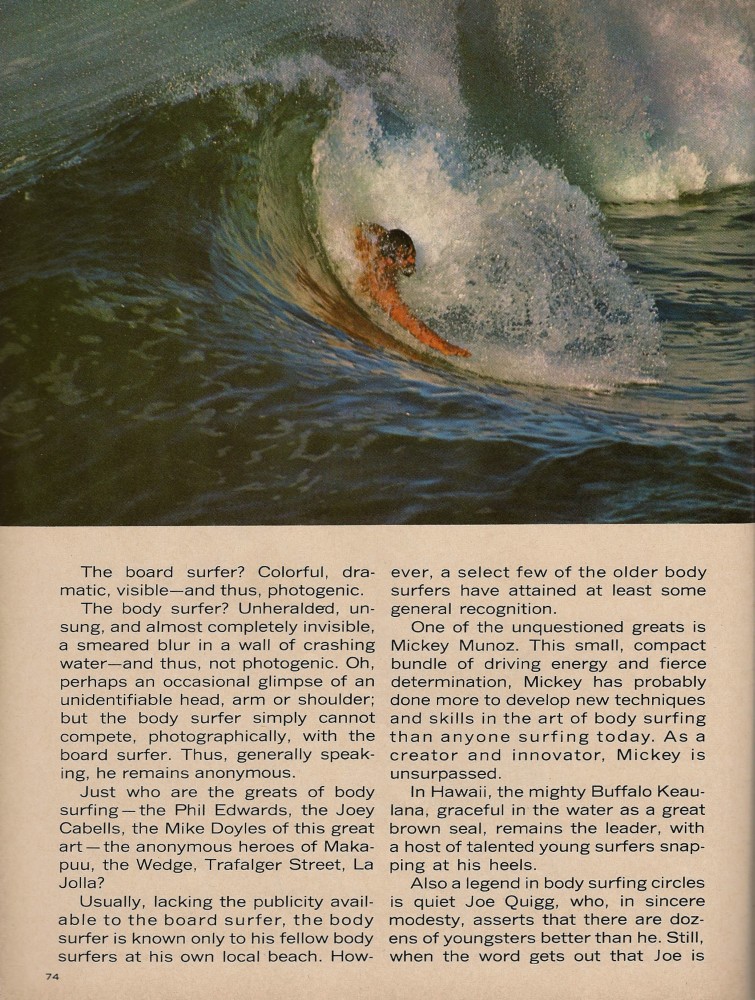
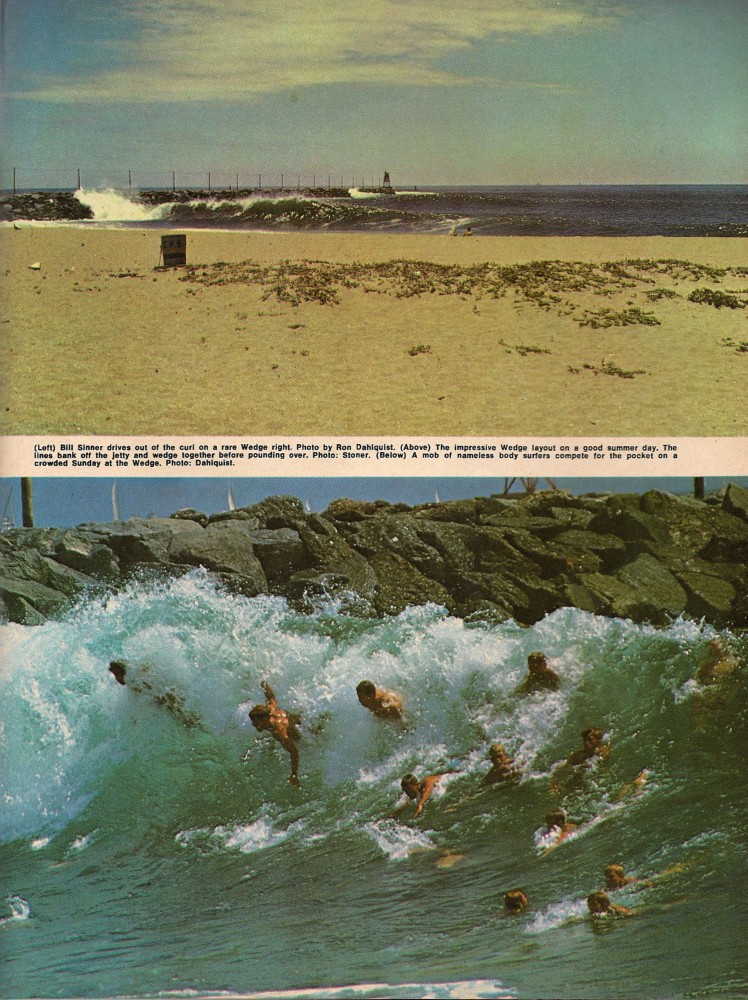
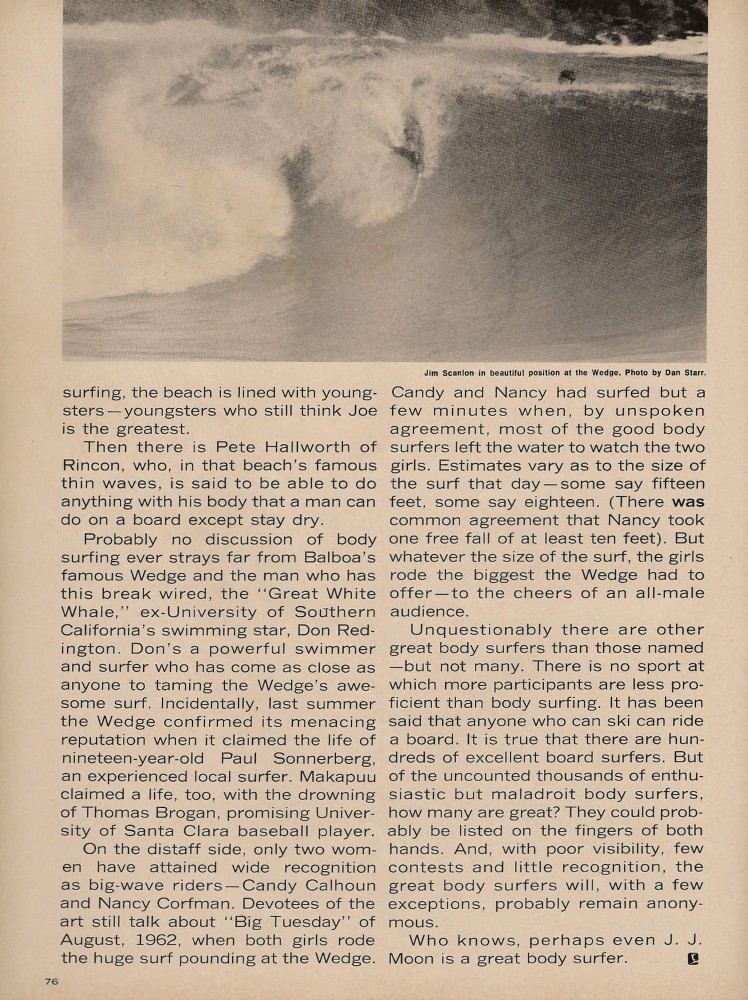
- Unknown. (1967, September). The Unsung Body Surfer. Surfer
Magazine, 8(4), 72-77. A
feature article on our friends riding the waves without a board. Mentioned are Bob
Gardner, Candy Calhoun, Nancy
Corfman, Pete Hallworth, Mickey Munoz, Buffalo Keaulana, and Joe Quigg.
Click on the link to the
article here
in PDF
[7.5MB]. See JPG pages p72 |
p73 | p74 | p75 | p76 | p77.
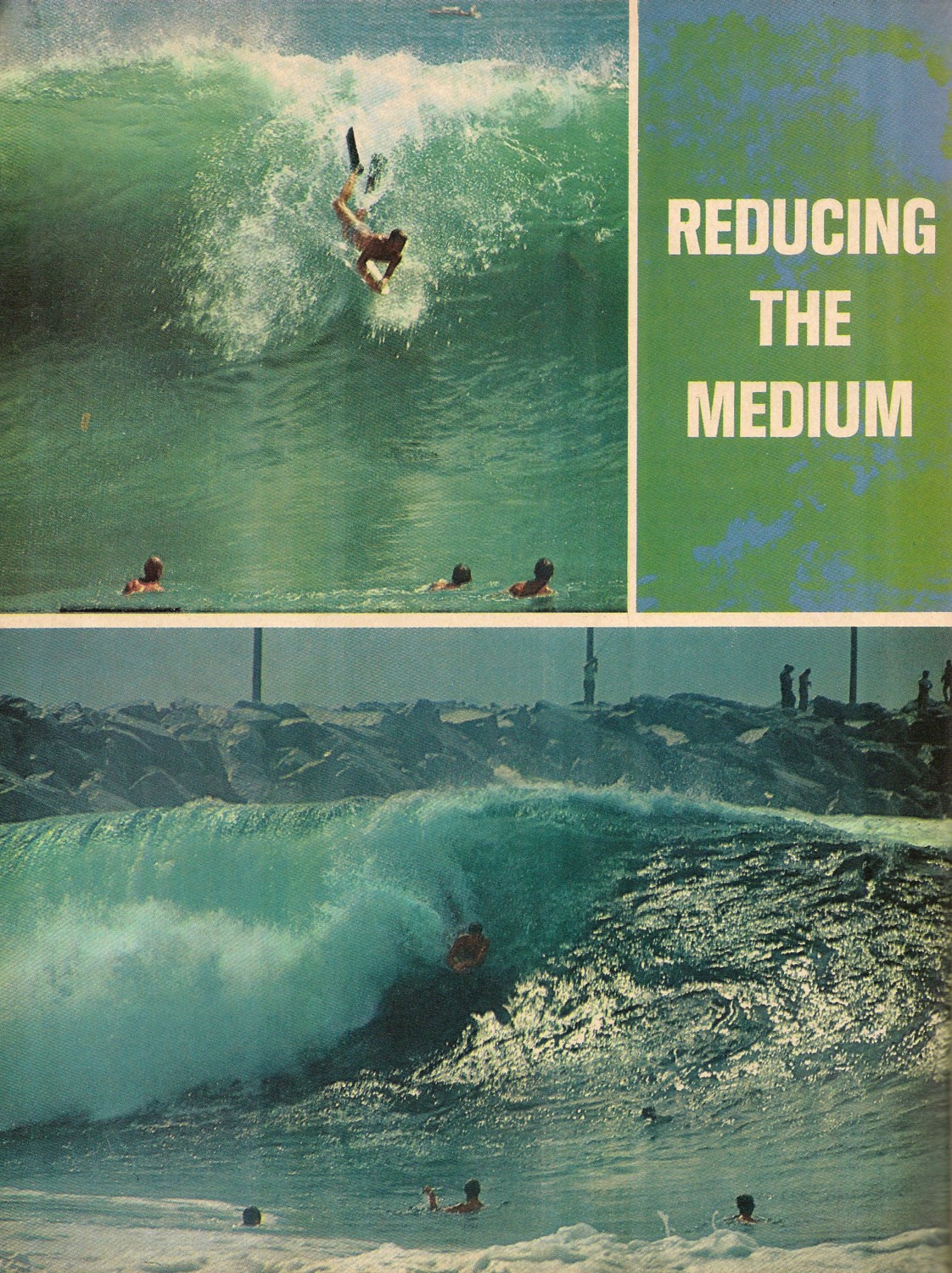
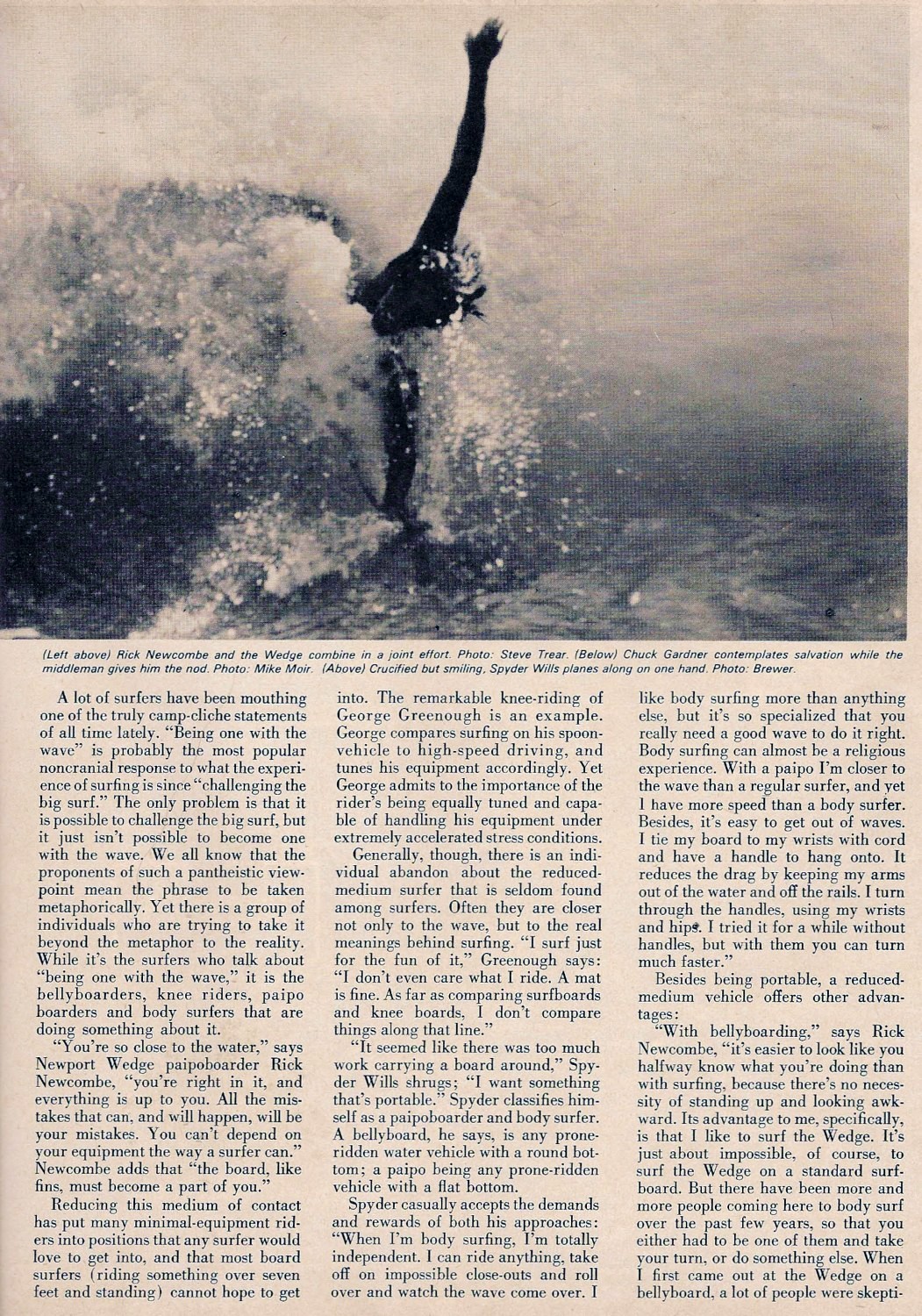
- Unknown. (1969, April/May). Reducing the Medium. Surfer
Magazine, 10(2), 92-93, 95. Three Wedge notables are pictured: Rick Newcombe (top far
left), Chuck Gardner (bottom
far left) and Spyder Wills
(middle page). Spooning is George Greenough. Click on the link to the
article here in PDF
[5MB]. Click on images below to read JPG files (~675KB).
   |
Questions:
- Are you one with the wave?
- What is a paipo vs. a
bellyboard?
- Knee riding or
kneeboarding?
- Prone board riding
features?
- Are pure to you ride?
|
- A lot of surfers have
been mouthing one of
the truly camp-cliche statements of all time lately... While it's the
surfers who talk about "being one with the wave," it is the belly
boarders, knee riders, paipo boarders and body surfers that are doing
something about it.
- "You're so close to the
water," says Newport Wedge paipoboarder Rick
Newcombe, "you're right in it, and everything is up to you.. the board,
like fins, must become a part of you."
- "I surf just for the fun
of it," Greenough says: "I don't even care
what I ride. A mat is fine. As far as comparing surfboards and knee
boards, I don't compare things along that Iine."
- "It seemed like there was
too much work carrying a board around,"
Spyder Wills shrugs; "I want something that's portable." Spyder
classifies himself as a paipoboarder and body surfer. A bellyboard, he
says, is any prone ridden water vehicle with a round bottom; a paipo
being any prone-ridden vehicle with a flat bottom.
- More from Spyder Wills,
"With a paipo I'm closer to the wave than a
regular surfer, and yet I have more speed than a body surfer. Besides,
it's easy to get out of waves. I tie my board to my wrists with cord
and have a handle to hang onto. It reduces the drag by keeping my arms
out of the water and off the rails. I turn through the handles, using
my wrists and hips, I tried it for a while without handles, but with
them you can turn much faster."
- Rick Newcombe, "For me,
at a place like the Wedge, bellyboarding has several advantages over
body surfing: you have more speed, there are less bellyboarders (Ron
Romanoski and myself are about the only two regulars), it takes turns
better, people get out of the way, and therefore, I get more waves."
- "I used to surf my
kneeboard standing up," Art Brewer states, "but it wasn't the same as
riding a surfboard and wasn't the same as knee riding. I figured I had
to do one or the other, so I chose knee riding."
- Just as in the surfboard
industry, the bellyboard-knee machine industry has its phases.
According to Newport paipoboarder Bud Hulst: "A revolution began in the
design of bellyboards last summer. For the first time, hard rails were
seen. The V, the Tri-plane as in surfboards, has come and gone...
Unlike the surfboard revolution, bellyboards and knee boards became
longer instead of shorter, from 38" to 54" and even longer. One longer
fin is replacing two small ones. Removable fins are also in."
|
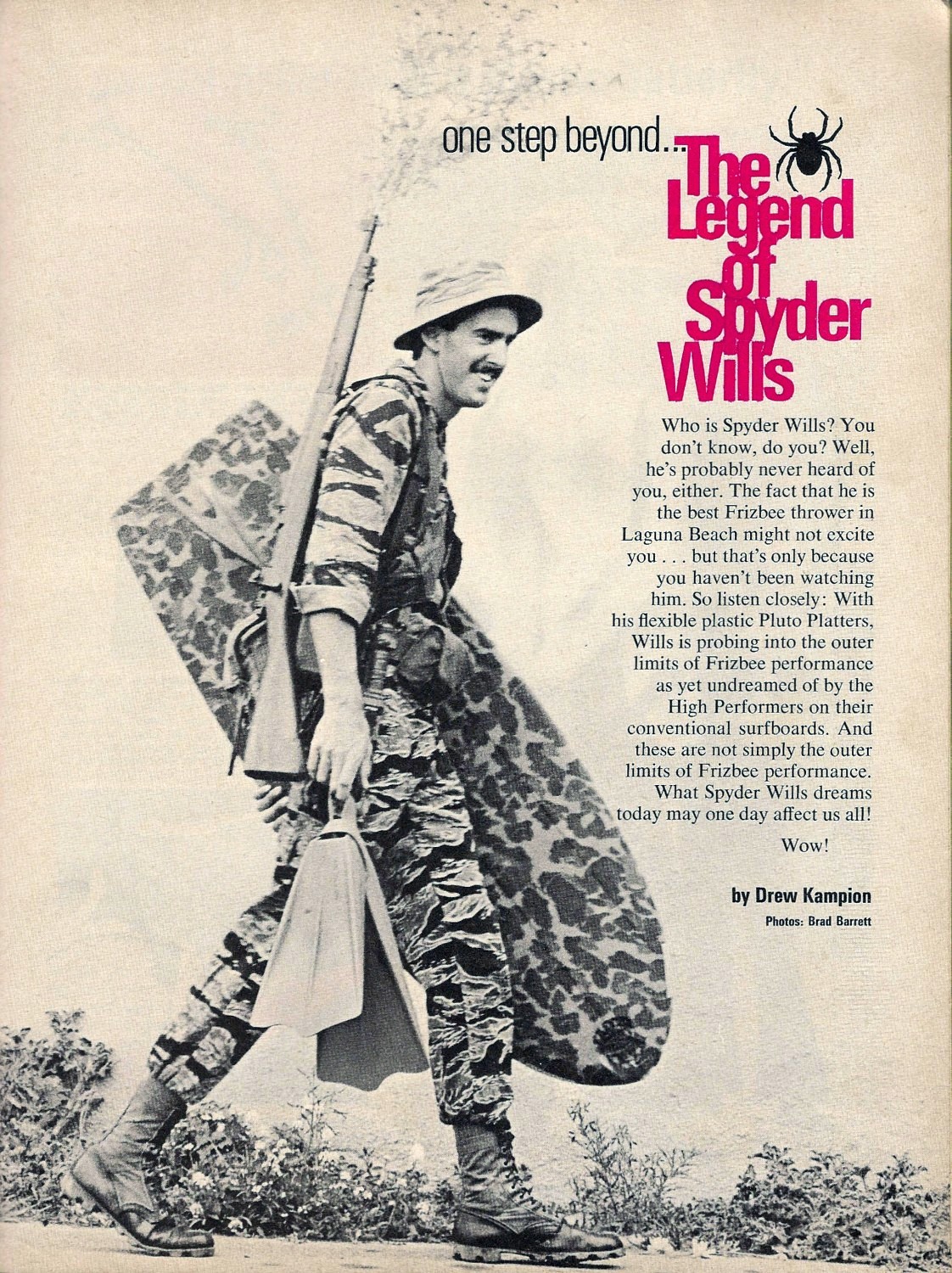
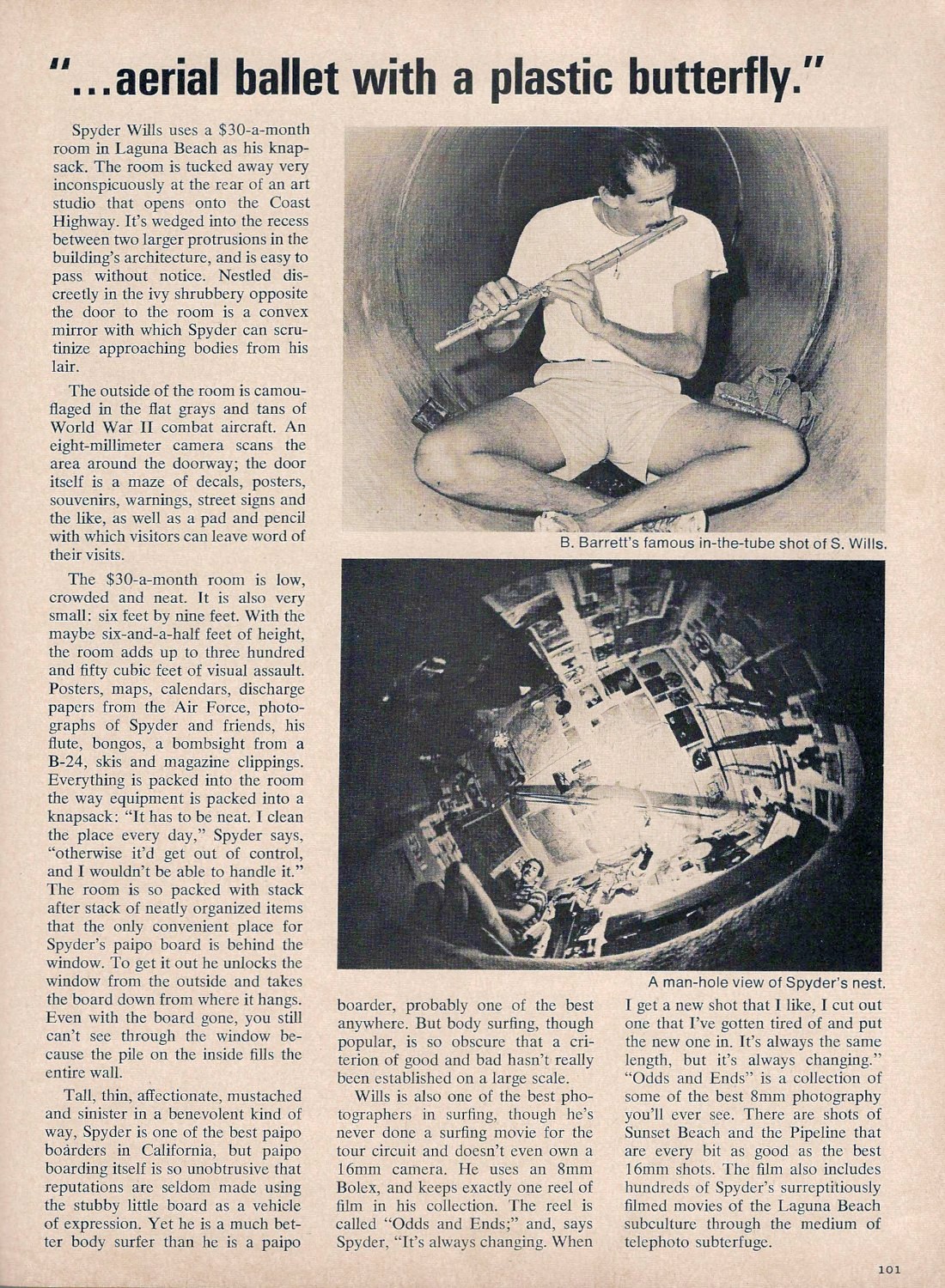
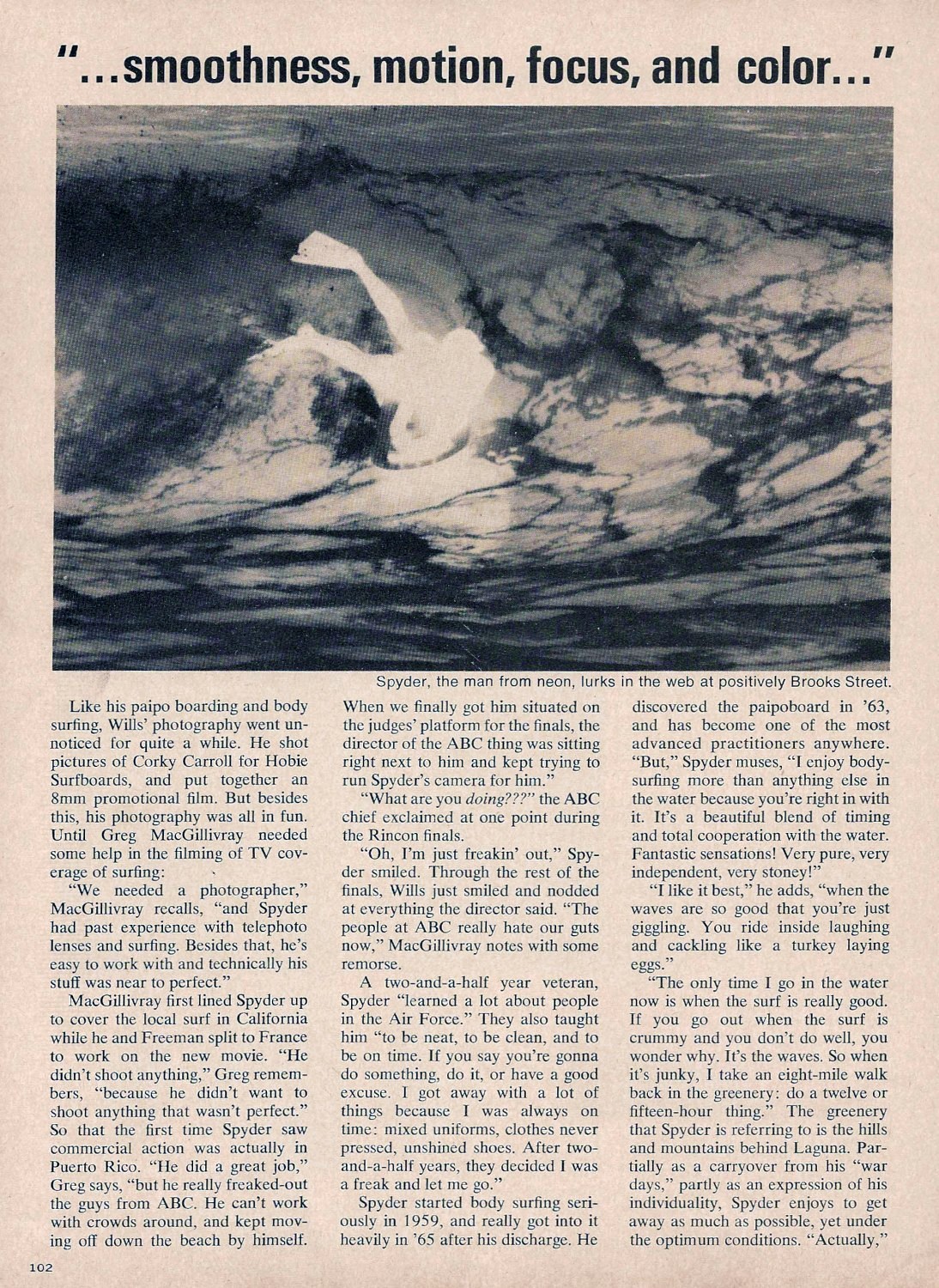
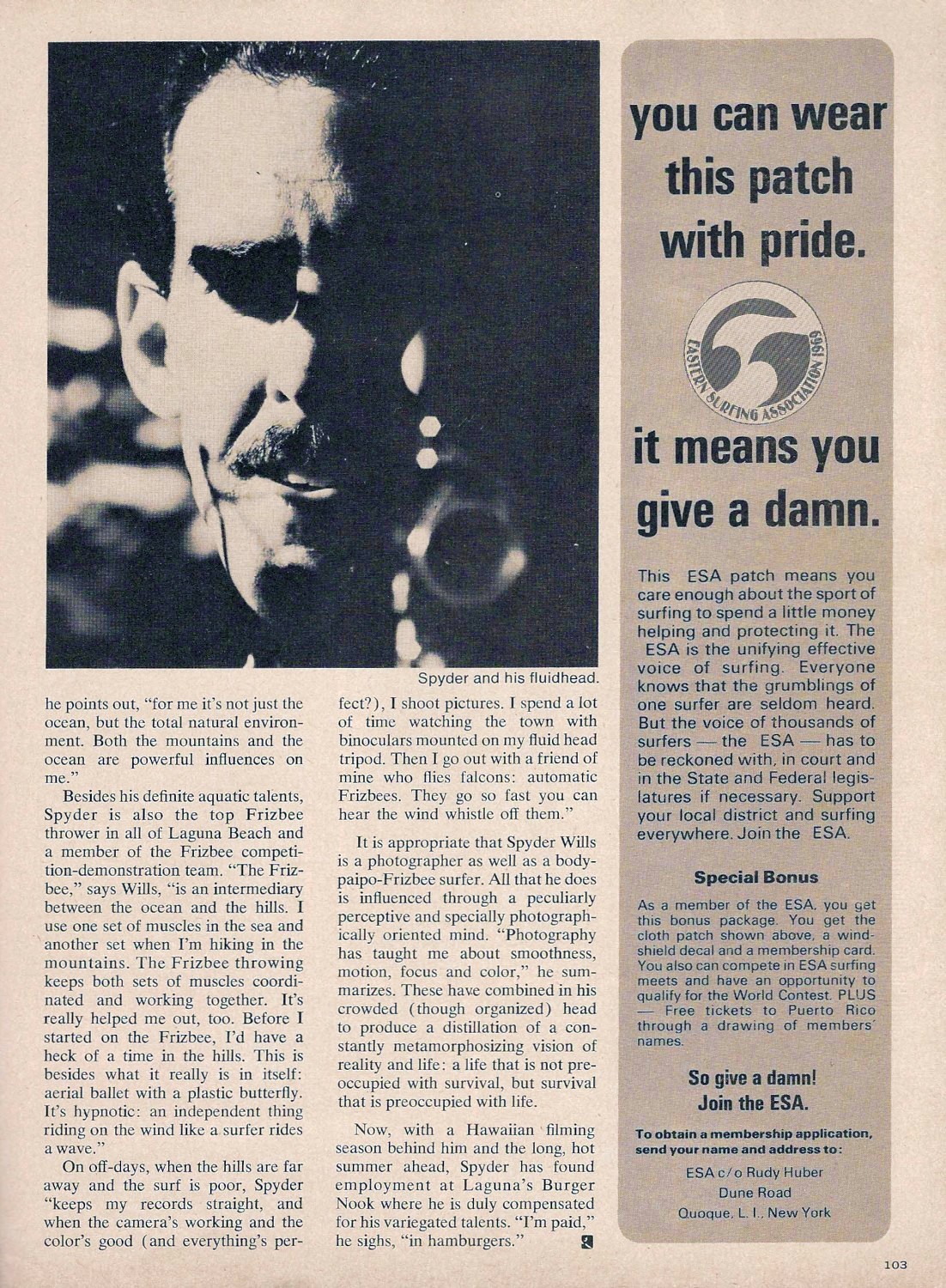
- Kampion,
Drew. (1969, September). One
Step Beyond... The Legend of Spyder Wills. Surfer Magazine, 10(4), 100-103. Article
with photographs, pp. 100-103. Click
on the link to the article here in PDF
[3.0MB]. Click on images below to read JPG files (500KB).
Legendary Laguna Beach frizbee
thrower, paipo rider, photographer and film maker and a man to make his
own trail. Wills worked on several classic surf films including Pacific
Vibrations, Forgotten Island of Santosha and Big
Wednesday. Kampion writes,
- "Spyder is one of the best
paipo boarders
in California, but paipo boarding itself is so unobtrusive that
reputations are seldom made using the stubby little board as a vehicle
of expression. Yet he is a much better body surfer than he is a
paipoboarder, probably one of the best anywhere. But body surfing,
though popular, is so obscure that a criterion of good and bad hasn't
reallybeen established on a large scale."
- "Spyder started body surfing
seriously in
1959, and really got into it heavily in '65 after his discharge. He
discovered the paipoboard in '63, and has become one of the
mostadvanced practitioners anywhere."
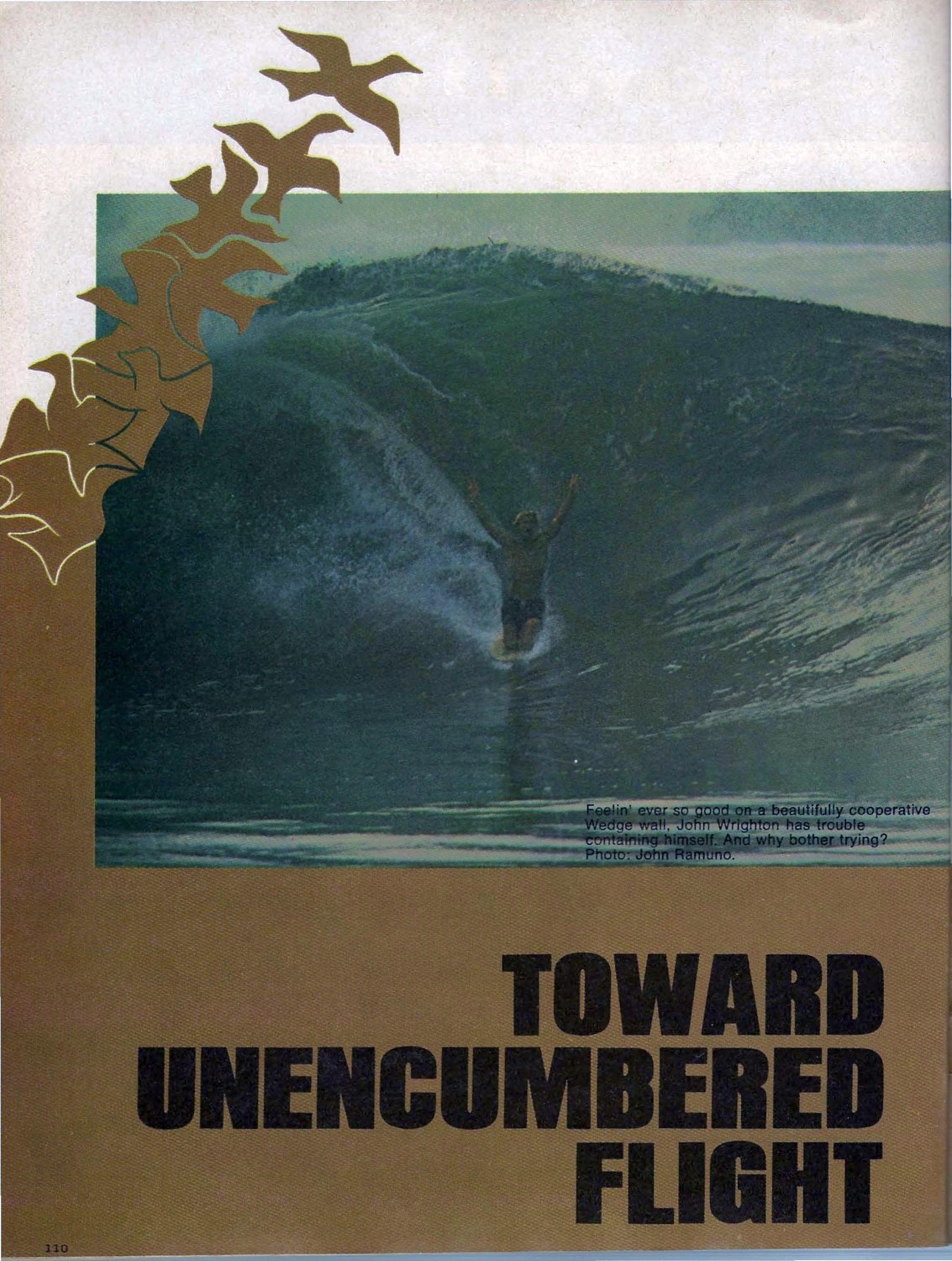
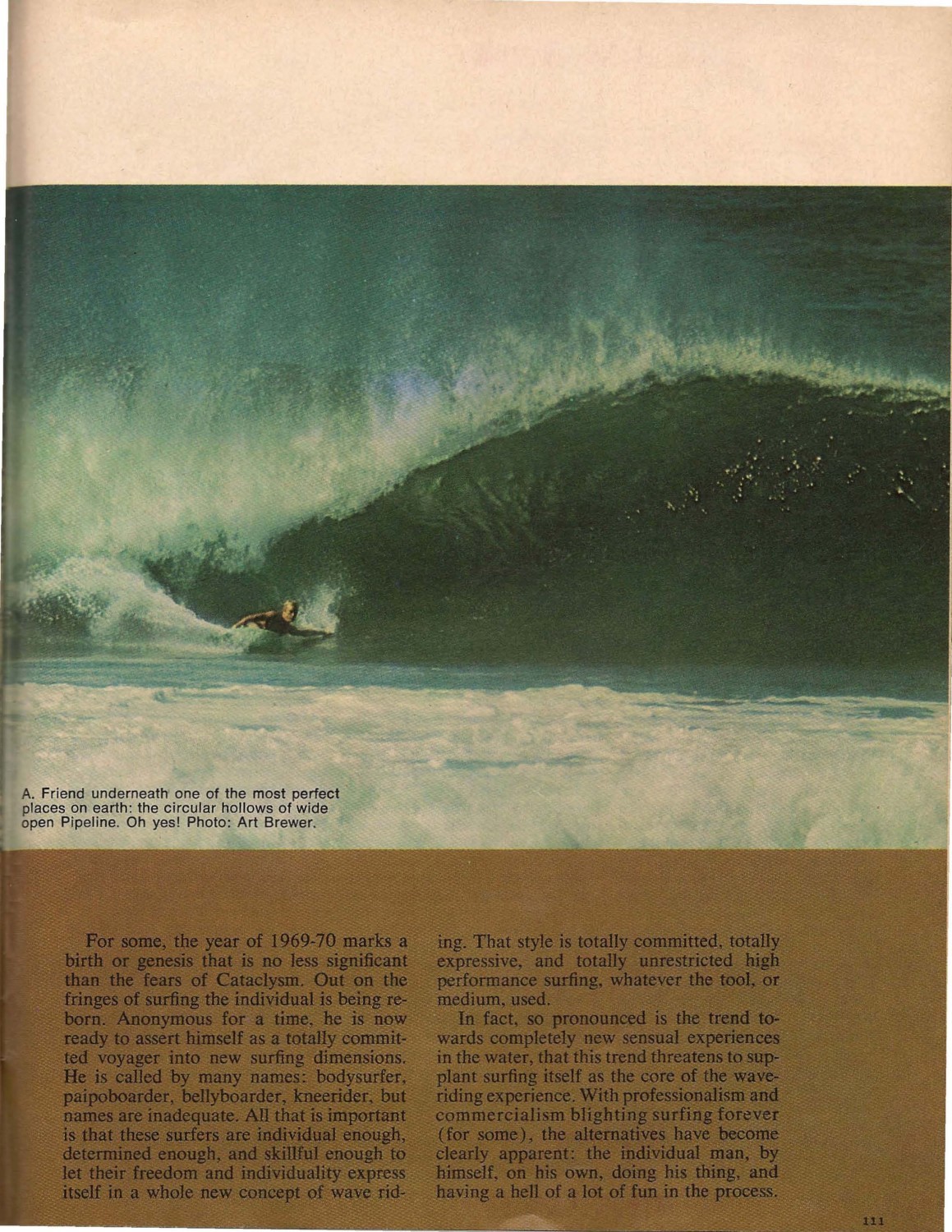
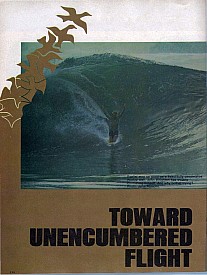
- Unknown. (1970, May). Toward
Unencumbered Flight. Surfer
Magazine, 11(2), 110-117. Link to the introduction and the three supporting
articles is here in PDF
[6.5MB], sections in JPG format below.
 |
 |
Introduction,
pp. 110-111.
Out on the
fringes of
surfing the individual is being reborn. Anonymous for a time, he is now
ready to assert himself as a totally commited voyager into new surfing
dimensions. He is called by many names: bodysurfer, paipoboarder,
bellyboarder, kneerider, but names are inadequate.
Photos by John Ramuno and Art Brewer. Both are from the paipo-related
surfing world.
[Rod's Note: appears to be Drew Kampion's style of writing, but the
author is unknown.]
|
 |
 |
(L)
Crandall, Gary. Potato
Chip Thrills In a Washing Machine, 112. Snippets:
- Steaming out of a grisly
tube on one rail of a potato chip leaves no time for tricks. Like a
dragster, the paipo board is built for one thing - speed. Flat-out,
tire-smoking acceleration.
- A paipo board reduces
surfing to its most functional simplicity. Plane enough to lift the
body out of the water and no more.
- It prefers hard-breaking
waves to fat, mushy ones...
- My homemade board -
L'enfant Terrible - is made of marine ply, fiveeighths of an inch thick
with a thin coat of paint and resin. The skeg is in the middle where
the center of weight lies and where turns, when needed, are cranked out
most effectively.
- In a prone position, the
wave folds around you, engulfs you. The sensation of speed is intense -
just inches from the surface - like opening the car door while speeding
down the highway and staring at the ground. The sensation of speed is
increased ten-fold.
|
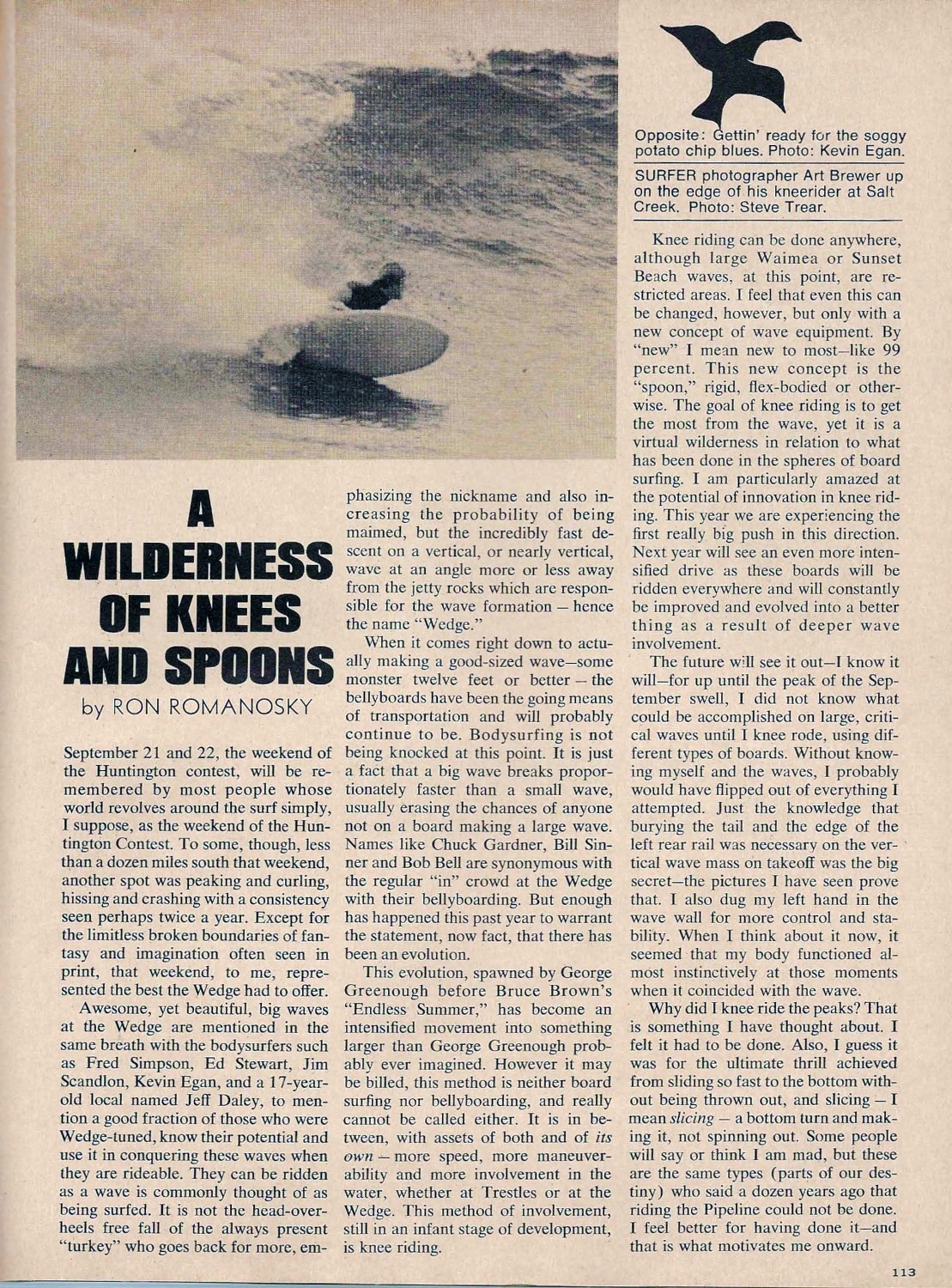
(Above Right) Romanosky, Ron.
A
Wilderness of Knees and Spoons, 113.
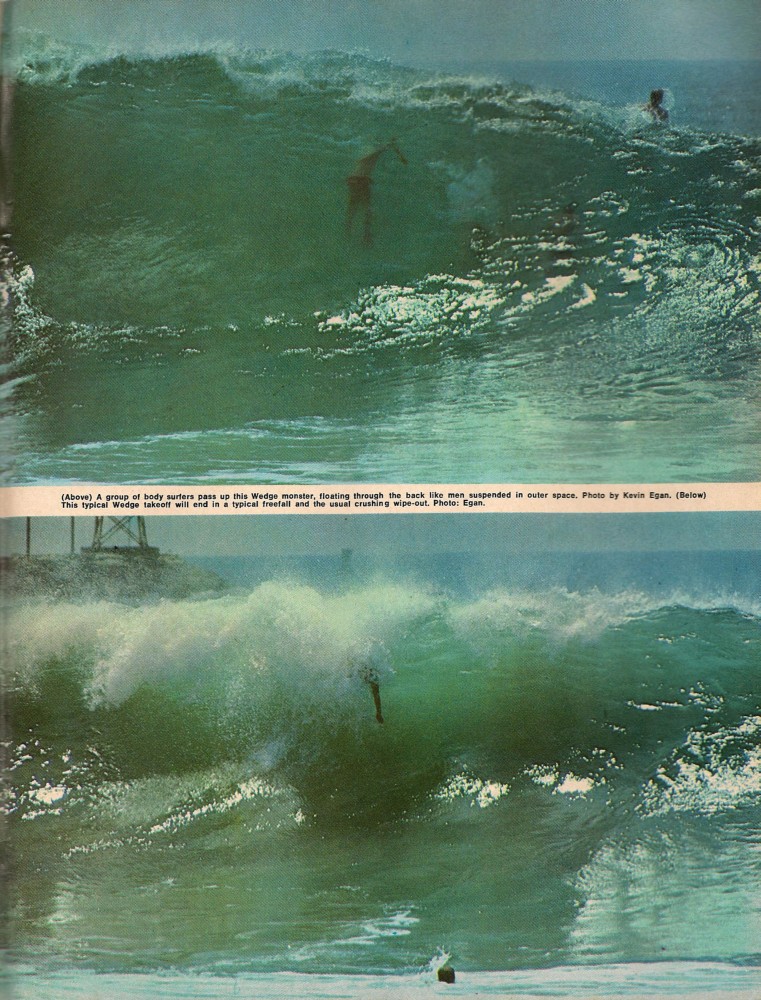
- The Wedge. [Note: Need we
say more?]
- "When it comes right down
to actually making a good-sized wave-some monster twelve feet or better
- the bellyboards have been the going means of transportation and will
probably continue to be. Bodysurfing is not being knocked at this
point. It is just a fact that a big wave breaks proportionately faster
than a small wave, usually erasing the chances of anyone not on a board
making a large wave. Names like Chuck Gardner, Bill Sinner and Bob Bell
are synonymous with the regular "in" crowd at the Wedge with their
bellyboarding. But enough has happened this past year to warrant the
statement, now fact, that there hasbeen an evolution."
- This evolution, spawned
by George Greenough... is neither board surfing nor
bellyboarding, and really cannot be called either... This method of
involvement, still in an infant stage of development, is knee
riding.Knee riding can be done anywhere, although large Waimea or
Sunset Beach waves, at this point, are restricted areas. I feel that
even this can be changed, however, but only with a new concept of wave
equipment. By "new" I mean new to most - like 99 percent. This new
concept is the "spoon, "rigid, flex-bodied or otherwise. [Note: It is
not clear to me why knee riding is restricted at Waimea and Sunset
Beach.]
|
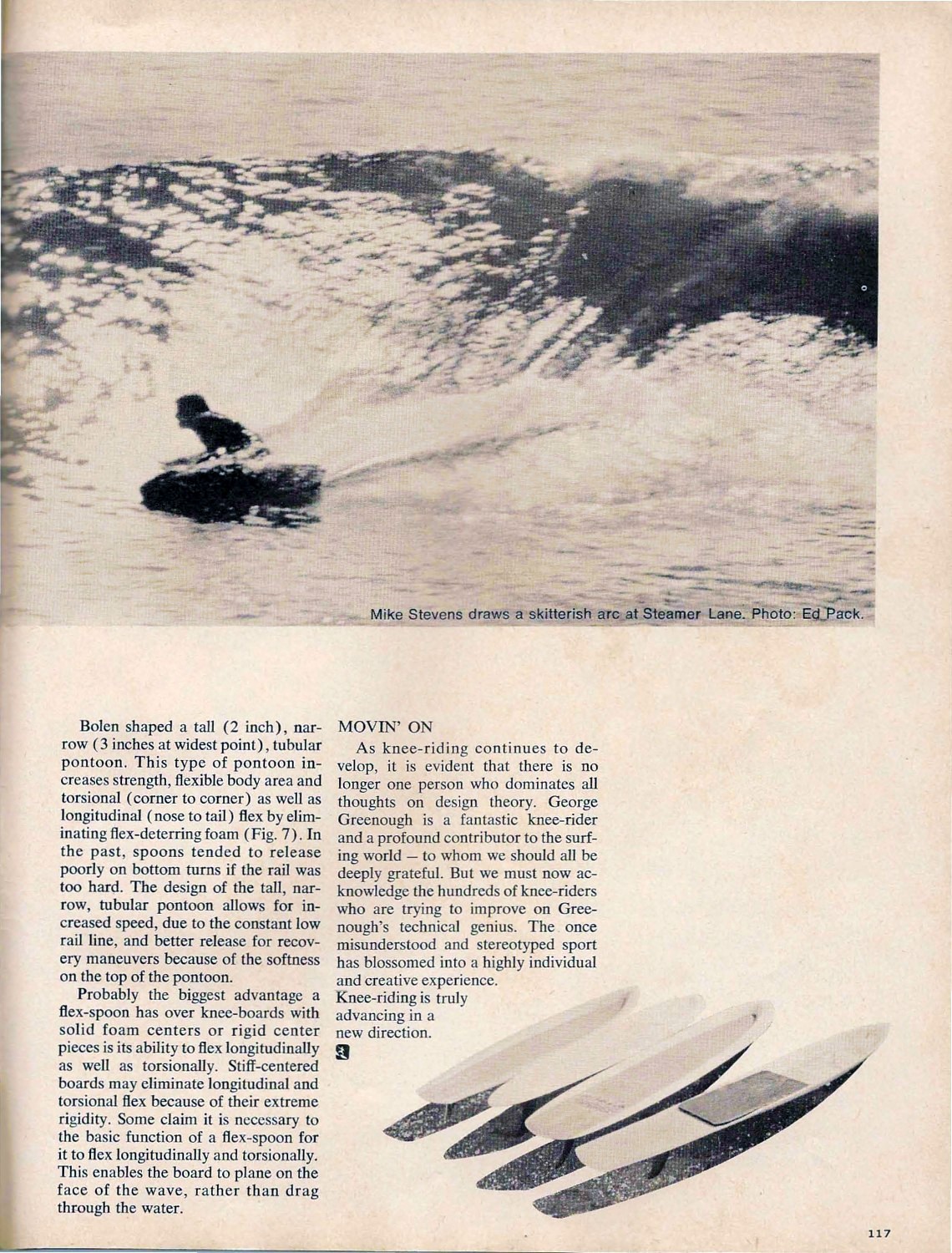
| Ramuno, John.
Specifications for the Revolution, 114-117. |
 
 
- Knee-riding is part of
the new surfing revolution. It is not just an easier, more portable way
of surfing-like some of the old paipo boarders claim. And it's not just
a way of "reducing the medium" to get more involved with the wave.
Knee-riding is a highly intricate and sophisticated aspect of surfing.
[See Surfer Magazine, Vol. 10, No. 2, pp. 92-3, 95.]
- It is changing every day
because of the great number of knee-riders who aren't satisfied with
what has happened in the past. They are individuals who have separated
themselves from traditional knee-boarders and are seeking a new
direction in knee riding.
- In spite of all the
improvements, the conventional foam knee-board seems to be dying a slow
death because of the increased interest and speculation concerning the
flexible knee-board.
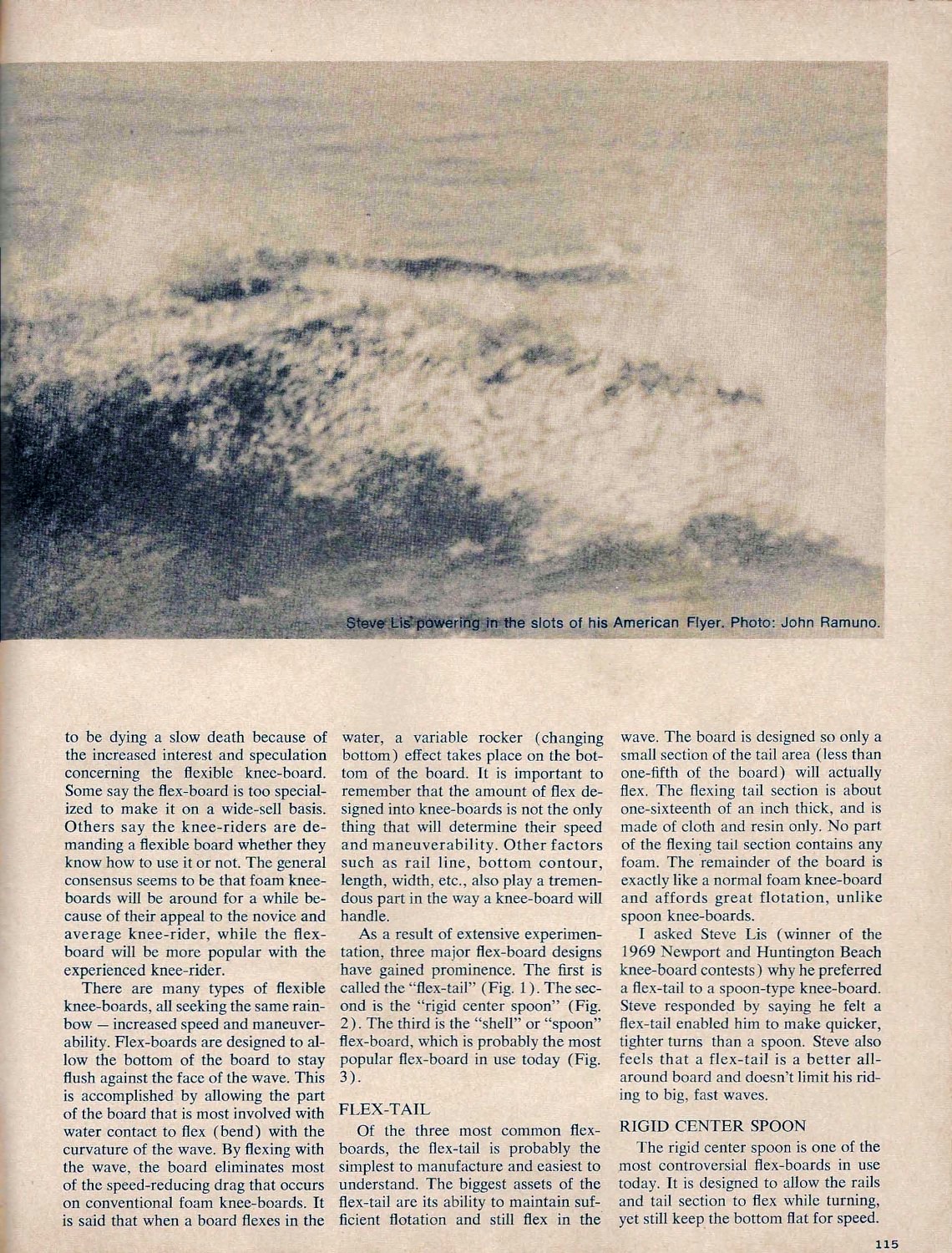
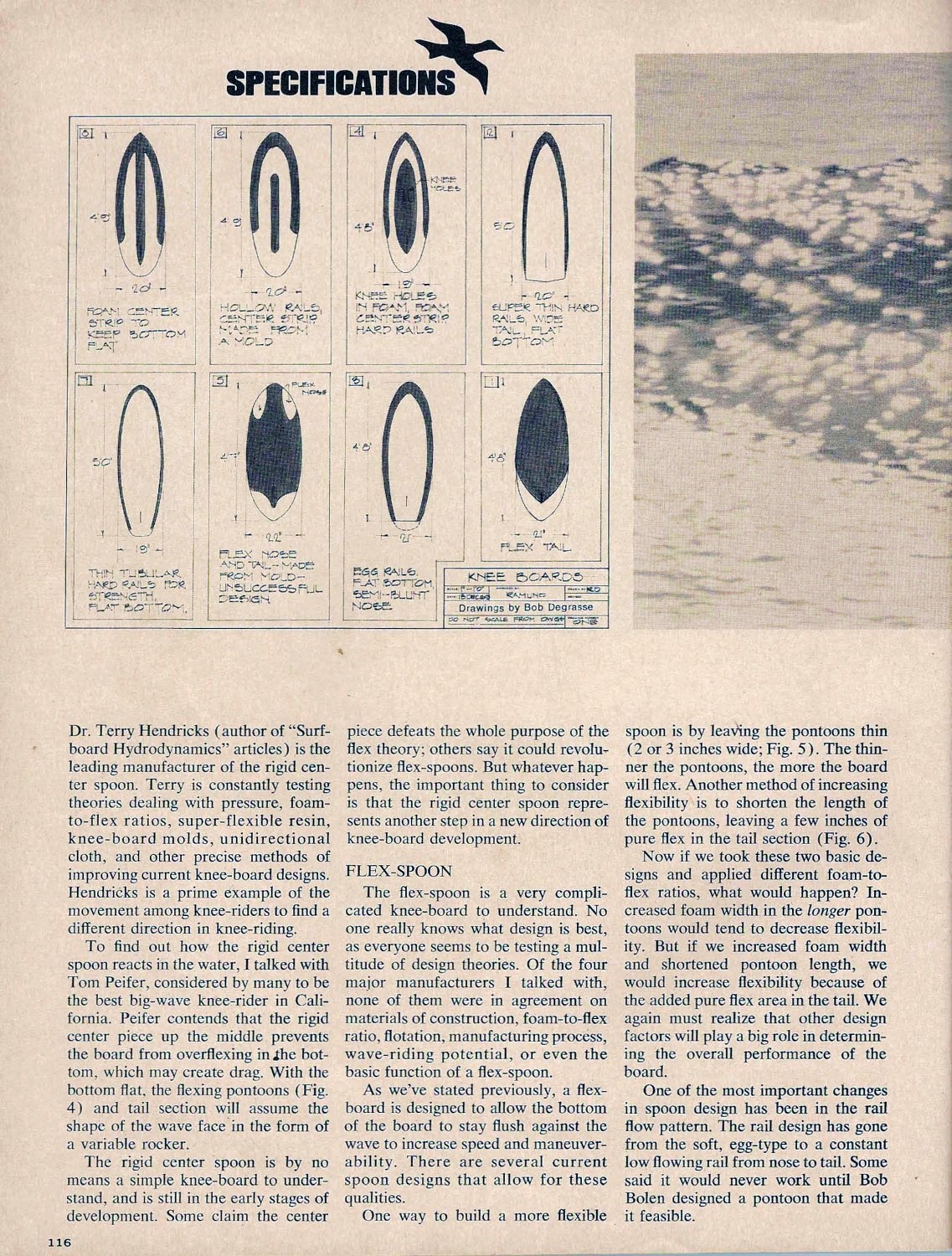
- As a result of extensive
experimentation, three major flex-board designs have gained prominence.
The first is called the "flex-tail" (Fig. 1). the second is the "rigid
center spoon" (Fig. 2). The third is the "shell" or "spoon" flex-board,
which is probably the most popular flex-board in use today (Fig. 3) .
[The article goes on to describe the variations. What isn't clear is
how "flex" in a knee riding board is differnet than flex that could be
and has been incorporated in various prone riding boards.]
|
|
Surfer's Path, The (on-line link
to the magazine)
- Carson,
David & Kenvin, Richard. (2009/2010, December/January). Deaf Musicians and Silent
Dancing:
Wave Riding with Richard Kenvin. The Surfer's Path, 75, 40-53. Article with several photographs. Below is an excerpt
from the article that discusses paipo boarding. Also see this section
in PDF format.
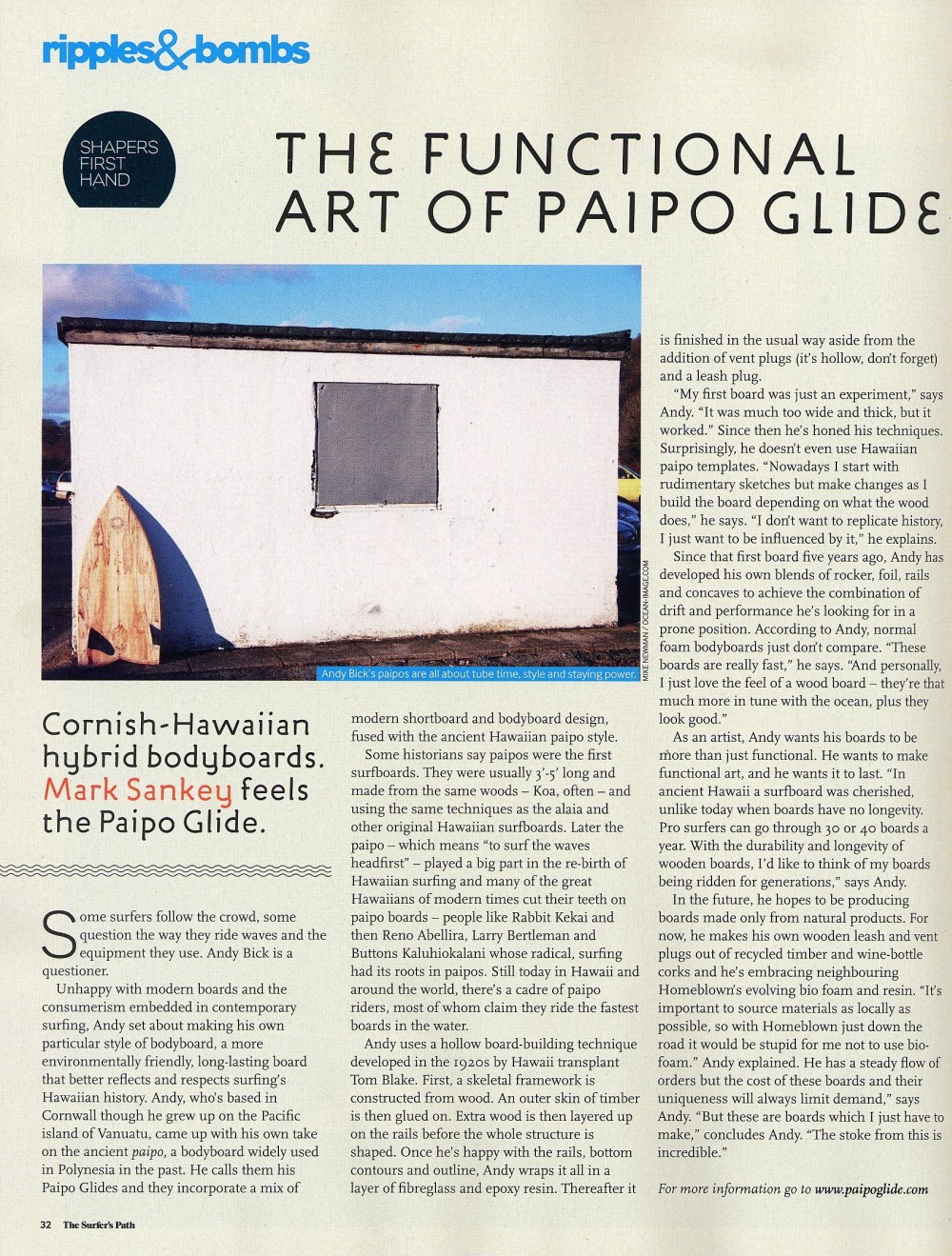
- Sankey,
Mark. (2010, August/September). "The functional art of paipo glide," in
Ripples & bombs - Shapers first hand. Surfer's Path, 79,
32. Article about the paipo glide boards built by Andy Bick, in
Cornwall, UK.
Click pic for a largr JPG or read it in PDF.
 |
|
Snippets
from the article
- "My first board was
just an experiment," says Andy. "It was much too wide and thick, but it
worked."
- Since that first board
five years ago, Andy has developed his own blends of rocker, foil,
rails and concaves to achieve the combination of drift and performance
he's looking for in a prone position. According to Andy, normal foam
bodyboards just don't compare. "These boards are really fast," he says.
''And personally, I just love the feel of a wood board - they're that
much more in tune with the ocean, plus they look good."
- He's embracing
neighbouring Homeblowns
evolving bio foam and resin.
|
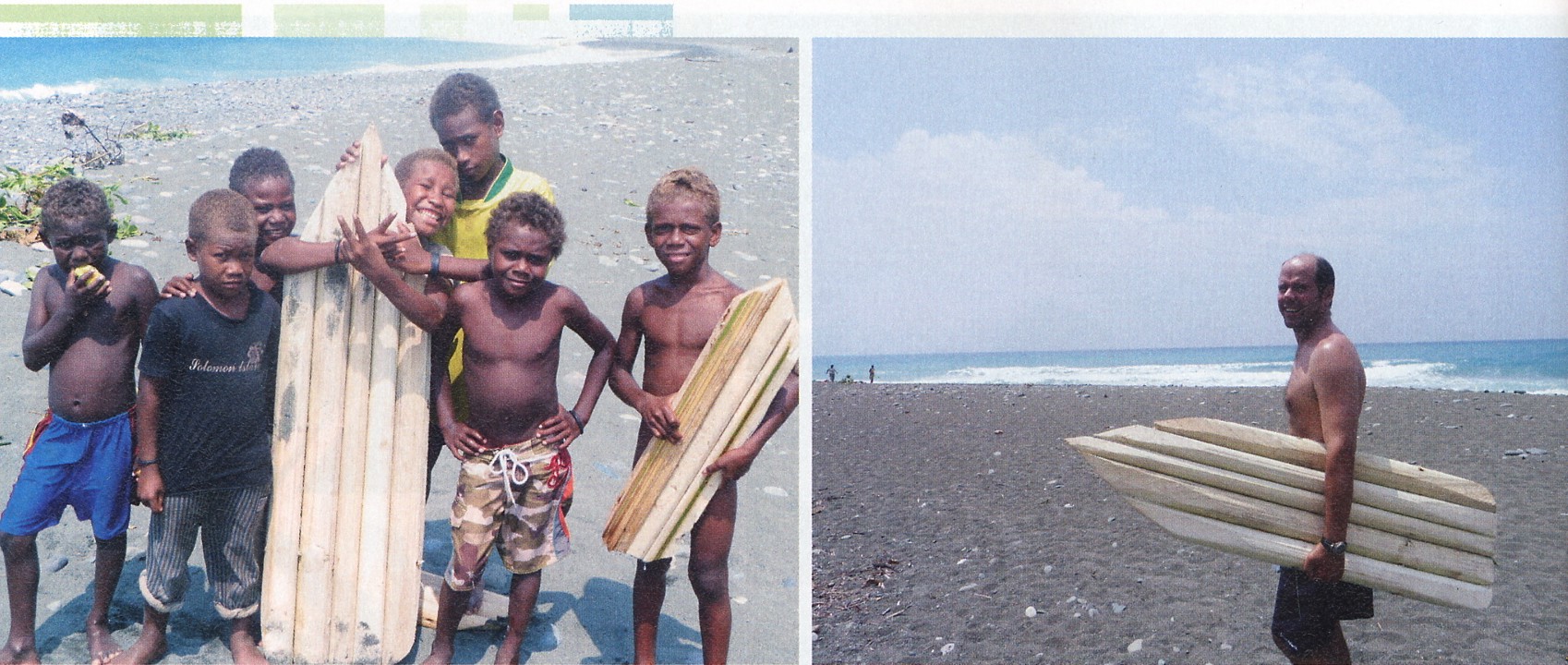
- Wood, Terence. (2013, March/April). Convergent Evolution. Surfer's Path, 95,
50-57. Photographs by Terence Wood and Trond Saetterm. Solomon Islands's Weather Coast kids make paipo surfing boards from sago palm trees. Apparently, the villagers have been riding these home-hewn boards for
generations, influence-free. More to come...

|
Caption for
photo appearing on p. 56: Local grommets, left, who's sheer enthusiasm
inpired the author, right, to give surfing another go after so many
years.
|
|
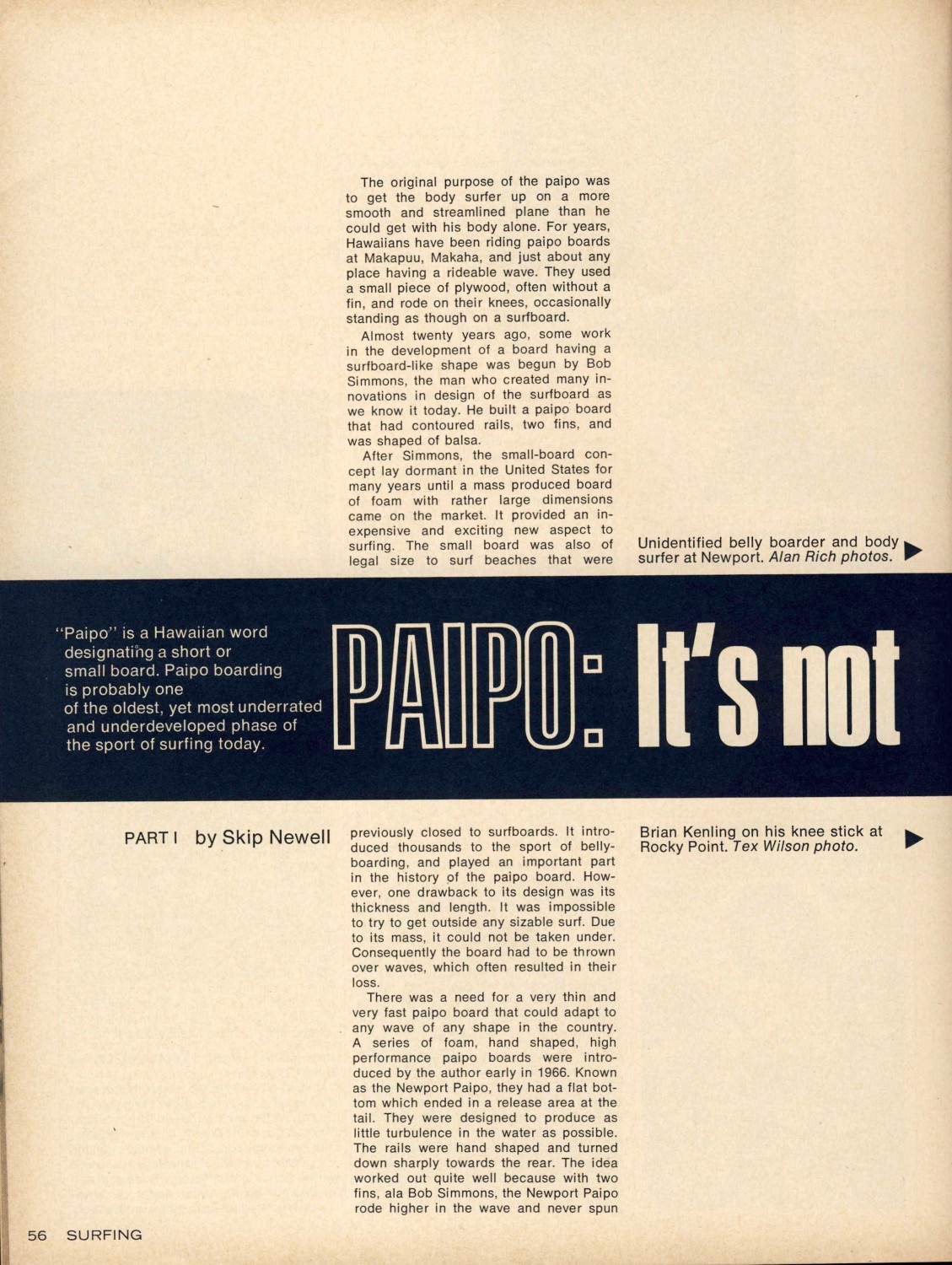
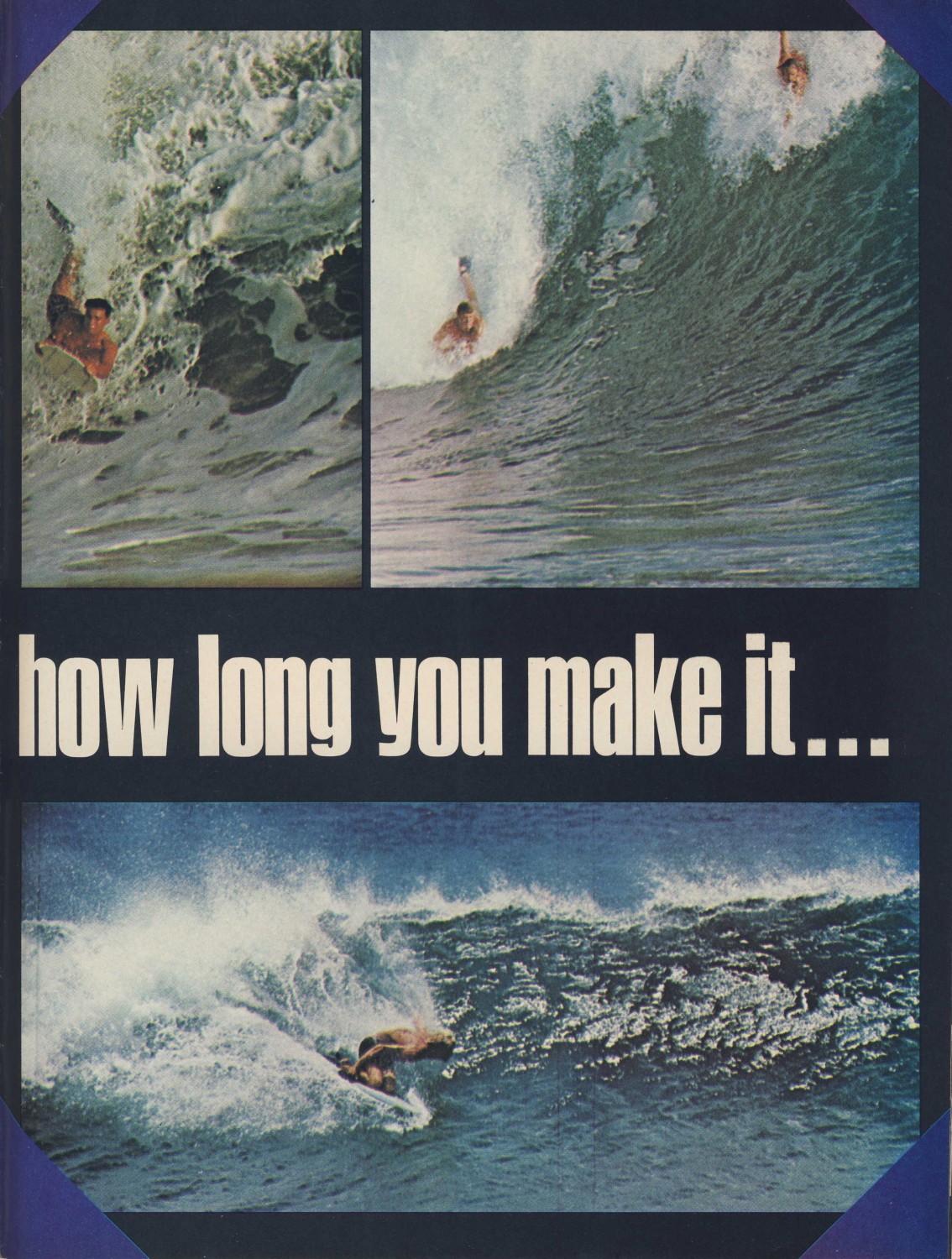
Surfing Action
- Newell, Skip. (1970, January/February). Paipo Part I: It's not how long
you make it...
. Surfing
Action,
3(1), 56-59.
First in a 3-part series focused on the paipo board. Click here for a PDF version
[3.2M]. Click on images below for large JPG views.
  |
  |
Quick Notes:
- Bob
Simmons
built a modern day balsa paipo around 1950.
- Skip Newell produced
the Newport Paipo.
- Con Colburn Surfboard
manufacturer and Newport Paipo board builder.
- Bud Hulst is
the manufacturer of the El Paipo "spoon" shape.
- Jack Hokanson,
of Jack's Surfshop, was the
first to market mass produced belly boards.
- Side cap to the
article: "Paipo" is a Hawaiian word designating a short or small board.
Paipo boarding is probably one of the oldest, yet most underrated and
underdeveloped phase of the sport of surfing today.
- As beaches become more
restricted, the easily portable and fast paipo boards are the possible
answer for many surfers.
The
article beings, "The original purpose of the paipo was to get the body
surfer up on a more smooth and streamlined plane than he could get with
his body alone."
"For years, Hawaiians have been riding paipo boards at Makapuu, Makaha,
and just about any place having a rideable wave. They used a small
piece of plywood, often without a fin , and rode on their knees,
occasionally standing as though on a surfboard."
"There was a need for a very thin and very fast paipo board that could
adapt to any wave of any shape in the country. A series of foam, hand
shaped, high peformance paipo baords were introduced by the author
early in 1966. Known as the Newport Paipo, they has a flat bottom which
ended in a a release area at the tail. They were designed to produce as
little turbulence in the water as possible. The rails were hand shaped
and turned down sharoply towards the rear. The idea worked out quite
well because with two fins, aka Bob Simmons, the Newport Paipo rode
higher in the wave and never spun out on hollow tubes." Newell goes on
to note that he experimented with different bottom countours (e.g.,
"V," concave, convex, slot) before settling on a concave bottom, naming
this design the Newport Paipo Concave Vector.
Newell takes
some credit for the popularity of kneeboarding with Rick
Newcomb riding his paipo design at The Wedge, and hence the evolution
of the "Knee Machine." Then the bluring between paipo riding (prone)
and kneeboarding -- the paipo board basically meaning "short board"
regardless of whether ridden prone or on the knees, or even stand-up
style. Newell goes on to write, "The paipo offers the surfer tremendous
speed and involvement with the wave, whether ridden prone or as a knee
machine."
"Several prominent riders came out of this era of foam paipos. Terry
Jay, usually found at the Santa Ana River jetty, was very adept at late
take-offs. The incredible speed of the paipo enabled it to beat
collapsing sections that would have stopped a surfboard . Rick Newcomb
started riding at the Wedge and astounded people by riding on his knees
to get more maneuverability out of his board. Hence, the era of the
knee machine."
Jack Hokanson famous quote:
"Belly boards
will soon outnumber surfboards."
1Editor's Note: ca1950.
|
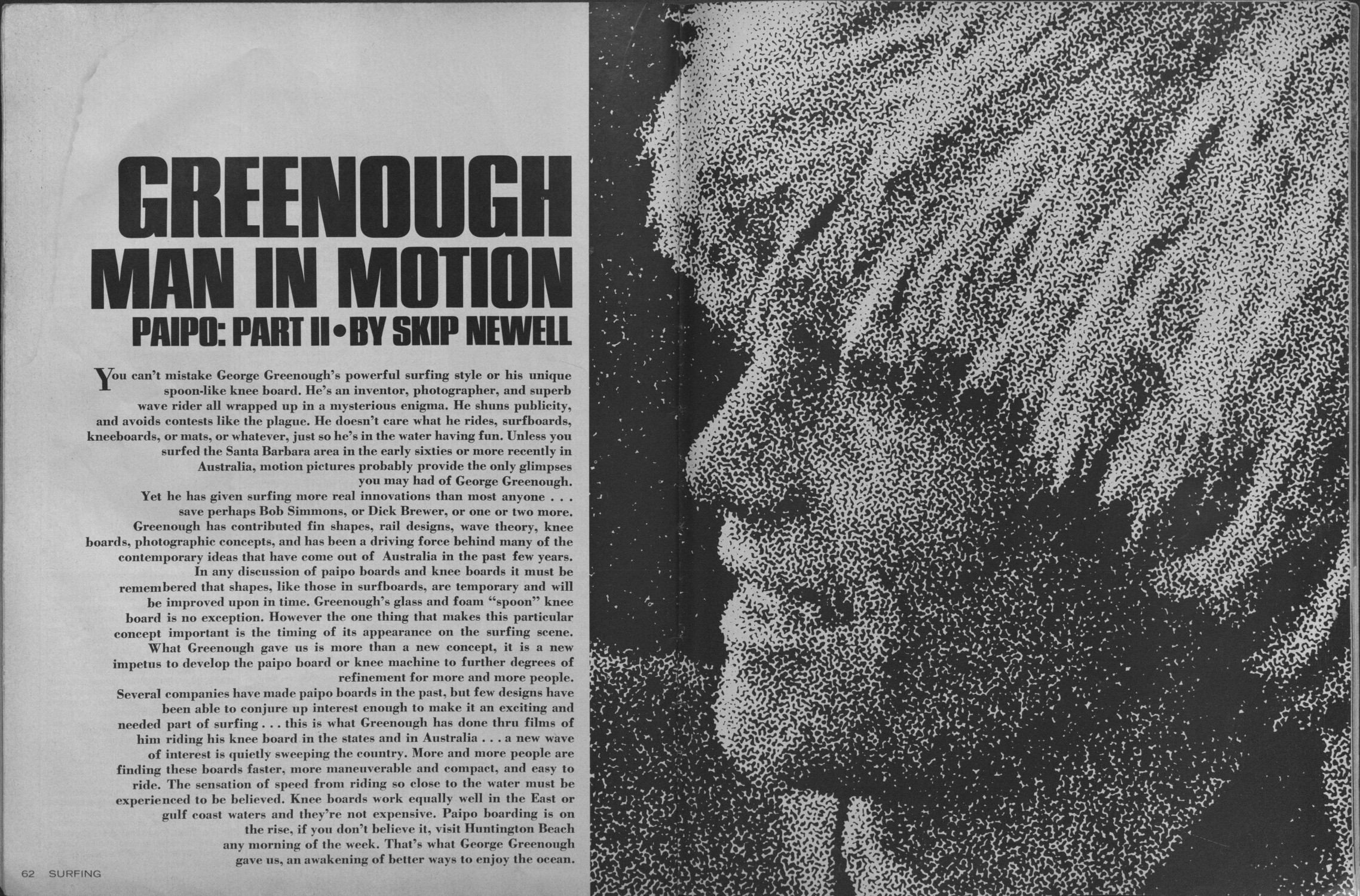
- Newell, Skip. (1970, March/April). Paipo Part II: Greenough-Man in
Motion. Surfing Action, 3(2), 62-65. Second in a 3-part series
focused on the paipo board. Click here for a PDF version
[2.2MB]. Click on images
below for large JPG views.
 |
 |
The author notes
Greenough's influence on riding waves, from mat surfing to erectile
boarding riding, in particular kneeboards. There is no mention of
Greenough riding a paipo (notwithstanding riding a "soft" paipo, aka a
surf mat). Newells states, "What Greenough gave us is more than a new
concept, it is a new impetus to develop the paipo board or knee machine
to further degrees of refinement for more and more people." Also
places Greenough among the greats in modern surfing history: "Yet he
has given surfing more real innovations than
most anyone... save perhaps Bob Simmons, or Dick Brewer, or one or two
more. Greenough has contributed fin shapes, rail designs, wave theory,
knee boards, photographic concepts, and has been a driving force behind
many of the contemporary ideas that have come out of Australia in the
past few years."
|
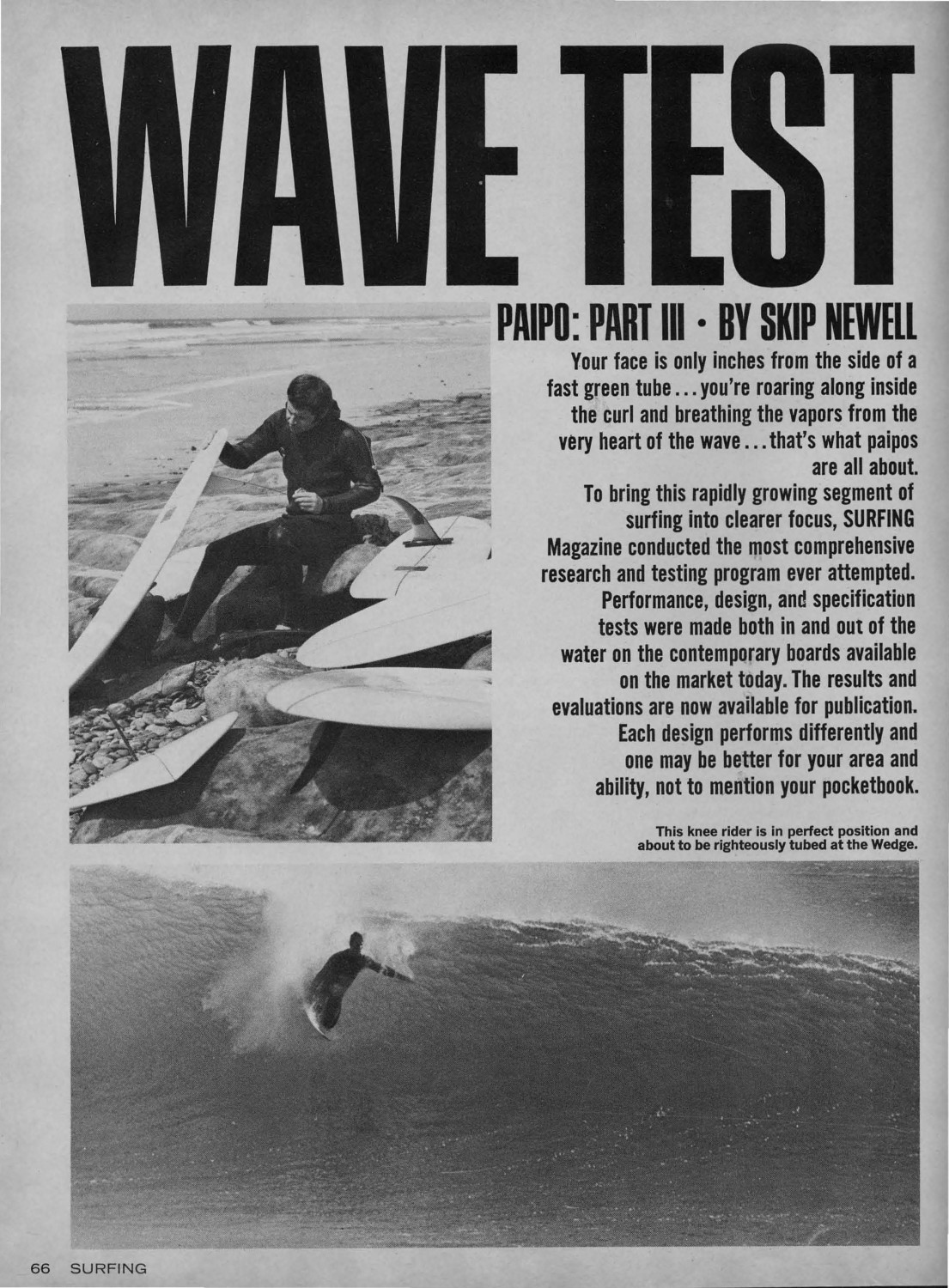
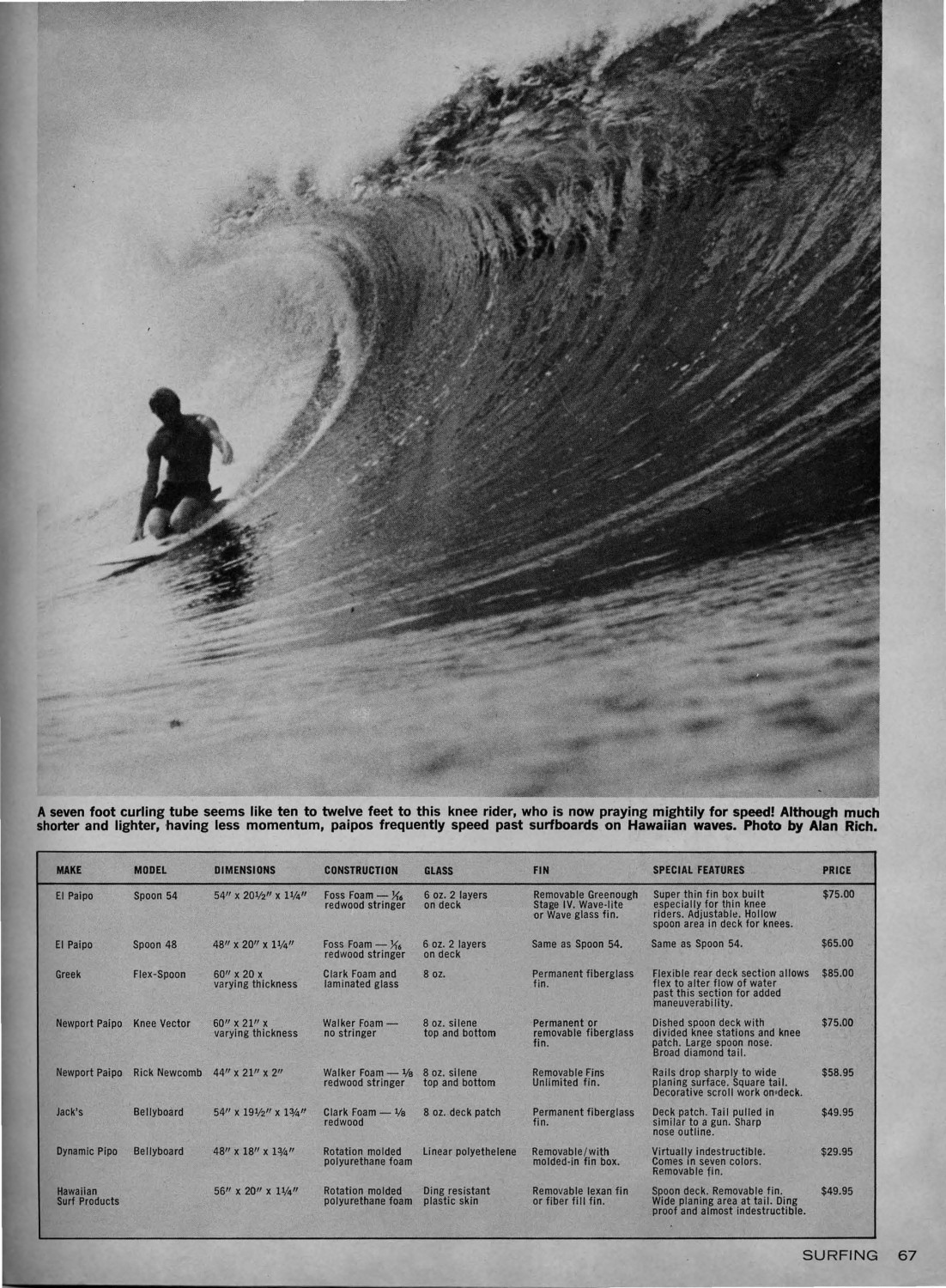
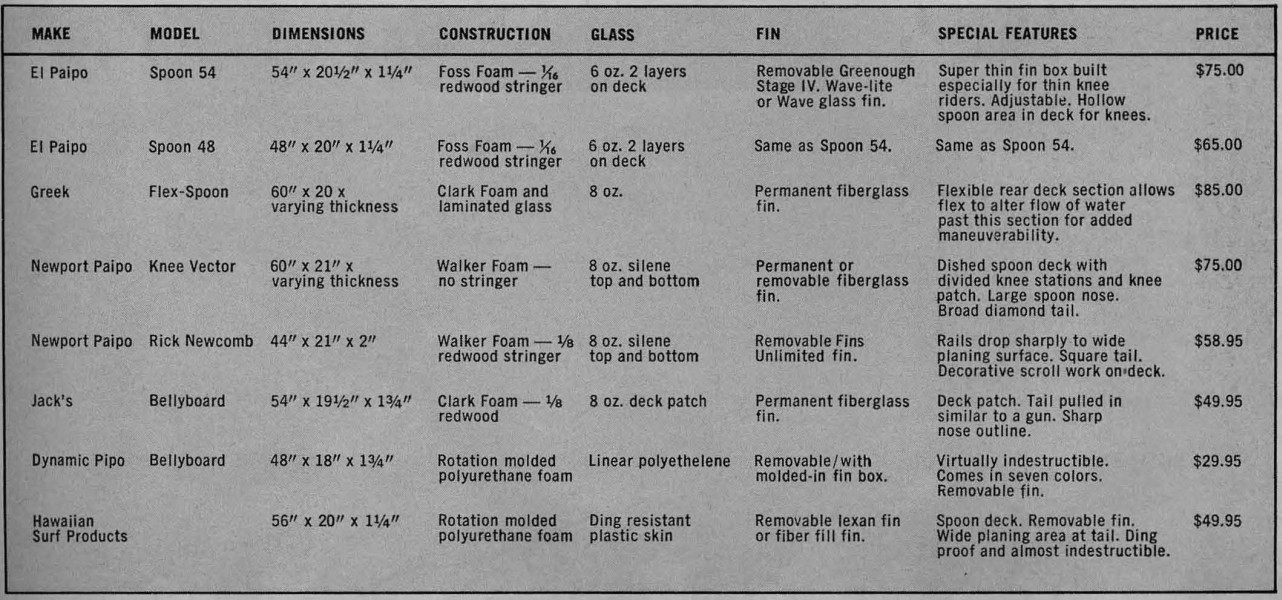
- Newell, Skip. (1970, May/June).Paipo Part III: Wave Test. Surfing Action, 3(3), 66-68. Third in a 3-part series focused on the paipo board. Click here for a PDF version of the entire article
(2.5MB) or the Table
of Boards from p. 67 (250KB). [Note: The emphais has certainly
shifted to knee riding.]
 |
 |
 |
"Your
face is only inches from the side of a
fast green tube... you're roaring along inside the curl and breathing
the vapors from the very heart of the wave... that's what paipos are
all about." |
"To
bring this rapidly growing segment of surfing into clearer focus,
SURFING Magazine conducted the most comprehensive research and testing
program ever attempted. Performance, design, and specification tests
were made both in and out of the water on the contemporary boards
available on the market today. The results and evaluations are now
available for publication."
|
The Surfing Heritage
Series, Parts I through IV
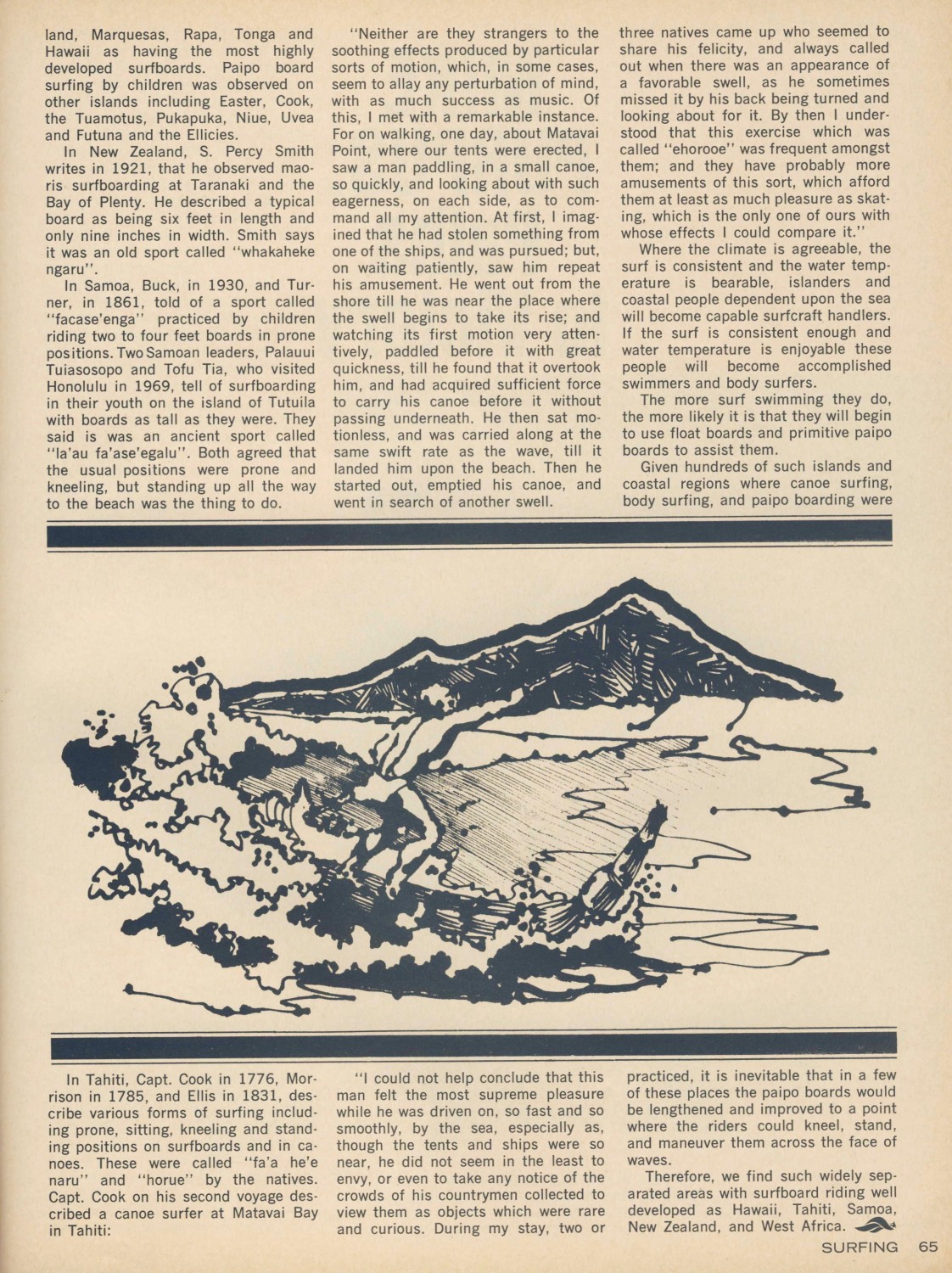
- Shipman, Chuck. (1969, July/August). Heritage Series Part I: Pre-Hawaiian Surfing History. Surfing
Action, 2(4), 64-65.
Surfing
was practiced in various forms (e.g., body, board and canoe) throughout
Oceania and along coastal Peru, where the Peruvian indians rode the
waves for thousands of years. Eighteenth centrury European explorers
observed body surfers in the West Indies and later compared this
activity to surfing in the Pacific Islands. More research is needed to
clarify if paipo boards were used to aid these body surfers. Surf
riding was also practiced in West Africa in the area of the Gulf of
Guinea, including body surfing, paipo surfing and standing erect on
boards about six feet long.
Click here for a PDF
version
[1.2GB] and Hi-Rez image files: p.
64 and p.
65
[~800KB each].
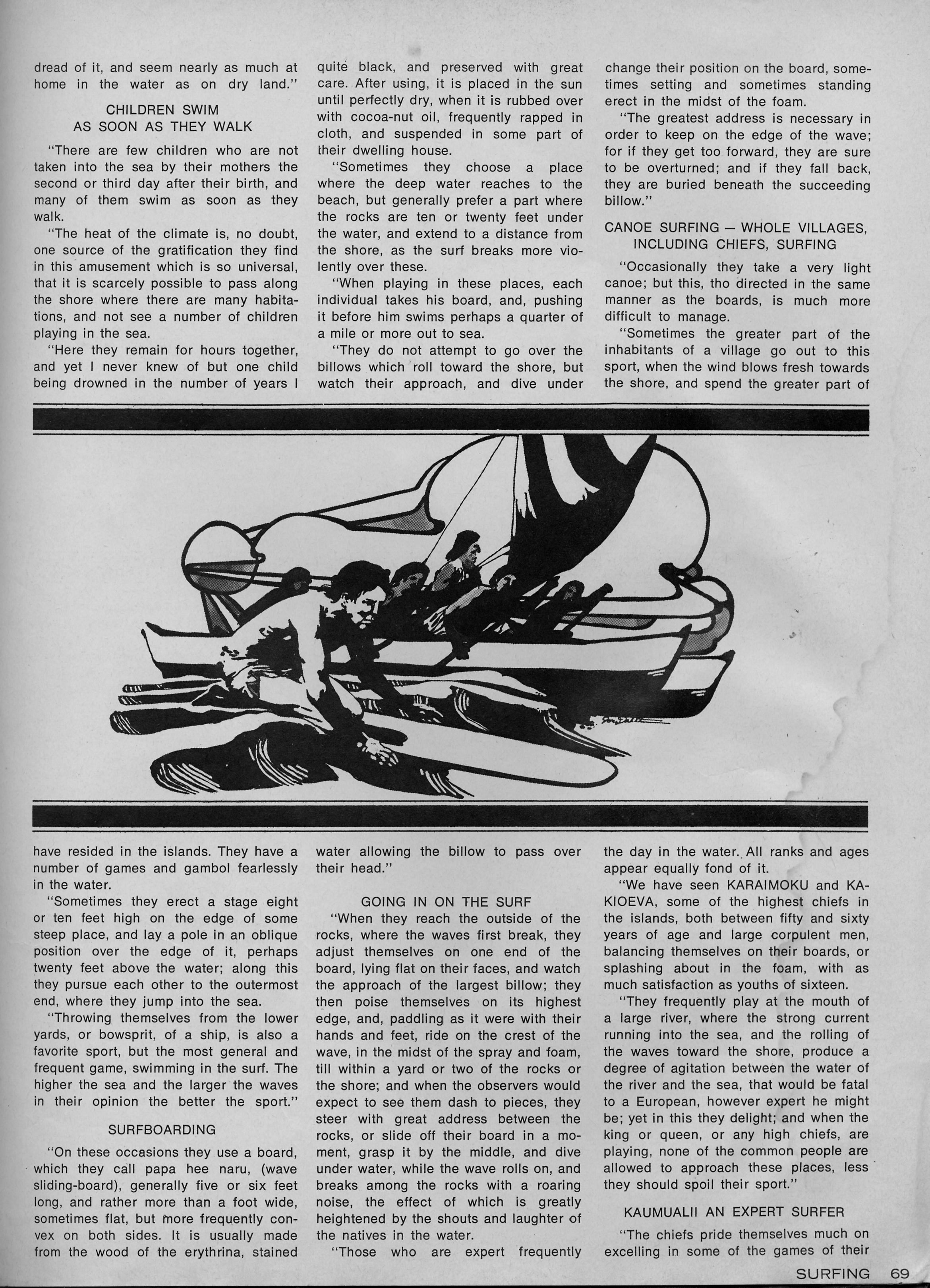
- Shipman, Chuck. (1969, September/October). Heritage Series Part II: Surfing
at the Time of Capt. Cook. Surfing
Action, 2(5), 68-70.
My reading of
the article is that a board similar to what is now called
the Alaia was most popular and that this board was usually ridden
prone. There is a mention of some very skilled riders that rode on
their knees or standing. Certainly provides a good departure point for
some serious research.
Click here for a PDF version
[2GB] and Hi-Rez image files: p.
68, p.
69, p.
70 [~1MB each].
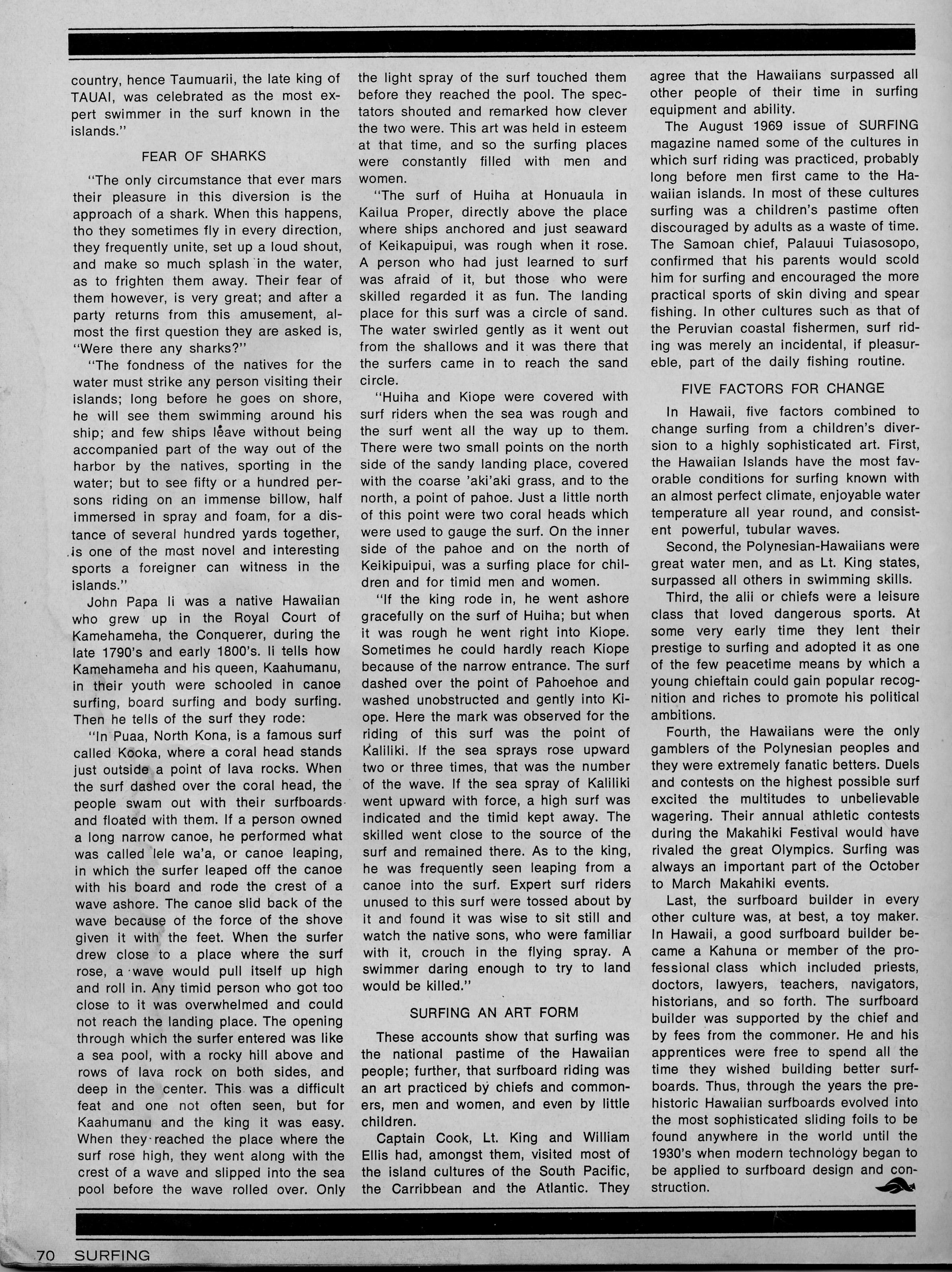
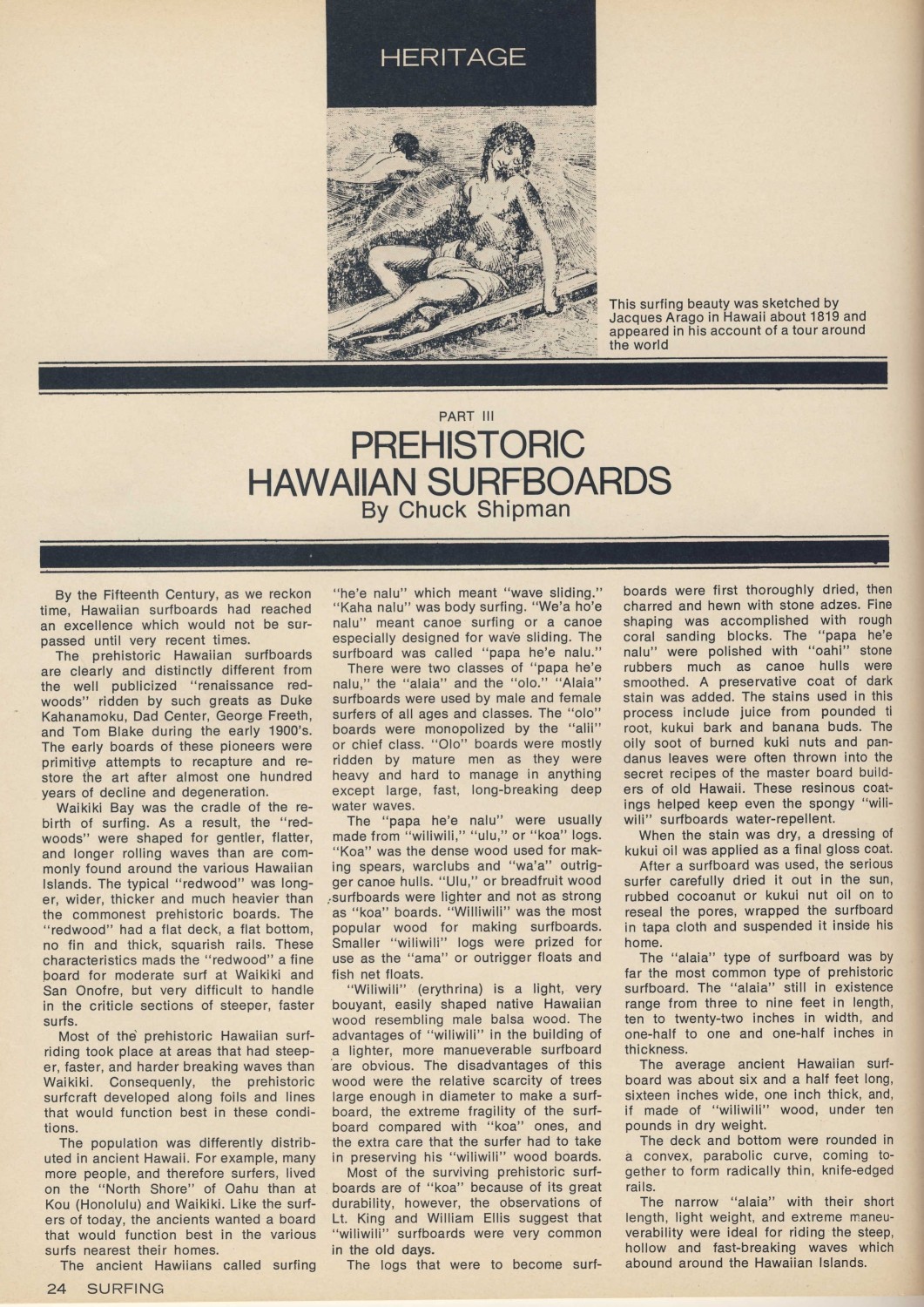
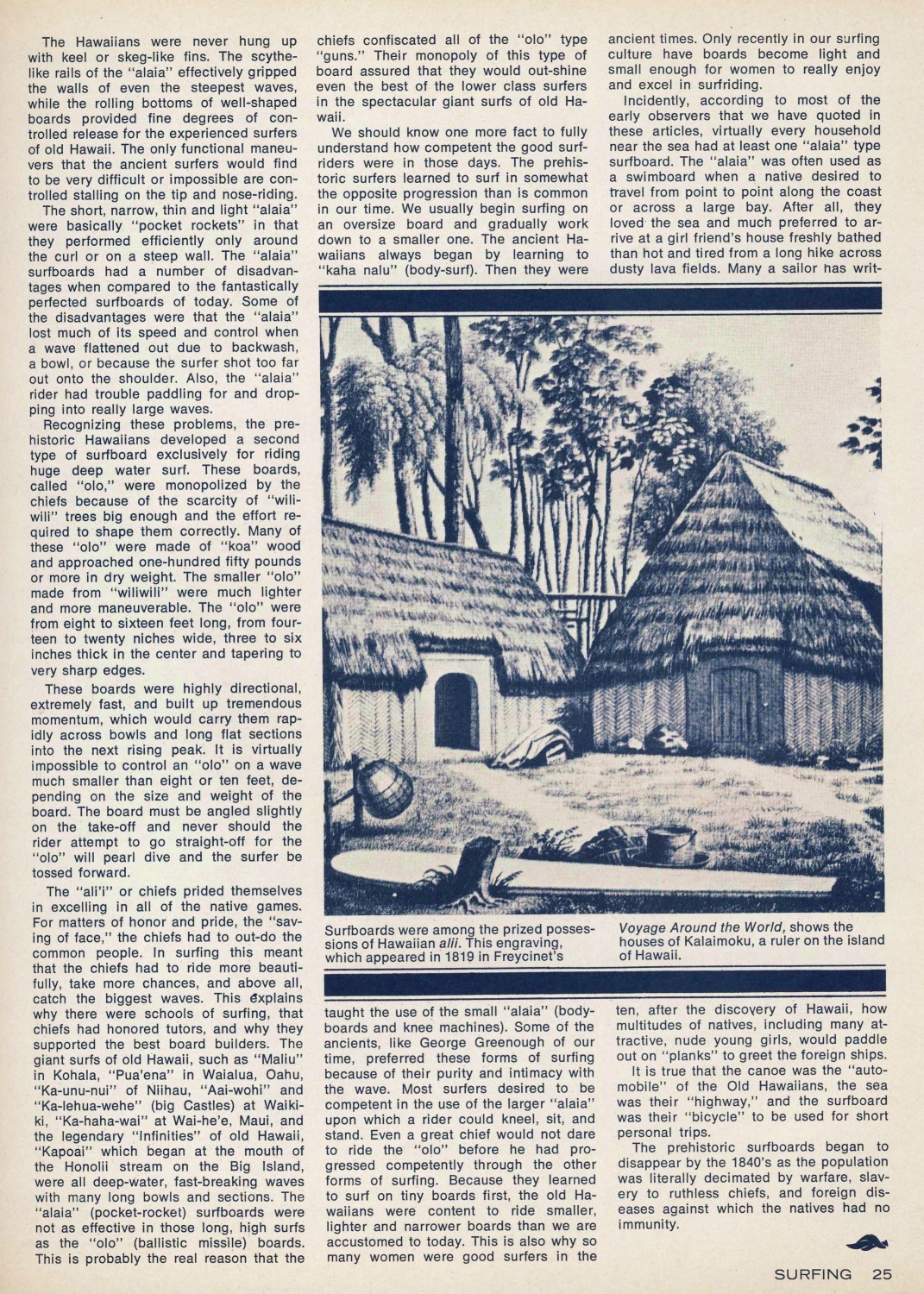
- Shipman, Chuck. (1969, November/December). Heritage Series Part III: Prehistoric Hawaiian Surfboards. Surfing
Action, 2(6), 24-25.
The
author makes his point very quickly, "By the Fifteenth Century, as we
reckon time, Hawaiian surfboards had reached an excellence which would
not be surpassed until very recent times. The prehistoric Hawaiian
surfboards are clearly and distinctly different from the well
publicized "renaissance redwoods" ridden by such greats as Duke
Kahanamoku, Dad Center, George Freeth, and Tom Blake during the early
1900's." Continuing, "Waikiki Bay was the cradle of the rebirth of
surfing. As a result, the "redwoods" were shaped for gentler, flatter,
and longer rolling waves than are commonly found around the various
Hawaiian Islands. Most of the prehistoric Hawaiian surfriding took
place at areas that had steeper, faster, and harder breaking waves than
Waikiki. Consequenly, the prehistoric surfcraft developed along foils
and lines that would function best in these conditions." And more, "The
alaia type of surfboard was by far the most common
type of prehistoric surfboard. The alaia
still in existence range from three to nine feet in length, ten to
twenty-two inches in width, and one-half to one and one-half inches in
thickness."
On
learning to ride the surf the author writes, "The prehistoric surfers
learned to surf in somewhat the opposite progression than is common in
our time. We usually begin surfing on an oversize board and gradually
work down to a smaller one. The ancient Hawaiians always began by
learning to kaha nalu (body-surf). Then they were taught the
use of the small alaia
(bodyboards and knee machines). Some of the ancients, like George
Greenough of our time, preferred these forms of surfing because of
their purity and intimacy withthe wave." Click here for a PDF
version
[1.3GB] and Hi-Rez image files: p.
24 and p.
25 [~1MB each].
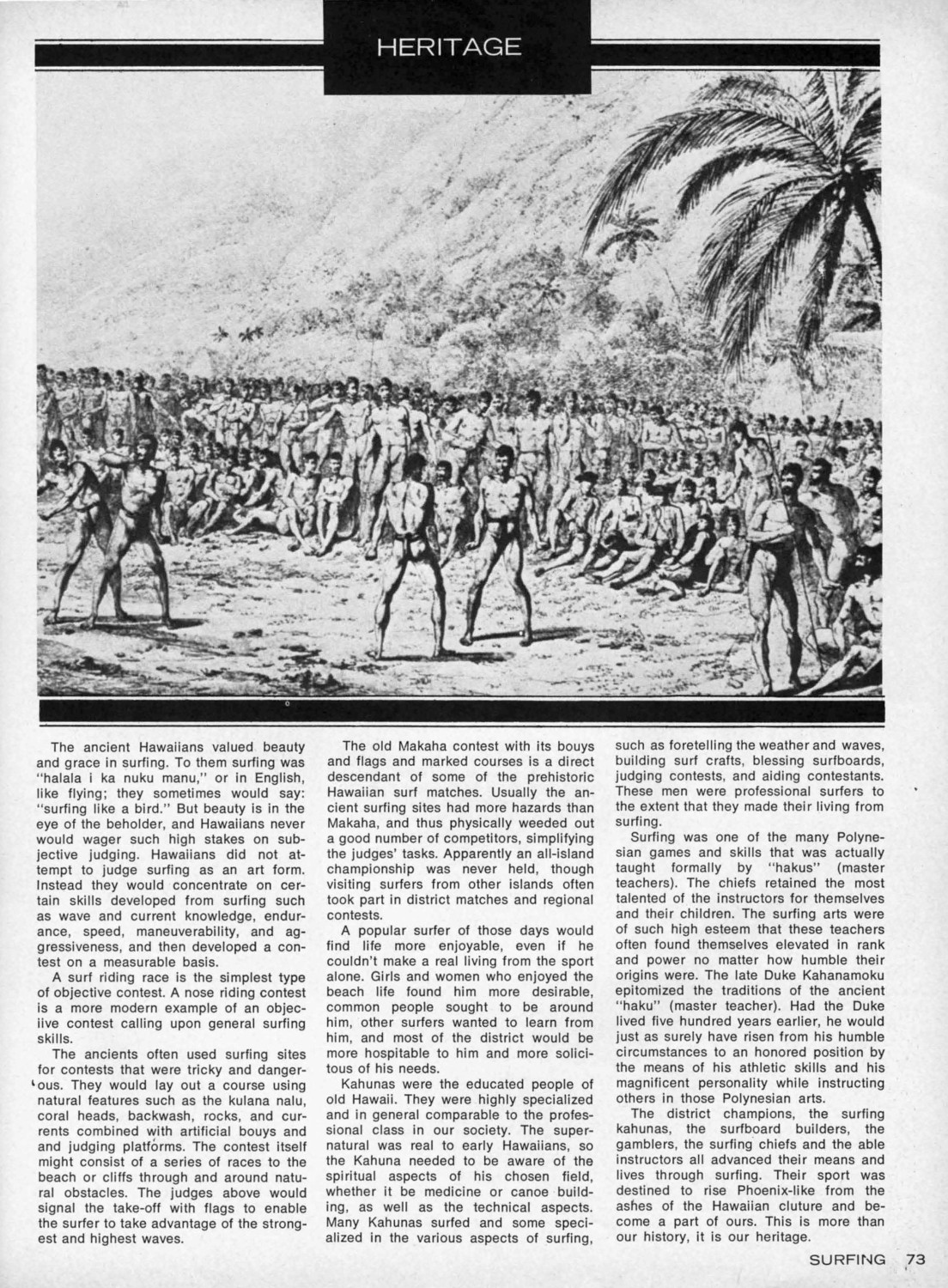
- Shipman, Chuck. (1970, January/February). Heritage Series Part IV: Prehistoric Hawaiian Contests. Surfing
Action, 3(1), 72-73.
Games
and contests for the ancient Hawaiians was serious business... even
deadly. Surfing contests were also hazardous by design to weed out the
less talented contestants. One advantage of being a talented surfer? "A
popular surfer of those days would find life more enjoyable, even if he
couldn 't make a real living from the sport alone. Girls and women who
enjoyed the beach life found him more desirable, common people sought
to be around him, other surfers wanted to learn from him, and most of
the district would be more hospitable to him and more solicitous of his
needs." ... .
Click here for a PDF
version
[2GB] and Hi-Rez image files: p. 72
and p.
73 [~1MB each].
|
Surfing World (See
the magazine at http://www.surfingworld.com.au/.)
(xxxx)
- Pennings, John. (1965,
May). New
South Coast Discovery: Wilinga
Reef. Surfing World, 6(2), pp. 13-16. Photos: John Pennings.
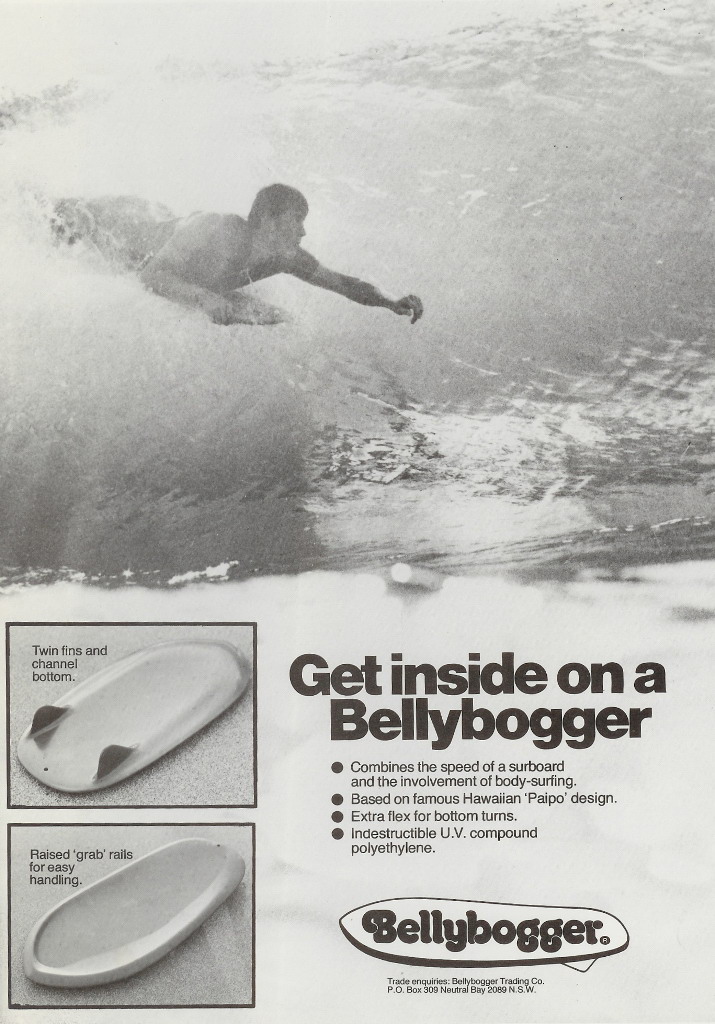
- Bellybogger
[Advertisement]. (1978, August). Surfing World, 27(5). Issue 167, inside
back cover. Thanks to Jeff Bickerstaff for
a copy. [Note: Date is approximate.] Also see the Dick Ash interview.
- Doherty, Sean. (2012, February). Board Design. Outside the square: Look mum,
they fibreglassed a boogieboard! Surfing World, 322, p. 101.

|
|
A short story about professional surfers who foot ride very
short boards (bodyboard type boards with fins) or very thin boards (alaia).
The article describes the board dimensions stating, "The tape says 4'6"
by somewhere around 23"' wide. The outline is something between a
boogieboard and a Mini Simmons with maybe a just hint of paipo
thrown into the mix." Continuing, Dave concurs, noting. "It looks like
an oId paipo and similar to the single fin Ted Spencer was
riding at Angourie in Morning of the Earth."
Dave apparently likes this board for riding small point break waves,
"The points at one, two foot have always been a challenge to find the
right craft.. Yoo need something to paddle you if the current's strong,
but somethtng that's small enough to fit in the pocket."
|
|
The Surfer's Journal (on-line link
to the magazine)
- Unknown.
(1993, Summer). Tales of a Town and Country: Walter Hoffman's
Scrapbook, The Early Years: 1948-1954. The Surfer’s Journal,
2(2), 83..
This article contains one noteworthy photograph and another photo which
is curious. The first photograph is noteworthy since there are not many
photographs of paipo boards from this period in time and the board
appears to be a reasonably modern looking shape for 1950 era. It's
unclear what the other board is in the other photo.

|

Above
partial caption: The guy that controlled the area where hundreds of
balsa life rafts were stored on the base at Pearl Harbor ended up being
our friend's, the Patterson brothers, father , so he'd let us drive in
there and we'd slice up the balsa rafts and glue the pieces into blanks.
Question: Is that a balsa life raft in the above photo or something
else?
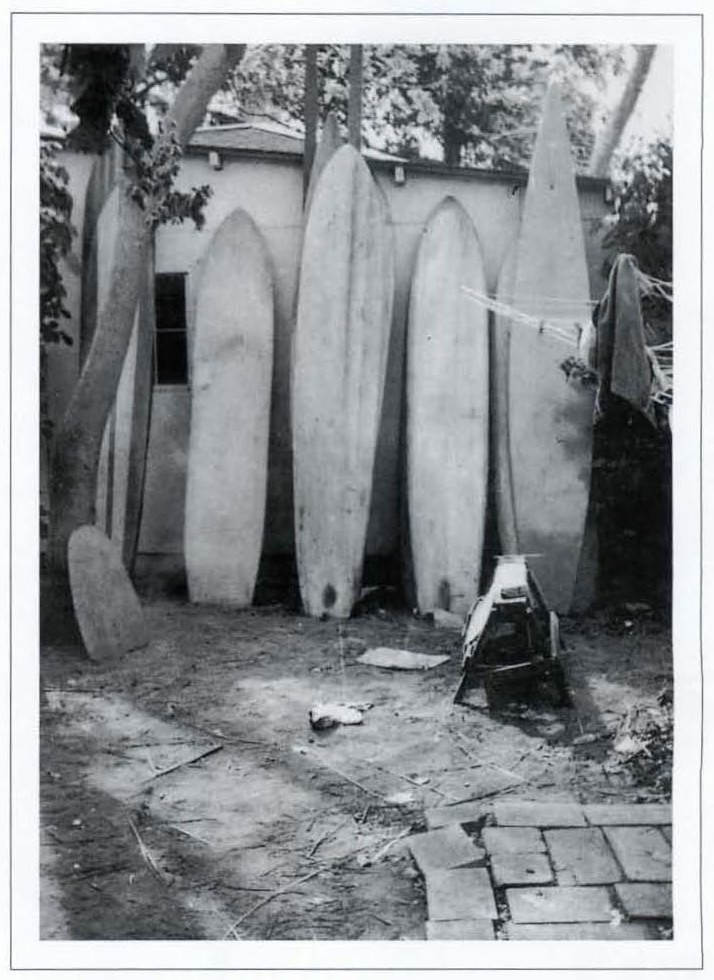
Caption
(left):
"Our living quarters, Summer 1950--a $25 a month basement and backyard
garden area where we kept our boards." Against the garden wall is a
variety of surfing equipment of the period ranging from the
balsa/redwood planks on the left (note the ittle plywood palpo
with
fin leaning against the tree), Malibu chips In the middle, ("They were
just beginning to arrive in the islands In the hands of guys like Zahn,
Quigg, Kivlin and Rochlen who would bring them over and sell them when
they left.") to the kook box at right.
|
- Gault-Williams,
Malcolm.
(1997, Winter). Surf
Drunk: Wally Froiseth. The
Surfer’s
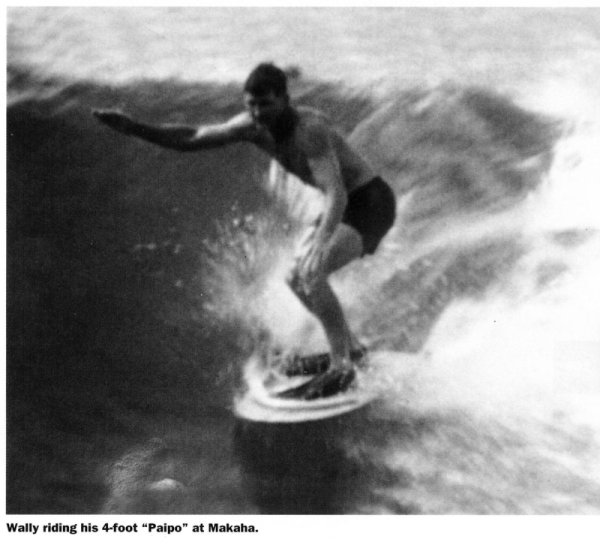
Journal, 6(4), 105. [PDF, 170KB]. Picture of Wally
Froiseth riding a paipo board vertically
at Makaha - no other references to paipos in the article.
- Pezman, Steve. (2009, August-September). Hobie's Story - Chapters from
His Early Years. The
Surfer’s
Journal, 18(4), 49,
54-55. [PDF, 320KB & 570KB].
Bellyboarding as a youth, swim fins and using a belly board mold in
early poly foam experiments.
- On p. 49,
Hobie Alter mentions his early days surfing as a kid at Laguna Beach: "When you think about how we
get into stuff, well, there's
a lot of luck involved. In my case, I picked good parents. If there was
ever a spot where you wanted to be: I had Brooks Street right here and
Oak Street there, and Thalia down at the other side of us. I mean,
that's it! That's surfing in Laguna. Dead center. Best bodysurfing of
anywhere around there. That's what we did. A group of us kids grew up
bodysurfing and skimboarding and bellyboarding." Hobie also mentions
using swim fins: "We had Owen Churchill swim fins, but you couldn't get
rubber during the war so they were made of black synthetic rubber that
wore holes in our feet. We'd wrap cloth around them, tape, everything.
There were even some wood ones on the market then, but they didn't look
like they worked very well."
- On
pp.
54-55, he mentions a bellyboard mold that was used in his early
experimentation with polyurethane foam: "You can't believe what a shock
it was after Styrofoam didn't work. That was the first I had seen of
urethane foam. After that I had a belly board mold that I tried to foam
up. I went up to Reichhold and did it right in their lab."
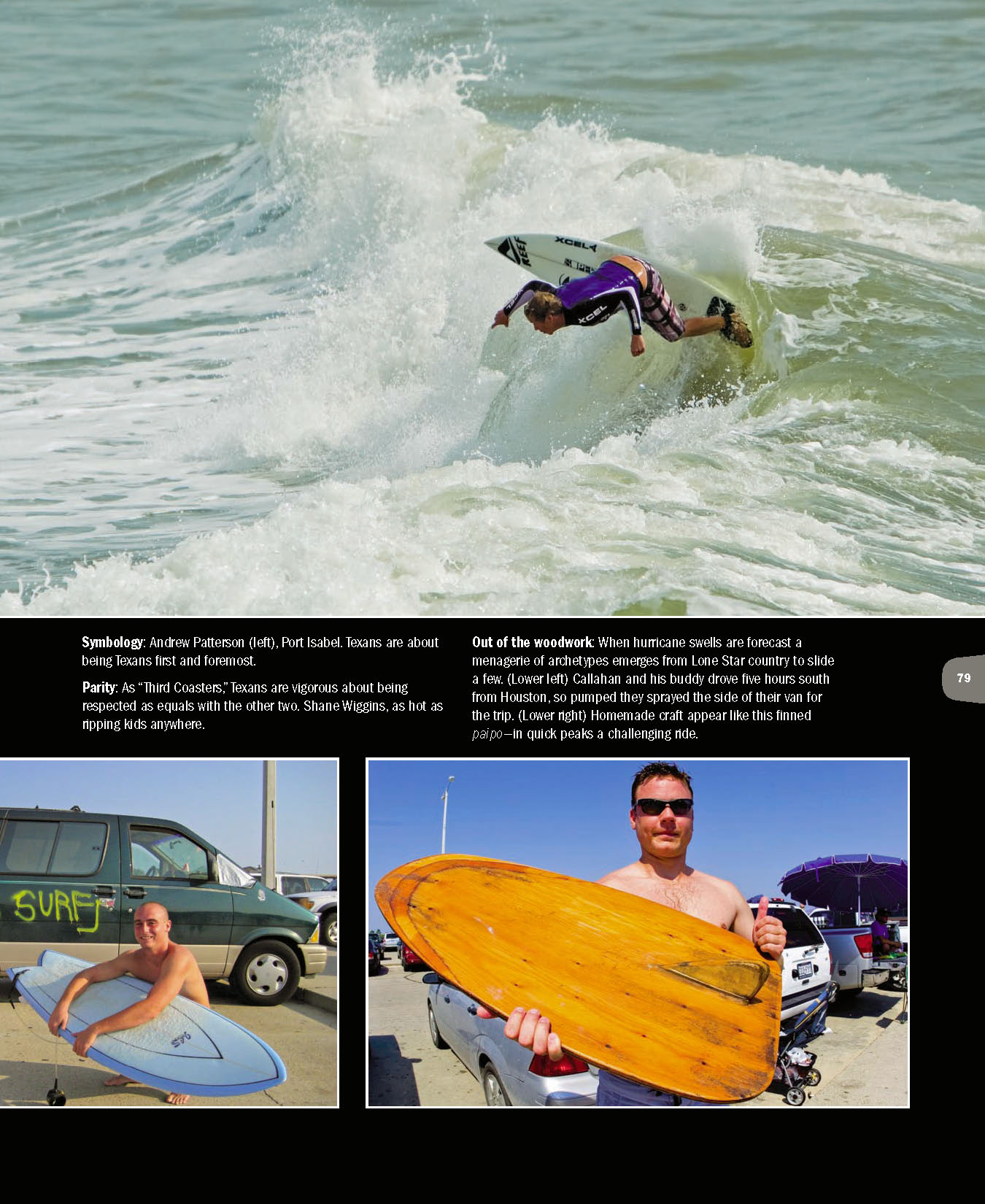
- Steele,
Jon. (2009, Winter). Cowboy
From Hell: Hoo-dang! The Surfer’s Journal,
18(6), 79.

|
Note
the picture of the Texas paipo-boarder from the article on Texas
surfing. "Out of the woodwork: When hurricane swells are forecast a
menagerie of archetypes emerges from Lone Star country to slide a few.
Homemade craft appear like this finned paipo--In quick peaks a
challenging ride."
Read the full article here: http://www.surfersjournal.com/node/828
|
- Pendarvis,
Cher. (2010, Winter). Uncle Val. Paipo in practice. The living link to
surfing's high-performance roots. The Surfer’s Journal,
19(6), 38-47. Article
summary: All
around waterman, Valentine Ching, Jr., has spent a lifetime surfing the
waters of Oahu and is known as the pioneer of shortboard surfing on his
paipo. He and his father began designing and riding paipo boards when
he was only 7 years old, riding both kipapa (prone) and ku (standing)
style. "Uncle Val" is busy passing the torch on to his children and
their generation by encouraging and teaching Hawaiian culture, farming,
arts fishing practices, and, of course, paipo shaping and riding.
[Rod's Note: More to follow.]
- Kenvin,
Richard. (2011, Feb-Mar). Child of the Cataclysm. The Surfer’s Journal,
20(1), 20-23.
Article summary: He made skateboard history, but Tony Alva’s
always
been a surfer at heart. In this piece we decode myth and the man down
in dusty, old Baja Mexico. Paipo punch line in the article appears on
p. 20, "Bertleman was, after all, raised on a paipo." This
comment was made in reference to how the surf/skate style traces its
worldwide roots to the Hawaiian paipo board and the ancient alaia
which are the elder siblings of the Simmons planing hull and Lis's fish.
- Pendarvis,
Cher.
(2011, Feb-Mar).
Home Grown: Steve Lis and His Fish. The Surfer’s Journal, 20(1),
108-119. Article
summary: It
was only one of the most influential developments in surfboard design,
no big deal. From his quiet perch above Sunset Cliffs, emerged Steve
Lis and this unabridged Fish story. Paipo bottom turn storyline: Steve
Lis started out bodysurfing at age 10, but wanted to rider steeper,
faster waves. He started building and riding small marine plywood
paipos, adding skegs near the tail, and then starting experimenting
with foils, concave and rocker. [Rod's
Note: More to follow.]
|
Transworld Surf (on-line link
to the magazine)
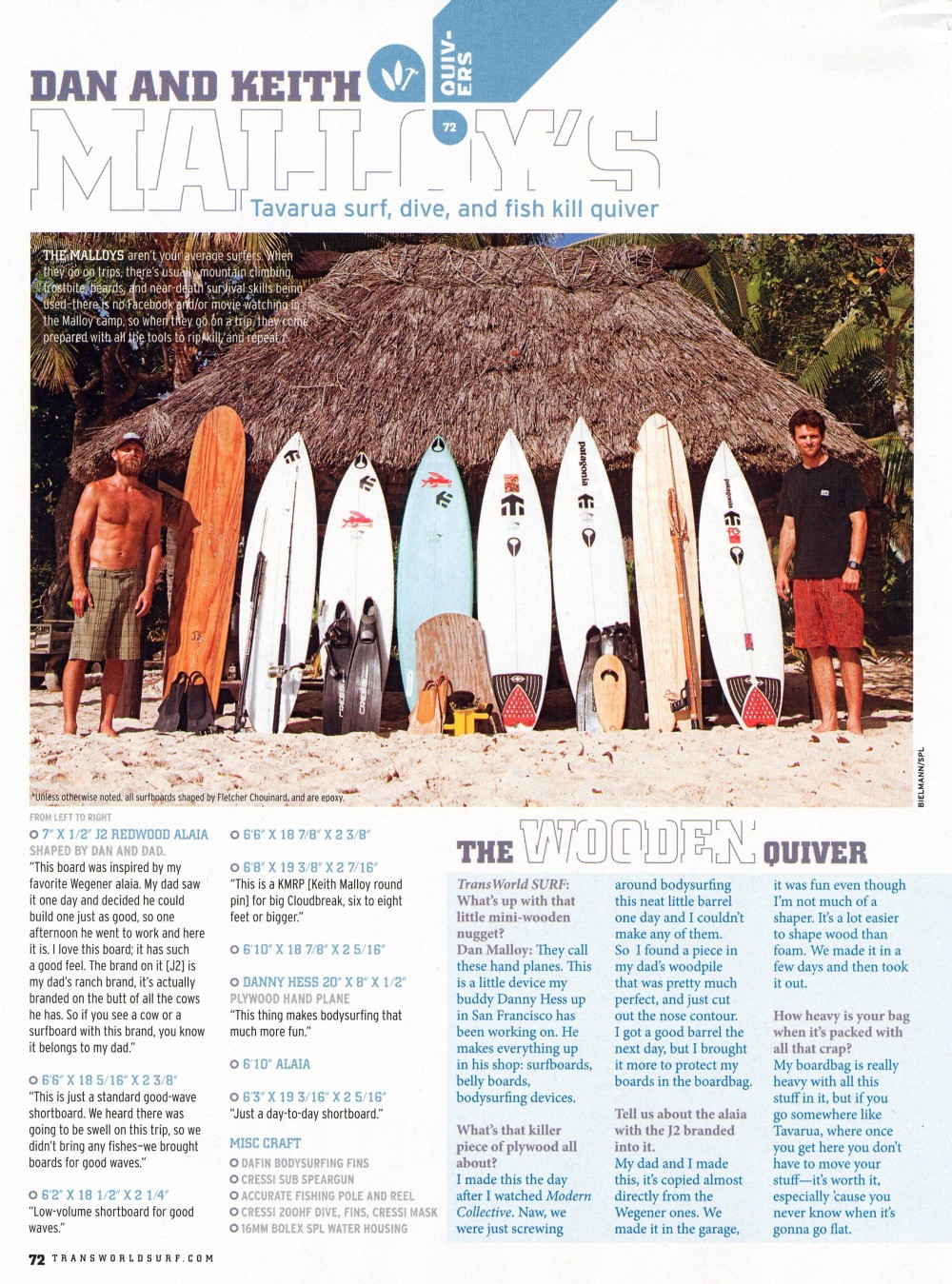
- Unknown.
(2010, October). Quivers: Malloys' Gear for
Killing Fish, slaying waves, and Much More. TransWorld Surf, 12(9), 72.

|
The
adjacent panorama image shows the paipo board on the right. Odd fact in
the article: the paipo is not listed even though the handboard and fins
are itemized. Side note: Danny Hess, in San Francisco, makes
bellyboards and bodysurfing devices. The plywood paipo was built by Dan
Malloy after watching the surf video, Modern Collective. [PDF
(740KB), JPG
(500KB) ]
Original photograph by Brian Bielmann. |
- Masters,
Brad.
(2012, June). South Pacific: Find Your Own
Way. TransWorld Surf, 14(5), 1-2, 94-99.

|
This
might represent the first time in a decade or more that a surfing
magazine cover shot featured a paipo surfer (other than in a
bodyboarding magazine). Alas, it appears to make for a nice novelty
photograph as not much text follows in the magazine article about
traveling to a remote South Pacific destination. (Although I am a bit
confused because the article cites Indonesia as the destination and
Indo appears to be in the Indian Ocean, not the South Pacific.)
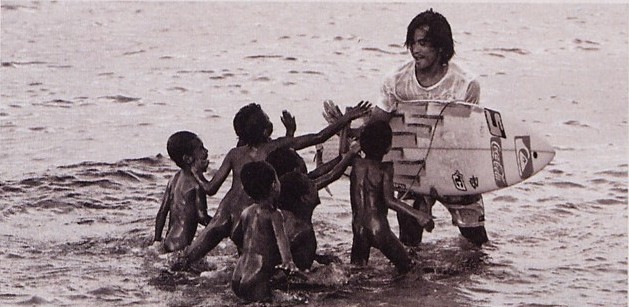
The
adjacent panorama image shows a super stoked native kid riding a plank.
The caption states, "Sometimes pro surfers don’t score the
trip’s best
photo. Instead, a stoked young kid on a plank does—by
exemplifying all
of the reasons we started surfing in one single moment."
Original photographs and words by Brad Masters. |
|

|
This
photograph appears in the table of contents. This wider version of the
cover photograph adds two dimensions not seen on the cover shot: (1)
there is noticeable rocker on the paipo plank and (2) the kids in the
background are also riding paipo planks.
The caption accompanying this photo in the table of contents states,
"Mikala Jones, Dede Suryana, and photographer Brad Masters cash in on a
hunch and a gamble--and prove that magical, untouched places still
exist."
|
|

|
This is an image appearing on the TransWorld Surf website. A
higher resolution image of the board being held in the foreground may
be seen by clicking on the figure to the left.
This photograph opens the 6-page article on pp. 94-95.
|
The online version includes the
following dialog:
"We
caught up with Brad as he was dashing through the Perth airport en
route to Bali, the place he calls home.
TransWorld
SURF: So Brad, how did this photo come about?
Brad
Masters: We’d been
surfing all morning and we’re driving back along the coast to
where we
were going to camp when I saw a bunch of kids playing in the water on
these little boards. The guys were surfed out so I just went out and
joined them for some fun. It was just a little reef pass, and I stayed
out there for about an hour and a half shooting photos of the kids.
Stoked! That’s two covers for WA guys in the last two months!
While
we’re not going to
disclose the exact location of the trip, it’s safe to say the
boys
scored somewhere in the South Pacific…"
|

|
Caption
for the photo on p. 96: "How many times have these groms witnessed
pumping surf without taking notice? Mikala Jones punts while the local
kids play."
My guess based on the history of surfing going back to ancient times is
that the local kids noticed.
|

|
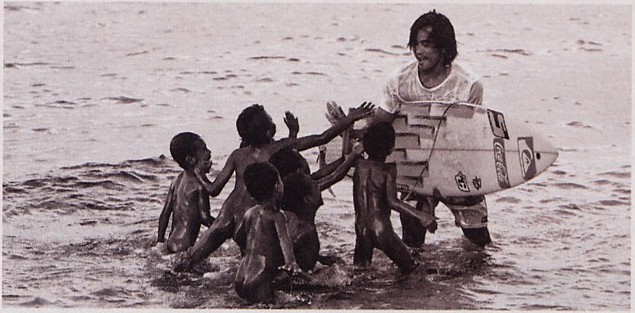
Caption
for p. 98: "Dede Suryana was just as stoked to high-five the local kids
as they were to see him. We couldn't help but wonder, were we the first
to surf these waves?"
My guess based on the history of surfing going back to ancient times is
that the indigenous people had surfed these waves before the TW visitors' arrival... just not on
thrusters! |
My
overall observations: Were these planks and the pictorial spread a
completely fabricated event? Did the kids have these boards lying
around
and ride them regularly? Unfortunately the trip story sheds little
light other than observing the now old cliché, "Were we the
first to surf these waves?"
|
|
Other Magazines (from the
non-surfing press in roughly chronological order)
|
- Rouch, Jean. (1949, April). Surf-riding: Sur La Cote D'Afrique. Notes Africaines, 42, 50-52. Bulletin d'information et de correspondance de l'Institut Français d'Afrique Noire (IFAN). Article in French -- translation assistance needed!

|
|
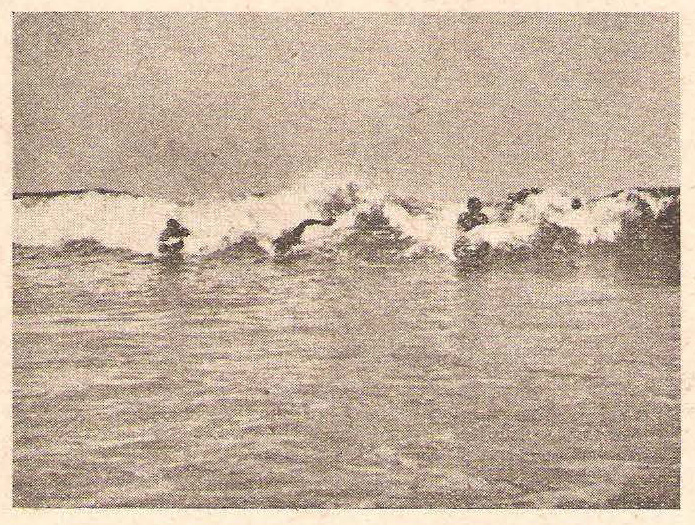
Not
withstanding my poor reading and comprehension of French it appears
that paipo/belly board surfing has been practiced along the coast of
Senegal for quite some time (a friends says the article suggests that
surfing on wooden boards in Senegal existed centuries ago.
|

Many thanks to Hervé Manificat for this article. Translation assistance needed!
|
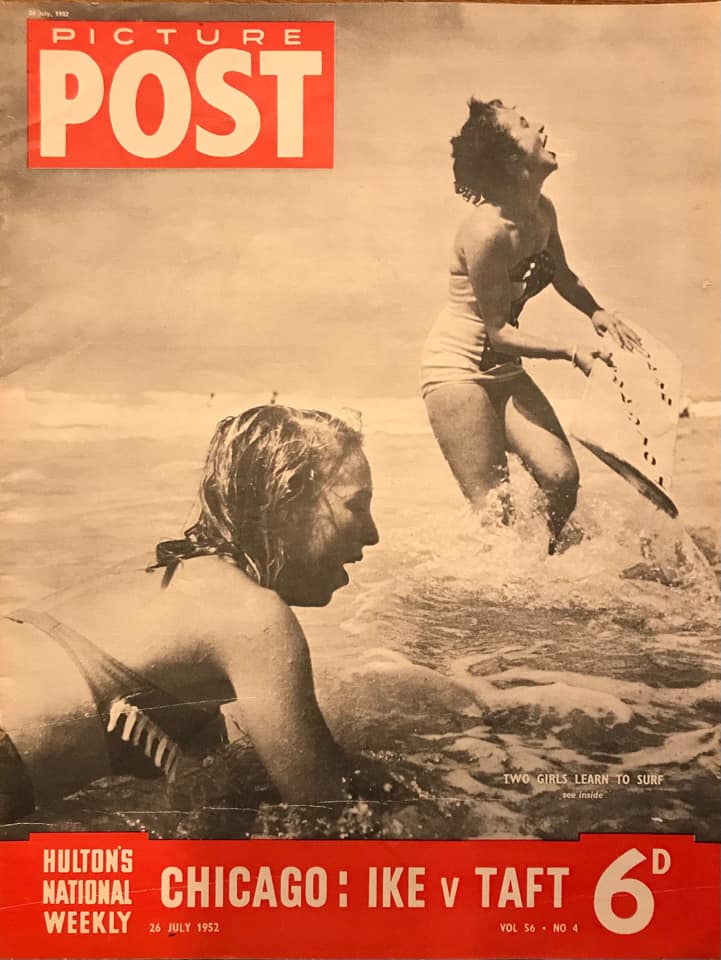
Kev Saunders contributed the cover
page shown above. On the right,
Steven Halpin contributed the image
starting this post.
|
|
|
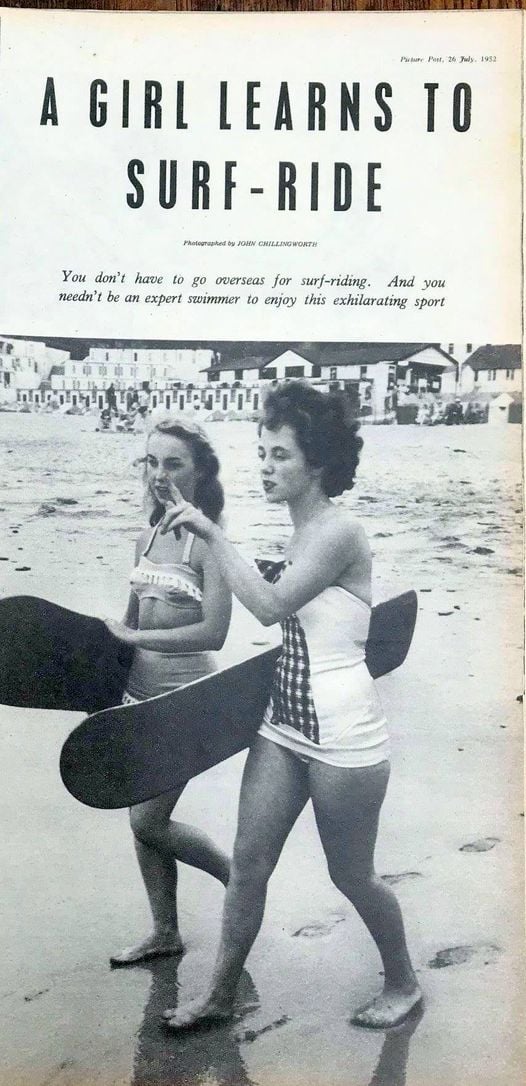
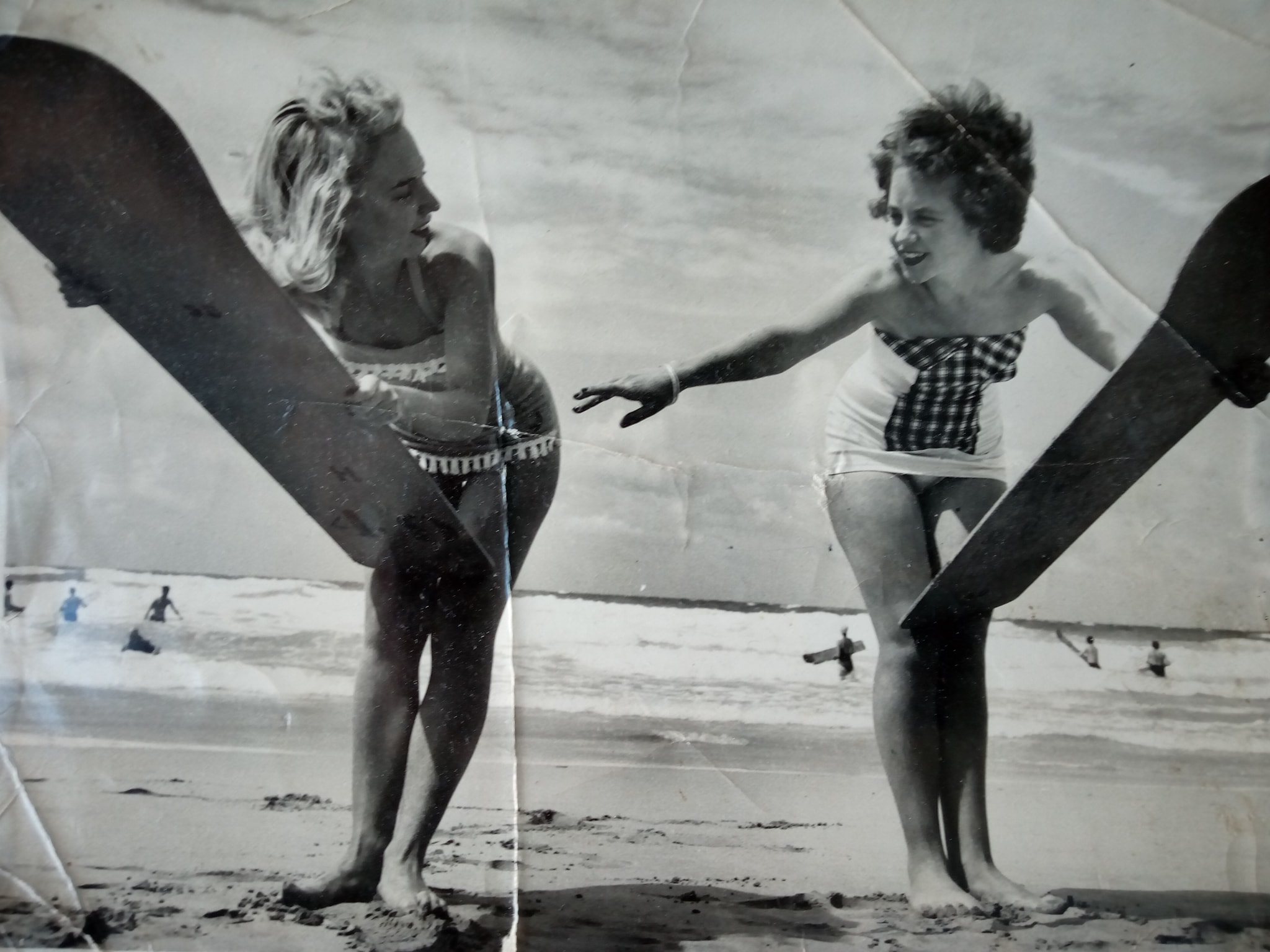
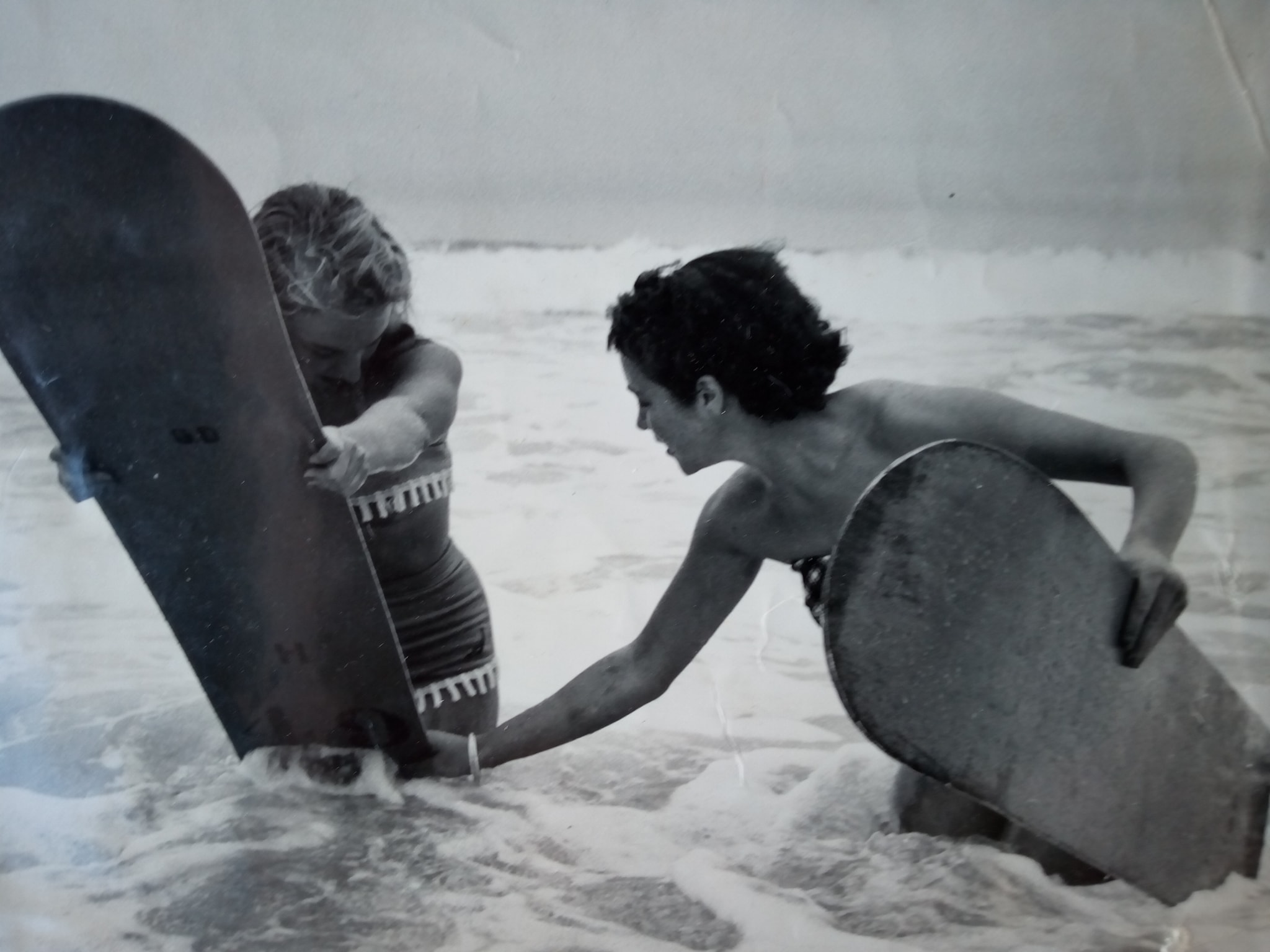
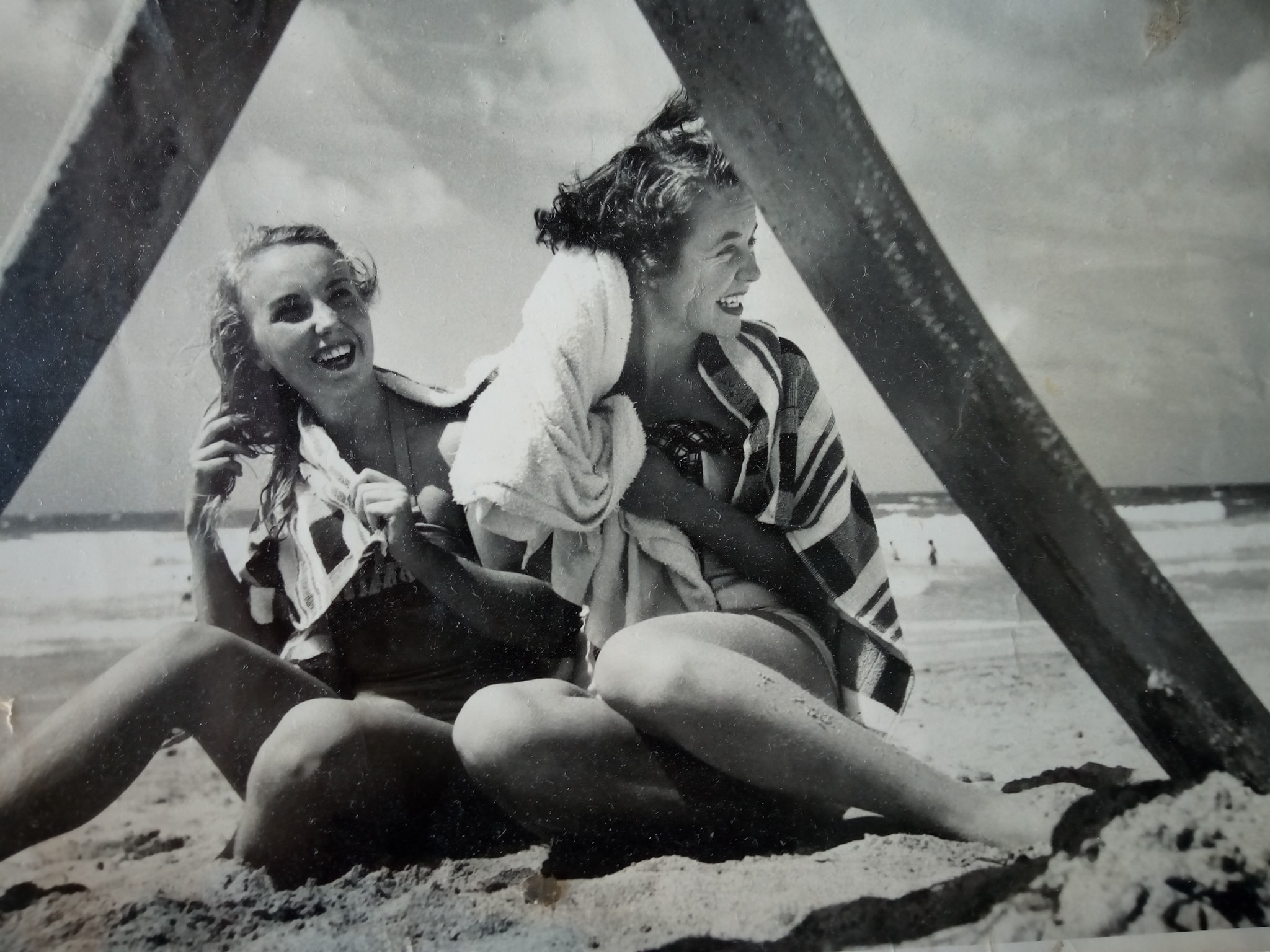
Alan Williams posted in the thread, "That's my Mum on the right. The
camera crew were all wearing Overcoats, like people in the background!!
Used in Picture Post magazine, a big deal back then. There's a cover
shot to go with it. Classic bit of Newquay and Surfing history. I'll
dig out my stash...."
Alan Williams contributed several other images in
the thread including the ones shown below.
|
Land lesson advances to in-the-water tips.
 
Preparing to launch onto a wave... leading to post-surfriding bliss.
 
|
- Unknown.
(1953, August). Making Your Own Surf Board. Woodworker, LVII(717),
158-159, 145.
Thanks
to Henry Marfleet for this contribution.

|
|
An article on making your own U.K.-style bellyboard, with
and without nose rocker.
Wood types are suggested along with board lengths and how to build
rocker into a board. The boards also feature finger grips and and a
strip of wood on the rear bottom of the board to prevent wear from
scraping along the sand.
From the article,
"One
of the pleasures of a holiday on the North Cornish coast is surf board
riding. Although surf boards can be hired, readers who propose to spend
a holiday in this part of Britain may like to make their own. The only
part of a board that may involve some difficulty is the slight upward
curl towards the front, though this curve is not absolutely necessary.
To anyone familiar with woodworking, the formation of this curve should
not prove an insurmountable obstacle. One real difficulty may well be
the obtaining of suitable material of the right size, in which case it
would be better to purchase a board rather than to use material, which
would prove unsatisfactory."
Click here to read a PDF
version [500KB] of the article.
|
- Teenagers' Weekly cover photograph]. (1962, August 22). The Australian Women's Weekly, 30(12), 39 [cover page for Supplement: Teenagers' Weekly, p. 1]. Retrieved May 10, 2015, from http://nla.gov.au/nla.news-article41860039
Thanks
to Bob Green for this contribution.

|
|
Caption:
"Our cover boys are some of the surfboard riders who competed at
Narrabeen, one of Sydney's northern beaches, during the rally organised
by the South Pacific Surf Riders' Club last season." [Teenagers' Weekly,
p. 3.]
In
the center of the back row is a lad in white trunks holding a twin-fin
paipo. Bob Green suggests it could be the same lad in white trunks
pictured in the Oct. 3, 1962, photograph below ("A Dream of Summer").
There might be another paipo board in the second row, second lad from
the left. Although it is difficult to determine the length of boards
laying on their sides, front to back, this board appears to have a red
handle... it just doesn't look like a logo or art work to me.
Note: Teenagers' Weekly was a supplement to The Australian Women's Weekly.
|
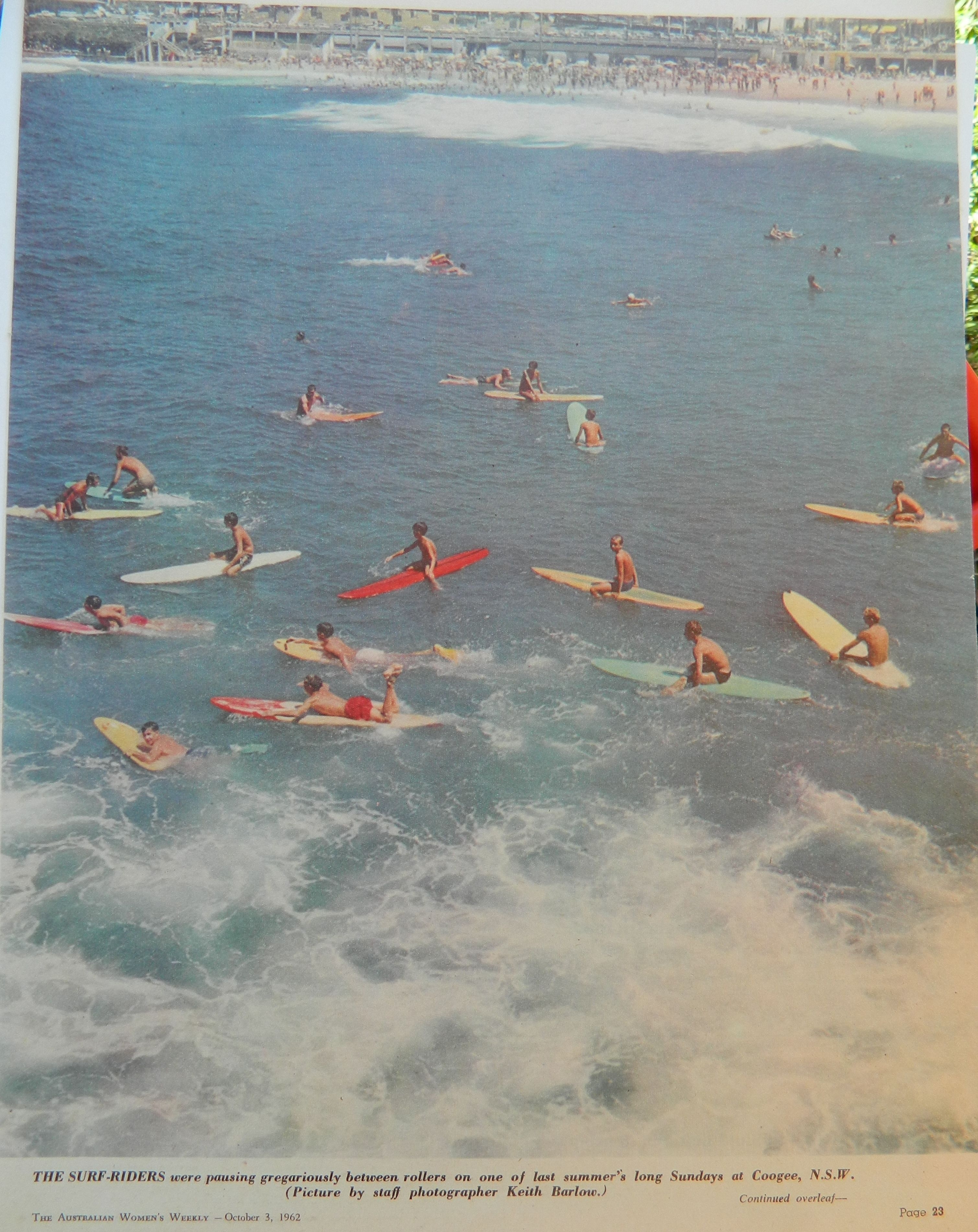
- Barlow, Keith. [Photographer]. (1962, October 3). A Dream of Summer. The Australian Women's Weekly, 30(18),
23.
Thanks
to Bob Green for this contribution.

|
|
Caption: "The surf-riders were pausing gregariously between
rollers on one of the last summer's long Sundays at Coogee, N.S.W."
At first
glance I only noticed the paipo boarder in the botttom left of the
photograph. After fully opening the photograph I saw the paipo boarder
that Bob Green referred to in another pic (note the wood handles). At
least four other prone riders are pictured but I can't determine what
kind of prone craft they might be upon (e.g., paipo, surf mat, coolite, lamaroo, surfoplane).
|
- Pedersen, M. J. (1966, April).
Surfboard for Sand and Sea. Popular Mechanics, 125(4), 98-99.

(Click on figure to see a
larger view of the belly riders.)
|
|
A combo sand, snow, or surf board. Excerpts from the article
appear below:
"It's
just as easy to ride down the slope of a sand dune as it is to ride the
crest of a wave with a new lightweight fiberglass "surfer."
The
multi-use surfer is really a thesis that was done by a UCLA student in
his industrial design studies.
The
board is five feet, eight inches long and weighs between 12 and 13
pounds. Runners on the bottom make it usable on sand and snow while an
aluminum skeg is attached to the bottom when the board is to be used in
water."
Many thanks to Poobah for
identifying this article. |
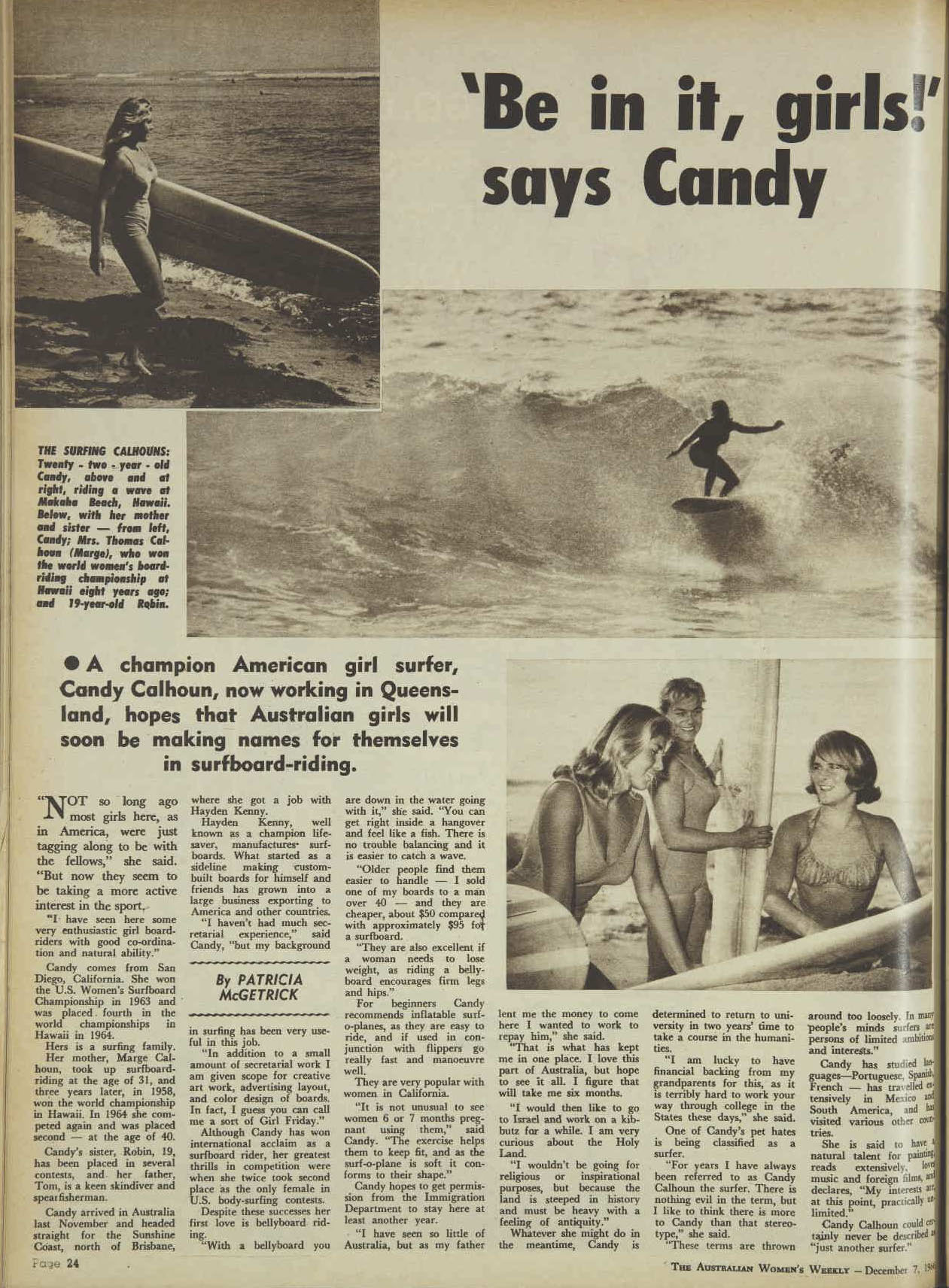
- McGetrick, Patricia. (1966,
December 7). Be in it, girls! The Australian Women's Weekly, 34(28),
24.
Retrieved December 1, 2010, from National Library of Australia website:
http://nla.gov.au/nla.newspage4902618
(or http://trove.nla.gov.au/ndp/del/page/4902618).
 |
|
An article on Candy Calhoun, an all-around accomplished wave
rider, loved the paipo.
Of special note is this excerpt from the article:
Although
Candy has won international acclaim as a surfboard rider, her greatest
thrills in competition were when she twice took second place as the
only female in U.S. body‐surfing contests. Despite these successes her
first love is bellyboard riding. "With a bellyboard you are down in the
water going with it," she said. "You can get right inside a hangover
and feel like a fish. There is no trouble balancing and it is easier to
catch a wave. "Older people find them easier to handle - I sold one of
my boards to a man over 40 - and they are cheaper, about $50 compared
with approximately $95 for a surfboard."
Click here different file
format versions of the article: PDF,
image
or a text
[in PDF].
Note: The text version Includes an editor's reference note
on the surfo-plane. |
- Gilmore, Roland. (2010,
October/November). Riding the Plank. Hana Hou: The Magazine of
Hawaiian Airlines, 13(3), 25. Retrieved June 3, 2011, from http://www.hanahou.com/.

|
|
An article on author and paipo rider, John Clark, and his
soon to be released book, Hawaiian Surfing Traditions from the Past.
Click here for a PDF
version [500KB] or text
only version or the article. |
|
Also see
my Bibliography
for Paipo Research, Annotated
Bibliography and
General
Acknowledgments, Sources, Places, Citations, Contributors...
|
MyPaipoBoards.org
recommends EasyBib for easily generating
citations
href="http://www.easybib.com">bibliography maker.
|
|