My Paipo Boards and...
More
(for those of us who are prone to ride)
Visit the Paipo
Discussion Forums (you can still view but not post at the
original Forums ).
"Where paipo boarders gather to
discuss their boards and
share ideas."
|
Table of Contents |
|
|
|
|
|
|
|
|
|
On Display at the Surfing Heritage & Culture Center
Alternative Wave Riding Equipment
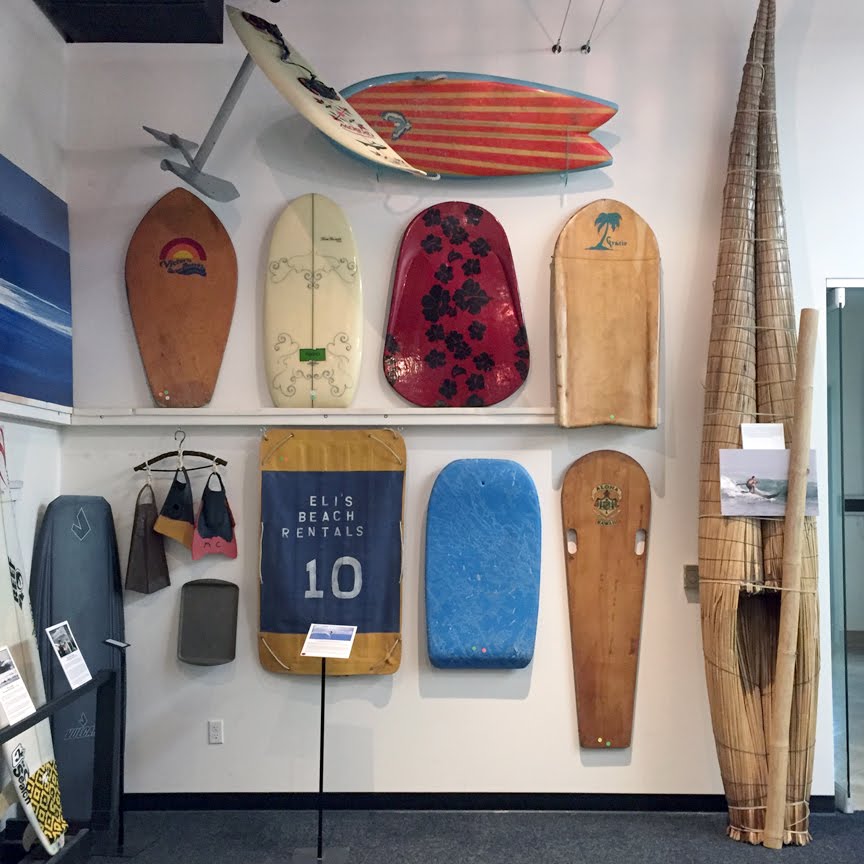
SH&CC Caption:
One of Laird Hamilton's hydrofoil boards, a Dyno kneeboard, a '70s
Victoria Skimboard, a '60s "Paipo" bellyboard,
a Hawaiian plywood, fiberglass and resin paipo, a balsa twinfin bellyboard, some swim fins (including 1 of Mark Cunningham's),
a McDonald's tray, a canvas mat (good for rashes from neck to knees), an early Boogie Board, a Hawaiian bellyboard (popular with
visiting tourists in the '30s, '40s & '50s), and a Peruvian Caballito de Totora. We'll be adding a handplane soon as well.
On display ca. October/November 2015. For more information, visit the Surfing Heritage & Culture Center.
|
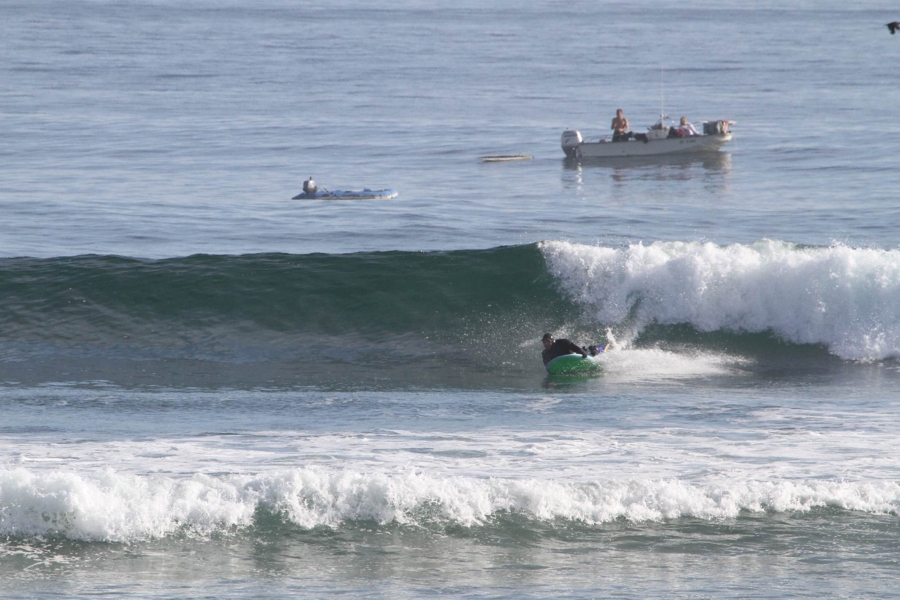
Unidentified paipo surfer at Maria's Point, Rincón, Puerto Rico, March 18, 2016. Looks like a foam/glass
board and the rider is wearing a pair of DaFins swim fins and paddling gloves. Photo by Jim Crotty.
|
 Jeff Chamberlain test riding his
newest board, "Mega Platter," one of many in his paipo experimentation
adventure.
Jeff Chamberlain test riding his
newest board, "Mega Platter," one of many in his paipo experimentation
adventure.
Features: EPS epoxy 6'3" x 29" x 3-3/8" with huge double
concaves, and a Futures quad system.
Somewhere in Central
California. December
2013.
Learn more about his adventure in our paipo
interview with Jeff.
|

John
Galera, "Pastures," 12/19/10. Keeping the sacred art of paipo boarding
alive and well.
Photo courtesy of Neal Miyake.
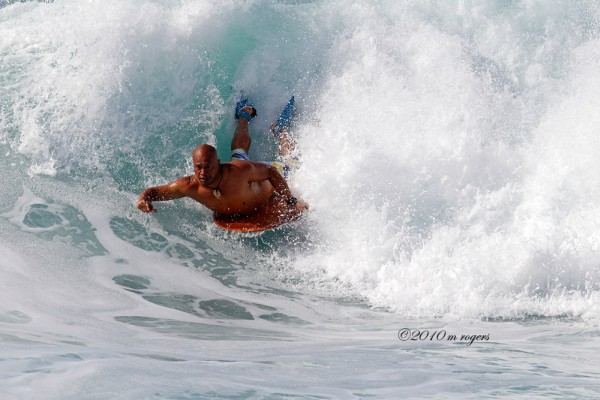
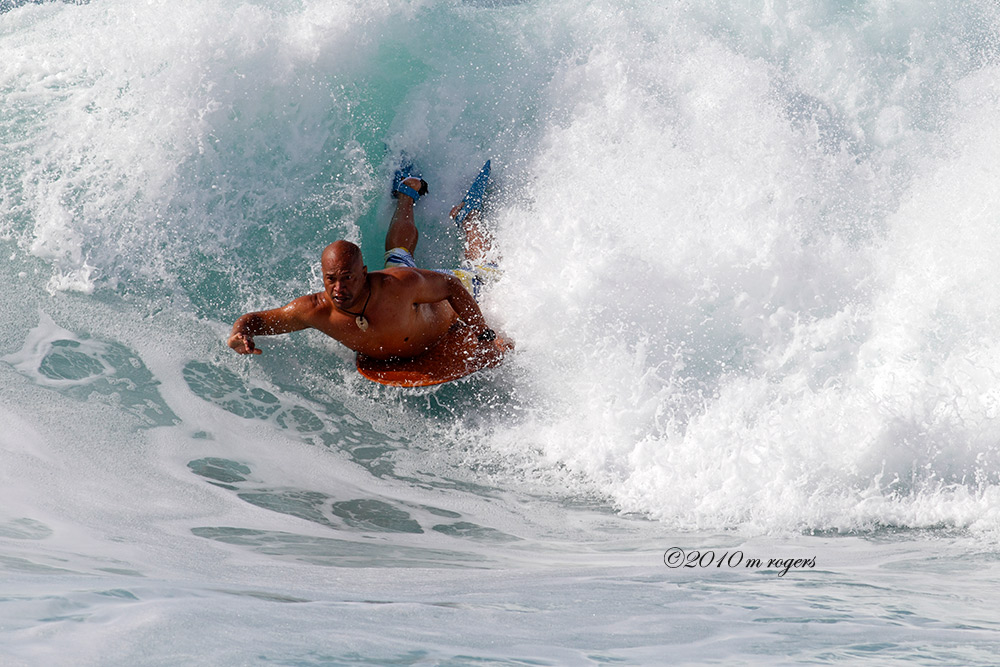
Classic pae
po`o riding by Jarrett
K. Liu -- Point Panic -- March 20, 2010.
The board is a
custom wood laminate with a steamed spoon in it, but Mike didn’t know
whether
Jarrett made it or got it from someone else. Photo courtesy Mike
Rogers Photography. R.I.P Mike, Jan 18, 2011.
|
|
Other
Paipo Boarding Links of Interest |
|
pods for primates: a catalogue of surfboards in
australia since 1900
|
|
|
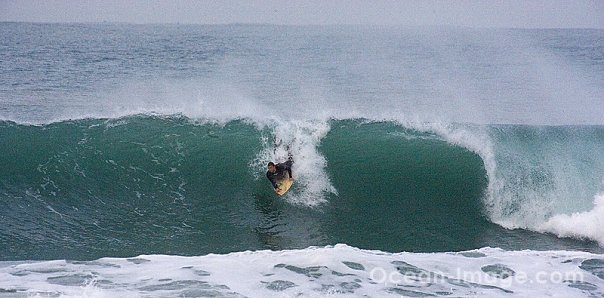
John Nevin riding
a hollow, finless balsa paipo at Porthmeor, St Ives in
Cornwall. Andy Bick's (Paipo Glide)
first built of this type.
Balsa sourced locally - grown in the Eden Project Tropical
Biome (giant greenhouse). Photo by Mike Newman of Ocean-Image.com
|
|
|
*** This site is a new domain (URL) - https://MyPaipoBoards.org - Please
update your bookmarks ***
*** Note: For now the paipo forums are still
being hosted at www.rodndtube.com (see the link below) ***
WHAT
IS
A PAIPO?
In Hawaiian ancient times: papa li`ili`i »
Also in ancient days: kioe »
In modern days (ca. 1900) there
were two terms:
1) used by Hawai`ian sufers: papa pae po`o » pae po`o » paepo`o » paepō
(pae po) » pai po » paipo
2) used by
non-Hawai`ian surfers: bellyboards
Collectively these types of surf riding boards are "bodyboards."
papa li`ili`i
is pronounced: papa
lē-hē lē-hē (Spanish phonetically, papa lí-ji lí-ji)
Paipo (pī-pō,
or Pie-Poe, or my favorite "pipe-oh," as "in the Pipe," "Oh,
yeah") is a
Hawaiian
word designating a short or small board.
Source: Surfing, "Paipo: It's not
how long you make it..." by Skip Newell,
Vol. 3, No. 1, pp.56-59 (Jan/Feb 1970)
The Term Paipo?
The term "paipo" may be derived from the clandestine
Hawaiian word, paepō, as told in the following mo‘olelo
(or, story):
I was born on September
15, 1905, and I'm a cousin of Bill Sproat... I have two papa paepō
in my artifact collection. They're two small concave boards about
1/4-inch by 1 foot by 3 feet made of wiliwili,
and they were used for spying. The spies selected a night with rough
seas and then surfed in to gather information about various activities.
The boards were easily concealed. I heard this from the old people and
they said that's why the boards were called paepō, "night
landing."
- Alfred Solomon, June 25, 1982 |
| Source: page 302
in Hawai'i Place Names: Shores, Beaches, and Surf Sites, By
John R. K. Clark, published by University of Hawaii Press, 2002. See
the image
captured
here from the book. Turns out that John Clark rides what appears to
be a paipo board as pictured in a Q&A with him on the blog, Literary
Lotus
(author, Christine Thomas). He is also an avid bodysurfer and one of
the founding fathers of the Sandy Beach Bodysurfing Championships in
1972, and was the head judge (and a competitor) until 1989. |
In John R. K. Clark's research
he traced some of the possible
transition to the modern day usage (at least sometime in the 1950s
through the present) of the word, paipo, to describe the method of
riding waves on a board prone style:
| "In the days of old,
Hawaiians referred to bodysurfing as kaha (or kaha nalu)
and pae (or paepo'o). During the early 1900s, the term paepo'o
was commonly used in Waikīkī, and it meant riding a wave with only the
body. After World War II, this particular word took on an alternate
definition, referring to bodysurfing with a small board. The
pronunciation of the original word, paepo'o, was altered, and
now even the spelling is changed to paipo. Today "to paipo" means to go
bodysurfing with a "bellyboard." The board itself is called a paipo
board." |
| Source: page 9 in
The Beaches of O'ahu, By
John R. K. Clark. Published by Honolulu: University Press of Hawaii,
1977. [There is also a 2005 Rev. ed, Beaches of O'ahu. Honolulu:
University of Hawaii Press.] |
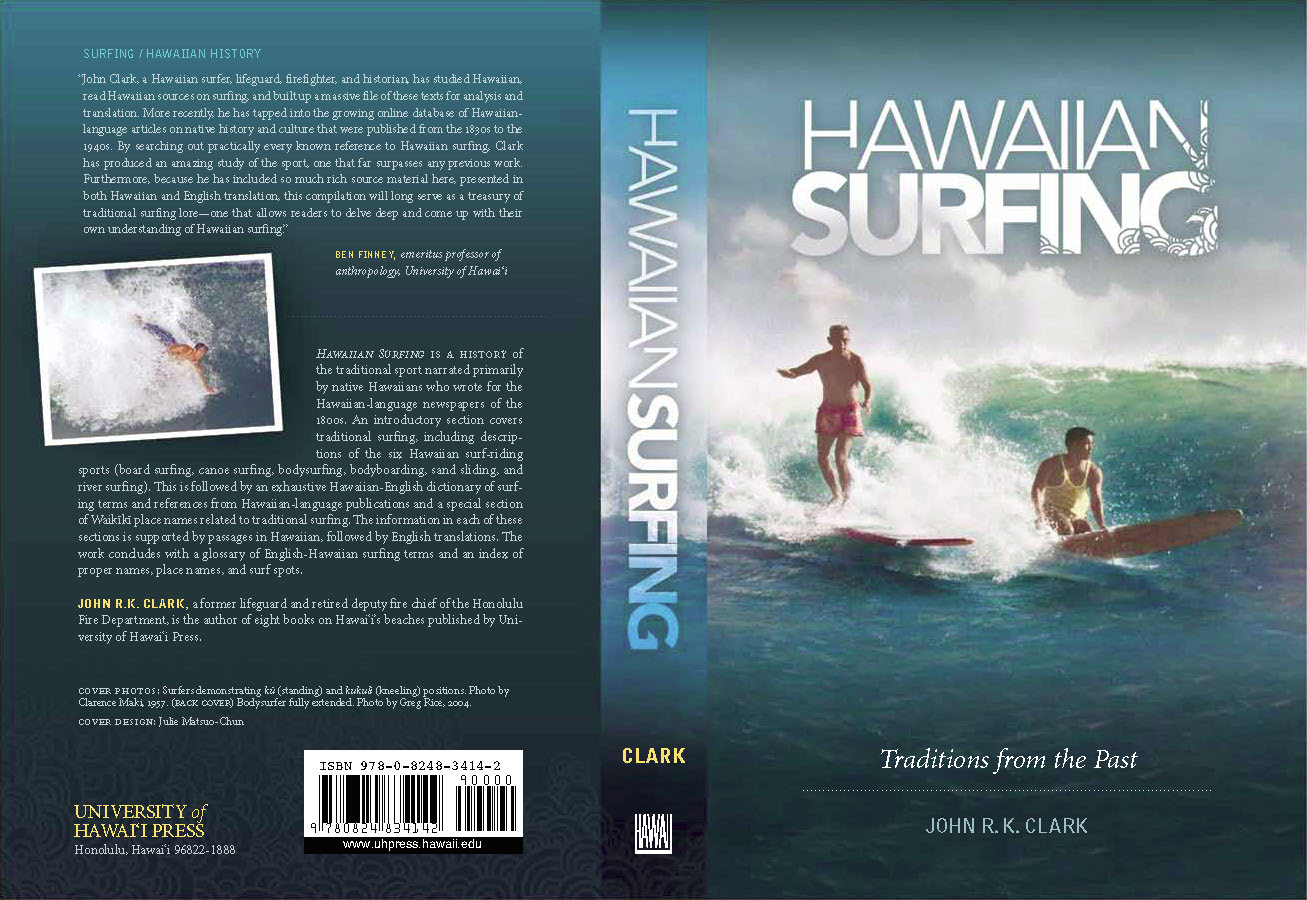
In Hawaiian
Surfing: Traditions
From the Past, John R. K. Clark
identifies
and describes the types of surfing that native Hawaiians did, one of
which was pae po'o, or prone board riding. He notes that while
it's true that "paepo" can be translated as "night landing" (as
noted in the mo‘olelo by Alfred Solomon), Clark has since
learned that the original word was actually "pae po'o". The
following is from the manuscript:
In the earliest
descriptions of surfboards by Hawaiian scholars, the
smallest boards, those that were shorter than six feet in length, were
generically called papa li`ili`i, or "small boards." During the
early
1900s, the name papa li`ili`i was changed on two fronts with
non-Hawaiian surfers calling them bellyboards, because they were most
often ridden prone, the rider laying on his or her "belly," and with
Hawaiian surfers in Waikiki calling them pae po`o boards.
Pae po`o is an
interesting word. It does not appear in any Hawaiian
dictionaries, Hawaiian language newspapers, or writings of the
prominent Hawaiian scholars of the 1800s, such as `I`i, Kamakau,
Kepelino, and Malo, who described traditional Hawaiian surf sports. The
term appears to have been coined by Hawaiian surfers in Waikiki circa
1900, where it was commonly used to mean bodysurfing or bodysurfing
with a small wooden bodyboard. The literal translation of pae po`o
is
"ride [a wave] head-first", or in other words, bodysurf, and a papa
pae
po`o was a bodysurfing board, or what surfers today call a
bodyboard.
|
|
|
In everyday conversation, pae po`o was
often shortened to pae po, which
is common among Hawaiian words that end with double "o's," such as Napo`opo`o
on the island of Hawai`i, which is often pronounced Napopo.
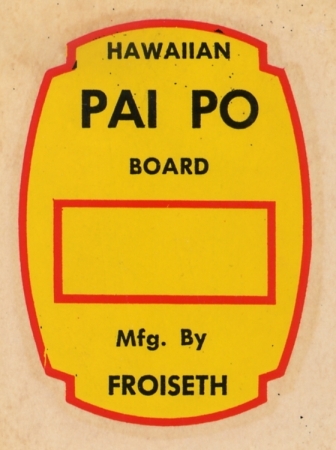
The popular spelling used today, paipo, was coined by Hawaiian surfing
legend Wally Froiseth, who, besides being an excellent surfer, was an
exceptional paipo board rider who was famous for standing on his
twin-fin board while riding big waves. From 1956 to 1986, Froiseth made
approximately 150 paipo boards, which he sold to friends and other
surfers, putting a decal on each board to identify it as his product.
No one before him, however, had ever spelled pae po, so without
the
benefit of seeing the word in print, Froiseth spelled it as he heard
it, pai po. His decals read, "Hawaiian Pai Po Board. Mfg. by
Froiseth."
Froiseth sold some of his boards to surfers from California, which
helped to introduce the word and its spelling outside of Hawai`i, and
today paipo is the accepted term for wooden bodyboards.
|
|
|
Source: Clark,
John R. K. 2011. Hawaiian
surfing: traditions from the past. Honolulu: University of
Hawaiʻi Press.
|
Additional note by John Clark: "Wally made
his first Hawaiian Pai Po Board in December 1955, but he
didn't like the way it rode. He re-designed it early in 1956 and
applied for a patent on it on May 9, 1956. The decal was used only on
his paipo boards, not on his surfboards. Wally and
many other Waikiki surfers from the
early 1900s, especially native Hawaiians, used the term paipo to
mean both
bodysurfing and bodyboarding." Source: John
Clark e-mails of June 2009.

|
|

Thanks to John Clark for an original Pai Po decal. |
Photograph
courtesy of Malcolm Gault-Williams, from
the chapter, Wallace "Wally" Froiseth: Legendary Hot Curl Surfer,
in Legendary Surfers: A Definitive History of Surfing's
Culture and
Heroes, By Malcolm Gault-Williams. Updated: 10 April 2005, accessed
on the Internet on June 19, 2009. Also see The Surfer's Journal,
Volume 6, Number 4, Winter 1997.
Wally
Froiseth holding one of his
paipo boards
 |
|
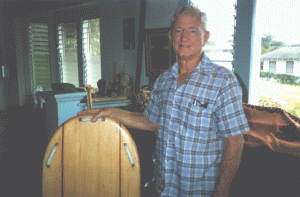
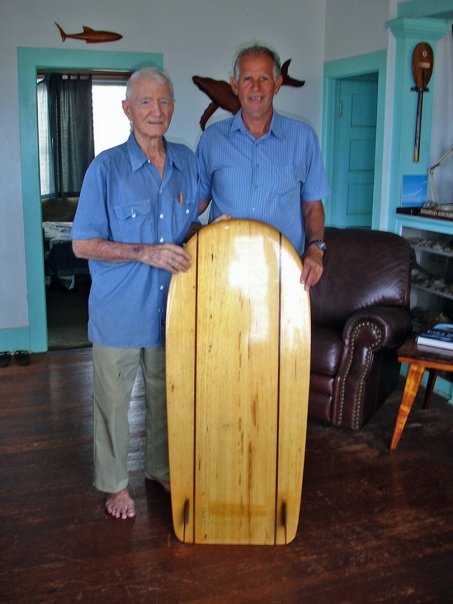
Wally
Froiseth and Bud Scelsa holding one of Froiseth's 1950s Pai Po boards.
 |
|
Wally
Froiseth with his 1954 balsa/redwood
twin fin paipo and Bud Scelsa with his 2012 wiliwili/koa paipo. Wally
rode his board standing up and Bud rides kneeling. September 8, 2012.

Photo courtesy of John Clark and Bud Scelsa.
|
|
|
|
The Redwings Memorial Contest also uses the term paepo board.
For the purposes of the contest it defines a paepo as "any wave
riding
device with a core of natural materials that is less than 55 inches
(140 cm) long and is used without a leash or skegs."
An article in Surfabout Magazine states that the name Paipo is
derived from the Hawaiian word Paepae which means "in a
slapping manner." (Source:
Unknown. (1965, Summer). Belly Boards. Surfabout:
Australasian Surfer, 3(1), 44.) [Editor's Note: Upon checking
the Andrews Dictionary and the Hawaiian Dictionary via
the http://wehewehe.org on-line electronic dictionary site and a hard
copy of Hawaiian Dictionary,a
I could not find a convincing reference for "slapping manner" although
the third bullet belows references "to flap of shake, as a sail." Some
definitions follow:
- pae.pae. 1. nvt. A support, prop,
stool, pavement, house platform; plate of a house on which the rafters
rest; block to keep an outrigger float off the ground; log or wooden
horse that supports a seesaw; to support, hold up, sustain; rows. 2.
Redup. of pae 2. hoʻo.pae.pae Redup. of hoʻopae. 3. n. Boom of a ship.
Cf. kaula paepae. 4. Same as iwi ʻaoʻao. (Hawaiian Dictionary)
- pae. 2. vi. To land, disembark, come
ashore; to mount or catch a wave, as of a surf rider; washed or drifted
ashore. Pae i ka nalu, to ride a wave into the shore. hoʻo.pae to cause
to land, reach shore. Hoʻopae malū, to smuggle, bring in secretly.
(Hawaiian Dictionary)
- pae. v. To flap or shake, as a sail; to
turn one side or be loose, as a tooth. (Andrews Dictionary)
- hoo-pae. v. See pae, to go ashore. To
cause to arrive at land; to go ashore from a canoe, boat or vessel.
(>Andrews Dictionary)
- hoʻo.pae. See pae, cluster, and pae, to
land. (Hawaiian Dictionary)
a Elbert, S. H., &
Pukui, M. K. (1986). Hawaiian dictionary: Hawaiian-English,
English-Hawaiian. Honolulu: University of Hawaii Press.
Also known in Hawaiian as kioe,
a
body
board,
or belly board, from 2-to-4 feet long, ridden in the prone position.
These boards were often made from breadfruit tree wood. The
Hawaiian Dictionary defines a kioe as "a small surfboard."
Sources:
Legendary
Surfers, "Surfing's
Origins" by Malcolm Gault-Williams, Chapter 1.
Pukui, M. K., & Elbert, S. H. (1986). Hawaiian
dictionary: Hawaiian-English, English-Hawaiian. Honolulu:
University of
Hawaii Press.
Early Period
Paipo Riders
Checking the Line-Up and Riding the Wave
|

This famous image is often mistaken for being a surfrider holding a
paipo board. It is really an alaia board which was
most likely
ridden in the standing position. Alaia boards were also ridden
in the sitting, kneeling and prone positions. For a similar image of a
surfrider holding a paipo, see this very
different board.
|
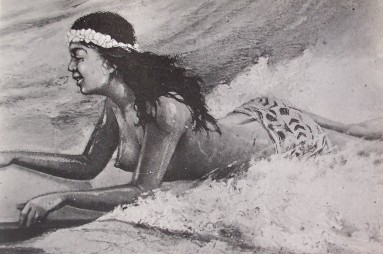
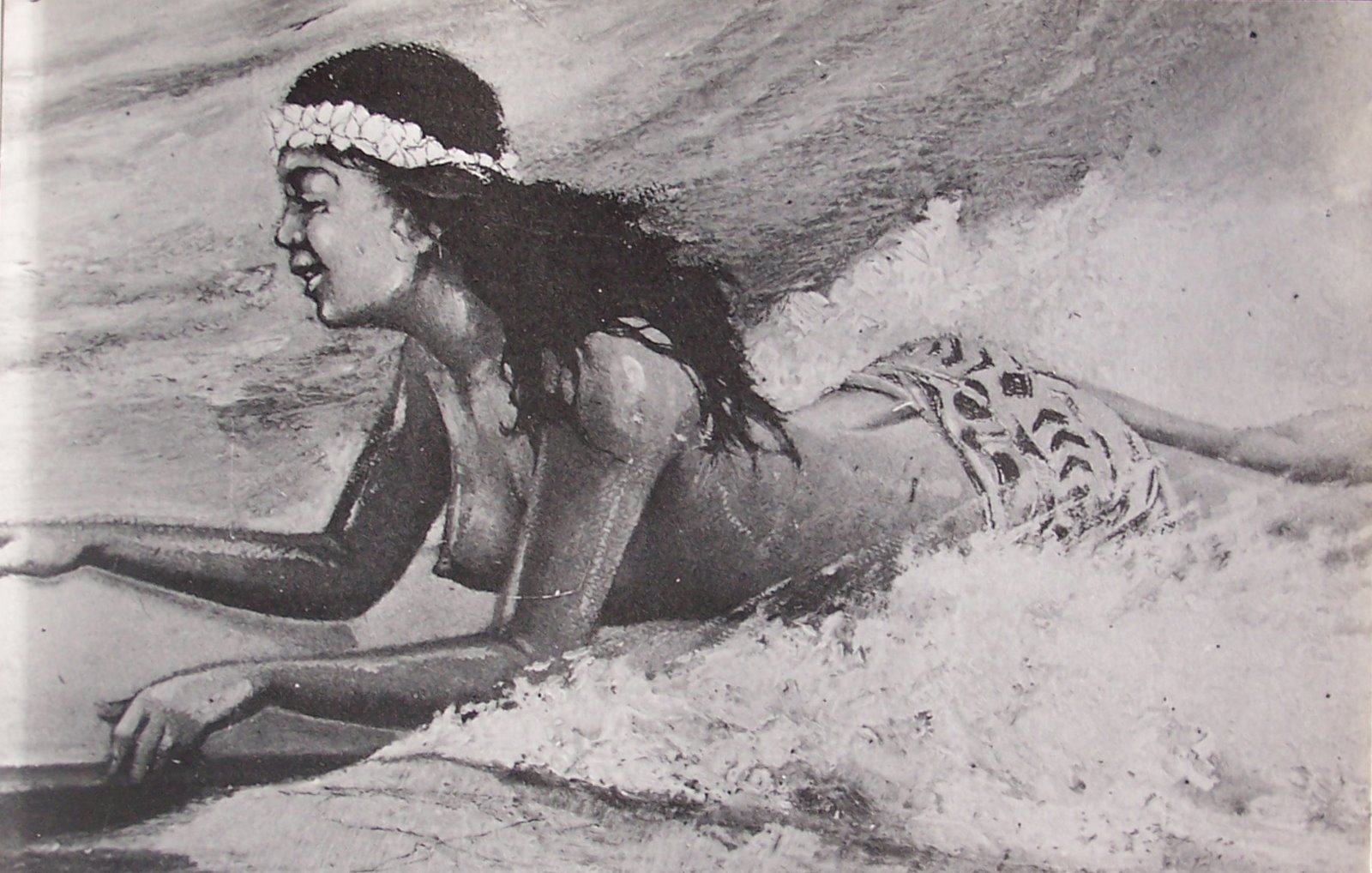
Is this a girl or a woman? This Hawaiian paipo surf rider is most
likely a woman most of us would agree. Why is this important
you might ask? Surf historians of the 20th Century often stated
that paipo boarding was for children and adults rode foot boards.
|
Sources: See the Paipo Annotated Bibliography. The image
on the right appears in: Margan, F., & Ben R. Finney. 1970. A
pictorial history of surfing.
Sydney: Hamlyn. [page 25]. The book's caption reads, "An early painting
of an Hawaiian girl riding a surlboard in the pre-missionary days."
|
|
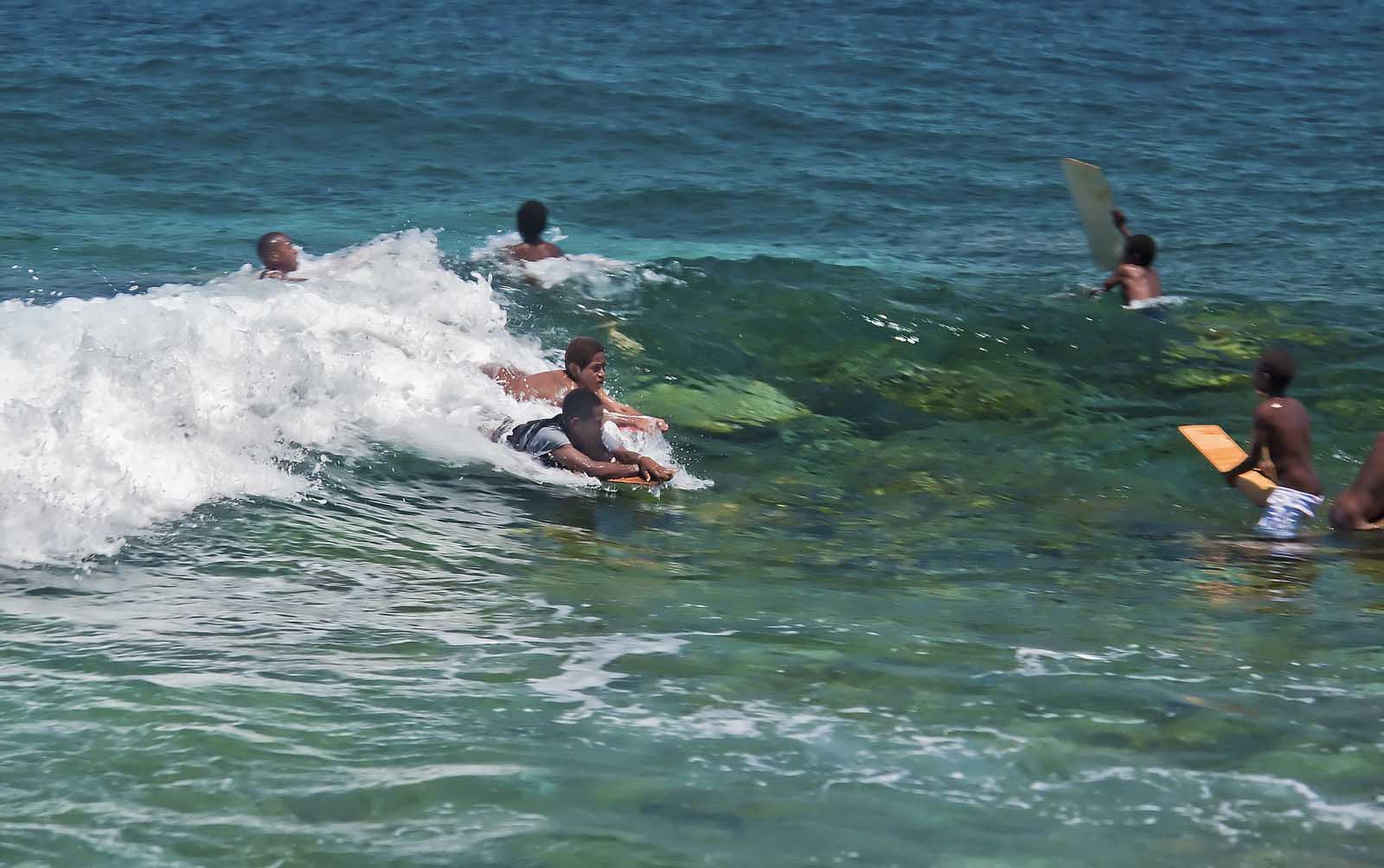
Some Contemporary Paipo Riders in
Papua New Guinea

Of course, that doesn't mean kids can't have fun on
planks of wood to shoot the curl!
Photo courtesy of: Jan Messersmith
The caption that accompanied the photograph: "It’s still a bit breezy
here in our belated dry
season. The kids were
surfing along Coronation Drive again today. I
stopped for a few minutes and got some better shots than I did the
other day. Have a look at these little guys zooming in on those little
pieces of plywood. They were getting nice
long runs too. Also check how
shallow the water is."
Source: Jan Messersmith,
posted on 2009/08/24/, and accessed on 6/17/2012, from the his blog " Madang
- Ples Bilong Mi".
|
The Earliest Descriptions of Surfing are
of
Paipo Boarding!
One of the most
famous and widely cited early descriptions of surfing by European
explorers is by Lt. James King:
"But
a diversion the most common is upon the Water, where there is a very
great Sea, and surf breaking on the Shore. The Men sometimes 20 or 30
go without the Swell of the Surf, & lay themselves flat upon an
oval piece of plank about their size and breadth, they keep their legs
close on top of it, & their arms are us'd to guide the plank, they
wait the time for the greatest Swell that sets on Shore, &
altogether push forward with their Arms to keep on its top, it sends
them in with a most astonishing Velocity, & the great art is to
guide the plank so as always to keep it in a proper direction on the
top of the Swell, & as it alters its direction. If the Swell drives
him close to the rocks before he is overtaken by its break, he is much
praised."
Source: Lt. James King, 1778, Kealakekua
Bay, Hawai`i,
from King’s unedited log of 1778. Reprinted in "The Voyage of the
Resolution
and Discovery," by John C. Beaglehole (1967); as quoted in "Surfing,
a
History
of
the Ancient Hawaiian Sport," by Ben Finney and James D.
Houston
(1996, Pomgranate Artbooks, San Francisco).
Surfing's Origins: Some Thoughts and Opinions of Surf Historian Malcolm Gault-Williams
Malcolm Gault-Williams writes a short op-ed on the
origins of surfing leading into his living on-line book, Legendary
Surfers, his chapter "The First Surfers."
Read Surfing's Origins first: https://legendary-surfers.blogspot.com/2022/02/surfings-origins.html (or in PDF format)
The read The First Surfers: https://legendary-surfers.blogspot.com/2017/03/the-first-surfers.html
Source: Gault-Williams, Malcolm (2022, February 19). Surfing's Origins. Blog Post. Retrieved from [Link] and
(click on pic for
a
larger version)
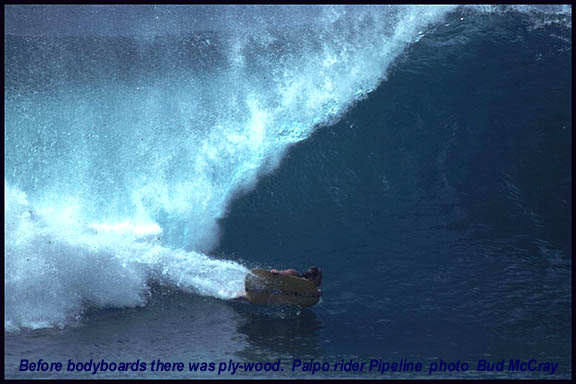
Paipo rider named
Sean Ross
having fun at the
Pipeline. He is
riding one
of Paul Lindbergh's
Hawaii
Paipo Designs boards. Sean was a life
guard at the Ehukai
Beach
(Pipeline) for years
in the 1970's.
Photo: Alan McCray,
Hawaii. |

John Galera riding
his NOFIN
paipo at Jocko's on
Oahu's North Shore,
January
2003. John's boards
are
make of
surfboard
foam or balsa.
Dimensions:
56"X 21"x
5/8". The rails and bottom
have a double layer,
that
creates a channel on the
bottom 9" wide, 1/2"
deep,
no need for a skeg.
Photo by: Jamie
Ballenger |
| Birthplace
of the Paipo Board? |
Forced to migrate into the
vast region by the
push of population and the pull of the horizon, the first Polynesians
arrived
in the Hawaiian Islands in the fourth century A.D. The Polynesians who
made the arduous journey from Tahiti and the Marquesas to Hawai'i were
necessarily exceptional watermen and women who brought a deep love and
knowledge of the ocean with them. The Polynesians who made it to
Hawai'i
also brought their customs with them, including playing in the surf on
paipo (belly) boards. Although Tahitians are said to have occasionally
stood on their boards, the art of surfing upright on long boards was
certainly
perfected, if not invented, in Hawai'i. [Source: From
Polynesia,
With Love -- The History of Surfing From Captain Cook to the
Present,
By Ben Marcus]
While paipo boarding continued its evolution in Hawaii it is not the
only place where the paipo was ridden in ancient times. Research
suggests that paipo boards of one form or another were used by people
in New Zealand (Maori), Peru and Africa. Certainly, Oceania, if not
Polynesia, was the center of wave riding since ancient times and into
the present.
In ancient Hawaiian times "the construction of the few
remaining papa
he'e nalu (pa-pa HAY-ay NA-lu) -- the wave sliding boards of ancient
Hawaiians
-- still show sophisticated parabolic contours, demonstrating a high
degree
of development. Four types of papa he'e nalu rode upon the waves
of long ago. Listed in order of length, from longest to shortest, these
surfboards were the: super-long olo (O-lo), kiko`o (key-CO-oo), alaia
(ah-LAI-ah)
and paipo (pipe-oh) bodyboard. Like the other shorter
boards (alaia) the paipo boards were made from either koa wood or ulu
(breadfruit)."
[Legendary Surfers,
Malcolm
Gault-Williams]
Pictured to the right are examples of the olo, alaia and the paipo
(labeled as a bodyboard) boards commonly ridden in ancient Hawaii,
scaled to height and with illustrative cross sections.
It is not clear to me whether the Bishop Museum or Ben Finney used the
designation of bodyboard in the figure, or the article from which the
figure is taken. In the article, Surfing in Ancient Hawaii,
Finney struggled with how to address and categorize the board used for
riding kipapa
(prone), sometimes calling it a surfboard, an alaia of 5 feet or less,
and at other times as a bodyboard. In his discussion on alaia boards,
Finney states, "The kioe is referred to as a small surfboard."
Perhaps the term kioe was used by ancient Hawaiians in
referring
to the shorter alaia style board that was used for bodyboarding. The
only other mention of kioe in this article is in the glossary (kioe-A
small
surfboard.
[Pukui, Mary K., and Elbert, Samuel H., 1957. Hawaiian-English
Dictionary. Honolulu, University of Hawaii Press. p. 142]).
|
|
Source: Finney, Ben R. Surfing in Ancient
Hawaii. Wellington, N.Z.:
Journal of the Polynesian Society. Vol 68 No.4, Dec. 1959. pp.
327-347.
Accessed on the JPS Internet
site. (Click on pic for a
larger version.) |
The Hydrodynamica Project View of
Paipo Boarding History
The paipo board is the most ancient of the Planing Totems. There are
historic accounts of these boards being ridden prone and while kneeling
from West Africa to Tahiti and of course Hawaii. The paipo’s main
function was as a small board to swim and bodysurf with. In Hawaii the
paipo was the first board kids rode when they began to surf. In Waikiki
during the classic beach boy era from the 1920s through the 1960s paipo
riding blossomed on plywood boards made from the surplus scrap wood of
Honolulu’s 20th century construction boom. The Kuhio beach groin, known
locally as “The Wall” became the epicenter of the paipo scene in the
1950s and 60s. Standing on a paipo was the considered the ultimate at
the Wall, and Hawaiian surfers like Valentine Ching mastered the art of
stand-up paipo in the fifties. From the Waikiki paipo school emerged
some of the most influential surfers of the 20th century: Rabbit Kekai,
Wally Froiseth, Donald Takayama, David Nuuhiwa, Reno Abellira, Eddie
and Clyde Aikau, Jeff Ching, Buttons Kaluhiokalani, Larry Bertlemann,
and many other Hawaiian surfers cut their teeth on paipo boards. This
familiarity with short planing boards helped these surfers played a
major role in the development of the surf/skate style that became
prevalent in the 1970s. [Source: Elwell, John, and Richard Kenvin. n.d.
"Hydrodynamica › Planing Totem › Paipo." Hydrodynamica.
Retrieved November 29, 2010, from http://hydrodynamica.com/totem/paipo.]
Notes: The Planing Totems are a family of surfboards that begin with
the paipo board of Oceana and Hawaii, along with the ancient Hawaiian
alaia. These boards were shorter than the olo boards of Hawaiian
royalty, and were used by the commoners of Hawaiian society. Learn more
about the Planning Totems (http://hydrodynamica.com/totem/)
and the Hydrodynamica film and book project (http://hydrodynamica.com/).
Hydrodynamica is an independent film project dedicated to exploring and
acknowledging the work of Bob Simmons, a brilliant and eccentric
California surfer who died while surfing at Windansea Beach in San
Diego in 1954, and Simmons's groundbreaking surfboard designs
structured around hydrodynamic planing hulls. Also see the Paipo
Research Project's interview
with John Elwell, one of the project's co-founders.
Widespread Myth
"...People called it "Paipo"... It was practiced on wooden boards until
1971 when the modern flexible board was invented by Tom Morey and the
sport
started its path to being one of the fastest growing sporting phenomena
of modern times." As shown below, the paipo evolved from finless
shapes made from wood to fiberglass and foam boards with skegs and then
evolved into the widely popular modern flexible foam bodyboard
shape.
Prone riding craft of today feature all of these designs, materials,
and
combinations, but the contemporary bodyboard dwarfs the others in
popularity.
... The Paipo Board
The Hawaiian paipo board was the ancient equivalent of today's
bodyboard or "boogie board." Examples of the Hawaiian paipo exist as
specimens
L-120-373 and P5019 in the Oceanian Collection of the Museum of
Archaeology
and Anthropology at the University of Pennsylvania. L-120-373 is made
of
either breadfruit or wili wili. It measures 12 1/2" at the nose, 9 1/2"
at the tail and is 56 1/2" long. Its bottom is convex, with shaped
rails,
nose rocker and slightly concave deck.
P5019 is constructed of California redwood, is 16 1/2" at the
nose, 12" at the tail, and is 65 3/4" long. Its shape is similar to a
board
in the Bishop Museum photograph collection of a Hawaiian native in loin
cloth, holding a shortboard horizontally. Waikiki and Diamond Head are
in the background and the photo was taken in the late 1800s. It's
possible
it may even be the same board. [Legendary
Surfers, Volume 1]
Reemergence of
Paipo
Board
In Australia from pods
for
primates (surfresearch.com.au):
+1915 Paipo:
traditional
solid
wood
Hawaiian bellyboard, ridden prone usually by juveniles
.The use of prone craft as an introduction to basic surf skills dates
back
to pre-history and has had many variations. X ANMN#00005796
D 3’9" x 26" [pods
for primates: The Paipo Catalogue: Images]
|
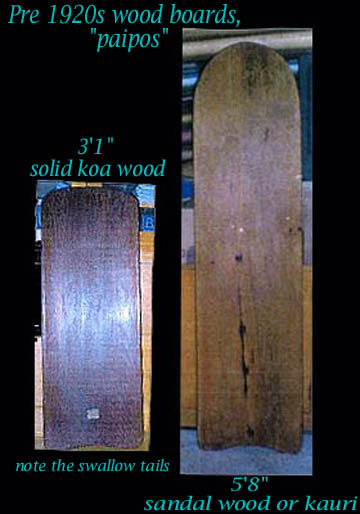
Two
pre-1920s boards
that were for sale by
Jamie Durwood, New
Zealand.
The small board on
the left
is made of Hawaiian Koa wood.
It was left in NZ in
the
20's & has inscribed initials.
The board on
the right
is made of Kaurie wood.
|
1934
Adaptation of paipo design, solid wood with steamed advanced scooped
nose.
Later models used laminated ply, fins (sometimes twin) and sometimes
a nose grip. X Surfworld #17 and #25 [pods
for primates: The Paipo Catalogue]
|
|
|
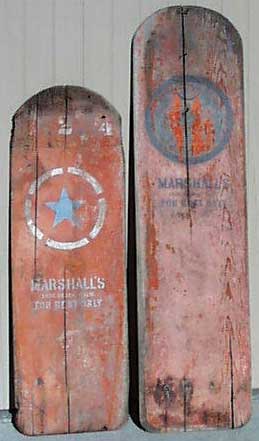
Two rental
bellyboards,
circa 1920's
Long Beach, redwood *
|
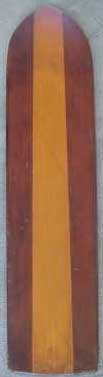
Hawaii
Bellyboard
circa 1930's
pine, redwood rails,
nose rocker *
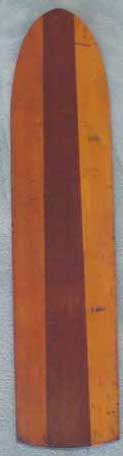
|
Hawaii
Bellyboard
circa 1930's
redwood, pine rails,
nose rocker *
|
* as
shown for
sale at Pacific Coast Vintage
Surf
Auction
2011 Hawaiian Islands Vintage Surf Auction.
The
paipo and alaia boards were listed in the Small Wood Board Set
on p. 5, of the catalog. The description reads, "The earliest of the
Hawaiian boards were little Alai`a boards, which were used as belly
boards. These evolved into the popular boards that were used in Waikiki
and then spread to the US mainland as an easy to rent, easy to ride,
way for anyone to get into the water. Plank boards of the 20’s gave way
to laminated boards of the 30’s and 40’s, yet the popularity of small
wood boards continued right up to the development of foam boards in the
late 50’s."
"Bubble Lady." This solid spruce belly board sold for $3,300.
|

|
|

|
5'0"
1949 (10). This is a neat wood collectable from the 1940’s. A spruce
belly board in all original condition. What I love about this board is
the water slide decal of the “Bubble Lady” and a couple other period
piece decals. Hand holds cut out in each side and finished in full
varnish. Amazingly good all original condition. Pre-auction estimate:
$2500-$5,000�. NO RESERVE. Source: Hawaii Surfing Promotions. (2011,
July). Auction
Catalog: 2011 Hawaiian Islands Vintage Surf Auction. Honolulu.
See page 5 for alaia and paipo boards at auction.
|
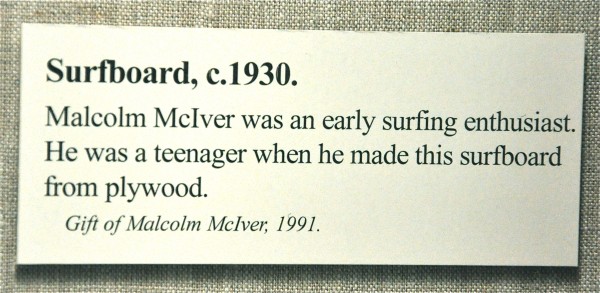
1930s North Carolina Surfing Board -- Harbor Island,
Wrightsville Beach, NC.
Waveriding
board on display at the Cape Fear Museum in Wilmington, NC (June 1930).
The board appears to be approximately 60 inches long and 24 inches wide
(based upon my assumption of a 32-inch baseball bat and scaling the
board).
|

|
|

Warren Overman subsequently e-mailed me: "My impression was it was
shorter than 60 inches, maybe 50 (compared to the waterski) and
narrower than 2 feet, that's why I called it a paipo. I very much got
the impression it was used for prone riding only. It had no skeg and
was really only a cutout piece of plywood. It was grouped with the ski,
bat and a very old skateboard presumably demonstrating equipment used
many years ago on the Cape Fear for recreation. Next time I go to the
Museum I'll ask a curator to give me more specifics."
Upon searching for the Bob Pope slalom ski, I found a 68-inch model
which would support a 50- to 55-inch guesstimate for the surfboard, aka
paipo length.
|
Photographs by Warren Overman.
|
A Postcard of Bodyboarding
North
Carolina,
ca. 1907

Skipper
Funderburg, author of Surfing on the
Cape Fear Coast, recently discovered a 1907
surfing
photo postcard view of people surf bathing on the ocean side of the
Sea Shore Hotel, including
a surfer on a Hawaiian styled body board on Wrightsville Beach. For
more info see the article from Global
Surf News [reprinted as a PDF file here].
Post
card image courtesy of New Hanover Public Library, Robert M. Fales Collection.
See
Funderburg, Joseph. Surfing on the Cape Fear Coast. Carolina
Beach, N.C.: SlapDash Publishing, LLC, 2008.
See more
paipo postcards in Paipos in
the Media.
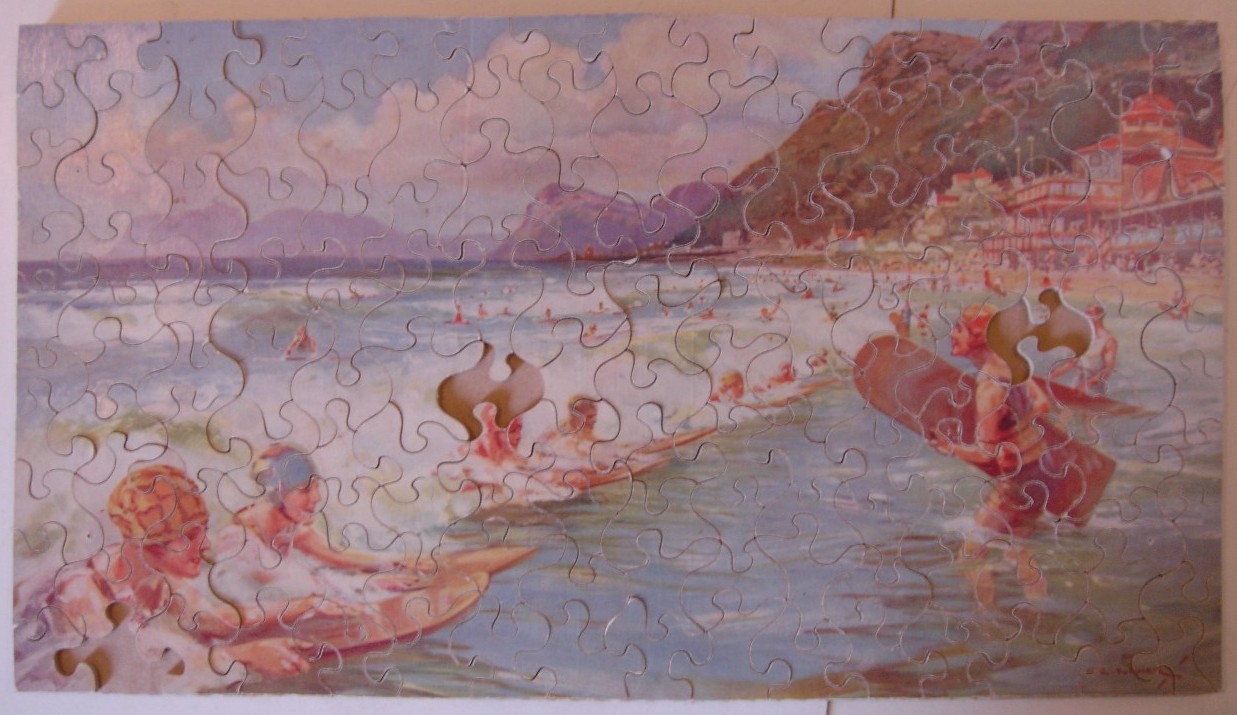
A Jigsaw
Puzzle of Bodyboarding South Africa, ca. 1920s

Jigsaw
puzzle image courtesy of Henry Marfleet, Tunbridge Wells, UK
(Henry is known as "bluey" on the paipo forums)
See more paipo jigsaw
puzzle information in Paipos in the
Media.
Technology
Transition
- Foam, Fiberglass, and Fins (skegs)
In Australia from Geoff Cater's pods
for primates (surfresearch.com.au):
1958 Bodyboard timber and fibreglass adaptation of paipo with more
flotation.
Minimal scoop, often twin fin.
D: 4 ft 6” x 22” In Victoria these boards were sometimes called
a Lamaroo. X Surfworld #26 and #42 [pods for primates:
Fibreglass
and Foam]
1960 Belly/Kneeboard in foam as standard above
[Foam/fibreglass with
redwood stringers, tail blocks, pigment colours, Glass fin in Standard,
Square or Reverse (or Phil or Pixie). X ANMM #;
Surfworld
#20, #22(balsa), #30, #40. Scott Dillon, Jackson [pods for
primates:
Fibreglass and Foam]
See the collection at pods for primates' "the
catalogue: Paipos*" which features a range of non-standing surf
riding
craft (Prone and Kneeling Craft - Paipo, Lamaroo, Bellyboard,
Surf-o-plane,
Coolite, Kneeboard, Spoon, Slab, Mat, Boogie). Additional info
includes: pods
for primates:
the paipo and pods for
primates:
the paipo images.
A tremendous catalogue of fins (skegs) with pictures and
descriptions: Fin
catalogue. Visit this site for some information on skegs: The Surfing
Handbook: Surfboard Fins
A collection of Greg Noll
paipos are shown on this website honoring Greg Noll (http://www.vintagegregnollsurf.com/bellyboards.html).
[click
on the Dextra
and Jeffrey Dale images to see a larger view of the board]
Evolution:
The
Modern Flexible Bodyboard
Surfing innovator and board maker, Tom Morey
of California (also know as "Y"), introduced two new products to the
surfing
world in the 1960s and early 1970s, Slipcheck and the Morey Boogie
Board,
respectively.* Slipcheck, a granular spray-on paint to replace
wax
became very popular for longboard noseriders but its utility quickly
fizzled
out as shortboarding came on strong. But the new materials
concept
used in the "Morey Boogie Board" made a Waimea-sized splash in the
prone
riding arena and extended waveriding opportunities to a new generation
of waveriders in the early 1970s. According to Tom Morey's son,
Sol
Morey, "the first boogie board was created in 1971 in order to surf
shallower
breaks that couldn't otherwise be enjoyed. The surf at our Hawaii
rental on the Kailua coast was where it began with the shaping and
sealing
of the foam to form the first boogie (still in exsistence at my parents
humble abode). The Morey Boogie Board was invented in Hawaii and
later manufactured both in Carlsbad CA and Kailua, Kona."
The introduction of the Morey Boogie Board in
the early 1970s set the sport of "boogieboarding" on a path to becoming
one of the fastest growing sporting phenomena of modern times.
The
emergence of this "soft paipo" board led to a quick decline in the
"hard"
fiberglass and foam paipos. The benefits of the Boogie Boards
were
many: safe for grommets (and geezers), economic (cheap!), and
they
could be ridden at beaches where hard boards with skegs were
prohibited.
[multiple sources-to be corroborated]
In Australia from pods
for primates (surfresearch.com.au) (pod links
need updating)
1972
Coolite - a coarse bubble foam molded juvinile/beginner board, usually
ridden prone, 4 ft 10" X 19" [pods
for primates]
1971
Morey Boogie Flexible foam bellyboard invented by Tom Morey as an
offshoot
of his experimentation leading to the Morey-Doyle flexible surfboard.
Based on the Hawaiian paipo and incorporating flex and ‘vacuum track
rails’ (Greenough / Brock hull design). Soft construction circumvents
bodysurfing
area restrictions. Originally offered as a buyer assembled mail order
product.
Extensively imitated. [pods
for primates: the Leg Rope] [redated from 1974 to 1971 by myself
based
on correspondence with Tom Morey's son and other sources]
* Since the
1950s,
Tom Morey has also introduced to the surfing world professional surfing
contests and in partnership with his University buddy Carl Pope, they
owned
the Morey-Pope Company in Ventura, California. From this venture
they invented and developed removable fins (notably the W.A.V.E. Set
Fin
System), the Morey-Doyle soft surfboard (the soft surfboard was
basically
a dud but has gone on to make a perfect rental board for beginning
surfers),
down rails, concave under nose, turned down nose, and a three section
breakdown
travel board (today perfected by Carl Pope with Pope Bi-sect). Y
continues to innovate and currently has a new design longboard called
the
"Swizzle." For
additional
information on Tom Morey, see Paul Gross' article: "Inventions:
Tom
Morey." The Surfer's Journal. Vol. 8, No. 3 (Fall 1999):
80-89.
Also see Neal Miyake's interview with Tom Morey at http://www.hisurfadvisory.com/views/tommorey.html.
| Rediscovery: The Reemergence of the
Wooden Alaia Paipo Board |
During
the first decade of 21st Century there has been a resurgant interest in
the building and riding of ancient surfing boards made of wood. In the
paipo community you will find board builders and riders experimenting
and adopting a wide variety of paipo board designs fashioned from a
variety of woods, including plywood, balsa, redwood, paulownia and
others. One of the popular forms has been the ancient alaia bodyboard.
John Clark, author of several Hawaiian beach books, a bodysurfer
and paipo rider, told me that as he started research for his
forthcoming Hawaiian surfing book (2010, Hawaiian Surfing:
Traditions From the Past), that he "decided to ride something
closer to what
traditional Hawaiians rode than the standard paipos that are common
today. My paipo partner, Bud Scelsa, makes our boards, so I asked him
to make me an alaia-shaped paipo. He ended up making me two, one out of
redwood with pine stringers and one out of wiliwili with koa stringers,
so that's what I've been riding for the past couple of years. Both
boards are about 5'2", 3/8" thick, flat-bottomed with no fins. They're
too thin to stand on, at least for me, so I just ride them prone
("kipapa"). I really like them, and I think they've helped me to
understand the pluses and minuses of traditional boards, and why the
waves at Waikiki were especially well-suited to the old styles and
equipment."
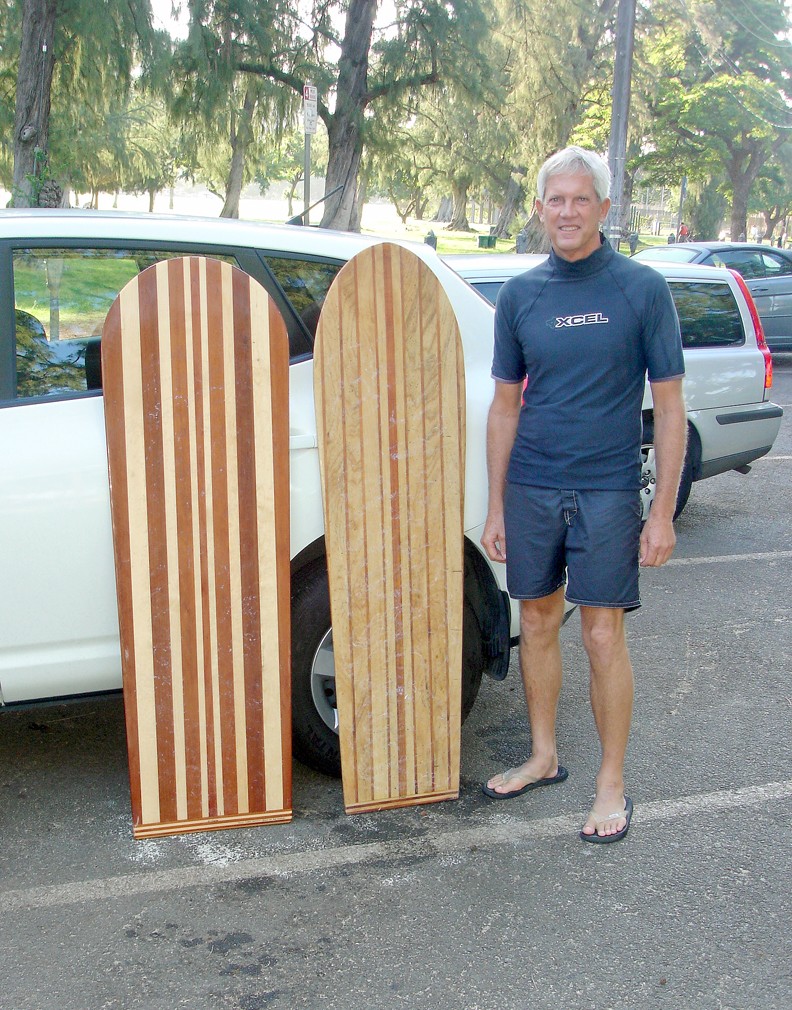
Figure: Examples of Modern Alaia
Paipo Boards
Based on Traditional Designs. Compare these to ancient
alaia paipos for auction in July 2009. Photo at Publics in Waikiki,
November 2008, by Bud Scelsa.
|
|

|
More Evolution:
The BodyGun
| from the
BodyGun's Product
Summary: "The BodyGun is a body surfing system developed in
South
Africa. The BodyGun harnesses to the user's chest and torso by
means
of integrated waist and shoulder-toggle, harness subsystems. This gives
BodyGunners buoyancy, speed, maneuverability and freedom of movement.
These
benefits combine to afford a longer, more versatile, enjoyable,
exciting
and safer surf-riding experience.
The Cornish-made board consists of a
Surlyn "slick"
bottom, profiled Dow ethafoam 220 core and Softlon deck and HiSeal
nose,
rails and tail. The Multi-point 4-way adjustable harness is in
hard-wearing
nylon and polyester materials. The BodyGun derives its name from
the Hawaiian Gun, a long surfboard with a narrow tail designed for
riding
large steep waves, and the handgun: a hand-held body surfing
accessory.
The BodyGun has true family appeal, especially among those who have
difficulty
penetrating the surf line with other forms of surf craft." [BodyGun
tm UK] Also see this Popular Mechanics
article.
|

|
|
More Evolution:
The Handboard
"More maneuverable than body surfing.
More
portable than a Boogie Board..." The innovative promoters of the
handboard say, "Designed and developed in Hawaii, these durable,
wooden,
twin finned handboards, over the years, have been to many of the breaks
in the islands and also have been slipped into suitcases and backpacks
to enjoy fun little waves all over the world... California, Mexico,
Tahiti,
New Zealand." For more info, read "A
Brief History of the Handboard," by John Hazen, Jr. [Need updated
link or file.] Also visit the French handboarding
web/blog page.
Shown to the left is the Woody Armstrong
Signature
Model
Picture by permission of The
Handboard Company, Copyright ©2002.
|
 |
|
More Evolution: The Surf Mat
"This adventure began in the winter of
1982,
when an Oregon surfer & inventor, Dale Solomonson,
created
the original 12 ounce nylon & polyurethane surfmat for two highly
skilled, multi-talented surfers: Paul Gross & George Greenough.
That first nylon mat was a success, & since then, the best
airmats for fast, high-performance surfing have never been the same."
[from
Dale Solomonson's former webpage, "Neumatic
Surfcraft." Read more here.
Earlier surf mats included the
surfoplane which would be superseded in the 1970's by the Coolite, the Zippy Board
and/or the Canvas
Mat.
In the 1980's the dominant prone board would be the Morey Boogie. A
2001 model of the Surfoplane is under development from a Newcastle
consortium. [from pods for primates : a catalogue of
surfboards in australia since 1900, the catalogue
#146, at http://surfresearch.com.au.]
Also see the informative article on surf
mats
in The Surfer's Journal,
"Inflatable
Dreams," Vol. 9, No. 2 (Late Spring 2000) and the surf
film/documentary
"Crystal Voyager" (with "Echoes" by Pink Floyd).
George Greenough Discussing Surf Mats on
YouTube.
Mat
Mania on the Internet - these sits will provide you most of what you
want or need to know, or point you in the right direction:
Graeme Webster's Mat Surfers (was UK Mat Surfers)
Paul Gross's web blog, Surfmatters
and 4th Gear Flyers website
Krypt Surf Mats website |
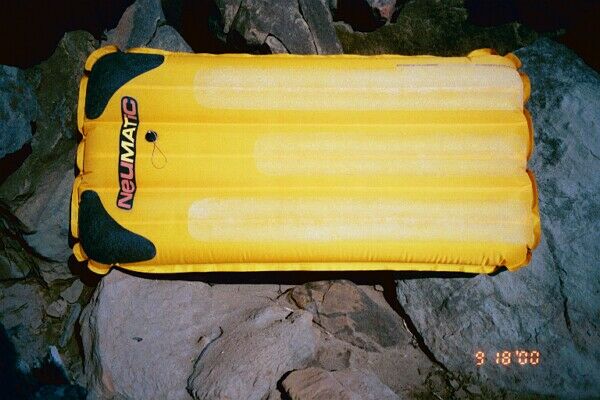
Dale Solomson's Neumatic Surfcraft

The Surfoplane ca. 1933
Source: pods for primates : a catalogue of surfboards in australia
since 1900, the
catalogue
#146.
|
|
Technology
Leap: The Hydrofoil Paipo Board
The hydrofoil represents a revolutionary jump in paipo boarding design.
According to Terry Hendricks, the primary design goals of this board
(the
Super Slicer) are: (1) high maneuverability, (2) paddle-in (vs tow-in),
and (3) flight elevation "autopilot." A secondary goal is to
achieve
at least as fast a speed as a state-of-the-art conventional board with
a planing hull.
Pictured to the right is a side view of the Super
Slicer. For
more info on this board and additional pictures, click
here.
Terry's early encounters with a hydrofoil bodyboard/hydrofoil paipo date back to the early 1960s and Gaylord Miller. Read his story here.
Another hydrofoil paipo board innovator is Gilbert Lum, of
Oahu.
See the article
written by Neal Miyake.
Read more about hydrofoiling prone craft in the Swaylocks and MyPaipoBoards forums.
|

|
Is This Really
Paipo Boarding?
There is a sometimes fascination with stand-up paipo
boarding. I am not sure exactly why -- within the context for paipo
board (bellyboard) riding which is by definition kipapa-style
(prone) surf riding. My hat is off to early shortboarders that helped
usher in the new wave of surfing. I will never forget the day that my
hands first touched the McTavish V-Bottom that some traveling Aussies
brought to the west coast of Puerto Rico during the Winter of
1967-68, and my first paddleout and rides on the "loaner" board. My
world had forever changed: no more long boarding for me! Nonetheless,
riding a short board is still a different experience than riding an
even shorter board, kipapa-style, as close to the water the
waver rider can be short of being a bodysurfer. Needless to say it is
all a very murky area, whether it be riding really long boards
prone-style
or really short boards stand-up-style, and all the variations of board
riding body style, board shape and materials used (e.g., ply, solid
wood, foam/fiberglass, molded plastic).
Below are photographs of two early short board riding innovators, Wally
Froiseth and Val Ching, riding stand-up style before shortboards were
commonplace.
|
Wally riding his 4-foot "Paipo" at Makaha.
|
|
Val Ching standup paipo ca.1963.
|
|

Gault-Williams, Malcolm. (1997, Winter). Surf Drunk: Wally Froiseth. The
Surfer’s Journal, 6(4), 105. Courtesy of The Surfers Journal,
Gault-Williams and Wally Froiseth.
|
|

Photo by Val Valentine, courtesy Jack McCoy. See and read more about
Val Ching in the A Paipo
Interview with Jack McCoy,
by Bob Green, and in this article: Pendarvis, Cher. (2010, Winter).
Uncle Val. Paipo in practice. The living link to surfing's
high-performance roots. The Surfer’s Journal, 19(6), 38-47.
|
|
Additional
information from Bob Green's Belly boarding in Australia: The 1950s
and beyond.
An e-mail from John Clark to Bob Green (2010, August 23)
contained a letter to Clark from Wally Froiseth (August 17, 2010), "I
first put a single fin on one of my paipos, but when I tried it at
Makaha, it was too shaky and not steady enough. My record shows that I
tried two fins in 1955-56. I think I showed you one of my record books
which confirms the timeline dates of 1955/56." Clark added the
following to the information in the letter from Wally, "Wally made his
first Hawaiian Pai Po balsa/fiberglass board in December 1955 with no
fins. This is the board that he loaned to Jimmy Alama that was stolen.
He made a second board without fins, but it side-slipped too much, so
he added two fins to it, which were too small and in the wrong
position. This was early in 1956, and from then on he continued to
experiment with materials, designs, and fins until he could ride the
boards to his satisfaction. By 1957, he was riding his paipos prone and
standing on big days at Waikiki, Makaha, and Sunset."
In another e-mail to Green, John Clark (2010, August 27) stated,
"Traditional paipo boards until after World War II were generally
short, narrow, and thin. Wally's boards were longer, about 4'; wider,
about 21" in front narrowing to 18" in the tail, and thicker, about 1
1/2" wide. He also glassed the boards and added a handle in the front
and twin fins on the bottom. Given all those features, his boards were
different than the existing boards."
Sources:
- Clark, John. (2010, August 23). [E-mail to B. Green].
- Clark, John (2010, August 27). [E-mail to B. Green].
|
 Who
Are
The
Paipo
Riders' Closely Related Water Brothers?
Who
Are
The
Paipo
Riders' Closely Related Water Brothers?
Closely related water kin include the bodyboarder and the kneeboarder
-- paipo boarding is really a blend of the two, not entirely like one
or
the other but sharing characteristics of each. In the beginning
there
were the paipos...then came the surfboards. In the the late 1950s
and early '60s the paipos boards re-emerged...initially made of wood
but
soon thereafter made of foam and fiberglass. At about the same
time
the kneeboard emerged and gave rise to the shortboard revolution and an
era of experimentation with all manners of waveriding craft:
board
lengths, templates, skegs (fins), rails, materials, and more. In
the 1970s the Morey Boogie Board exploded upon the scene. Over
the
next several years the paipo board generally declined in popularity as
vast numbers of wave riders migrated to the bodyboard and others chose
the kneeboard.
Bodyboarding and Kneeboarding Links
There are numerous web pages on bodyboarding and kneeboarding, both
commercial and personal. Links to many can be found at my general
links page under the heading of "Kneeboarding,
Boogie,
and
Skimboarding!" Some other good sources include: Kneeboard
Surfing USA (KSUSA), Surfinfo.Australia,
Alan
"Bud"
McCray's Blast
Kneeboards Hawaii, Dean Cleary's Kneeboards,
the
American Kneeriding
Club (AKC), and NetBodyBoarding.
See
a
succinct
review on the anatomy
of
a bodyboard (courtesy of eBodyboarding.com).
Skimboards
are
also
used to ride a wave breaking upon the shore (check
out Skim Online). An
interesting documentation of bodyboarding models dating from the
original Boogie Board in 1972, can be found at VintageBodyboards.com.
Two of the better bodyboarding shops in the USA
are Turbo Surf (Honolulu, HI)
and eBodyboarding.com, an
excellent on-line shop owned by Jay Reale (formerly of Ocean City,
Maryland) and his wife Vicki. We sincerely miss the Shoreline
Board Shop (Ocean City, MD, ceased business operations summer of
2003). In Australia, you can check out http://www.bodyboarders.com.au.
Bodyboarding Links
Be sure to check the bodyboarding community's magazine A-Frame. (Option rip Oct. 20, 2004.) An
East Coast USA bodyboarding forum: EastCoastBodyboarding.com.
Wave Riders: Intimacy or Evolution -- It's All in the Eye
of
the Beholder
Look and see for yourself: Is your surf riding vehicle a "step
forward in evolution" or is it a "step backward from intimacy with
mother
ocean?"
Click here.
The Tool Essential to Paipoboarding, Bodyboarding, Kneeboarding,
and Bodysurfing -- The Surf/Swim Fin
Finding some flippers or swim fins for catching your waves can
sometimes be a real challenge. Depending upon your style of riding,
frequency and foot shape you may have some special requirements.
Personal preferences rule the day when it comes to swim fins. Visit
this page for some links and info.
Need a Board Bag? If you need a travel bag you'll know
they are hard to come by -- even day bags aren't easy to find. Visit
this page for some links and info.
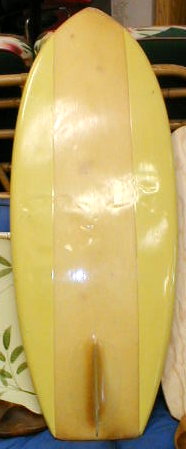
MY
PAIPO BOARDS
Four Decades of Paipos
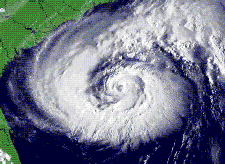
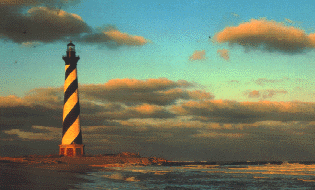
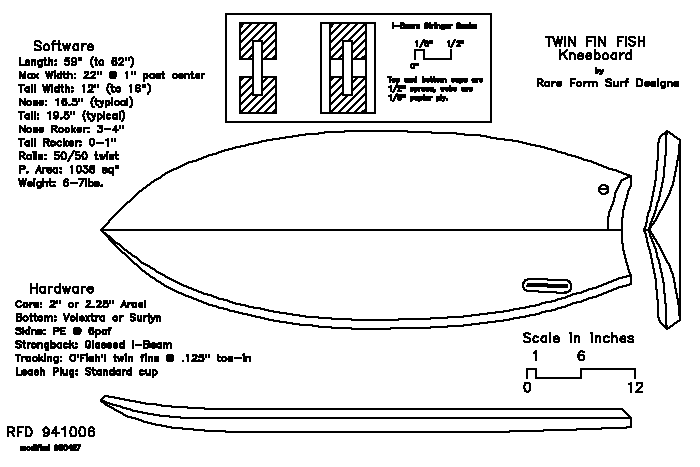

I've acquired a paipo during each of the past four decades and used
it for any number of years before retiring the poor, beaten up
specimen.
Paipo-60 was made from a stripped down long board ca. 1969. I
called
it my Green Machine I, probably a blatant rip-off of something from the
period, but it was green and used in the emerald Caribbean waters of
Rincón
and vicinity. Paipo-70, plain white but called Green Machine II,
was made ca. 1978. My truly disgusting glassing abilities are
evident
in that board but it brought he great pleasure over the next 10 years
at
assorted breaks from DELMARVA to Puerto Rico to La Jolla and up to
Ventura.
Both boards were tear drop shapes with single fins. GM-I was
potato
chip thin with easy round rails, great on the crisp waves of PR and
when
I was a much lighter rail (5'9", 130#). GM-II was thicker and
transitions
from easy rails forward to has very hard rails from the
midsection.
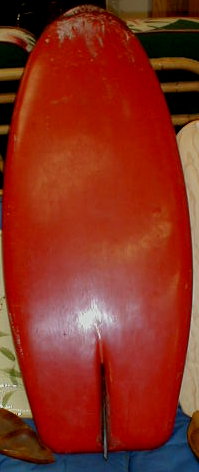
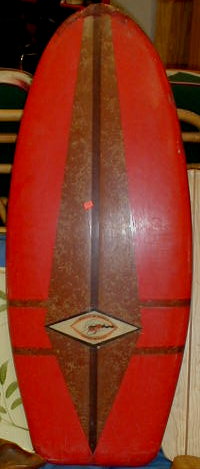
My next two boards, Red Machine III and Red Machine IV have parallel
lines,
contemporary surfboard rails, 3-fins, and additional rocker in the nose
area. These boards are better suited to the waves on the U.S.
East
Coast but have performed well in surf up to 8-10 feet in Puerto Rico
and
Hawaii. My newest board, the Checkered RPM, moves me back to a thinner,
narrower and lighter board, and one more optimized for good surf rather
than a board optimized for all waveriding conditions.
See some quick pics of my Paipo
Boards.
See a description, the vital statistics, and pictures (future
item) for each paipo at these links:
[Paipo-60
Green Machine I] [Paipo-70 Green
Machine
II] [Paipo-80 Red Machine III]
[Paipo-90 Red Machine IV]
[Paipo-XP04
Green Disk V]
| [Paipo-El Chillito VI]
| [Paipo-07 Orange Matter VII]
| [Paipo-09 Checkered RPM VIII]
[Paipo-11 S&S Checkered RPM IX] | [Paipo-12 S&S
Checkered RPM X] | [Paipo-14 S&S Checkered RPM
XI] | [Paipo-14 S&S
Diamond Bonzer RPM XII] |
Collection: 1960s
Red Hansen | El
Paipo Knee Machine 48 #1070 |
[Spec
Sheet for your paipo]
The Newest Members of My Quiver
PAIPO
TESTIMONIALS -- MY PAIPO STORY by Paipo Enthusiasts
Random Stories by Paipo Enthusiasts from
Internet Postings, Magazines, Newspaper Articles and
Elsewhere, including MyPaipoStory submissions to MyPaipoBoards.org (see
the Your
Paipo History Survey Form).
Bruce Barcik. "My Paipo Story,"
submitted to MyPaipoBoards.org on February 7, 2011.
"...on cold winter days I can still close my eyes and
feel that rush of the wave, the acceleration you feel as the wave grabs
you, the view of the shoulder developing before you and that special
place in the tube charging along at what seemed 100mph. These are the
things I will never forget."
"Skinners Brewery
World Bellyboard Championships in Cornwall"
-- SIBA News Article: The surfing scene of yesteryear was re-created at
Chapel Porth Beach near St Agnes, Cornwall, when the clock was turned
back in style for the Skinners Brewery World Bellyboard
Championships... Click
here for the news article in PDF format.
"Rabbit Kekai: First Hotdogger, Last Beachboy -- 1930s
Paipo
Beginnings," Legendary
Surfers, by Malcolm Gault-Williams.
The Wedge Story,
an awesome story about paipoboarding the Wedge and Huntington Beach in
the early-60s, written by David Richards and Tod Brown, as told by Mike
McKerracher. Read more about the "Big Wednesday" at that site
(hope you have a broadband connection - long loading).
"Gliding
Gilbert"
-- paipo boarding on a paipo with a hydrofoil, by Neal "Sponge" Miyake
Gaylord Miller's
Hydrofoil
Paipos
of the 60's -- Info provided by Terry Hendricks
"Wooden
Bellyboards-Cornwall
9/92" -- by Neal "Sponge" Miyake
"Homegrown Pocket Rocket" -- a
story
about a bodyboarder's finest creation -- by Foondoggy
Neal Miyake's InnerView
of Russ Brown (aka "Captain Turbo") of Turbo Surf Designs Hawaii
(4/13/98),
innovator of the stiff bodyboard in 1983:
"We realized
that
bodyboards back then were just flexible piece of foam. Having
ridden
paipos (paipo boards) at The Wall, right away I knew the boards should
be stiffer, and if it was stiff, then you could put skegs on them. So
began
the line of Turbos."
Paul Lindbergh's (Hawaii Paipo Designs) "Paipo
Boards Story" (an excerpt--go to the link for the complete story):
"I remember
in those
days that Makapuu was the place to paipo. All kinds of home made paipos
everywhere. Ehukai, on the North shore was another Paipo place. Very
hip
place too I should add. This all took place before Boogie boards were
invented.
When Boogie boards came out the Paipo almost disappeared. People were
attracted
to the new materials (i.e., polyethylene), and with peoples creative
levels
going down, it seemed easier (and, or, more decadent) to buy a Boogie
board
than to build your own Paipo.
As far as I'm
concerned,
the surfboard, and later the boogie board, were modeled after the boat
(or canoe, same context). The surfboard has evolved from boat designs
and
is really a scaled down, redesigned, and much improved version of the
outrigger
canoe and the Boogie board the same. Of course there have been many
improvements
in shapes and materials, Surfboards are designed for the rider to
paddle
around on and float around on, much like a small boat. The same with
Boogie
boards, a main factor is its ability to float, like all good boats. If
it don't sink, it's good. People feel safe when it don't sink. Surfing
the waves was very much like the old canoes did. Of course it's been
around
for many years now and a lot of things have changed, but not the basic
boat origins.
My opinion is that
surfboards
and boogie boards are improvements on an old theme, not a design
synthesized,
after thought and observation. The paipo is just that. It was not
designed
to float; it was designed with hydraulic dynamics in mind only.
Previously
the comfort of the rider was not even considered. The rider laid on the
hard surface of the board, and often took a pounding. This board will
take
off easier than surfboard, Bogie board or boat, go faster, and has the
ability to dive under outside sets with great ease. It's a good
feeling,
I tell you."
Surfer Magazine, Letters to the Ed - Post
(1996), In the Water is Fun at Makaha!
"...I don't
think
the guys at Windansea have anything to complain about. Windansea guys
have
trouble with boogieboarders and kayakers? At Makaha we have
bodysurfers,
guys on surfboards, longboards, bodyboards, paipo boards,
kayaks
and canoes. We've got things in the water the Windansea guys have never
heard of. At Makaha everybody shares and everybody has a good time.
Yeah,
we got some huge guys who will take action if somebody gets out of
line,
but nobody gets out of line and everything goes pretty smoothly." -
Sunny
Garcia, guest editor.
Kiah
Interviews His Dad, November 1997, by Kiah Imai (excerpts)
How did
you learn
to surf?
We were in the water a
lot
from when we were young. First we just swam. Then we used a foam board
and body surfed. They didn't have boogie boards then. The foam boards
would
fall apart and give us a rash on our stomachs. They we started using
and
making paipo boards. Paipo boards are pieces of plywood that we cut and
shaped just like a surfboard. We sanded the edges and painted them with
marine paint. The Paipo boards were about 4 feet long. This was in 1967.
My dad came
with
us paipo boarding off of Port Lock. Then we got into surfboards. We
started
with used boards and then made our own boards. I surfed with my friends
and my brother.
Did surf
boards
change [from] when you were young?
Yes they did. Now surf
boards
are shorter. They have leashes. There are also more fins. On our paipo
boards we just had one big fin. Boards now are also lighter, they
have less fiberglass so they are lighter and also weaker.
Sam
Mokuahi,
‘Mayor of Waikiki,’ By Helen Altonn, Honolulu Star-Bulletin.
[Excerpt from an obituary on Sammy "Steamboat" Mokuahi]
"In those
days,
Kevin Mokuahi said, his uncle would cut a piece of plywood and tell
kids,
"Here, take this out and catch some waves." The "piper board,"
as
kids called it then, was the forerunner of the boogie board and much
more
difficult to use, he said."
from the Wedge Guestbook
Entries [The Wedge] posting by mike,
the mackman, Location: Seattle, WA. USA, September 27, 1997
ache for the
ocean,,,,
in 1962 I had made a paipo board with 2 skegs out of wood. When
we were kicked out at 11 for no surf times, I would go back in with
fins
and my original paipo. No one else had one. September of 62 we had a
huge
swell. closing out every where but the wedge. I went out with my
paipo. Was I the first to boogie board the wedge. Morey's didn't come
out
till 63 or 64. Would love to know. I think I was. I would start on the
left backwash and cut across the bowl,,, a little dangerous but you hit
the bowl with enough speed to blow out over the top on the other
side.,,,,,,,anyone
know,,, the macman,,, ps still surfing,,,
from the Mike
Stewart Guestbook,
posting by Don Andrade, on 08/24/99
I can't tell
you
how stoked I'd be if there were a possibility of getting one of your
boards
in a custom length. I've been riding body boards and body surfed since
I was a little kid in southern California, I remember the first "body
board"
I ever rode; it was a thing my brother had called a Paipo
board,
and it looked to have been the front end of a long board, cut off with
two skegs attached to the bottom at the time. I realized later on that
this thing was made that way, it was a lot of fun and needless to say
totally
lethal, I quit riding it after it whacked me for the fifth or sixth
time
& continued to mostly body surf the beach break between Bolona
creek
and Hermosa. I am thirty-one and still enjoy charging nice waves &
currently live on the Central Coast near San Luis Obispo, in a little
town
called Los Osos. We get some pretty nice waves in here for body
boarding,
and surfing. I currently ride a 46" custom Turbo board and am pretty
stoked
on it, it's a lot different from an old Turbo I had in the early 80's,
however it is a really good big wave board. I've gone through quite a
few
of our local Toobs boards and would like to try something with a little
more snap to it, something that the Turbo has only in big swell. So let
me know if it is at all possible to have one of your boards made
special
for me. Thank you, sincerely Don P.S. I really wish I knew
where that 'ol Paipo board went, it would be a cool thing to hang on my
wall and look at & remember the beginning of this sport.
from the Mike
Stewart Guestbook,,
posting by Allen "wrench" Pantaleon, on 12/28/99
Aloha again
Mike.
Got cut off. I need some help from the "best". I'm seriously thinking
of
purchasing a new bodyboard but confused as to which one is best for me.
No laugh now. I have surfed for over 35 years on paipo,
shortboards,
and longboards at mostly on the Westside of Oahu. I've also been an
amateur
competitor in the local HSA, HSF, and HASA surf meets. I was a member
of
the old Makaha Surfing Association and Makaha Surf Team along with Rell
Sunn, Bird Mahelona, Johnny Boy Gomes, Sunny Garcia, etc. My trademark
surfing maneuver was and is the "Allen Wrench" which uncle Buff named
after
he first saw me doing it back in the Eighty's. But now I'm fully into
bodyboarding
and having sooooo much fun. I'm 52 years old now and have been
bodyboarding
about a year now and still learning. Most of my surfing buddies think
I'm
crazy or I got hurt surfing. But really I know I'm getting an all
around
physical workout; every wave is overhead; almost every wave is
potentially
a barrel; and I don't have to worry too much about skegs and pointed
noses
of my own. I'm 5'6"; 140lbs; and have been using an original Lance
Ronquillo
Morey 42.5 x 12.5 x 22 x 18.5 board. It has a few wrinkles on the
bottom
and rails are separating a little where my hands are at. I still like
it
but I think I'm ready to go to the next levels of this sport. Please
help
me out with some of your best respected ideas. Allen "Wrench".
from The
Surf
Connection, an excerpt from "One Step Beyond (Hanging Five in
the Tube, on Short and Big, Loose Boards)" by John Orr
"...I I was
born
and grew up in Hawaii (Oahu), started surfing or paipo boarding (like a
Boogie Board, but made from, like a 1/2" plywood, usually with a single
or twin fins) at the Wall, by the Zoo, in Waikiki. I remember paipo
boarding
with Eddie Aikau, his brothers (Sol and Clyde, etc.), Hawaiian,
Palakiko
and Val Ching, they were standing up on little plywood boards, and
surfing
good, at the Wall (before they surfed on regular Big surfboards).
My brother Ron and I finally got into standing up and surfing our
little
paipos, too. About that time my brother talked my Dad into buying us a
couple of new pop out Velzy's. ... ."
from a alt.surfing
autobiographical posting
about when "Doc" saw the light, "Re: Selling Out To The Man (Long)" by
Doc, on 1999/11/02
<slice> Going
back further...
I learned waves
back in about
1966...with one of those heavy single fin boards. A 9'6" or bigger,
depending
on what I could borrow. Anything smaller...didn't
exist.
For kids and girls, 9'6" was as small as it got. Real, full grown
guys used bigger boards.
It wouldn't turn.
Leash?
We didn't have them, and I have El Roca to back me up on that. Takeoffs
were...interesting...on hollow days, as early as we could make it into them
because those %$#@&!! pigs wouldn't turn fast enough. Eat it and
hanging
onto your board was a dicey proposition, lose it and 40+ pounds of round
railed thing loose and moving got respect from peers and elders all
right,
stark bleeding terror more like it 'cause that THING was coming with a wave
behind
it and if they didn't get the hell out of the way they were dead meat.
Elegance? Naah.
Slow. Hell,
an elephant looks elegant if it's slow enough...and they often are.
Range
of motion was point it and trim, that's all. No other choices.
You ever think
about the
old, double-glassed boards you see, with ding repairs in 'em? What it
would
take to ding one of those suckers that would only star a bit if you
smashed
a baseball bat into it? And what that would do to your gourd if it
smacked
you?
We thought about it
a lot.
The fixed dings you see on those things came from other boards. Meat
isn't
hard enough to make a ding in one. One of the first boards I used
had
an aluminum plate for a skeg...I won't attempt to call it a fin, it was
a skeg, a not especially blunt instrument that would do a very nice job of
slicing
and dicing or just plain ax murder with that heavy, ugly,
unmaneuverable
bloody THING it was attached to.
Uh huh.... and
that, my friend,
was no golden age. That was the stone age. Getting munched by
dinosaurs.
The thrill of surfing wasn't from the waves, it was from coming out
undamaged.
But, we didn't have anything else. Until....
One day, I may have
been
thirteen or fourteen, 120 lbs, if I'm lucky, walking up a cliff with a
9'6" double glassed Spoiler under my arm...and on my back...and under my
other
arm...and..... I watched somebody coming down the cliff with a paipo.
Little bitty thing.
How's
he gonna paddle it? Fins...TWO fins? Whassat? Lemme siddown a
minute
and watch this. (and I can set down this GODDAMNED HEAVY TANK for a
GODDAMNED
MINUTE!).
The guy goes
out....and I'm
watching....and he goes for a wave ...and I'm watching.....and I wanna
yell HEY BUDDY, TOO LATE........and he GOES LIKE HELL! He gets to the
end
of the wave where any good longboarder is gonna just head straight for
a while and wait for the mush so he can do his poses for the beach
crowd,
what they called a 'cutback', then....WOW! He RIPPED that turn! He's
headed
BACK? INTO IT? And now he's gonna make ANOTHER GODDAMNED TURN! Just
RIPPING
IT UP!!!
I carried the
GODDAMNED HEAVY
TANK to the top, later. Much later. Never wasted my time with
another
one. Scored me a paipo, later a kneeboard. Nat had hit the scene,
Greenough.
It all changed. It came alive.
The Stone Age was
dead.
from "Surf's been up for 40 years," an article in The
Florida
Times-Union, 07/19/2000, by columnist Bill Longernecker
"Forty years
ago,
a part of my growth was stunted. Finding surf became a consuming
passion.
In 1960, I strapped on a pair of swim fins and took a 5-foot slab of
wood
out into a northeaster and became a surfer. Wooden boards like
that
were called paipo boards. I still have my original board. Today, they
are
called belly boards and boogie boards, and are made of soft foam. My
definition
for a "surfer" is anyone who rides waves, not just one who stands up."
from "The
Original
Surfboard
Company," sourced from book citations, on July
28, 2008:
"Long before
people started to stand up on ‘Malibu’ surf boards in Britain in the
1960s, they surfed the Atlantic rollers lying down on thin flat wooden
boards - a design based on the ancient Hawaiin “paipo” boards (paipo -
meaning short or small board).
They are more often called belly boards these days, but originally they
were called surf boards or surf-riding boards. Until recently a number
of surf historians claimed that this type of surfing began in Britain
in 1918 when the first world war veterans returned home - but The
British Surfing Museum has recently discovered the existence of a
photograph of a man with a short board in 1904.
In "The Art of Surf-riding" (1934 edition) author Ronald S. Funnell
writes ‘ A new and exhilerating sport is rapidly gaining many fans in
England - surf-riding and deservedly so, for its health giving as well
as invigorating relaxation and pastime. The 1953 ‘Coronation edition’
claims that “the keen interest in surf-riding has become intensified
owing to excellent photographs” which had appeared in recent years in
the national press."
from the Team FLI Blog, "Wood is
Good!," posted by Charl van Rensburg on February 18, 2009,
excerpts:
"I have been
bodyboarding for almost 20 years now, and I must admit, about 12 – 18
months ago, I just got so jaded with the sport… I’d find more reasons
not to go Bodyboarding than to actually paddle out, you know that “been
there done that” feeling. This prompted me to start looking around at
what is currently going on in the Surfing World / Industry, and in so
doing have found some inspiration, and with it have started exploring
some alternative wave-riding craft... this inspiration has not come
from line-ups packed with kids who have sun-bleached hair, industry
Sponsorships and a lot of attitude. My lifeline for Bodyboarding came
from the periphery, the edge, the place where Heretics, Hippies and
Intelligentsia reside (or have been banished to).
One of the most inspiring short-films I have seen recently is “The Life of Ply”
by Ocean Motion Pictures. I just love the stoke of the person in the
clip, it resonates with wave-riders all over the world. Dot, featured
in the clip, lives in the UK and I recently met someone who knows her,
named Sally Parkin. Sally owns a company called 'The Original Surfboard
Company' ( http://www.originalsurfboards.co.uk ), a UK based business
manufacturing traditional plywood boards. In the pic above, my Son Neo
is holding an Original Surboard. Wow, they are amazing to ride. Not
made for tricks, just down the line speed and pure joy. I now ride
waves all the way to the beach." (read
the
PDF
file of "Wood is Good!".)
from Paipo
Days: Paipoboarding, Bodysurfing and Brotherhood, by the brothers
Malcolm & Frank Orrall, excerpts:
"Our family grew up walking
distance from the ocean in Hawai'i Kai in the 60's and 70's, back when
there where still pig farms out there. The ocean was our playground,
& my brother Malcolm taught me how to body surf at Sandys, Makapu'u
and Waimea. I used to love to follow what he was up to 'cause he
was always doing cool stuff in the ocean like; spear fish diving, cliff
fishing, surfing, riding Paipo & paddling canoe. I asked Malcolm if
he would write about this period, and specifically about body surfing
and Paipo boarding, which are two of the most classic, mystical &
soulful styles of surfing.
My love of wooden paipoboarding began like it did for many other kids
in Hawaii, as a wave-riding sport you could engage in for little or no
money. Surfboards were so expensive, and all you needed to paipo
was a piece of exterior plywood, a borrowed jigsaw, and maybe a resin
finish coat or some glass if you were patient enough to wait for it to
dry. It is the perfect wave riding sport for the masses.
And since it is one of the best kept secrets about surfing, there is a
kind of mystique about it to me, and a connection with the real old
style Hawaiian wave riding that you don’t see represented in surfing
culture in general."
from the MyPaipoBoards Forums, by HIpaipo, posted on October 26, 2009:
"My first experiences riding a
board of anysort was a morey bodyboard in the 90's. Like all kids here
in hawaii that came after the Boogie Board Era, I would play by the
shore, catching the soup by pushing off the bottom when the wave came
(like British Bellyboarding) at White Plains Beach. After growing up to
the age of about 11, and getting tired of occasionally getting drilled
into the sand face first (the result of not bottom turning), I moved
on, going out to the line up with my Morey Bodyboard from Costco, and
my old pair of blue and black Duckfeet I used for snorkeling. It was
out in the lineup, in slightly more serious waves, I learned the
concept of bottom turning.....the hard way. However, I could never dive
the bodyboard really well, and one day at White Plains stands out: I
had just caught a wave and was headed back out to the line up(because
there are no channels at White Plains to go back out through, you must
dive under every wave on the way back out) and a seemingly endless set
came in, I kept diving and kicking forward, only to get pushed back.
The set finally ended, and I eventually got back to the lineup. This
went on until I was about 14 and a half years old, and I saw my mom and
dad's old guitar pick style paipos when my dad and I were cleaning out
the garage. I asked about it, and he told me it was an old skool
bodyboard. I handled it, noticing how heavy and thin it was. I was
skeptical, and thought it would never work. Curiosity got the better of
me, and I brought my mother's paipo with us one day we went to the
beach. Paddling out felt odd, and everyone looked at the board trying
to figure out what it was (I love when people do this Laughing ). I
tried for a couple of waves, and missed them, but I didn't give up, and
finally caught one. I was amazed by the speed once I got on the wave,
and when my ride finally ended, I noticed how easy it was to dive under
waves. I was hooked. I made a wood board for me a couple of months
later (my "bullet" board), and currently at the age of 16 still have
and ride my "bullet" board and a HPD SR flex paipo, and usually ride at
White Plains, Big Rights, Cunhas, and The Wall (Walls)."
from comments on an article by Neal Miyake, "Alternative Waveriding
Methods," by Bob Sanchez, posted on February 11, 2004:
"I was happy to read your
article. I have been an avid waterman my whole life. My dad was a
police officer and my mom worked in town. Living in Waianae my family
made friends with neighbors who had a built a place on Makua beach
across from the Army Shooting range. We surfed at Makaha and body
surfed Pray for Sex and Yokohama. When I went to high school I
bodysurfed Sandy Beach and Makapu'u regularly and knew everyone. We
used McDonalds trays from the McDonalds in Hawaii Kai. As I am 36 now
its been YEARS since I have been in the water like I was in my youth
but I remember bodysurfing, using home made hand boards, paipo boards
and yes, the McDonald's trays. I actually was in competition against
Mike Stewart and that guy totally rips bodysurfing and he won that
contest. I also met Mark Cunningham before he won the Pipe contest.
Thank you for letting me remember how fun it was."
another comment on the "Alternative Waveriding Methods" article, by
Katoanui, posted on February 20, 2004:
"I could not stop laughing
about the Mcdonald's tray. It brought back so much memories when I used
to be a 'Waikiki Wall Rat'. I remember Mcdonalds yelling at us for
taking their trays. It even escalated to the point where they would
have people watching to make sure none of us 'wall rats' would make a
run for the simple but effective hand boards. Great stories and
pictures! I enjoy the pics very much as my background! Keep it
coming!!" and Neal's reply, "Katoanui: Glad the story brought back
memories. I remember people used to even put leashes on their trays. So
funny when you think about it."
another comment on the "Alternative Waveriding Methods" article, by
Bobby Thompson, posted on April 30, 2004:
"I stumbled on this site and
took me back to small kid time. Our weekly drive from Kalihi valley
over the pali (the old road) to Bellows field in waimanalo. The waves
weren't big but the rides were long and fun on our home made plywood
paipo boards. I was probably 8 years old when I started- this was our
ritual until I was about 12 years old. this was over 45 years ago. I
now live in louisiana... mahalo for the memories."
from the Swaylocks Forums, "Why I ride prone," by idler, posted on
February 28, 2010:
"I have surfed for roughly
twenty seven years. I started as a ten year old in Durban, South
Africa, riding a five foot Spider Murphy shaped Safari twin-fin. I soon
graduated to thrusters, since that was what everyone was riding. We had
a 6'6 single-fin pop-out sitting in the garage for years and one day I
pulled it out because the surf was small but really clean. It felt like
a mal to me, and I loved it. This was the day I realised the joy of
playing around with different types of surf equipment.
Fast forward 26 years, I'm living in Australia now. I've been building
and riding alaia's almost exclusively for nearly four years, although I
still love my big nose rider and my 6'6 Bluebird single-fin. One day I
grabbed a 6ft alaia, and a pair of flippers, and waded out into some
clean 2ft ankle-snappers. There was a small crowd of local hot-shot
shortboarders out, and I could feel the stares of derision as I kicked
my way out into the line-up.
I stroked into a small wave, and woosh......I flew along the glassy
face! Being prone, the water felt like it was inches from my chin, and
the perspective was beautiful. It was like being disembodied, or like a
gull gliding above the water. It also felt really.....symmetrical.
Instead of standing and moving toward a preferred, or less preferred
and awkward SIDE, I was almost flying, stretched out, and FORWARD in
the true sense of the word.
I had ridden boogie boards as a kid, but they always felt slow and
awkward to me. I couldn't figure out why people would lie down given
the option of standing up? But it seemed I had missed something. Prone
surfing has swallowed me up completely. I wouldn't say I've retired
from standing up, but with the options of ply bellyboards, wooden and
fiberglass paipo's, surfmats, handplanes, cubit boards and plain old
bodysurfing, I just don't seem to have the urge or time to ride my old
boards!
There is also a sense of stepping off the grid once you embrace prone
surfing. The decision to choose the less popular and less flashy
surf-style is almost instantly rewarded by a plethora of new surf spots
too small, too steep or too shallow for a finned stand up board. The
amount of time spent in the barrel is multiplied tenfold, and your
entire quiver can fit under the seat of your car!
All I can say is.......JOY!!!!!!!!!!!"
"Bring forth the Mollusk...."
http://billyboarder.blogspot.com/
another comment from the thread on the Swaylocks Forums, "Why I ride
prone," by unclegrumpy, posted on February 28, 2010:
"I'm with you Idler! I started
surfing back in the mid 60's but neck and shoulder problems for several
years have prevented me from paddling overarm so my surfing is now
limited to prone riding. I certainly don't feel it's a handicap. Like
yourself , I have mats, old fashion belly boards, Hawaiian Paipo, home
made alaia, hand boards and even a couple boogers.The alaia is getting
the most water time these days and it's just amazing how fun a basic
little plank can be. For me, the simple fact that we are actually in
the wave, makes for a more enjoyable experience. Proud to be Prone."
PAIPOS IN THE MEDIA: MOVIES, VIDEOS,
BOOKS, POST CARDS, JIGSAW PUZZLES, POETRY
Random Citations of Paipo
Riding Captured Live
The
History of Paipo Boarding:
The
history of paipo boarding (aka bellyboarding) has been captured and
documented in many manners and forms. Boards are in museums and
personal collections. Books, journals, magazines, monographs,
pamphlets, photographs and figures, web pages, blogs and a host of
other media capture bits and pieces of the history, but very few of
these sources provide a unified message of the sport of paipo boarding.
More often than not these media capture a glimpse, or a
snapshot in time, of the paipo, usually as a subset of sport of
waveriding (aka surfing). Usually the written word on paipo riding (or
bellyboarding) consists of a small article in a surf magazine or maybe
even a small chapter in a book of surfing. These are all very important
contributions and not to be minimized. They are the building blocks of
paipo history. In the list below you will find some histories of the
paipo as we understand it today.
Books:
See a listing of
books and journal
articles, organized by
author, that include references to or provide insights to the sport of
paipo
boarding, in An Annotated Bibliography of
the Paipo Board.
Brochures:
This
section of MyPaipoBoards shows brochures which are short of being a
pamphlet, but more than a basic advertisement in a magazine, that are
handed out to prospective customers or other interested folks. See the Brochures here. (This is an initial work-in-progress.)
Surfing
Magazines
and
Other
Magazines:
See
the developing list of magazine
articles and advertisements.
(A work-in-progress.)
Newspaper
Articles:
See a developing collection of newspaper
articles in this section.
(A work-in-progress.)
Postcards:
The first addition to this on-line collection features
bodyboarding along coastal North Carolina, USA, in 1907. See more in
the Paipo Postcards.
Jigsaw Puzzles:
The first addition to this on-line collection is from a
South African series of jigsaw puzzles dating to the 1920s. See the Paipo Jigsaw Puzzles.
Interviews:
The Paipo Research
Project
started interviewing "paipo people" during 2009. Interviews from
earlier times will be added as they are made available. Click on this
link for the The Paipo
Interviews. Many thanks to our worldwide volunteer community of
paipo historians, researchers and fans.
Videos on the
Internet:
A very large
collection of paipo videos are listed at WritersTip.com.
Many thanks to jbw for sharing this on the Paipo Forums (June 4, 2012).
- Kauai Sound and Cinema Media Corporation.
(2018, Jun 22). Boogie Foil. Retrieved May 30, 2019, from https://youtu.be/roW0gKXzuAU. Riding a hydrofoil bodyboard, foil adaptable for paipos, surfboards, etc.
- Mijares, Scott [Audio Interview]. (2017, July). A Surf Stories Interview with Clyde Aikau. Surf Stories on SoundCloud. Retrieved 2017, July 27, from https://soundcloud.com/surf-stories/clyde-aikau-on-surf-stories?. Around the 4:45 mark, Clyde Aikau discussed riding paipo surfing at The Wall in Waikiki.
- Kovar, John (Malaroo).
(2015, November 29). Another paipo adventure, parts I and II. Bob
Green went on a surf trip south of Sydney with two boards, a new
finless board and a twin fin. Part I features the finless board, made
by Huie, in action: https://youtu.be/WlvHCGMeh8U.
It handled steep take-offs, turns and has some speed. He tended not to
take it out at spots that needed a long paddle, but it did catch waves
well. Part II features the twin fin, made by Chris Garrett, in different waves, different board: https://youtu.be/lFjqLZDCYzI.
- Yerobi, Mikel.
(2014) Egurraren Gizona. Retrieved July 7, 2014, from https://vimeo.com/89525318. Building and then riding a wood
paipo at Mundaka.
- Clark, John.
(2013, June 9). 板子乗り- Japanese Traditional Surf Riding at Waikiki -
YouTube. Retrieved June 14, 2013, from
www.youtube.com/watch?feature=player_embedded&v=NbFigfXH5Yg.
John Clark tells us that Japanese surfing culture dates back to the
1800s, and possibly earlier. The surfing board is called an itako.
Clark demonstrates waveriding on an Itako in Waikiki. See the video
here: http://youtu.be/NbFigfXH5Yg
- Blair, Milton. (Director). (1967, July 18
[released]). Blue Surf-ari excerpt uploaded to YouTube entitled
Greg Noll Ricky Griggs Surfing Hawaii 1967 Piapo Board. StarrFilms.com. Uploaded to YouTube on
January 23, 2011. Video excerpt from the surf movie, Blue Surf-ari.
Short snippet features Frenchie on his paipo board riding Sunset Beach
on a large day with Ricky Grigg in the water and Greg Noll watching
from the shore. Paipo action starts around 6:15.
Milton Blair - Director, Don Brown - Editor, Don Brown -
Cinematographer, Don Brown - Producer. Soundtrack by The Blazers.
Thanks to Jeremy Oxenden for the tip. See the poster. See it here: http://www.youtube.com/watch?v=az7dseB4DN0
- Howard-Jones, Phil. (Producer & Editor).
(2012, May 10). Polzeath Beach 1936. A Wonderful World
Presentation. Vanessa MacMahon 2012. All rights reserved. Short clip entitled "Surfing,"
that show bellyboarding UK-style boards in 1936, probably some of the
oldest footage around for UK-style bellyboarding. Video summary: A
beautifully nostalgic look back in time to halcyon days and a wonderful
family summer holiday at Polzeath, Cornwall August 1936.
See it here: http://www.youtube.com/watch?v=gX481AAt6l0.
- Unknown.
(Director). (1947). Riders of the California Surf. Hermosa Pix,
An American Miniature. [Film short.]
Summation by Paipo Forums' OG-AZN: Mostly solid wood stand up riding in
this, but there's wood paipo / belly board riding, bodysurfing, and mat
riding at the beginning. Also a segment on making redwood & balsa
boards. Surprised to see a lot of people using (swim) fins that early.
See it here: http://www.youtube.com/watch?v=xQzXlnYUhAg.
- British Pathé. (1968). Surfing -
Devon 1968. Retrieved December 27, 2012, from http://www.britishpathe.com/.
Poster's
description: North Devon. Big GV long beach on North Devon coast, with
holiday makers. Various shots children and adults playing on surf
boards in the small waves off the beach. One woman wears a red swimsuit
and a pink pixie swim hat. Deckchair attendant sits at his post.
Various shots of lifeguards (some with big beards) looking seawards for
swimmers in trouble. My comments: Traditional UK bellyboard surfing in
the shorebreak. Of special interest is the beach bellyboard vendor at
2:12 (for example, see this snippet).
- Clark, John R.
K. (2012, November 12). The Six Types of Hawaiian Surfing. Surfing
Heritage Foundation - YouTube.com. Retrieved November 23, 2012, from http://www.youtube.com/watch?v=7MFN-XdBbGA&hd=1.
John Clark discusses the six types of Hawaiian surfing: 1. He'e
Nalu (board surfing); 2. Pakaka Nalu (outrigger canoe
surfing); 3. Kaha Nalu (bodysurfing); 4. Pae Po'o
(bodyboarding); 5. He'e One (sand sliding or skimboarding); and
6. He'e Pu'e Wai
(river surfing). A short slide lecture at a Hawaiian Historical Society
meeting in the Kamakakookalani Auditorium, drawing on materials from
his book, Hawaiian Surfing: Traditions From the Past.
- Cornwall Tourist Board. (2011).
Bellyboarding: A digital postcard from Cornwall. YouTube.com.
Uploaded to YouTube on December 20, 2011. Retrieved February 27, 2012,
from http://www.youtube.com/watch?v=hChI5TzKSrU.
Producer: Sideways Collective
http://www.sidewayscornwall.co.uk/. Old
school surfing at it's very best: no wetsuits, no leashes, a bit of
wood and a swimsuit is all you need! Hosted by the National Trust,
don't miss this annual event on Chapel Porth beach on the North
Cornwall coast.
- xxxwall Tourist Board. (2011,
August 15). Creation Plantation- Wooden Bodyboards (Japanese &
English). YouTube.com. Uploaded by longboarder8899 on Aug 21,
2011. Retrieved May21, 2012, from http://youtu.be/QJ9ul1hc_e8.
Poster's
comment: The wood body boards had a hey day from the 1920's to the
1960's. The are GREAT fun and actually very advanced in the way they
use flex to ride the wave. I highly recomment trying one. Tom Wegener
and Nobbywoods.
- Morris, Steven. (2011, December
1). Surfing in Britain: earliest known footage discovered. The
Guardian. Retrieved December 2, 2011, from
http://www.guardian.co.uk/travel/2011/dec/01/surfing-britain-earliest-known-footage.
From the article, "Video from 1929 shows Lewis Rosenberg taking to the
waves off Newquay on a board he carved himself out of balsa wood The
equipment may be rudimentary and the technique suspect, but the
pioneering spirit shines through. The earliest known footage of surfing
off the chilly shores of the UK has been discovered in an attic and is
being hailed as a national treasure." The video beings with surfing
prone on a "half-board" before moving on and trying to stand on a
surfing board like in Australia. Read more
here and watch the video at: http://gu.com/p/33njg.
[Note: another article appeared with an updated publication date of
December 2, 2011: Allen, Emily. (2011, December 1). Lewis
Rosenberg: First UK surfer filmed in Newquay on home-made board in
1929. Daily Mail. Retrieved December 2, 2011, from http://www.dailymail.co.uk/.
Subtitle: "Tally ho
chaps! First-ever British surfer caught on film taking to waves on
home-made board... in 1929."
This is a more extensive article than the one appearing in The
Guardian.
The film was donated to the Museum of British Surfing. Peter Robinson,
founder of the museum in Braunton, Devon, said: 'When Maxine visited
one of our exhibitions and told us the family had film of surfing
exploits on a wooden longboard in the late 20s we were totally blown
away. We knew that belly boarding was happening at this time but this
film is very significant. Lewis and his friends appear to have seen
standing up surfing on a newsreel from Australia and just thought, 'we
would like to have a go at that." Slightly different film footage than
what appears on The Guardian is posted here: http://bcove.me/5r491yha. The
original source, the Museum of British Surfing, has an article on their
website: http://www.museumofbritishsurfing.org.uk/2011/06/30/standing-proud/.
- Wilhoite, J.
(Director), & Wilhoite, J. (Producer). (1965). Stop the Wave, I
Want to Get Off [Motion picture on YouTube.]. USA.
See
a poster here. This
snippet of a film features some paipo boarding at about the 6 minute
mark. Thanks to Paul Gross for bringing this one to my attention.
Stars: Stoney Burke, Steve Cabell and Candy Calhoun. 90 minutes;
$29.95. Available at Haleiwa Strong Current. From the Star
Bulletin archives
is a film synopsis and story: "In a fortuitous sequence of events,
North Shore surfer Bernie Baker discovered and resurrected a gem of a
surf film that was created in the early '60s and shown to a limited
audience, before fading into oblivion. When Baker and his wife, Marie,
joined a Rocky Point potluck party hosted by longtime friends from his
hometown of Carpinteria, he found them watching a surf video that Baker
quickly placed in the '60s. Baker was intrigued. The sound track was
professional, cool jazz, the narration was witty, and he absolutely
could not recognize the footage from any of the many surf movies he has
memorized. But when Baker saw footage of a young George Downing surfing
perfect Laniakea and other Hawaii late greats, still-living greats and
California surfing legends ripping up the North Shore on old
longboards, he had to know what he was looking at. It turns out his
friends Stan and Wendy Cowan, had found a film that Wendy's father, Jim
Wilhoite, had made on a trip to Hawaii in the early '60s, and had
converted it to VHS videotape format. Wilhoite had shown it
commercially in California, but it was buried by the megahit Endless
Summer.
So he shelved the film. "It was such a gold mine find," says Baker. "I
wouldn't let Wendy leave Hawaii with the tape ... when I showed it to
my friends, they said it was like finding King Tut's treasure."
Wilhoite, now retired and living in Palm Springs. gave Baker permission
to market the video and send him the profits. "I promised Wendy that
her father would never have to buy golf balls or gasoline again," he
says. Now anyone can rediscover the lost footage. "It's time traveling
at its best," says Baker." Made available on YouTube by Scott Starr,
Surf/Skate/Snow Photographer/Historian. See a snippet of the film here: http://youtu.be/LgmenGSYw0M.
- Pesce, Adam.
(Director). (2011). Splinters [Motion picture]. USA: In Effect
Films. [Trailer, film in release.]
Producer's
movie summary. "Splinters is the first feature-length documentary film
about the evolution of indigenous surfing in the developing nation of
Papua New Guinea. In the 1980s, a pilot left behind a surfboard in a
remote seaside village in Papua New Guinea, a land known for cargo
cults and cannibalism. Twenty years later, the sport of surfing is
splintering Vanimo Village. For select surfing talent, it’s a way out
to compete in the “whiteman’s” world. Personal and clan rivalries
emerge as hopefuls claw for this prestigious position. The
countercultural sport is also a unique catalyst for social change as
women gain newfound status in a violent, patriarchal community. The
surfing experiment comes to a head when four village surfers compete in
the country's first-ever national surfing titles. As the village
grapples with its identity, these young heroes dream their surfboards
will carry them to a better life." My brief take from having watched
only the trailer is that it shows people having tons of fun belly
surfing, but when the stand-up surfboard enters the scene it becomes
competition-oriented and more aggressive. Long live the funsters! See the film trailer here: http://player.vimeo.com/video/22277325.
- O'Roarty, Ian. (2011). Paipo segue to next dimension. Uploaded by Blackwatersurfer
on May 25, 2011.
Greg Betz, buzzing at his peak. His focus in his last year on earth was
pure: surf, spend quality time with friends and family, create art, and
love. He was unaccepting of anything that was trivial. This video is
also a tribute to original Paipo man RIP Ray Hookano, kind and
inspiring Hawaiian paipo man. Aloha nui loa Ray. There's alot of
wisdom to be gleaned from what these two guys had in common. This
footage is from his time working on the Hydrodynamica project as still
photographer with Cher Pendarvis (producer) Richard Kenvin (Director)
and Ryan Field (DP) . Here he is coming home to his roots in Oahu and
relivingchildhood memories at the "Wall." See the video here: http://www.youtube.com/watch?v=RLSLCFTqaFQ&feature=youtu.be
- John Kovar. (2011, February 24). Footage from Bob Green's recent
surf trip. From somewhere in Australia.
- Start of the
trip and a new spot. This board was made by Chris Garrett on
specifications supplied by Larry Goddard, the creator of the design.
The board is based on Larry's Makaha Master design. Although designed
as a twin fin it is being ridden finless. See the video here: http://www.youtube.com/watch?v=JQaAPe5R9os
- Surfing includes
David Guy and John Kovar on malaroo made by John. BG is riding a Galera
nofin paipo. Fun can be had even on real small days.. See the video
here: http://www.youtube.com/watch?v=FbikeQ6qNl4
- A bit windy but
some fun ones came through. This board was made by Chris Garrett on
specifications supplied by Larry Goddard, the creator of the design.
The board is based on Larry's Makaha Master design. Although designed
as a twin fin it is being ridden finless. See the video here: http://www.youtube.com/watch?v=nbcseXmkYkA
- Start of the
trip
and a new spot. This board was made by Chris Garrett on specifications
supplied by Larry Goddard, the creator of the design. The board is
based on Larry's Makaha Master design. Although designed as a twin fin
it is being ridden finless. See the video here: http://www.youtube.com/watch?v=vTSsxx0CU6g
- BBC.
(Late-1950s/early-1960s?). John Betjeman bodyboarding. Posted by Lightw81. Video
clip of people enjoying English-style belllyboarding. Best guess is the
footage is likely to be Polzeath from the late-1950s or early-1960s.
It was taken from a BBC documentary on Betjeman and was presumable a
home movie shot at Polzeath, North Cornwall. You can probably access
the original video in the U.K., searching for the 3-part series, Stein,
Rick. (2006). Betjeman and Me – Rick Stein’s Story. BBC TV. See
the video here: http://www.youtube.com/watch?v=whW5exlFoc4.
- Barry McGuigan.
(2011, February 24). 1964 Hawaii paipo footage of
Leigh Tingle. Edited by Bob Green.
Barry MGuigan shot footage on a 1964 trip to Hawaii. Included is
footage of Leigh Tingle from Sydney. Tingle's board can be seen in a
group shot - notable is the wood hand grip. See the video here: http://www.youtube.com/watch?v=xBmAqQ_64u0
- Paipo Agogo
(OG-AZN). (2011,
February
11). Fun
with some homemade plywood paipo boards... .
The critics say,"Wow! Very enjoyable. Some of the best paipo footage
I've seen. I particularly like some of the shots near the end with the
camera reversed. Artistic and really gives the feeling of what it's
like to ride a paipo. This should be the first thing people look at
when they want to know what it's like to ride paipo. Four stars!" See
the video here: http://vimeo.com/19824895
- Paipo Surfing
1958-1965. (2010,
February 25) Home movie by Stig Waidelich, filmed by Val Valentine. 9
minutes. The surfers are Stig's father, John Waidelich, and Jim
Growney, who John Clark interviewed ( read
the interview). Click here to see the video: http://vimeo.com/9742493
- Proto Kneelos:
History of Kneeboarding in Santa Cruz, the Early Years.
Home movie by Bob DuBois, film by Scott Wessling and posted by
babybonzais. This segment has a thing about oldskool kneeboarding and
has a nice bit
about paipo-riding. Appearances include John Manss, Gordie, Bob Du
Bois. Click here: http://www.youtube.com/watch?v=S58kY5jsLTI
- Plywood Paipo
Surfing.
Posted by bawean3w. Free your mind and the plywood will follow! Click
this link to view the video: http://www.youtube.com/watch?v=PAGhZuxNnpk
- Bailey, Christiaan. (2011, February 24). The Life of Ply. Ocean Motion Pictures. Posted
to Youtube.com by Oceanmotionpictureson on Nov 15, 2008. From the Prone
to Belly blogspot: The Life of Ply,
a film by Christiaan Bailey, featuring the talents of Dorothy (aka:
Dot) and Peter Long, was voted the "Most Inspirational Film" of the
Board Shorts screening event as part of the Cornwall Film Festival. The
prize, sponsored by Leap (www.leapmedia.co.uk) and awarded by a panel
of highly respected judges, was accepted by Dorothy Long from Mark
Kermode (BBC, Respected Film Critic), on behalf of Ocean Motion
Pictures and Christiaan Bailey, to a tremendous clamour of cheers,
clapping, wolf whistles (Dot's still got the magic!), and hoots from
the very appreciative crowd. The award winning film will be available
to view on this blog very soon!Stay stoked everyone!" [Rod's Note: My
favorite line by Dot is, "...if you don't surf, you can't understand
it, but when you do surf you can't explain it...I've been surfing for
60 years..." See the video here: http://www.youtube.com/watch?v=lmSi5_tXe3w
- There's also this
one about Tom Wegeners alais
(somewhere towards the middle): http://www.youtube.com/watch?v=P7T1Io7_Cwk
- Bellyboarding
1964 by Barry McGuigan. Video editing by Bob Green. Bellyboarding and paipo.
Surfers include Leigh Tingle. Click this link to view the video:
http://www.youtube.com/watch?v=Lss-QILYwGc
- Point Panic
Hawaii Bodysurf and Paipo Surfing. Posted by bevertw. Free your
mind and the plywood will follow! Click this link to view the video: http://www.youtube.com/watch?v=vnzMMWMMYfg
- Pipeline video,
Patagonia Surf Video: Talkin' Pipe w/ Gerry Lopez Pt. 3,
includes a radical
paipo shot at Pipeline at the very end of the talk (minute 7:50). Believe it is Sean
Ross they are referring to in the picture. Link: http://www.youtube.com/watch?v=JHTeBFQAUKo
- Traying
Sickness, traygnar, posted by Barnslice. Link: http://www.youtube.com/watch?v=0lBkN8XDTLY
- Making and
riding a wood paipo, Chad Waldren Paipo pt. 1 and Pt. 2,
posted by Barnslice. Using simple handtools and piece of paulownia
wood, filmmaker Chad Waldron makes a bodyboard-style paipo for he and
his friends. Posted on: September 18, 2009. Link for part 1: http://www.korduroy.tv/2009/waldron-bros-paipos-1;
Link
for part 2 http://www.korduroy.tv/2009/waldron-bros-paipos-2
- Big Island Surf,
posted by PaipoTed on Feb. 13, 2010. Ted says, "I left the camcorder
running on the shore Thursday afternoon (Feb 11, 2010) and got some
decent, but distant, video of some Austin Paipo rides. First ride going
right is the Austin Paipo; second ride going left is my buddy on his
sponge. I did get a nice RH barrel, but the tape had run out.
(Honest.)" See: http://www.youtube.com/watch?v=KUl5VrpRLmE
- Thomas Patrick
Surfboards T-Belly. Shaper/Surfer
Thomas Haugh discusses with customer Jay Golien, from Slider Magazine,
the T-Belly Belly Board that is modeled after one of Larry Goddard's
designs, the "Twin Fin Hustler" (learn more about the Goddard designs
in The Paipo Interviews). The first half of the video discusses
a longboard shape before transitioning to the important stuff, the
T-Belly. See: http://www.youtube.com/watch?v=SwtgnXEmg4c&feature=player_embedded
- John Kovar
Rides the Malaroo. This
footage provides an unedited view of the Malaroo being ridden stand-up
and prone. The Malaroo is a foam & fiberglass paipo (bellyboard).
Read more about it in the Paipo
Interview with John Kovar: Geometry, tubes & the Malaroo. Click here for the link to the
video.
- Val Ching Paipo
Surfing. (2010,
October
6). The
Hydrodynamica Project. "The paipo board is the most
ancient of the Planing Totems. There are historic accounts of these
boards being ridden prone and while kneeling from West Africa to Tahiti
and of course Hawaii. The Kuhio beach groin, known locally as “The
Wall” became the epicenter of the paipo scene in the 1950s and 1960s.
Standing on a paipo was the considered the ultimate at the Wall, and
Hawaiian surfers like Valentine Ching mastered the art of stand-up
paipo in the fifties."Click here to read more and to see the video: http://vimeo.com/15613761.
- Bondi Surfing
in the 1960s. (2011, January 5). Posted
and written by Gary Crockett, "A brief cut-and-pasting from a box load
of 1960s 16mm footage shot by local artist and photographer Charles
“Bill” Moseley at Bondi Beach, Sydney, along with a minute or two of
surfing inside the harbour at Neilson Park, courtesy of his daughter
Marilyn Moseley." Footage includes a nice close-up shot of a paipo
board being carried into the surf and several paipo rides. See the
video: http://vimeo.com/18489802.
- Richard Kenvin:
Behind The Polyester Curtain. (Undated). A Series by Tyler Manson. The
Surfer's Journal.
Accessed on March 28, 2011. "Ripping La Jolla surfer, RK, walks us
through his absolute obsession with the dynamic planing hulls of Bob
Simmons, and the multitude of designs and shapers they inspired. In
hallmark Journal fashion, the history of surfing isn't an artifact;
it's a base to be built upon. Kenvin brings it all current with
velocity and some beautiful surfing at Windansea. While the original
boards are ancient, the current versions are stunningly modern. RK
brought this movement to our attention in TSJ 17.6's "Remember the
Future." Archival footage was provided by Richard Kenvin from the
upcoming film, Hydrodynamica. Several references are made to
the paipo heritage in all of surfing in addition to a few sequences.
The board shown in this video is a 3'11" paipo designed by Valentine
Ching and built by Valentine Ching and Tom Henry Scalletti. Click here
to watch the video: http://www.surfersjournal.com/video/richard-kenvin-behind-polyester-curtain.
- Elwell, John, and Richard Kenvin.
n.d.
"Hydrodynamica › Planing Totem › Paipo." Hydrodynamica.
Retrieved November 29, 2010, from http://hydrodynamica.com/totem/paipo.
The paipo board is the
most ancient of the Planing Totems. There are
historic accounts of these boards being ridden prone and while kneeling
from West Africa to Tahiti and of course Hawaii. The paipo’s main
function was as a small board to swim and bodysurf with. In Hawaii the
paipo was the first board kids rode when they began to surf. In Waikiki
during the classic beach boy era from the 1920s through the 1960s paipo
riding blossomed on plywood boards made from the surplus scrap wood of
Honolulu’s 20th century construction boom. The Kuhio beach groin, known
locally as “The Wall” became the epicenter of the paipo scene in the
1950s and 60s. Standing on a paipo was the considered the ultimate at
the Wall, and Hawaiian surfers like Valentine Ching mastered the art of
stand-up paipo in the fifties. From the Waikiki paipo school emerged
some of the most influential surfers of the 20th century: Rabbit Kekai,
Wally Froiseth, Donald Takayama, David Nuuhiwa, Reno Abellira, Eddie
and Clyde Aikau, Jeff Ching, Buttons Kaluhiokalani, Larry Bertlemann,
and many other Hawaiian surfers cut their teeth on paipo boards. This
familiarity with short planing boards helped these surfers played a
major role in the development of the surf/skate style that became
prevalent in the 1970s. See the video here: http://vimeo.com/15032156.
Movies and Videos (in
order of year released):
- Brown, Bruce.
(1962).Surfing
Hollow Days. A paipo ride. Other
surfing: The fourth movie Bruce Brown made travels to Mexico,
California and Florida, along with a trip to Australia and Hawaii with
Phil Edwards. Features a fifteen-foot shark checking the line-up at
Rincon and the first wave ever ridden at Pipeline.
- Severson, John. (1963). Angry Sea. According to
the Paipo Nui brochure this film has some paipo footage.
- Browne, Bud. (1964). Locked In. According to the Paipo Nui
brochure this film has some paipo footage.
- MacGillivray, Greg. (1964). Cool Wave of Color, A.
Paipo footage includes MacGillivray narrating, “There is Chuck Gardner, King of the Wedge,
getting tubed.”
- Rohloff, Grant. (1964). For Surfer's
Only. According
to the Paipo Nui brochure this film has some paipo footage.
- Valentine, Val. (1964). The Call of
the Surf. According to the Paipo Nui brochure this film has some paipo
footage.
- MacGillivray, Greg
and Jim Freeman. (1970). Waves of Change. (see below, The Sunshine Sea.)
- MacGillivray, Greg
and Jim Freeman. (1971). Sunshine Sea, The. MacGillivray Freeman Films.
Review by Nels Norene: Features some
paipo riding in the first couple of minutes taken at the Waikiki Wall.
The movie was from 1971, but the footage is probably a bit older.
It was pre-boogie, pre-leash, smiling happy surfing... when surfing
meant riding waves in any way, shape or form. There is mat surfing,
bodysurfing, real traditional paipo surfing as well as the bulk of the
show being what we now call "transition era" surfing. It ends (footage
chronologically) with Lopez in ascendency at Pipeline. Pure paipo
content is small Waikiki Wall... can't for the life of me remember if
they show any paipo on the north shore. General synopsis: A Wedding of
Nature and Man. In a world apparently bent on destruction of the
natural environment, the surfer has established a harmony with nature.
"The Sunshine Sea" is about the changes which have released the surfer
from the limitations of the past to the freedom and harmony on the
waves of today. World champion surfers Mark Martinson, Nat Young and
David Nuuhiwa are shown living natural life in France, Portugal,
California and Hawaii.Originally released in 1971 as Waves of Change.
- Kenvin,
Richard. (Forthcoming, 2011?). Hydrodynamica.
There should be some
paipo action in this one.
Music:
- Belly Board Beat
by The Music Convention (1968). The Music Convention also recorded the
soundtrack to one of New Zealand’s first surf movies, Children Of
The Sun. Listen to a 30-second sample
here.
Paipo Poetry:
- Untitled paipo
poem posted in the signature line on the Paipo Forums by Uncle Grumpy
Paipo
surfer in repose,
Nose on the nose,
No grunting he-man pose.
See how fast he goes!
What is it he knows?
Errata:
George
Bernard Shaw with Bellyboard
"Playwright George Bernard Shaw was a surfer in the early 1930s and
possibly before. He was a 'secret photographer' & clearly a beach
lover from the early 1900s. The National Trust & London School of
Economics are preserving and showing his wonderful photographic work."
Picture to the right courtesy of Pete Robinson, Museum of British
Surfing.
George Bernard Shaw was a famous Irish playwright and writer that also
won a Nobel prize. Perhaps the most famous paipo rider of all time?
Far right: Source:
South African Travel News. Thanks to Hilton Teper for providing this
scanned copy. |

|
|

|
|
Agatha Christie rides the
waves, 1922
Excerpt from the Museum
of British Surfing surf history archives of Jul 27, 2011.
Acclaimed crime writer Agatha Christie spent her teenage years on the
south coast of England around Torquay where sea bathing was a common
practice in the early 1900s – but in 1922 she would become one of
Britain’s earliest “stand-up” surfers.
“In fact, on a rough day I enjoyed the sea even more,” she said.
After the First World War her husband Archie was offered a position to
help organise a world tour to promote the British Empire Exhibition to
be held in London in 1924. The couple left England in January 1922,
leaving their baby daughter in the care of Agatha’s mother and
sister.
They arrived in Cape Town, South Africa in early February and
immediately took to sea bathing at Durban, and were soon introduced to
prone surfboard riding at the popular Muizenberg beach. She would
write about her experience in her novel published two years later The
Man in the Brown Suit.
Also see an article from The
Guardian, published on July 29, 2011, and extensive research piece
at: Cater, Geoff. (2011). Agatha
Christie: Torquay, Muizenberg, and Waikiki, 1922. http://www.surfresearch.com.au/.
Photo courtesy of surfresearch.com.au and facing page 286, per Geoff
Cater.
|
|

|
|
Candy
Calhoun Article by Dr. Robert Moynier
Some memories of Candy
Calhoun and her highly evolved paipo riding.
|
|
|
|
|
Children bathing in the surf: Gold Coast colony, Ghana ca. 1910.

Source: Schomburg General Research and Reference Division, The New York Public Library. (1910). Children bathing in the surf: Gold Coast colony. Retrieved from http://digitalcollections.nypl.org/items/510d47dd-e5e7-a3d9-e040-e00a18064a99,
by way of Geoff Cater and The Surf Blurb. Additional information on the
source: Names: Johnston, Harry Hamilton, Sir (1858-1927) (Author) and
Hincks, T. C. (Photographer). Collection: Britain across the seas:
Africa; a history and description of the British Empire in Africa.
Dates/Origin: Date Issued: 1910. Place Term: London. Publisher:
National Society's Depository. On the location: The Gold Coast was a
British colony on the Gulf of Guinea in west Africa that became the
independent nation of Ghana in 1957. (Wikipedia).
|
OTHER
LINKS

|
|
|
 |
|
|
 |
Legendary Surfers,
by Malcolm Gault-Williams |
The Surf Blurb
is a weekly surf magazine that started in the early 2000s by Joe Tabler
in San Diego, California. Growing through word-of-mouth for 15 years,
the Surf Blurb has gathered a tight-knit community of famous surfers,
professionals and aficionados.
|
|
|
pods for primates:
a catalogue
of
surfboards in australia since 1900,
by Geoff Cater |
|
|
|
|
 |
|
|
|
|
|
 Cove Pads for the deck of your boards. Grip, control and padding. Custom made to your board dimensions. Cove Pads for the deck of your boards. Grip, control and padding. Custom made to your board dimensions.
|
Hawaii Paipo
Designs
by Paul Lindbergh - Hilo, The Big Island, Hawaii
|
|
|
|
|
|
|
|
|
|
|
|
|
|
|

|
Austin Surfboards by
Austin Saunders. Austin stated making custom paipo boards during the Summer of 2007. Building his first paipo for me, he
"cloned" my design and made a paipo for his father, and then proceeded
to make paipos for himself and his glasser. More were built and orders
continue to trickle in. More on Austin's paipos on
MyPaipoBoards and More....
Virginia Beach, Virginia, USA. Austin ceased surfcraft building in late-2015.
|
|
|
|
|
|
|
|
|

|
|
|
|

has picture of a number of old craft ranging from surf mats to paipos to kneeboards
|
Hybridz
Kneeboard - Soft
Surf
Designs
Soft kneeboards by Rob DiStefano. For more info click
here.
|
|
|
|
|
|
|
|
|
|
|
|
|
|

Hydrodynamica is an
independent film project dedicated to exploring and acknowledging the
work of Bob Simmons, including his groundbreaking surfboard designs
structured around hydrodynamic planing hulls.
|
|
|

Gus Acosta makes a paipo in Hawaii that "is a mini trimaran or a triple
hull outrigger. By defining the three hulls two channels were created
and the three hulls appear." Learn much more about his board
design and story at:
http://www.wavearrow.com/
Location: Hawi, Big Island, Hawaii
|
|
|
|
|
|
|
|
|

|
|
vagabondsurf.com is
an open forum for the entire surfing world, featuring articles and
pics
of alternative surf riding vehicles and an alternative view of the
surfing
industry. During November 2016, the historical website was transferred
to MyPaipoBoards.org for maintaining an important historical record of
alternative surfcraft and surfriding; and, other items of surfing and
alternative thoughts as recorded by the site's originator, Nels Norene.
|
|
|
|
|
|
|
|
|
The
League of Lamaroos - is a club for
paipos, bellyboards, surfmats and other alternative
prone-riding craft that are shared at periodic paloozas.
The League of Lamaroos is dedicated to promoting camraderie and a
spirit
of experimentation amongst
prone riders. |
|

|
|
Red
Wings Memorial Website -
The purpose of the Redwings
Memorial World Championships
Events is to promote the bodysurfing,
handboarding and paipo sports
among the people.
|
|
|
|
|
|
|
|
|
 |
|
Swaylocks is the premier
waveriding design forum on the Internet, covering anything and
everything used for riding the waves.
|
|
|
|
|
|
|
|
|
 |

Grain Surfboards
offers complete kits as well as completed, hand-built paipo boards.
Located in York, Maine.
|

|

Olosurfer.
Traditional
handcrafted
oiled Hawaiian Empress wood paipo by New
Zealand shaper, author and researcher, Roy Stewart.
|
|
|
 |
|
| Hand crafted in the traditional way -
making every board unique. Designed in Cornwall & made in Devon.
Each board is individually
handcrafted from plywood, hot steamed in a traditional surf board press
and then hand painted or varnished. Our original designs are then
applied with waterproof boat vinyl to give them that twenty first
century twist. The
Original Surfboard Company |
|
|
|
|
 |
Interesting Paipo
Logo Gallery at Stanley's
Surf Crazy site. |
|

Located on Oahu, Hawaii.
|
Kenu
Custom Boards specializes in making unique custom bodyboards,
especially for the bigger rider, including fins (skegs) and vinyl wrap
rails. |
|
|
Prone
to
Belly
A Blog to all those who
refuse to stand up
bellyboarduk
|
|
 |

|
Xylem Surfboards
Joshua Klein says his paipos are designed to be ridden prone, are fun
and fast. Lengths are short. These are what most people rode way back
when.
Formerly Kapaau, HI 96755, now located in Wilmington, NC.
|
|

|
|
|
J.Blair Professional Surfboards
365 N. Hwy 101
Solana Beach, CA 92075
858.755.6629, 760.809.9074
For inquiries contact: dave@jblairsurf.com
Joe Blair crafts a Rocket
Boogie Quad Fin.
|
|

Since 2005, Bick Paipo Boards
has been buidling hollow paipo, or bodyboards,
using plywood, glass
cloth and epoxy. These boards are lighter than the traditional
solid
wood boards. Also see the PaipoGlide
Blog. Located in the U.K.

Paipos, along with Alaias, were the wave riding craft of surfers in
preeuropean contact Hawaii. Short, wide and fast, these bodyboards
became the punk rock of surfing in the twentieth century. Surfers like
Valentine Chang rode them standing up in the fifties. A surfing style
of the distant future. Video footage of the big wave pioneers riding
giant
Waimea show locals flying past the haole heroes at
twice their speed on little Paipos. Our Paipos come
both finned (based on boards ridden by Valentine
Chang) or finless. Wawa
Wooden Surfboards, Muizenberg, South Africa.
|
GZB
Paipo Surfboards. From Griz's website, "Custom made hardwood
paipo belly board surfboards. I shape boards from a variety of
hardwoods laminated together to form interesting designs. I can make
any length of belly board . The prefered size is around 48 inches long
and 15 wide. I do variations on this and make smaller, wider or longer
boards."
|
|

Clark,
John R. K. 2011. Hawaiian
surfing: traditions from the past.
Honolulu: University of Hawaiʻi Press.
|

Hemel Board Company
2380 West Commodore Way, Seattle, WA 98199
Call Steve for more info:
206-715-7289, 206-261-2781, or
e-Mail: steve@hemelboardco.com
|
|
|

"The Alaia is not just for
standing up! Put on some fins and get out
and amongst it with a Paulownia belly board. This template is fast and
fun. With a deep single concave, nice sharp rails and a slightly
parabolic tail this board will hold in the steepest of waves. With a
nice wide nose, it is also good for drop knee. Made from Paulownia and
sealed with linseed oil, these boards require a light oiling every few
weeks/months depending on how often you use it. Paulownia is super
light, yet still strong and is resistant to salt water. Leash plugs are
installed upon request. Please allow at least a week for delivery as
all our boards are made to order. Recommended for prone riding only.
The standard model is 48″ x 16.5″ x 3/5″ but can be modified to suit
your needs" Link to the paipo
page. Located in Australia.
|

From our paipo brothers in
Anglet, France, "Le paipo est une planche en bois (Paulownia)
apparentée au bodyboard qui se surfe allongée et permet de ressentir
des sensations de glisse ludiques et uniques. Les paipos HIDDEN WOOD
sont réalisés dans les mêmes conditions que les alaias de la gamme
CLASSIC." They also make alaia and handboards.
|
|
|
 |
|
"I really
enjoy talking about boards, answering questions, sharing what I've
learned. There should always be a lot of discussion before you buy a
surfboard. It helps to ensure you and your shaper are on the same page,
and that the board that's shaped is the one you expect."
- Thomas Haugh
|
See the T-Belly
Article on the Thomas Patrick Blog.
Location: Ojai, California.
|
|
wud... wave
toys for sea-monkeys.
An evolution in name from DeluxePaipo.
Boards by BillyBoarder.
|

Proudly continuing the tradition
of high quality traditional wooden surf riding bellyboards, canvas
surfboard bags and beach
accessories that are all hand made, hand sewn and hand printed here at
Sennen Cove, in the far West of Cornwall, by
people who just love to surf.
|

|
"Pendoflex.
Well, when we ride a normal board, it just feels like a board. A
Pendoflex seems to tap more of the available energy. . .sort of like a
Fiberflex skateboard, weighting and unweighting . . . building speed on
speed. . . it’s really cool. The high speed torque built into these
boards slingshots you around sections, yeah and also on top of them.
They cover all kinds of area in the flats, are sure and steady in the
tube and sick in the pit. Subtle flex characteristics fuel powerful
rail turns, while the board conforms to the wave face." [accessed from
Steve Pendarvis's website, December 18, 2011.] Located in San Diego,
California.
Pictured to the left are the Lil' Dorado, Lil' Garibaldi, and the first
Rubber Ducky.
|
|
 |
longshipdesign
bellyboards.
All bellyboards and handplanes are designed and built individually in
my wood and fabrication shop in Santa Cruz, California. Years of
material testing and R&D has resulted in solid shapes that will
last a life time. |
|
|

Hand shaped natural wood paipo boards and acessories. Minimalist
website as of late May 2012. Boards by Ed O'Connor. Located in
Delaware, USA
http://www.go-paipo.com/

Malcolm Campbell has built several Bonzer paipo boards the past
few years (2012-2014). Reports are very positive--I should be
receiving my version of a Bonzer paipo in June 2014.
http://bonzer5.com/boards/
|
Lasca Surfboards and
Paipos. From
the website (translation assited by Google from Portuguese to English),
"Rodrigo has specialized in the art of shaping alaias and handplanes using wood, a technique learned from various shapers, including teacher and friend, Yuichi Endo, Japan's best alaia shaper. Lasca Surfboards,
now based in Brazil, shapes
all the boards by
hand and seals them with a special blend of natural oils."
|

The Paipo Society is "a collective of waterborne
individuals who enjoy
riding finless, Hawaiian-style wood paipos. Our mission is to get every
surfer to add a paipo to their quiver." Founded in May 2012. Many
members reside in Southern California -- the Society has sponsored two
gatherings in San Diego, in 2012 & 2013.
|
|
|
|
 |
|
Ahoi Surfcrafts.
Paul Eigenhuis owner, shaper, glasser and sander of Ahoi Surfcrafts.
Longboards, shortboards, handboards and paipo boards. Features three
different stock bellyboard designs.
Ventura, CA. Tel.: 805-407-9714.
eMail: paul@ahoisurfcrafts.com.
Also on Facebook. |
|

Leo Bellyboards is based out of Orange County, California, in Oceanside - San Clemente, California. 949-481-0949
Leo and shaper, Chris Kaysen, present several stock shapes and will
also custom build a board. The boards feature a hand strap on the nose
of the board.
|
|
|
Phaeton is a 44 x 18 inch three-part throwback/innovation....
All are handmade originals.
|
|
|
|

One part Paipo; One part Greenough Spoon; and One part Fish.
Silverstrand Beach, Oxnard, CA
Damon Duval - phone: 805-952-4427
email: damon.voltaire@gmail.com
website: www.phaetonsurf.com
|
|
|
Mission: The
Surfing Heritage & Culture Center (formerly the Surfing Heritage
Foundation) is a non-profit organization dedicated to preserving,
presenting and promoting surfing’s heritage for the appreciation
and education of current and future generations; and to achieving our
goal of surfing being more accurately understood, represented and
enjoyed.
And the SHCC does a damn good job in fulfilling its mission statement!
|
|
|
|
Historic
Paipos
Museums, Surf Shops and Such
Bernice Pauahi Bishop Museum
The
State
Museum
of Natural and Cultural History
1525 Bernice Street, Honolulu,
Hawai`i 96817
Phone:
Collection of ancient paipo boards and other surfing artifacts.
Huntington Beach International
Surfing Museum
Address: 411 Olive Avenue, Huntington Beach, California 92648.
Phone: 714-960-3483.
Hours: Mon, Wed, Thu, Fri, 12 to 5 pm; Tue, 12 to 9 pm; Sat & Sun,
11 am to 6 pm
There is usually a paipo or two on display; revolving exhibits
Surfing Heritage Foundation
Address: 110 Calle Iglesia, San Clemente, CA 92672
Phone: 949-388-0313
Hours: Visiting Hours: Mon-Sat, 1 pm to 4 pm; Business Hours: Mon-Sat,
9 am to 5pm
The Foundation has one of the largest and best paipo board collections.
California Surf Museum
Address: 308 North Pacific St., Oceanside, California 92054.
Phone: 619-721-6876
Hours: Open Daily 10am to 4pm, Thursdays until 8pm, except for some
major holidays; Free for Museum Members, $3 Adults
The museum devotes a room to pay tribute to bodysurfing, paipo boarding
and kneeboarding.
Leucadia Surfboards
Address: 1144 N. Highway 101, Leucadia, California
92024
Phone: 760-632-1010.
The shop is located in Leucadia
(near
Encinitis). Geoff Myers is the owner and paipo collector. He is
currently selling off his great collection of paipo boards -- stop by
the shop or call for more info. Seveal boards are also being listed on
eBay (as of March 2011).
The
World Wide Web of Paipo Boarders
"People who paipo"
- Tom Hackett, [web
page] Honolulu, Hawaii
- John Galera, [Riding
the
Boards] Oahu, Hawaii. Shaping and surfing finless paipos for 30+
yrs (see pic atop the page).
- Paul Lindberg, [web page]
Keaau, Hawaii
- Albert Oyamot, Kapahulu, former paipo board wall rat, lives to
surf, lifelong
member of the Kaiser Surf Crew, WBA
Lifeguard Crew
- Erin K. Smith, Hawaii
- Eric Nordskog, California
- Greg Lawrence, Bay Area, California [a new paipo nui
boardrider]
- Wayne Ernzer, Bay Area, California [pics of his paipo
collection
coming]
- Nels Norene, [web page]
Ventura
County, California
- Ken
Cullings, Ventura, CA (formerly of Half Moon Bay, CA). The proud
new owner of LarryOB's "Skeletor" paipo. His newly shaped (2006) blue fish board shaped
by a guy on the North Shore, Sean Rotella.
- Donald Schoubye, Huntington Beach, CA. Proud owner of a paipo
board, 4
feet long, 22 inches wide and 3 inches thick. Its the funnest board
I've
ever had. Faster then any boogie board Ive ever had and for down the
line
speed it can't be beat.
- David Richards and Tod Brown, the PaipoDudes, Huntington Beach,
California.
- Mike McKerracher, the MackMan, Huntington Beach area, California.
Look
for me at T Street when big, or SouthSide Northside of HB Pier
depending
on swell direction..... 50 and still surfing.
- Larry OB, San Diego, CA [League
of the Lamaroos] See his "Skeletor
by Axis" and "Butterfly
Fish" models (dead links). Shared some small surf with Larry in
the Sunset
Cliffs area and rode his bitchen' butterfly fish [July 2000].
Paipo
boards by The Green
Room
Surf
Shop (or http://www.surfshot.com/directory/main/282) shaper,
Rich "Toby" Pavel -- Axis and Choice surf riding vehicles -- 1963
Abbott
St., Ocean Beach, San Diego, CA. The "Skeletor" has since been
sold
to Ken Cullings.
- Scott Ghiz, [web
page]
Philadelphia,
Pennsylvania
- Rod Rodgers, [web page]
Baltimore,
Maryland
- Chet Halleck, Jr., Washington, D.C. Paipo & kneeboard rider
and collector.
Surfs the DelMarVa beaches.
- Christopher Harazda, Indian Harbour Beach, FL. [The
Boards] My wife and both ride our 4'6", wide swallow tails, twin
fins.
I love my little paipo.
- Gary Steinborn [The
Boards]
- Chris Fifield, Holford, Birmingham, United Kingdom [The
Boards]
- Rick Boufford's Black
Sheep
Surfing and his special page, Making
a
Paipo
Board. [The
Boards]
- Brett Curtis, Australia [The Boards]
- Evert "Eef" or "smallwaves" Willem [Monsterboards.org], Alkmaar,
The Netherlands
- Andy Bick [paipo glide.com],
Falmouth, England
- Michael Richard, Ventura, CA [Surf Crazy aka Stanley's Surf Gear]
- Tim Chastain, Cocoa Beach FL. Owner of a Choice fish purchased
from Poobah of San Diego
- Terry Newcomb, Mechanicsville, VA. Surf locally in Virginia
Beach. Owner of a Romanosky paipo and now an Austin R2 model.
- Mr. Mike, San Diego, CA. [The
Boards]
- Soul Glider, Point Loma, San Diego, CA [The PaipoPaipo Blog]
- Chris Ryan, Chapel Porth, Cornwall, UK [World Bellyboard Championships]
- Henry Marfleet aka "bluey", Cornwall, UK [Some old surf craft]
- Gus Acosta, Hawi (The Big Island), Hawaii [The Boards] and [The Wave Arrow]
- Austin and Troy Saunders, Virginia Beach, VA [Austin Surfboards] and [The Boards]
- Atlanta Surfer, somewhere near Atlanta, GA [Some Wood alaia-style
paipos]
WHERE
TO GO
Oldest known postings to newsgroups citing a paipo:
 |
|
An
internet-based usenet
newsgroup for waveriders from around the world. alt.surfing
is an
unmoderated, text-based discussion forum. It used to an active
discussion group (1990s until about 2005). See the FAQ
before posting.
|
Where
to Ride?
Where are the paipo boarders riding the crests?
Worldwide!!!
Where can you expect to find today's paipo boarders?
- The Wall in Waikiki, Oahu, is a favorite gathering spot of
paipo boarders. Publics is another favorite.
- Makaha-All of the traditional and fun loving waveriders are
welcome
here--within limits. Also you'll find tandem riders and
outriggers.
- Makapuu Beach-This is an excellent beach, some call it a
"paradise,"
for body surfing, paipo and body boarding.
- The Canary Islands: "Surf. Este deporte, de origen
hawaiano y
de difusión americana que se implantó en las Islas hace
20
años ha crecido espectacularmente desde hace tres años.
En
sus diferentes estilos (surf, boogie y paipo) cuenta con más de
4.000 practicantes."
- The 1977 edition of The Beaches of O'ahu, lists several
beaches around the island that were popular paipo boarding spots,
including Wāwāmalu Beach Park, Sandy Beach, Kūhiō Beach Park, Mākaha,
Yokohama Bay, 'Ehukai (next to Pipeline), Turtle Bay (Wild Beach),
'Aukai Beach Park, and Makapu‘u.
Where can you expect to find surfing competition
for today's paipo
boarders?
Redwings World
Championships of Handboarding and Paepo Boarding
- June 25, 2000. Point
Panic, O`ahu, The 1st Annual Royal Richard
Memorial
World Championships of Paipo Boarding
- June 2009. Some
Pictures
from the 8th Annual Royal
Richard World Championships of Paepo Boarding
- April 9, 2011. Makapu`u Classic
contest results and report.
Annual Buffalo Big Board
Surfing Classic,
at Makaha Beach, Oahu. In 1976, upon returning from the Hokulea's
maiden voyage to Tahiti, Buffalo Keaulana wanted to do something to
give back to his community and perpetuate his Hawaiian culture. That's
when he started the Buffalo Big Board Surfing Classic, now in it's 35th
year (2011). Buffalo explains, “I wanted something for the old-timers
to enjoy.” Buffalo wanted something to bring out those who don’t
usually surf in contests, something that doesn’t rely so heavily on
judgement calls, something that uses big boards (10 feet and over), and
something that is fun. The first Classic, in 1977, had only a men’s
open surfing division. As the event evolved, bodyboarding was added to
the list of Classic events. There were solo divisions, but real
ingenuity centered on a team event where two people shared a wave
together. A weight division weighed-in for longboarding and
bodyboarding to give the big guys (250 pounds and over) their time for
fun. Even, a special bodyboard (bullyboard) was created by Gary
Fischer of Wahoo International. Forms of surfing that had almost died
out, also were revived: tandem, canoe, bodysurfing, paipo,
Beachboy style (stand-up-paddle) surfing and, in 2009, the Alaia
Board Division. This last division uses skegless, wood replicas of
boards used by commoners during the Hawaiian Monarchy.
Photos courtesy of the Buffalo Surfing Classic.
The Paipo Expression Session held during the annual Cocoa Beach
Surf Museum Waterman's Challenge, in Cocoa Beach, FL, in early June.
The Chris Harazda Memorial Paipo Expression Session is normally on
Sunday morning, at 10am. Chris Harazda was known on the paipo forums as
Tumak.
Chapel Porth, Cornwall, UK,
where
the
7th World Bellyboard
Championships are due to take place on
Sunday 6th September 2009. Visit the Website at: http://www.bellyboarding.co.uk/.

|
The World Belly Boarding Championship (WBBC)
was first started in 2003, at Chapel Porth, by Martyn Ward (RNLI
Lifeguard Supervisor) and Chris Ryan (Chapel Porth National Trust Car
Park Attendant) as a memorial contest to the late Arthur Traveller, a
Londoner who holidayed with his wooden board at Chapel Porth every
year.

|
From its humble
beginnings with only a handful of competitors it has
now grown into the World Championships we see today with over 100
entrants. From the beginning it has been a very simple, back-to-basics
comp – no
wetsuits, no leashes and no swim fins. A bit of wood and a
swimsuit is
all you need, you don’t even need to
bring money as the entry fee is free although a donation would be
massively appreciated! Even parking is free if you’re a National Trust
member, and there’s a free tea or coffee for each competitor thanks to
Robin Ross of Chapel Porth Beach Café. Photos courtesy of http://www.bellyboarding.co.uk/.
See a picture
sampling of the contestants, the boards and the 2009 bellyboarding
festival site.
New! Read the 2010 contest
on-line article by the Daily Mail Online [PDF file] and
the short video by the sponsoring organization, The National Trust, at:
http://www.sidewayscornwall.co.uk/blog/?p=86#ooid=h2YnJvMTpvO3Tr052DsbkZbBSFXMWb9j
|
Check out the many boards
and paipo riders from
The
Great
Big
Honking Paipo Gathering, July 31-August 2, 2009
in Big
Sur, California
|
PaipoPalooza
2010!
October 15-17, 2010 - in
San Clemente, California at the San
Clemente State Beach Campground
For
more information see the Paipo Forums. |
PaipoPalooza
2012!
August 3-5, 2012 - in
San Simeon, California
Paipo HQ at the Hearst San
Simeon State Park Campground
For more information see
the Paipo
Forums. Some photos from the
gathering.
|
|

|
KSUSA 2012 Kneeboard
Surfing USA Titles & Festival
January 27-28, 2012 - in
Huntington Beach, California.
The
paipo community has received some general feelers to be part of the
kneeboarding titles during future events. In the meantime our community
has been invited to attend this year's event and "partake in the
evening festivities taking place at Sandy’s Beach Grill. This
would be a good time to mingle and talk shop with other like-minded
fined freaks."
Of
special interest to paipo riders during the Kneeboarding Titles and
Festival will be a kneeboard and paipo board exhibit at the HB
International Surfing Museum that will run during the event and for
about two months and host another event at the museum in February to
showcase the exhibit.
More info here: http://www.ksusa.org/Forum/ksusa_titles_2012.php
|
|
Acknowledgments,
Sources, Places, Citations, Contributors...
Many mahalos go out to the surfriders who made many of the
contributions
through original source material, sent suggestions, scanned articles,
or
assisted in some other way in helping me form this page for paipos.
Please see the Bibliography
for Research and My
Annotated Bibliography for more information.
Serving the
paipo community since January 2000.
You may send submissions, comments, questions, and or other related
items to me via e-mail at: MyPaipoBoards
I am aware that some of the images and other content on this website may be subject to copyright and
will gladly remove any such items if so requested by the genuine holder
of the rights. Such content is not used for commercial exploitation. The sole purpose is to share knowledge with enthusiasts and interested parties. To the extent possible copyright holders have been contacted for permission to share content on this website. Likewise please respect the copyright content of this site.
|
All
contents of this site ©1998-2023 Rod's Home Port
for SurfMarks and MyPaipoBoards.
All
images within this section copyright of
respective
credited contributor.
|
|
Last
updated on: 11/02/23