| Table of Contents On-Line Hawaiian Dictionaries || Authors: Scott Anthony | David Aguirre | Jim Allen | Dick Ash | Vernon Bartlett | H. Beattie | Mark Blackburn | John R. K. Clark | Trevor Cralle | Timothy DeLaVega | DiMauro & Kugelberg | Peter Dixon | Lázaro Echegaray Eizaguirre | P. Ellam | El Paipo | J.C. Elwell | Steve Estes | Midget Farrelly | Ben R. Finney | Joseph "Skipper" Funderburg | Ronald S. Funnell | Robert Gardner | Thomas Hickenbottom | Joseph James | Mark Jury | Duke Kahanamoku & Joe Brennan | Drew Kampion | John Kelly | H. Arthur Klein | Beatrice Krauss | Cameron Kirk | Peter Kreeft | G.W. Kuhns | Lindsay Lord | Margan & Finney | Mary L. Martin | Guy Motil | Desmond Muirhead | William Desmond Nelson | Max Nodaway | Charles Nordhoff | José de Olivares | George Orbelian | Otto B. Patterson | Steve Pike | John Severson | Tina Skinner and Mary Martin | St. Pierre, Brian | Thomas Thrum | Herb Torrens | Michael Walker | Wayne Warwick | Unknown authors | |
Preface to the Annotated Bibliography of Paipo and Bellyboard Surfing This annotated bibliography is a collection of surfriding summaries highlighting the inclusion of paipo and bellyboard surfriding. It is organized by the primary author's last name except for the initial summaries which document early reports of prone surfing. For a list of bibliographical sources reviewed see the Bibliography for Research. The Annotated Bibliography includes direct citations, visual snippets of information of both the written word and images for collective research purposes. Most of the books and booklets also include my own comments and notations. Many of the books included below are very good and informative but possibly not directly relevant to paipo & bellyboard waveriding. General Acknowledgments include many people and organizations that have provided support to the Paipo Research Project. Special thanks to WorldCat.org and the national and worldwide network or libraries that have graciously shared their resources through the Inter Library Loan system and the people that have facilitated access. |
|
Rodriguez, Rodrigo. (1952). Paipo Forever!. Rincon, PR: 2nd Rock Publishing. |
|||
| Title page and Contents [PDF] and Introductory Chapters Source(s) |
 |
This book on surfing for life is written by an older man, especially for the late-1960s era. Allen states, "I am a 41-year-old family man, a respected community member, and a university professor who holds the Ph.D. degree. I am also a confirmed surfer." This is in contrast to the youthful, rebel stereotypes of the era. He goes on to state, "...most older men look upon surfing as either a frivolous waste of time or an activity appropriate only for youngsters - if for anyone at all." He also talks about surfing as a fad, the increasing commercialism of the sport and paradoxically the high degree of conformity within the surfing community. | |
| Ch. 9, pp. 130-133, Body Surfng and Bellyboarding | Of
the four
pages devoted to body surfing and bellyboarding, 2.5 pages cover body
surfing and 1.5 pages are on bellyboarding. No section covers hand
boarding or kneeboarding. Key passages include:
|
||
| Overall observation | Although published in 1970, the first edition is mostly written in a mid-1960s flavor with a longboard orientation except in the chapter "The Boards." There are tons of photos but none of bellyboarder/paipo riders. The terms bellyboard and paipo ("as they are called in Hawaii) are both used. In the glossary defines paipo, but not bellyboard, "Paipo: the Hawaiian term for a bellyboard. See Chapter 9." There is no real discussion of board lengths, widths, thickness or plan shapes. | ||
Beginning of Entry xxxx
|
Rodriguez, Rodrigo. (1952). Paipo Forever!. Rincon, PR: 2nd Rock Publishing. |
|||
| Title page and Contents [PDF] and Introductory Chapters Source(s) |
|
This book on surfing for life is written by an older man, especially for the late-1960s era. Allen states, "I am a 41-year-old family man, a respected community member, and a university professor who holds the Ph.D. degree. I am also a confirmed surfer." This is in contrast to the youthful, rebel stereotypes of the era. He goes on to state, "...most older men look upon surfing as either a frivolous waste of time or an activity appropriate only for youngsters - if for anyone at all." He also talks about surfing as a fad, the increasing commercialism of the sport and paradoxically the high degree of conformity within the surfing community. | |
| Ch. 9, pp. 130-133, Body Surfng and Bellyboarding | Of
the four
pages devoted to body surfing and bellyboarding, 2.5 pages cover body
surfing and 1.5 pages are on bellyboarding. No section covers hand
boarding or kneeboarding. Key passages include:
|
||
| Overall observation | Although published in 1970, the first edition is mostly written in a mid-1960s flavor with a longboard orientation except in the chapter "The Boards." There are tons of photos but none of bellyboarder/paipo riders. The terms bellyboard and paipo ("as they are called in Hawaii) are both used. In the glossary defines paipo, but not bellyboard, "Paipo: the Hawaiian term for a bellyboard. See Chapter 9." There is no real discussion of board lengths, widths, thickness or plan shapes. | ||
Beginning of Entry xxxx
|
Rodriguez, Rodrigo. (1952). Paipo Forever!. Rincon, PR: 2nd Rock Publishing. |
|||
| Title page and Contents [PDF] and Introductory Chapters Source(s) |
|
This book on surfing for life is written by an older man, especially for the late-1960s era. Allen states, "I am a 41-year-old family man, a respected community member, and a university professor who holds the Ph.D. degree. I am also a confirmed surfer." This is in contrast to the youthful, rebel stereotypes of the era. He goes on to state, "...most older men look upon surfing as either a frivolous waste of time or an activity appropriate only for youngsters - if for anyone at all." He also talks about surfing as a fad, the increasing commercialism of the sport and paradoxically the high degree of conformity within the surfing community. | |
| Ch. 9, pp. 130-133, Body Surfng and Bellyboarding | Of
the four
pages devoted to body surfing and bellyboarding, 2.5 pages cover body
surfing and 1.5 pages are on bellyboarding. No section covers hand
boarding or kneeboarding. Key passages include:
|
||
| Overall observation | Although published in 1970, the first edition is mostly written in a mid-1960s flavor with a longboard orientation except in the chapter "The Boards." There are tons of photos but none of bellyboarder/paipo riders. The terms bellyboard and paipo ("as they are called in Hawaii) are both used. In the glossary defines paipo, but not bellyboard, "Paipo: the Hawaiian term for a bellyboard. See Chapter 9." There is no real discussion of board lengths, widths, thickness or plan shapes. | ||
Beginning of Entry xxxx
|
Rodriguez, Rodrigo. (1952). Paipo Forever!. Rincon, PR: 2nd Rock Publishing. |
|||
| Title page and Contents [PDF] and Introductory Chapters Source(s) |
|
This book on surfing for life is written by an older man, especially for the late-1960s era. Allen states, "I am a 41-year-old family man, a respected community member, and a university professor who holds the Ph.D. degree. I am also a confirmed surfer." This is in contrast to the youthful, rebel stereotypes of the era. He goes on to state, "...most older men look upon surfing as either a frivolous waste of time or an activity appropriate only for youngsters - if for anyone at all." He also talks about surfing as a fad, the increasing commercialism of the sport and paradoxically the high degree of conformity within the surfing community. | |
| Ch. 9, pp. 130-133, Body Surfng and Bellyboarding | Of
the four
pages devoted to body surfing and bellyboarding, 2.5 pages cover body
surfing and 1.5 pages are on bellyboarding. No section covers hand
boarding or kneeboarding. Key passages include:
|
||
| Overall observation | Although published in 1970, the first edition is mostly written in a mid-1960s flavor with a longboard orientation except in the chapter "The Boards." There are tons of photos but none of bellyboarder/paipo riders. The terms bellyboard and paipo ("as they are called in Hawaii) are both used. In the glossary defines paipo, but not bellyboard, "Paipo: the Hawaiian term for a bellyboard. See Chapter 9." There is no real discussion of board lengths, widths, thickness or plan shapes. | ||
Beginning of Entry xxxx
|
Rodriguez, Rodrigo. (1952). Paipo Forever!. Rincon, PR: 2nd Rock Publishing. |
|||
| Title page and Contents [PDF] and Introductory Chapters Source(s) |
|
This book on surfing for life is written by an older man, especially for the late-1960s era. Allen states, "I am a 41-year-old family man, a respected community member, and a university professor who holds the Ph.D. degree. I am also a confirmed surfer." This is in contrast to the youthful, rebel stereotypes of the era. He goes on to state, "...most older men look upon surfing as either a frivolous waste of time or an activity appropriate only for youngsters - if for anyone at all." He also talks about surfing as a fad, the increasing commercialism of the sport and paradoxically the high degree of conformity within the surfing community. | |
| Ch. 9, pp. 130-133, Body Surfng and Bellyboarding | Of
the four
pages devoted to body surfing and bellyboarding, 2.5 pages cover body
surfing and 1.5 pages are on bellyboarding. No section covers hand
boarding or kneeboarding. Key passages include:
|
||
| Overall observation | Although published in 1970, the first edition is mostly written in a mid-1960s flavor with a longboard orientation except in the chapter "The Boards." There are tons of photos but none of bellyboarder/paipo riders. The terms bellyboard and paipo ("as they are called in Hawaii) are both used. In the glossary defines paipo, but not bellyboard, "Paipo: the Hawaiian term for a bellyboard. See Chapter 9." There is no real discussion of board lengths, widths, thickness or plan shapes. | ||
|
Anthony, Scott, and Oliver Green. 2012. British aviation posters: art, design and flight. Farnham, Surrey: Lund Humphries. |
|||
| p. 135 |
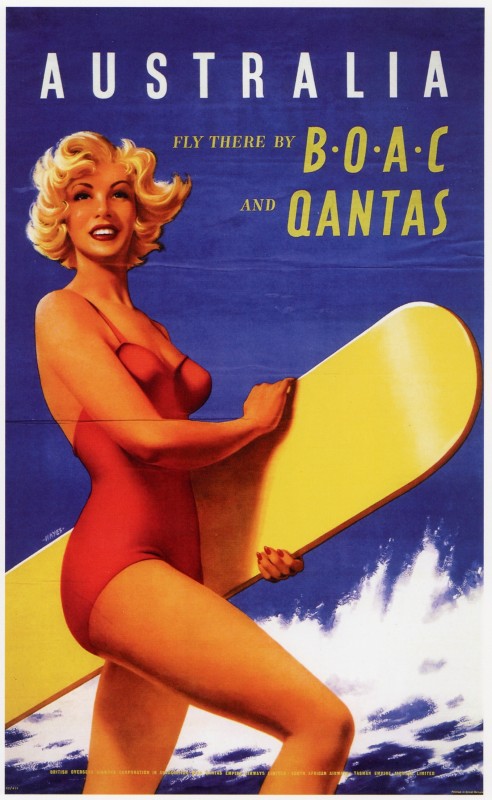 |
Paipo
significance: a poster promoting BOAC and Qantas airlines features a
bathing beauty sporting a bellyboard (also called a surfboard in the
U.K. and Australia before the 1970s). In the on-line article promoting the book there appears to be a slight discrepancy on the date of the poster. Above the poster the article states, "...a 1958 poster depicts a bikini-clad, surfboard-holding blonde below the words “Australia – Fly there by BOAC and Qantas”.Image sourced from the on-line article: Business Traveller. (2012, July 16) BA launches aviation poster book - Business Traveller. Retrieved May 04, 2013, from www.businesstraveller.com/news/ba-launches-aviation-poster-book. The bottom of the poster in the book states, "British Overseas Airways Corporation in Association with Qantas Empire Airways Limited - South African Airways - Tasman Empire Airways Limited" Thanks to Philip Zibin for the article referral. |
|
| Overall observation | A couple of questions about dating of the poster -- 1956 or 1958 -- and the woman is certainly not wearing a bikini! The book cites the poster as c.1956. |
||
|
Aguirre, David. 2007. Waterman's eye: Emil Sigler--surfing San Diego to San Onofre, 1928-1940. San Diego: Tabler and Wood. |
|||
| Cover |
 |
This book contains one image with a paipo/bellyboard pictured in the foreground (see below). Photo caption: "A crowded surfing contest at San Onofre in 1938. Five years before this, there had only been a handful of surfers at San Onofre. The Old Mission Beach gang did not compete, but watched carefully to see how the other guys surfed. The San Diegans' boards, which had only 1 inch fins, were not well suited to competition." Click on the photo for a close-up snippet of the board. |
|
| Photo on p. 77 |
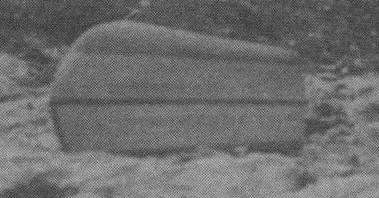 |
||
| Overall observation | Unusual photo of an early paipo board, ca. 1938. |
||
|
Allen, Jim Lovic. 1970. Locked in: Surfing for life. South Brunswick: A.S. Barnes. |
|||
| Title page and Contents [PDF] and Introductory Chapters |
|
This book on surfing for life is written by an older man, especially for the late-1960s era. Allen states, "I am a 41-year-old family man, a respected community member, and a university professor who holds the Ph.D. degree. I am also a confirmed surfer." This is in contrast to the youthful, rebel stereotypes of the era. He goes on to state, "...most older men look upon surfing as either a frivolous waste of time or an activity appropriate only for youngsters - if for anyone at all." He also talks about surfing as a fad, the increasing commercialism of the sport and paradoxically the high degree of conformity within the surfing community. | |
| Ch. 9, pp. 130-133, Body Surfng and Bellyboarding | Of
the four
pages devoted to body surfing and bellyboarding, 2.5 pages cover body
surfing and 1.5 pages are on bellyboarding. No section covers hand
boarding or kneeboarding. Key passages include:
|
||
| Overall observation | Although published in 1970, the first edition is mostly written in a mid-1960s flavor with a longboard orientation except in the chapter "The Boards." There are tons of photos but none of bellyboarder/paipo riders. The terms bellyboard and paipo ("as they are called in Hawaii) are both used. In the glossary defines paipo, but not bellyboard, "Paipo: the Hawaiian term for a bellyboard. See Chapter 9." There is no real discussion of board lengths, widths, thickness or plan shapes. | ||
|
Ash, Dick. 1994. Bellybogger: The fastest way to get your guts across a wave. Byron Bay NSW, Australia: The Author. |
|||
| Short Booklet | 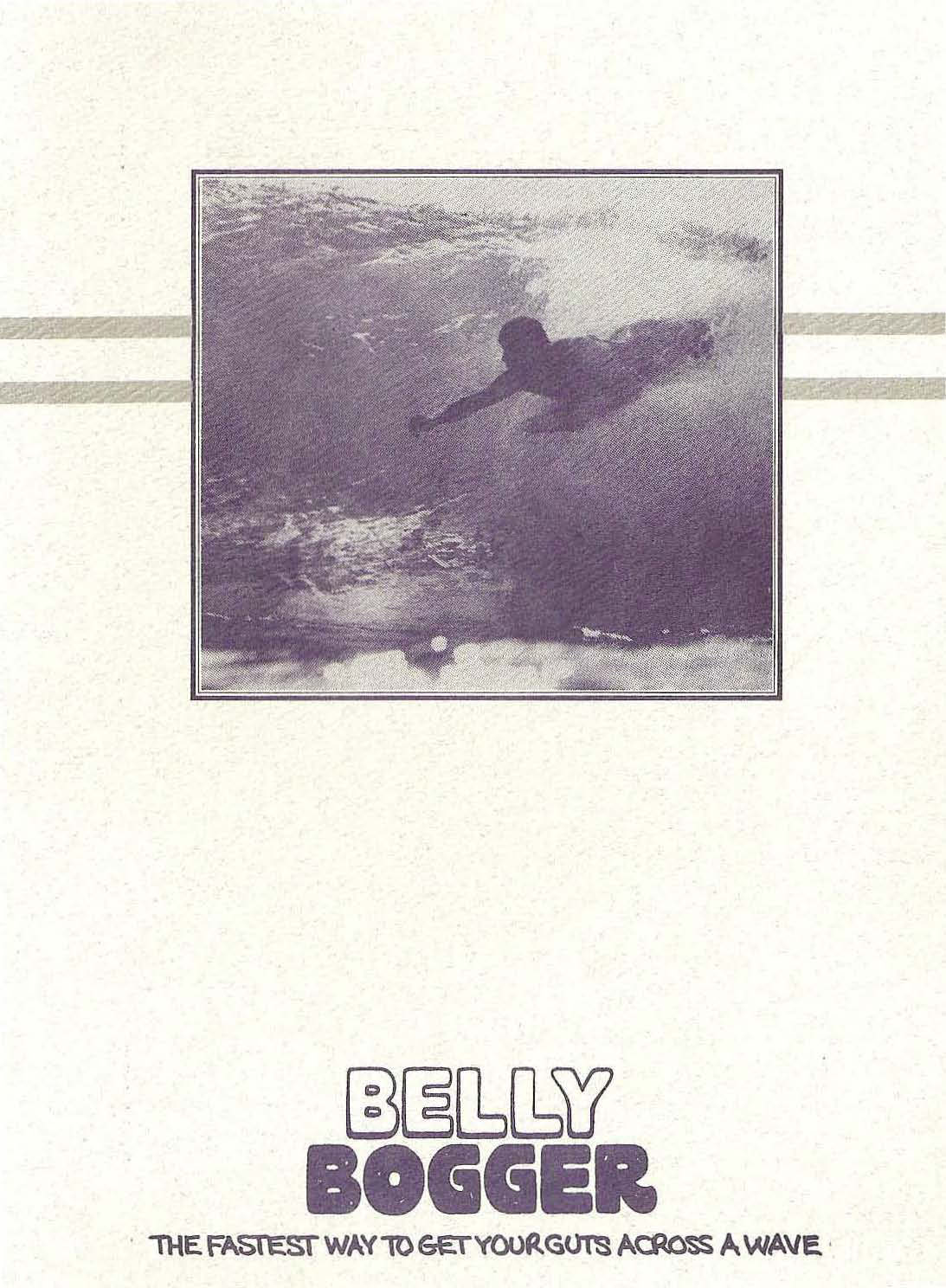 |
A few snippets
from the booklet:I realise that the Bellybogger is not everyone's answer to surfing. But, I believe there's a small group of enthusiasts out there who still know what the art of bellyboarding and bodysurfing is all about.Download and read the 12-page booklet here. [PDF, 3.5MB] |
|
| Overall observation | The Bellybogger inventor and author of the booklet establishes early on that the Bellybogger bellyboard/paipo is not for everyone but that it is the board of choice for many. In the booklet, Dick Ash describes the evolution of the Bellybogger and compares and contrasts it with the boogieboard. He explains how the board has been designed for speed. | ||
|
Bartlett, Vernon, and Maurice Bartlett. 1953. You and Your Surfboard. London: The Author. (With additional illustrations by Maurice Bartlett.) |
|||
| Pages 3 & 4, selected excerpts | 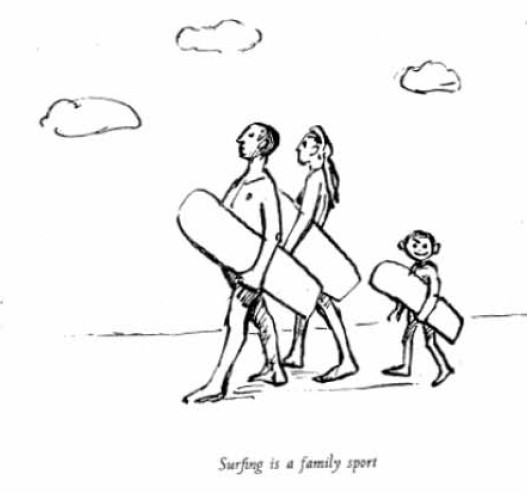 |
Booklet in
PDF: You may download the booklet here.
Note that in the quotes below that there is no reference to stand-up
surfboards. [
|
|
| Editor's Note | The pictured boards appear to be about 50 inches long. It would be interesting to know the length and width of Bartlett's boards and the dimensions of the boards used in Durban, South Africa. | ||
| Overall observation | An enjoyable read. The illustrations and writing are sure to bring a smile to your face as you browse through this book about one's joy in surf riding. The title may be a little misleading since the booklet is about waveriding with a bellyboard (paipo) and not the "surfboard" ridden in the erect style, such as on a longboard or shortboard. This booklet may be the first documented riding of paipos in the far reaches of the world, including the shores of England, Sri Lanka (formerly Ceylon), South Africa (Natal and Cape Town) and West Africa. This booklet was privately printed around 1950, with a couple of editions. Through much diligence over quite a few years a copy was finally acquired by Henry Marfleet (known as "bluey" on the paipo forums). Bluey says, "It was well worth the wait." | ||
|
Beattie, H. 1919. Traditions and legends. Collected from the natives of Murihiku. (Southland, New Zealand) Part XI. Journal of the Polynesian Society, 28(112), 212-225. For access to the article on the Internet click here. |
|||
| Pages 221-222. | SURF-BATHING. At least four of the old men mentioned the sport of surfing, as follows:—“The young Maoris would swim out with a short board, put it under the chest and shoot in on the waves. I remember round at Kakararua (Hunt's Beach, Westland) we were at it, and a white man named Baker would try it. He was a big, heavy man, and when he came in his board struck the shore and almost stunned him. His chest was rather severely hurt.” “The board used in surfing was called a papa, and it requires certain practice to use it. You must keep the end of it up just as you reach the beach or it will dig into the sand and perhaps break your ribs. The board was about four feet long perhaps, and came in like an arrow. I was round at the West Coast diggings, and the beaches there are very suitable for it. Another sport was when the boys would take a tawai (a kind of canoe) out and come in through the surf. They would capsize sometimes but that was all the more fun.” “I never saw the sport of surfing, but know that a papa or surf-board was used. I have heard that in the whaling days old Takata-huruhuru went surfing in the bay at Port Molyneux. He was a descendant of the people who came south in the Makawhiu canoe.” The late Tare te Maiharoa said:—“Take kelp off the rocks and dry it as for pohas or kelp bags [to preserve birds in]. Take two of these bags and tie them together about two feet apart. Blow them up, and having got them out beyond the surf, put one on each side of you from the armpits to the hips, lie on the flax connecting them, and come in with the breakers. It is fine sport and you cannot drown. This was an old pastime at Moeraki, Waikouaiti, and other good beaches, and was called para. (He pronounced it pālă.) In the old Maori days there were very few sharks about—they have only come in any numbers since the European fishermen throw the fish-heads back into the sea.” The names papa and para are interesting. The collector looked up Tregear's Dictionary, and in it he notes that in Hawaii a surf-board is called papa, and in Tahiti it is named papahoro. As for para the nearest appropriate meaning seems to be “the half of a tree which has been split down the middle” (and hence may be cut down into a surf-board) but perhaps Maori scholars could help to explain the term para. |
||
| Overall observation | Two interesting
observations: (1) the Maori rode a form of paipo board, the papa
and (2) a form of surf mat, the para. Methodology question as to when the interview(s) were conducted, the ages of the people, and a specific time reference, per "The question of acquatic sports cropped up in conversation with the old men, and here is what they said... ." on page 221. One person cited on p. 222, Tare te Maiharoa, had recently passed away (see p. 225). When were the whaling days old Takata-huruhuru? |
||
|
Blackburn, Mark. 2000. Hula girls & surfer boys, 1870-1940. Atglen, PA: Schiffer Publ. |
|||
| Cover and About the book. |
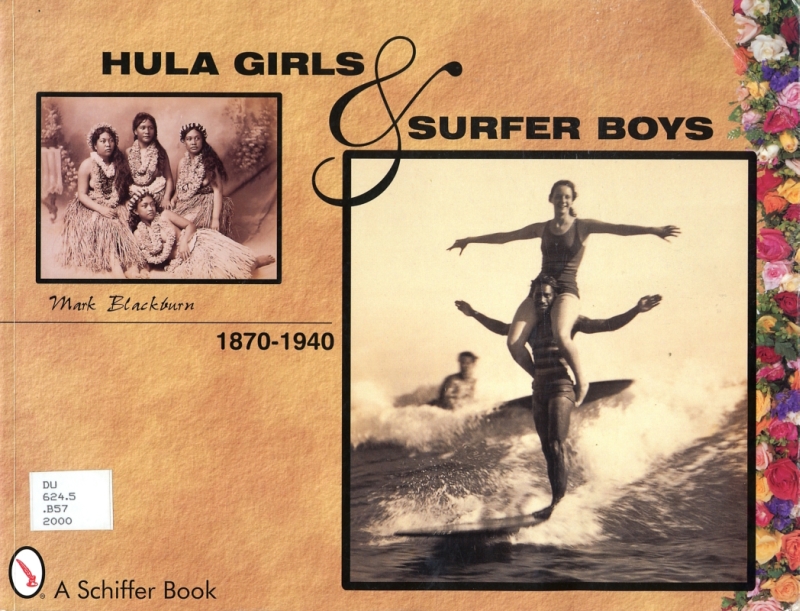 |
About the book: Powerful portrayals of Hula and surfing in the past represent the quintessential Hawaiian experience. Over 270 original photographs and post card images are presented chronologically from 1870 to 1940 to portray the evolving styles and popularity of these icons of Hawai`i. The Hula and surfing traditions both are deeply rooted in legend and myth and Hula dancing was actually outlawed for over 60 years. Surfboards were highly prized by the ancients and the sport became reserved for Hawai`i's kings. These enchanting images include famous personalities including Duke Kahanamoku as well as unknown practitioners of their arts. [inside cover] |
|
Preface / Introduction |
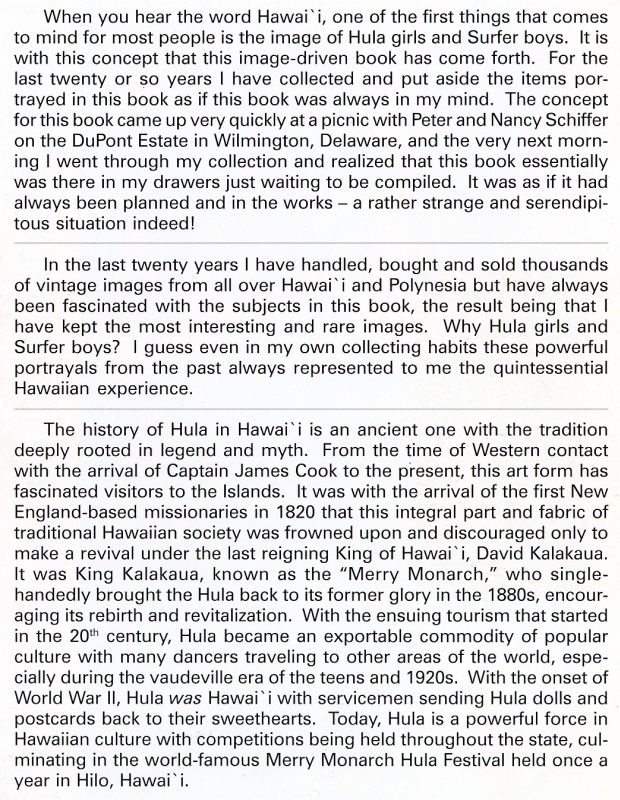
The author's introductory statement on the Hula and surfriding are on pages five and six [text only]. The preface begins, "When you hear the word Hawai`i, one of the first things that comes to mind for most people is the image of Hula girls and Surfer boys. It iswith this concept that this image-driven book has come forth. |
||
|
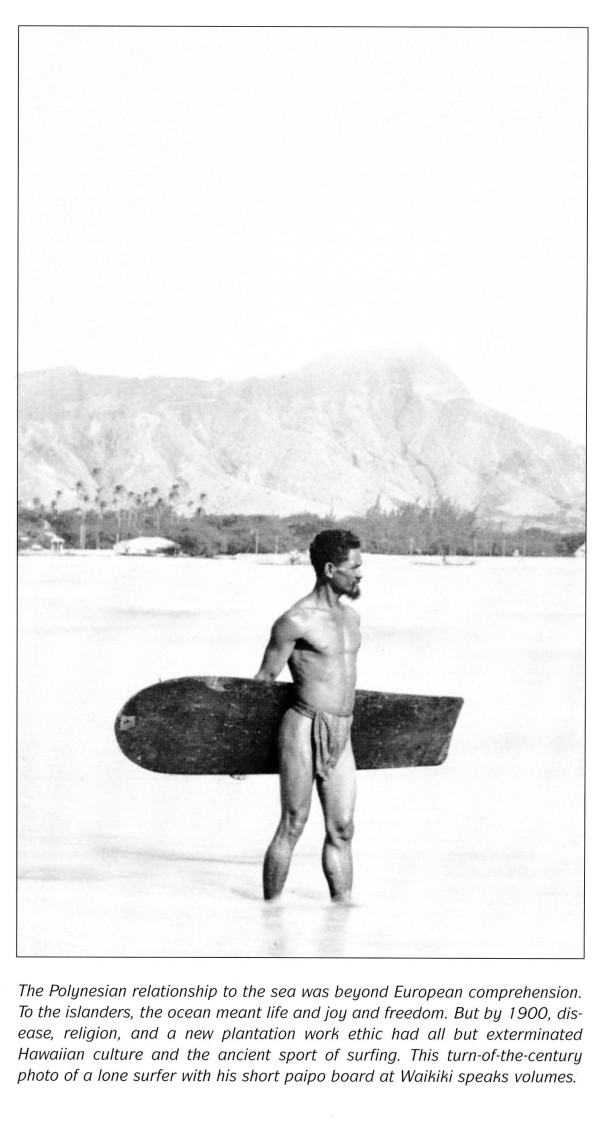
Pictured below is a popular pose of a native holding a surf board with the scenic Diamond Head in the background. This image is of significance in the paipo surfing world because the man is holding a paipo and not an alaia surfing board. The board in this photograph appears to be around 48 inches long with a very parallel planshape compared to the typical board shown in these images that measures at least 5-foot long and is wider overall (especially so in the nose). For example, see the image below from p. 28. Native With Surf Board (p. 9). 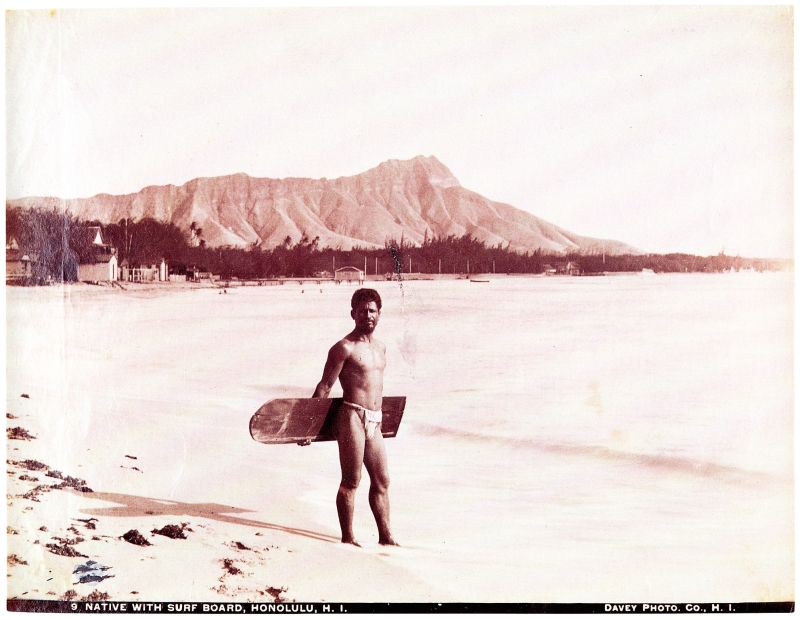 The sourcing of this image is: Davey Photo. Co., “9 Native With Surf Board, Honolulu, H.I.,” Hawaiian Historical Society Historical Photograph Collection, accessed July 1, 2013, http://www.huapala.net/items/show/6544. In Timothy Tovar DeLaVega's Surfing in Hawai'i 1778-1930 [p. 32], he notes that London-born Frank Davey, Davey Photo Co., was very prolific, although Davey only documented Hawai`i from 1897 to 1901. |
|||
|
Native holding an Alaia-style surfing board (p. 28). 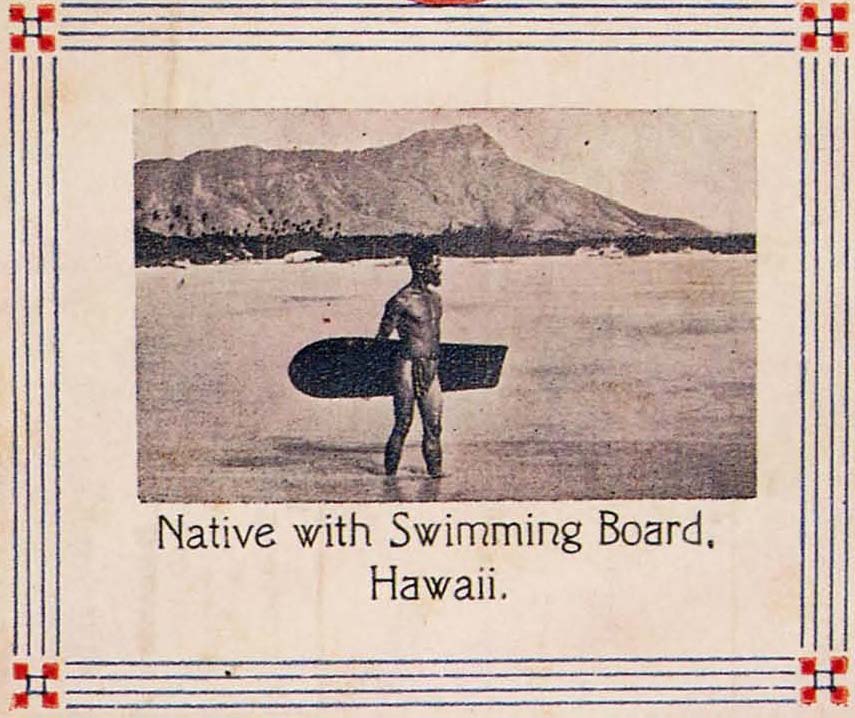 Snippet from Postcard, "Native with Swimming Board, Hawaii." Copyright 1908 by Franz Huld Company, New York |
|||
|
Another common scene showing kids prone riding the waves onto the shore is shown below (p. 36).  Two surfriders riding kipapa-style on their alaia or paipo boards (p. 96). 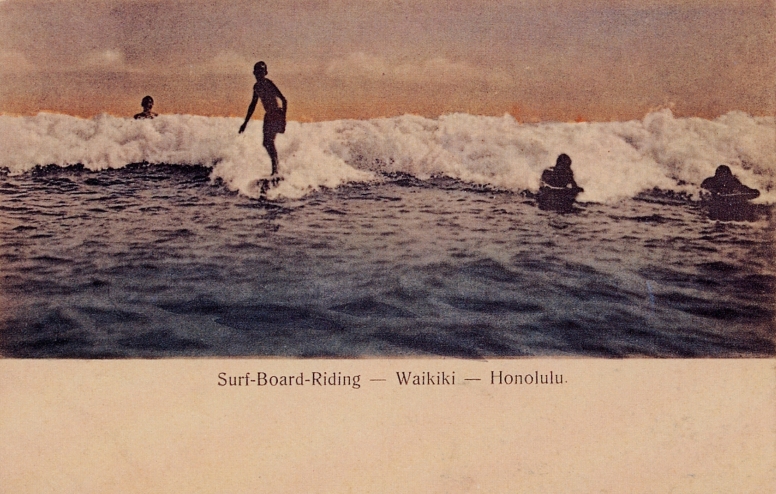 This post cards appears on the bottom half of p. 96. |
|||
| Overall observation | Hula Girls & Surfer Boys
is rich in photographic and post card history documenting two important
components of Hawai`ian history and culture. Maybe my eyes were not
sufficiently open before but there is a treasure trove of Hula-related
images in this excellent book. The post card image on page 9, is significant in showing a person holding a paipo instead of an alaia surfriding board. |
||
|
Clark, John R. K. 1977. The Beaches of O'ahu. (A Kolowalu book). (Rod's Note: I have not seen the 2005 revised edition.) |
|||
| Page 9, in the
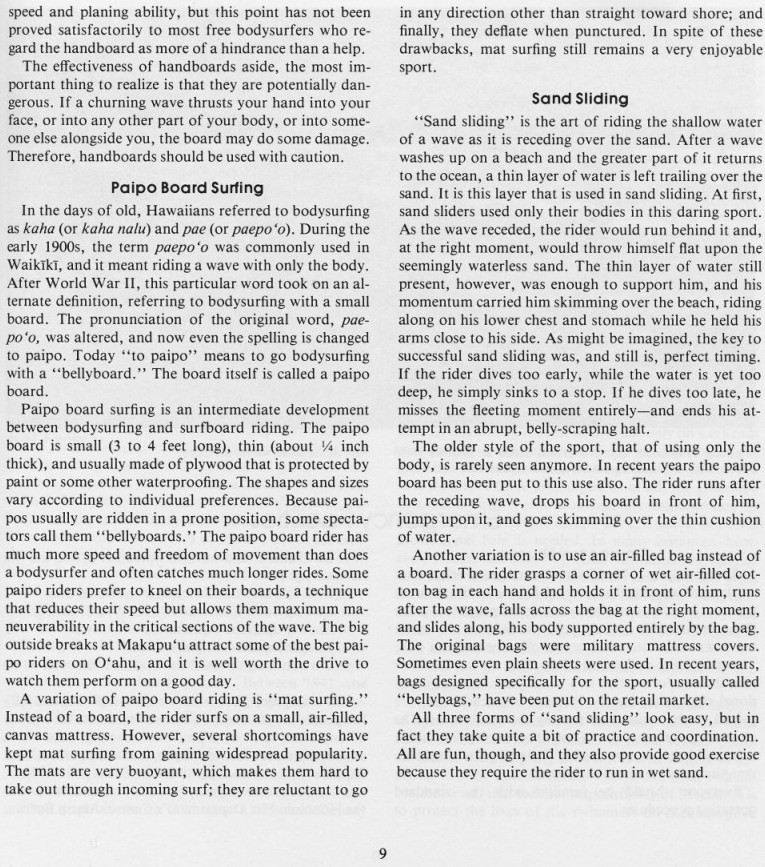
section titled "Paipo Board Surfing" JPG (300KB) PDF (600KB) |
 |
Origins of a
word: The first paragraph reads: "In the days of old, Hawaiians
referred to bodysurfing as kaha (or kaha nalu) and pae
(or paepo`o). During the early 1900s, the term paepo`o
was commonly used in Waikiki, and it meant riding a wave with only the
body. After World War II, this particular word took on an alternate
definition, referring to bodysurfing with a small board. The
pronunciation of the original word, paepo`o,
was altered, and now even the spelling is changed to paipo. Today "to
paipo" means to go bodysurfing with a "bellyboard." The board itself is
called a paipo board." The second paragraph describes paipos and paipo riding: "Paipo board surfing is an intermediate development between bodysurfing and surfboard riding. The paipo board is small (3 to 4 feet long), thin (about 1/4 inch thick), and usually made of plywood that is protected by paint or some other waterproofing. The shapes and sizes vary according to individual preferences. Because paipos usually are ridden in a prone position, some spectators call them "bellyboards." The paipo board rider has much more speed and freedom of movement than does a bodysurfer and often catches much longer rides. |
|
| Some paipo riders
prefer to kneel on their boards, a technique that reduces their speed
but allows them maximum maneuverability in the critical sections of the
wave. The big outside breaks at Makapu`u attract some of the best paipo
riders on O'ahu, and it is well worth the drive to watch them perform
on a good day." The third paragraph describes mat surfing: "A variation of paipo board riding is "mat surfing." Instead of a board, the rider surfs on a small, air-filled, canvas mattress. However, several shortcomings have kept mat surfing from gaining widespread popularity. The mats are very buoyant, which makes them hard to take out through incoming surf; they are reluctant to go in any direction other than straight toward shore; and finally, they deflate when punctured. In spite of these drawbacks, mat surfing still remains a very enjoyable sport." |
|||
| Overall observation | |||
|
Clark, John R. K. 2002. Hawaiʻi Place Names: Shores, Beaches, and Surf Sites. Honolulu: University of Hawaiʻi Press. |
|||
| Page 302 from the story about the beach named Pololū |  |
Origins of a word: The term "paipo" may be derived from the clandestine Hawaiian word, paepō, as told in the following mo‘olelo (or, story) by Alfred Solomon to John Clark: "I was born on September 15, 1905, and I'm a cousin of Bill Sproat... I have two papa paepō in my artifact collection. They're two small concave boards about 1/4-inch by 1 foot by 3 feet made of wiliwili, and they were used for spying. The spies selected a night with rough seas and then surfed in to gather information about various activities. The boards were easily concealed. I heard this from the old people and they said that's why the boards were called paepō, "night landing." - Alfred Solomon, June 25, 1982 | |
| Overall observation | John Clark does a wonderful job documenting and describing the names and uses of beaches in the Hawaiian islands by interviewing people who lived and used them. One of his styles of interviewing is through the collection of stories (mo‘olelo) of a beach. As Clark states in the preface, "One of the important rules about place names in the Hawaiian language is that you never know the true meaning of a name unless you know the mo‘olelo, or story, that goes with it." | ||
|
Clark, John R. K. 2011. Hawaiian Surfing: Traditions From the Past. Honolulu: University of Hawaiʻi Press. |
|||
| TBD. See Wally Froiseth paipo
board logo. |
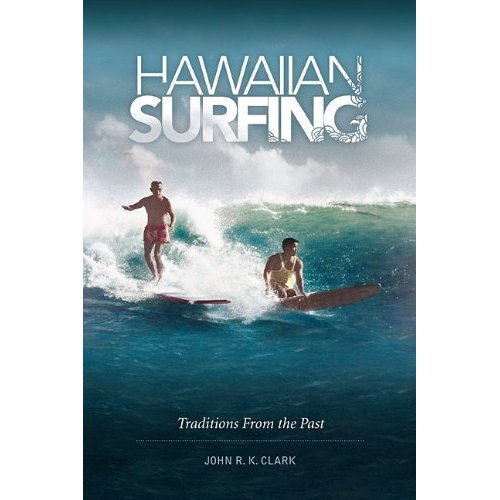 |
See the New York Times op-ed article here. Lawrence
Downes. (2011, July 7). Big Boards, Banana Stalks and Everybody in the Waves [book review of "Hawaiian Surfing: Traditions from the Past" and "Waves of Resistance: Surfing and History in Twentieth-Century Hawaii"]. The New York Times, p. A22. Retrieved July 11, 2011, from http://www.nytimes.com/2011/07/08/opinion/08fri4.html Origins of a word: John Clark's forthcoming book identifies and describes the types of surfing that native Hawaiians did, one of which was pae po'o, or prone board riding. He notes that while it's true that "paepo" can be translated as "night landing" (as noted in the mo‘olelo by Alfred Solomon), Clark has since learned that the original word was actually "pae po'o". The following is from the manuscript: "In the earliest descriptions of surfboards by Hawaiian scholars, the smallest boards, those that were shorter than six feet in length, were generically called papa li`ili`i, or "small boards." During the early 1900s, the name papa li`ili`i was changed on two fronts with non-Hawaiian surfers calling them bellyboards, because they were most often ridden prone, the rider laying on his or her "belly," and with Hawaiian surfers in Waikiki calling them pae po`o boards. |
|
| Pae po`o is an interesting word. It does not appear
in any Hawaiian dictionaries, Hawaiian language newspapers, or writings
of the prominent Hawaiian scholars of the 1800s, such as `I`i, Kamakau,
Kepelino, and Malo, who described traditional Hawaiian surf sports. The
term appears to have been coined by Hawaiian surfers in Waikiki circa
1900, where it was commonly used to mean bodysurfing or bodysurfing
with a small wooden bodyboard. The literal translation of pae po`o
is "ride [a wave] head-first", or in other words, bodysurf, and a papa
pae po`o was a bodysurfing board, or what surfers today call a
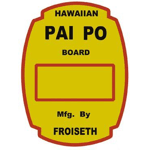
bodyboard. In everyday conversation, pae po`o was often shortened to pae po, which is common among Hawaiian words that end with double "o's," such as Napo`opo`o on the island of Hawai`i, which is often pronounced Napopo. The popular spelling used today, paipo, was coined by Hawaiian surfing legend Wally Froiseth, who, besides being an excellent surfer, was an exceptional paipo board rider who was famous for standing on his twin-fin board while riding big waves. From 1956 to 1986, Froiseth made approximately 150 paipo boards, which he sold to friends and other surfers, putting a decal on each board to identify it as his product. No one before him, however, had ever spelled pae po, so without the benefit of seeing the word in print, Froiseth spelled it as he heard it, pai po. His decals read, "Hawaiian Pai Po Board. Mfg. by Froiseth." Froiseth sold some of his boards to surfers from California, which helped to introduce the word and its spelling outside of Hawai`i, and today paipo is the accepted term for wooden bodyboards." |
|||
| Overall observation | Historic documentation for the word, paipo. | ||
|
Cralle, Trevor. 2001. The Surfin'ary: A Dictionary of Surfing Terms and Surfspeak. Berkeley, CA: Ten Speed Press. (2nd Ed.) |
|||||
| Road Map to Sources |  |
|
|||
| Definitions | Listed below are
several of the terms related to prone riding that are listed in The
Surfin'ary: alaia board n. An ancient Hawaiian board for bodysurfing. (DM) belly board or belly board n. A small surfboard used primarily to ride the waves on your stomach, but It can also be ridden kneeling or standing. (MF) Same as PAIPO BOARD. bellyboarding n. Bodysurfing with the aid of a planing device, such as a small hand-held kickboard or surfboard. bodyboard n. Originally a BOOGIE BOARD, but now includes soft foam boards with a hard plastic or fiberglass covering. bodyboarder n. Someone who surfs using a bodyboard. bodyboarding n. Riding a bodyboard in the surf. Bodyboarders originally rode lying down, but now they occasionally stand up. See BOOGIE BOARD. bodysurfer n. 1) A surfer who rides the waves with the body alone; swim fins are sometimes used to help propel the bodysurfer through the wave. 2) Someone who uses the body as a wave vehicle. bodysurfing or body surfing or body-surfing n. The art of riding the waves without a surfboard, using the body as a planing surface. Side caption on page 51: Bodysurfing is considered by some to be the purest form of surfing. The sport was invented by marine mammals such as dolphins, seals and sea lions. Unlike their marine counterparts, however, humans occasionally need to wear swim fins to help them generate enough speed to catch a wave. boogie board n. A soft, flexible foam bodyboard, which can be used in flagged areas. (MW) The original Boogie Board (a brand name) was invented by Tom Morey in 1971. The most widely used surf riding implememt of all time, ridden prone and with or without swim fins. Coolite n. 1) An Australian brand-name for a Styrofoam trainee surfboard. (MW) 2) The first board of most Australian grommets, including MR, Rabbit, and Barton Lynch. (SFG, 1989)
kneeboard n. A surfboard, usually short (fIve to six feet In length), ridden on the knees. (NAT, 1985) kneeboarder n. A surfer who rides a kneeboard. kneeboarding n. Surfing on the knees on a specialized board. The rider can maintain a compact and stable position, good for quick, radical maneuvers, and tube riding. lay down surfing n. BODYBOARDING Lilo (lie-low) n. Australian brand name for an inflatable vinyl SURF MAT. No Aussie ever talks about a raft. McDonald's tray n. Cafeteria-type plastic tray used for bodysurfing planing aide. First used by Hawaiians in Waikiki and now used by many a surfer around the world. On Oahu, frequent "borrowIng" of these trays caused the fast-food restaurants to drill holes into them. Morey Boogie n. The original Boogie Board invented by Tom Morey in the 1970s; developed from aircraft foam. See BODYBOARD, BOOGIE BOARD. paipo, paipo board (PAY-po) n. A small polyurethane-foam bellyboard used in the Hawaiian Islands. skimboard or skim board n. A rounded plywood or fiberglass board two or three feet across, used to slide over the shallow water at the water's edge. skimboarding, skimming n. Standing up on a flat board and riding it along the shoreline on top of a thin layer of water. Also called SANDSLIDING. skitter board n. 1) A fast, finless, flat-bottomed bellyboard or paipo board about farly-two Inches long and thirty inches wide and around three-eighths of an inch thick--one of the fastest wave-riding devices. 2) An old term for SKIMBOARD. surf-o-plan n. [Note: I neglected to copy this one down.] |
||||
| Ancient Hawaiian Terms (PDF, 360KB) | The Surfin'ary provides a good, concise collection of ancient Hawaiian surfing terms terms. The list relies heavily on secondary sources, such as the listing of terms in the excellent Ben Finney and James D. Houston book, Surfing--The Sport of Hawaiian Kings, and the lexicon in the Gary Fairmont R. Filosa II book, "The Surfer's Almanac: An International Surfing Guide." The list of terms relies less on a close review of original source material such as the seminal dictionary by Lorrin Andrews, "A Dictionary of the Hawaiian Language To Which Is Appended an English-Hawaiian Vocabulary and a Chronological Table of Remarkable Events [1865]." For example, conspicously missing from this listing are two terms, pae (to be carried along by the surf towards the shore; to play on the surf-board) and aupapa (losing one's board, or "wipe-out"). Nonetheless, this is probably one of the best consolidated listings of ancient Hawaiian surfing terms one will readily find. | ||||
| Overall observation | My
optimism on the overall potential of this book disappeared as I read
and browsed through it. Some of the definitions related to prone
surfing are almost hilarious, but upon a second glance would simply benefit
from a refreshing update. The book appears to be heavily influenced by
the author/editor's California and "pure, stand-up" roots. For example,
this passage from early in the book, "What is Surfing?""Surfing is a thrilling water sport for persons of all ages thaI has been practiced for centuries. The act itself involves riding across the face of a wave toward the shore while standing on a special board, called a surfboard. Modern surfboards are made of foam and fiberglass and come in various shapes and sizes, from short boards to longboards and everything in between.A close attention to the ancient history of surfing reveals a rich history of bodysurfing and board riding prone, kneeling, and sitting, in addition to standing. There is nothing "pure" about riding a board in the stand-up position. It also strikes me as peculiar, or even naive, to call a kneeboard a "specialized surfboard." There are probably about twenty derogatory terms for bodyboarding sprinkled throughout the dictionary plus a special section in the appendix, but there is no such attention to detail for "stand-up statue riders." Nonetheless, there are several highlights sprinkled throughout. Note: I have not reviewed the first edition. |
||||
|
DeLaVega, Timothy Tovar. 2011. Surfing in Hawai'i 1778-1930. Arcadia Pub. |
|||||||||||||||
| Title page and Contents and Acknowledg- ments [PDF] |
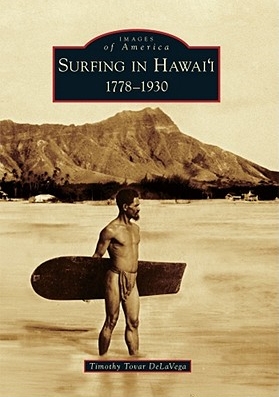 |
The
publisher describes the book, "In this volume, Kauai resident and surf
historian Timothy DeLaVega has orchestrated a worldwide team of surfing
historians, who have compiled surfing images that span the centuries
from ancient petroglyphs (rock etchings) to the first modern surfing
boom at Waikiki. These images offer a unique and historical
perspective, with many never-before-seen images of surfing in Hawai'i." In the acknowledgments, DeLaVega states, "This project was done to properly identify the early photographers/artists as well as establish a proper timeline of early surfing images. We hope you enjoy our discoveries and that this will promote future research. This book could never have been accomplished without a worldwide TEAM (Together Everyone Achieves More) of dedicated surfing fanatics who have again combined energy to create our third project in 10 years. This book is an example of aloha (affection, love, and peace), as each door I knocked on was opened wide with warmth and love." |
|||||||||||||
|
|
|||||||||||||||
|
|||||||||||||||
| Overall observation | Since John Clark's recent publication, Hawaiian Surfing: Traditions From
the Past (2011), this is the first book, to my knowledge, to use the term papa li`ili`i, the origins of the
word, paipo. DeLaVega does a fine job once again in putting together a book intended for people with an appreciation of wave riding history and traditions, and a love for he`e nalu (wave sliding). A solid addition to any collection of surfing books. |
||||||||||||||


|
DiMauro, Danny, and Johan Kugelberg. 2024. I Heard There Were No Waves in New Jersey : Surfing on the Jersey Shore 1888-1984. New York: Rizzoli International Publications. |
|||||||||||||||
| Cover, Title page and Contents and inital book sections |
 |
This
is a large format coffee table book full of photographs reflecting New
Jersey surf culture from the late-19th century through the 1980s–about 100 years. Most pages feature a single figure or a
two-page spread of a single figure with a small descriptive caption.
There are many nice beach crowd, surfing contest and bikini shots
although the authors are diligent in representing women's role
throughout New Jersey's surfriding history (after all the first surfing
of New Jersey's waves was done by the Sandwich Island Girl (the former name of the Hawaiian Islands. A short article in the book by surf historian, Mike May, outlines some historical waveriding milestones:
|
|||||||||||||
| Section: Beneath the Surfing Underdog, written by ed. Johan Kugelberg. |
One intriguing
historical fact on paipo/bellyboarding in New Jersey emerges in this
solemn litany of New Jersy as underdog surfriding:"By 1917, visiting Hawaiians had constructed wooden belly boards that were in use at several Atlantic City beach hotels." [p. 137]Kugelberg summarizes in the last paragraph of the one-page narrative section, "When Danny and I started working on this project, we were truly lucky to find these caches of unseen masterful photography, and to have been steered in the direction of treasure troves of cultural remains. This book is steeped in romanticism and the picturesque, certainly: the stuff is so cool and visual, and the photography is like stepping inside a gentler time with better clothes. But more than that, I hope this book is a useful stepping stone toward the unveiling of more and more historical and cultural narratives."My appetite was whetted by the above statement in expectation that several historical photographs would emerge. Alas, the following 20+ pages were mostly of 1964 longboarding. Nonetheless, there is promise in learning more about the 1917 bellyboard revolution in Atlantic City! |
||||||||||||||
| Section: Ephemera. This section compiled and written by editors Johan Kugelberg & Danny Dimauro. |
|
||||||||||||||
| Section: A History of Surfing in New Jersey (pp. 236-7) |
|
||||||||||||||
| Overall observation | Not much documentary information on paipo/bellyboard surfing except for some lines in passing. This "surf history in fine pictures" focuses mostly on vertical stand-up surfriding but there are a couple of photos of wave ski surfing and one photograph of an alaia or paipo board. The narrative does mentions raft/mat surfing and skim boarding and boogie/bodyboarding, including on an ironing board. I do not recall a written or visual mention of kneeboarding. Several interesting leads to follow-up on. | ||||||||||||||


|
Dixon, Peter L. 1965. The Complete Book of Surfing. New York: Coward-McCann. Dixon, Peter L. 1967. The Complete Book of Surfing. New York: Coward-McCann. (2nd Ed.) |
|||
| Cover, Note
& Contents. Ch. 1, The History of Surfing |
 |
Just for
the record. Click here for
the Table of
Contents, (100KB, PDF). Chapter 1, The History of Surfing
|
|
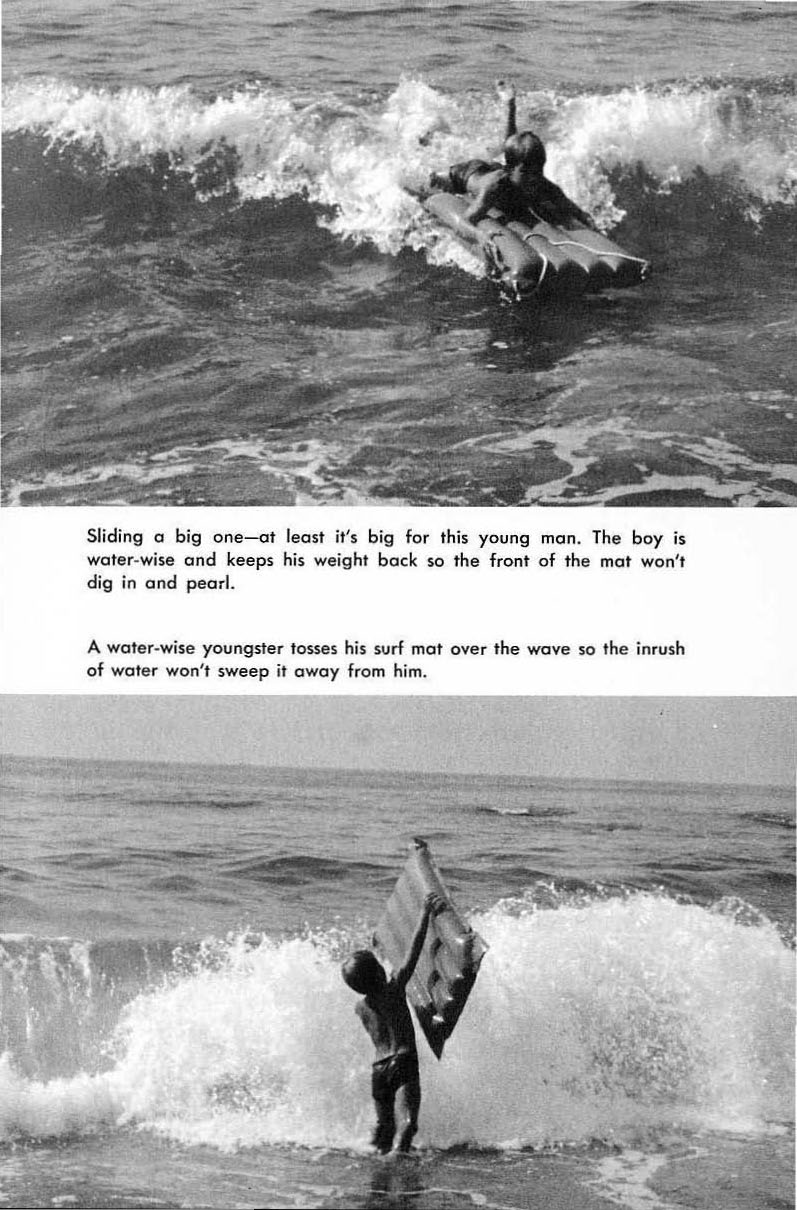
| From Chapter 11, Surf mats, Bellyboards, and Dories (800KB, PDF) | Paragraph
two reads, "Bellyboards are really
little surfboards. Several types are now in use--some are simply flat
pieces of wood with a rounded nose and others have one or two skegs.
The modern commercially made bellyboard is like a full-size surfboard,
except the dimensions have been scaled down. Both mats and bellyboards
are propelled with swim fins on feet and arms paddling." (See the mat surfing pictures from p. 137.) "The Bellyboard" section of the chapter begins on page 139, "The bellyboard is really just a short surfboard. Years ago bellyboards were short wooden planks with rounded ends. Surfers made the start while standing on the bottom and always rode the bellyboard in the white water. The modern bellyboard has grown a skeg, a covering of fiberglass and an inner core of foam. These are very fast, and on the right wave they can go faster than a surfboard. In Hawaii the bellyboards are called paipos and are ridden right along with surfboards, even in the big surf at Sunset Beach." Note the comment in paragraph two, "On medium-size, well-formed waves the little boards are ideal; in fact they're almost as much fun as riding a conventional surfboard." [Editor's Note: Also as fun???] 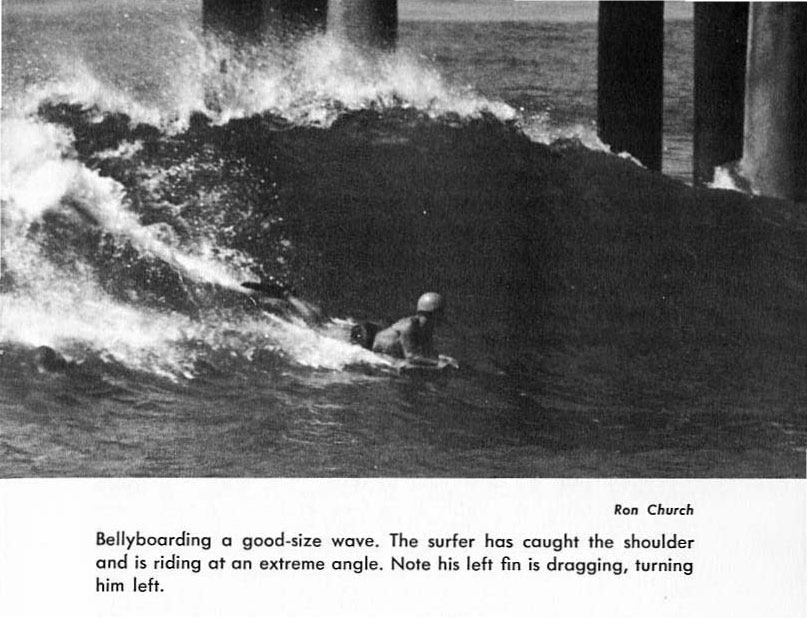 Picture on page 141. |
||
| Glossary (260KB) |
|
||
| Overall observation | The
book is written in a "popular-style" for a wide audience that covers
many of the bases for introducing standup surfing and other various
forms of waveriding, in particular mat surfing and dory surfing. The
2nd edition uses the terms bellyboard and refers to the Hawaiin name, paipo
board. The 1st edition appears to be virtually the same as the 2nd edtition. No material to add or change. |
||
|
Dixon, Peter L. 1966. Men and waves; a treasury of surfing. New York: Coward-McCann. |
|||
| Cover & Contents. |  |
Overall
observation. An excellent compendium of exceprts from surf-related
publications by several well known authors including James Michener,
Jack London, Tom Blake and Willard Bascom. In the introduction, Peter
Dixon writes, "This book, then, is a colorful collection of man's
relations with the surf as written and photographed by surfers and
those splashed by the waves' spray. The profesSional writers have
alsobeen inspired by the spectacle and experience of surfing." This book about surfing is divided into five sections: 1) the history; 2) the science of sea, waves, and beaches; 3) stories of the people who surf; 4) the adventures of man against the waves; and in the center section, 5) the photographs. |
|
| The book is a good read but unfortunately is light on other forms of waveriding, including bodysurfing, paipo boarding and kneeboarding (and others). There is one picture of a bodysurfer and no mention of paipo or bellyboarding. The book includess a citations page, but no other bibliography or index. | |||
|
Dixon, Peter L. 2001. The complete guide to surfing. Guilford, Conn: Lyons Press. |
|||||
| Title page and Contents |
 |
Excerpt from the book description on WorldCat:"This comprehensive how-to book explains the technique, etiquette, and secrets of surfing to any wave rider, be he absolute beginner or seasoned pro. Written by a fifty-year veteran, it first takes the reader step-by-step through such basics as paddling out and judging waves, and goes on to explore such topics as surf-board design, surfing hazards, and radical surfing. Additional chapters survey the world's best surfing areas, examine new sports such as body surfing and surfing Boogie Boards, and even supply tips on how to build your own board."Illustrated with more than 150 color photographs and illustrations. In Chapter 1, "Surfing 's Rich Legacy," the author writes on page 6: "Longer, better-riding boards and the best surfing breaks were reserved for members of the ruling class, the alii. These long boards, called olos, could reach 16 feet and weigh as much as 150 pounds. Commoners used shorter boards, called akaias, which were about eight feet long. Children surfed little planks called paipos, similar to today's bodyboards." [Note: The alaia is misspelled as akaia. Paipos were widely surfed by all ages and genders, not just children]. |
|||
| Ch. 9, pp. 166-175, "Bodyboarding" |
"Many of us who began bodyboarding some years back still call them Boogie Boards. I use the term "boogie" interchangeably with "bodyboard," to refer to the same small and simple, ride-on-your-chest, all-time fun, wave-surfing machine. Bodyboarders are also called "spongers," and the board itself, a "sponge." A skilled bodyboarder on a soft, three- to five-foot-Iong, five-pound boogie, helped along by swim fins, can perform almost every surfing maneuver--and a few more beyond the ability of stand-up surfers." p. 168.Subchapter, "Bodyboards, Past and Present," pp. 169-170: "Before today's flexible foam bodyboard became universally adopted in the late 1970s, there were several variations of these short, prone- or knee-riding surfboards. Bodyboards have always had three major advantages over traditional surfboards: They're easy to learn to ride, they cost much less than surfboards, and they're much more portable."The remainder of the chapter discusses the invention of the boogie board by Tom Morey, the board's general shape and contour, its widespread availability and accesories and equipment used in riding the "bodyboard." A subchapter of general interest is "Boogie Board Swim Fins," part of which states: "Bodyboarders use the same type fins as bodysurfers (see a discussion on fins on page 153 in chapter 8). Since bodyboarders seem to enjoy the more technical side of the sport, several variations of the classic swim fin have been developed and marketed. You'll have a choice of the traditional Churchills, Viper Duckfoots, the Redley fins favored by competitive bodyboarders, and an evolution of the Churchill called a"Slasherfin." Prices range from $35 to $ 75 a pair." pp.174-5. [Note: According to Fred Simpson, founder and owner of Viper Swimfins, there were never a "Viper Duckfoot." Duckfeet were marketed by Voit. It is a stretch to state Redley fins were favored by competitive bodyboarders.]In the next subchapter, "Let's Boogie," the author is spot on in his description of bodyboarding (and paipo/bellyboarding): "Once you've learned the basics, it's easy to catch waves with a bodyboard. Riding a Boogie provides a great workout that's truly fun. And, when the lifeguards raise the black ball flag (no surfing), bodyboarders can keep on riding." p. 175. [Note: Riding kipapa-style is a great workout that's truly fun!] |
||||
| Glossary | The
glossary is a bit more extensive with several "boogie board" related
terms. The definition for paipo remains virtually the same but no
longer included is the term "bellyboard."
|
||||
| Overall observation | This book is largely an updated, modernized version of The Complete Book of Surfing
(first and second editions, 1965 and 1967, respectively), including
numerous color photographs of shortboarding and more photographs of surf
breaks from around the world. The book has several chapters that appear
in the earlier books that cover everything from "how to surf" to safety
and equipment. There is no bibliography or use of footnotes but sources
are incorporated in the text in some places. The book includes a glossary of
surfing terms and an index. This 2001 edition replaces the 1960s chapter title of "Surf mats, Bellyboards, and Dories" with a streamlined "Bodyboarding," which covers early bodyboarding (paipos), boogie boarding and mat surfing. The chapter includes several very good bodyboarding color photographs but no photos of paipos or bellyboards. I was a bit disappointed in the inaccuracy of some of the information. Missed not reading a reference of surfing by Mark Twain (for example, see Twain, Mark. 1872. Roughing It, Part 8, Chapter LXXIII, "Surf Bathing." Hartford, Conn.: American Publishing Co.). |
||||

|
Dixon, Peter L. 2001. Men who ride mountains: Incredible true tales of legendary surfers. Guilford, Conn: Lyons Press. (see first edition [1969] note below. |
|||
| Cover & Contents. Short excerpts. Ch. 8, The History of Surfing |
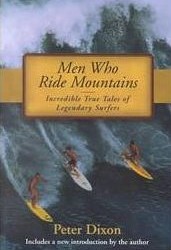 |
Ch. 8, The
Aussies, and Ch. 10, The Competitors,
are two short acknowledgments of George Greenough's impact on the world
of waveriding. There are several references to Greenough's belly board,
but I suspect this is a kneeboard - no mention is made of Greenough
belly riding or knee riding. For example, on page 121, "The Aussies
couldn't fathom George at first. They were expecting some sort of cool
American cat, polished and citified, which George is not. They were
also troubled by the fact that George didn't ride a surfboard, but only
his radical, self-designed fiberglass belly boards." Later on page 164,
Skip Frye is quoted saying, "Then Greenough came back from Australia
with his mind blown free of all preconceptions and he started a lot of
us looking in new directions. Greenough stressed surfing on anything
people could ride - mats, belly boards, boats, anything that could
capture a wave and slide fast. George designs surfingvehicles. It's as
simple as that." See the excepts here [PDF file]. |
|
| Overall observation | Excellent book on surfing from the early modern years through
the shortboard revolution of the late-60s with other selective updating
of the original 1969 edition, in this 2001 new edition. Well worth the
read for general wave riding history, but very little on the prone
riding world of surfing except the references to "belly boarding" above. Note: Bob Green, Paipo Research Project, reviewed the first edition (1969) and did not see any references to paipo or bellyboarding. |
||
|
Echegaray Eizaguirre, Lázaro, and Mikel Troitiño Berasategi. 2007. What the waves brought in: a history of surfing in Zarautz. Zarautz: Ayuntamiento de Zarautz, Departamento de Cultura. [Also published in Spanish and Basque -- see the Paipo Bibliography.] |
|||
| Title page and Contents [PDF] and Introductory Chapters Source(s) |
Cover page goes here. | This
book documents the origins of surfing in Zarautz, a coastal town
located in the province of Gipuzkoa, in the Basque Country, northern
Spain. In it is a chapter on "bodyboarding." The first chapter
summarizes the beginning of bodyboarding in this area:"The bodyboard came to Zarautz by way of a local carpenter, Marcelo Linazasoro, in the early 1950's. He had seen them on the French coast, at the Cote des Basques, in Biarritz, and he thought it would be a good idea to make some in Zarautz and rent them out on the beach next to the canoes. The French called it bodysurf, and some theories believe that this was the first form of surfing to reach Europe. It was used to catch waves lying down on top of the thing. It was a piece of wood that looked like an ironing board, but shorter, wider and slightly raised at the nose. For a long time, this was one of the most outstanding activities at the beach, competing with the "aspirin," also made of wood and similar to the bodyboard, but completely flat, rounder, and used to skim across the fine layer of water left on the shore after the wave retreated." [p.21]Eventually, swin fins enable more varied surfriding: "At the beginning ofthe 70's, kids started wearing swim fins and looking for the peak. Before this time, they would normally ride the white water onto shore. The swim fins allowed for them to catch the bigger waves."The sport of waveriding prone and the boards continued to evolve: "The kids would paint thelll with their favourite colors and designs, they would put fins and leashes on them, which were basically a piece of rope wrapped in plastic and with a wristband at the end. They even tried putting cork plaques onthe bottom so they would float more."The four-page chapter contained several interesting photographs of the materials used to form the bodyboard, or txampero in Basque (see a couple of sample figures below). |
|
| Chapter on Bodyboarding, pp. 20-23 |
Homemade bodyboard press 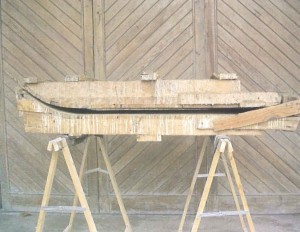  Source: pages 20 and 23. |
||
| Overall observation | Local paipo boarding began after watching surfing on similar planks in southern France. I did not review the book in its entirety so do not know to what extent other forms of prone surfriding craft were included. The English version in this chapter did not use the term txampero that was used in our interviews with area surfriders (e.g., see Green, Bob. (2011, September 20). A Paipo Interview with Javier Arteche: El Txampero in Spain. Accessed at MyPaipoBoards.org, February 13, 2012. |
||
|
Ellam, Patrick. 1956. The sportsman's guide to the Caribbean. New York: Barnes. |
|||
| Forward Chapter 2 section on surfing. |
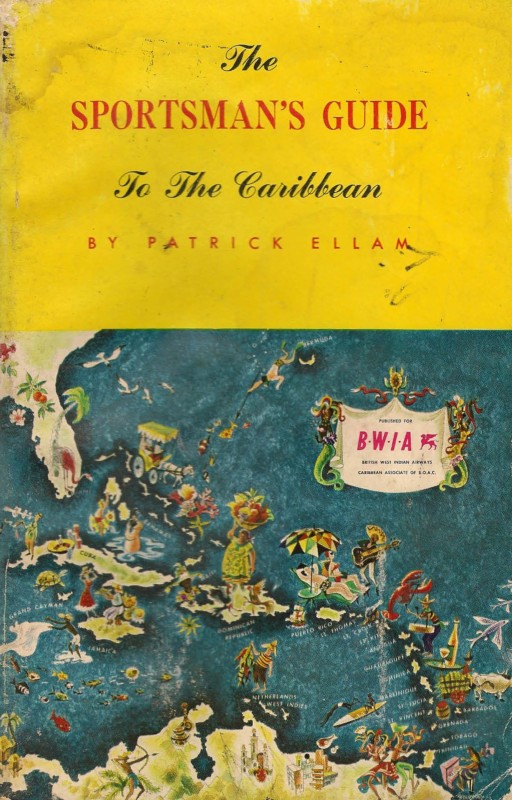 |
In the Forward
the author notes, "The aim of this book is to give an accurate account
of the sporting facilities that are available throughout the islands of
the Caribbean; to show where they are, what they are like, who runs
them and what equipment they have." Chapter 2, Participation Sports, in the section titled "Surf Riding," the following: SURF RIDING Where to go: There is only one place where the surf riding is good and that is at Trinidad. They have a good beach facing directly into the Trade Winds with either side of it a headland running well out to sea, forming a deep V-shaped bay. In the middle of the bay the Atlantic rollers pile up on a series of sand bars and travel for some distance before they break, providing just the right conditions for a good ride. No instructors are available, but it is quite easy to learn on your own and once you get the hang of it you will find it a safe, pleasant and rather romantic sport that somehow fulfils the dreams one has on cold winter nights of far-away tropic islands. |
|
| The beach: It is called Maraccas Bay
and lies on the North shore of the island about 14 miles from Port of
Spain. To get there you either rent a car or take ataxi, making a deal with the driver for the
round trip before you start. But first you call at a timber yard in town and get them to make you a board each. They use the short type there so that all you need is a 4-foot length of cedar or similar wood about 15 inches wide, not too heavy and rounded off at one end (the front). Any yard will make them for you in a few minutes while you wait and the usual charge is about 60 cents each, but make sure that they do not leave any rough edges or splinters. The road from town climbs up over the mountains and drops sharply down on the other side, providing one of the most scenic drives in the whole Caribbean, while Maraccas Bay itself is strictly glamorous, with the sweeping curve of white beach and the high green headlands stretching away on either side. On weekends there will be a line of cars parked under the palm trees and everyone from town will be out there but at other times it is quiet, with just a few other people around. Using a surf board the trick is to get started. In the beginning it is best to wade out to the first sand bar, where the water is no more than waist deep, face the beach and wait for a wave that is just about to break as it reaches you. Then you give a little jump and launch yourself down its steep front face, keeping the rear end of the board at your waist and the front end as flat on the surface of the water as you can without actually letting it go under. To avoid collisions with other bathers you can steer to a limited extent by tipping the board down on one side and as you get better at it you can start further out to get a longer ride, but be careful as the sea is definitely rough. What it costs: About 60 cents per board and your car ride out there. Equipment: Get one board each in town before you go. Tips: Do not go out beyond your depth in the breakers unless you are a strong swimmer. Take drinks and sandwiches with you. |
|||
| Overall observation | General
Observation: Basic
paipo boarding in the south Caribbean. The question one must ask is for
how long has the sport been practised and to what extent? Special thanks to John Hughes of the Cocoa Beach Surfing Museum for finding and sharing this story. |
||
|
El Paipo. ca. 1971. El Paipo Kneeboards. Newport Beach, CA: El Paipo Company. |
|||
| The brochure (PDF format) | 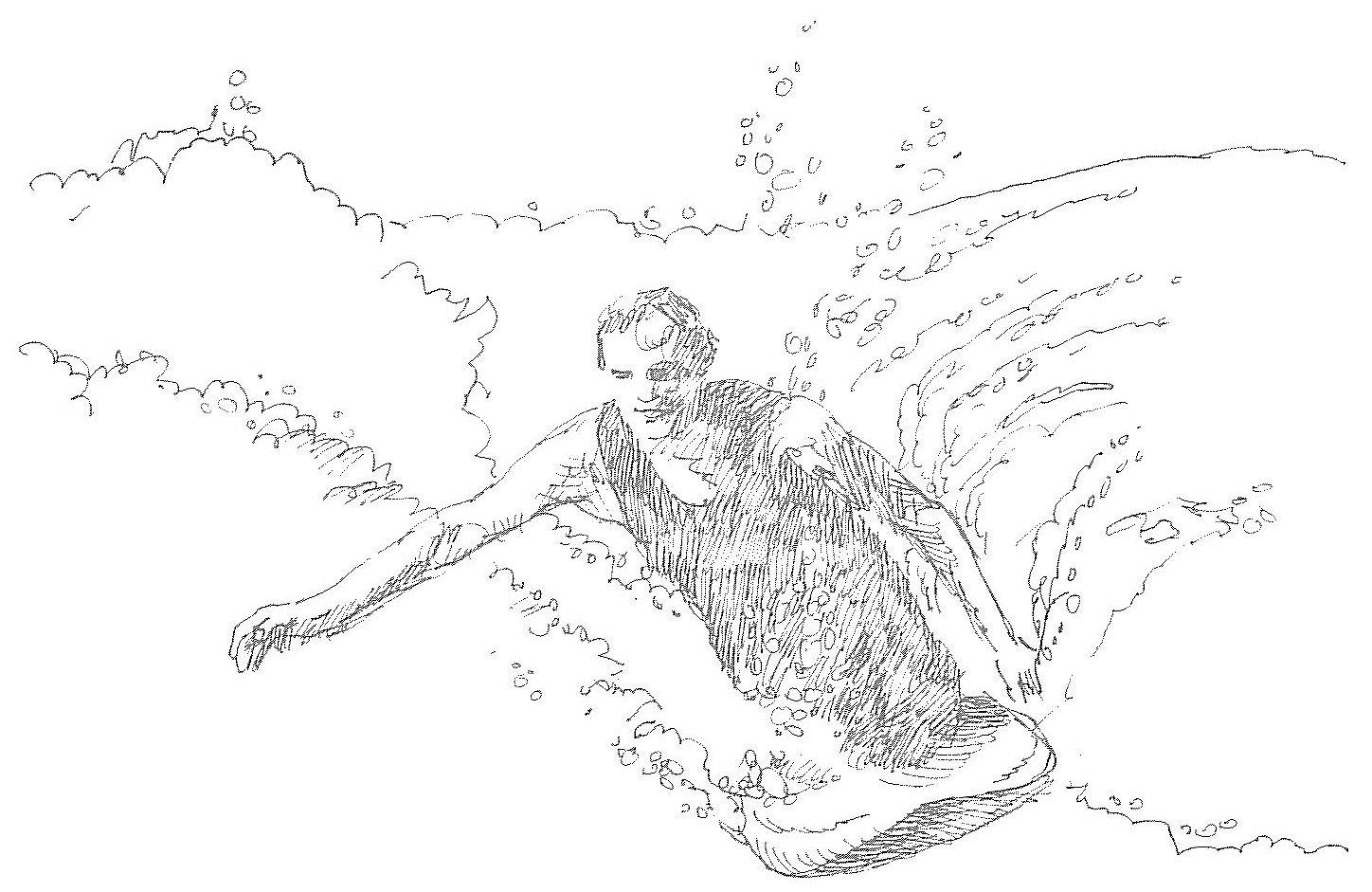 |
Pictured
to the left is an excerpt from the front page of this ca.1971 brochure.
The figure captures the full transition of the El Paipo company from a
bellyboarding/paipo board builder to a kneeboarding design and build
company. Four designs are featured in this 5-page brochure, the: (1) El Paipo Standard Model, (2) Fish Family, (3) Gun, and (4) Pocket Mouse. All except the Pocket Mouse are kneeboards. The Pocket Mouse is a large handboard (28 inches). All four boards feature scooped out decks, deck handle(s). and a Fins Unlimited fin box (except for the finless Pocket Mouse). |
|
| Source | The El Paipo brochure ca.1971, on El Paipo Kneeboards was provided by Bill Baldwin, a former shop manager at El Paipo (1970-1972) and shaper and rider at House of Paipo (1968-1970). | ||
|
Elwell, John C., Schmauss, J., and California Surf Museum. 2007. Surfing in San Diego. Charleston, SC: Arcadia Pub. |
|||||||
| Snippet of cover. |
 |
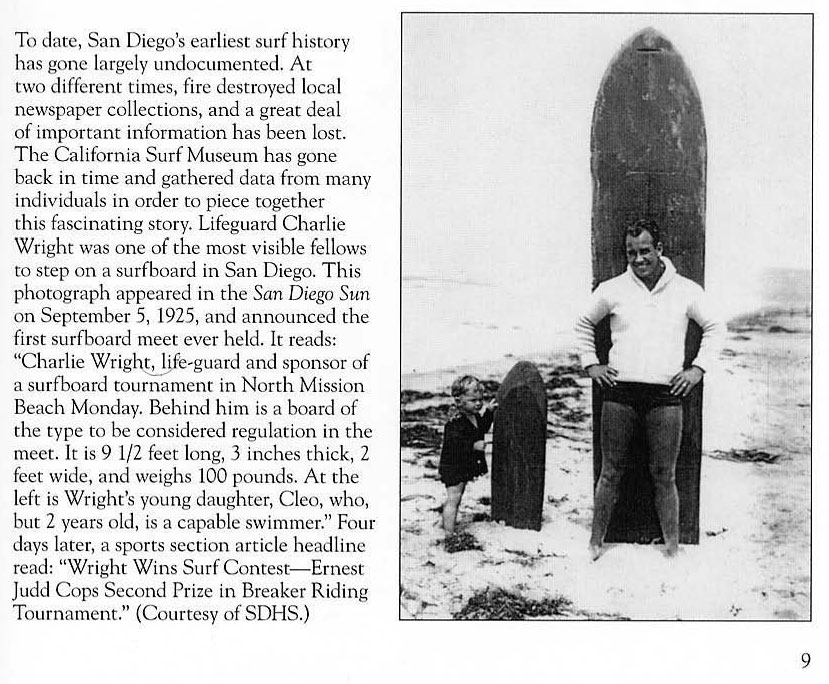
Great effort by the authors and the Californaia Surf Museum in publishing this pictorial history with words. Of relevance to the world of paipo riding are two pictures and captions of bellyboard/paipo boards. | |||||
|
|||||||

|
Estes, Steve. 2022. Surfing the South: The Search for Waves and the People Who Ride Them. Chapel Hill: The University of North Carolina Press. |
|||||||||
| Title page and Contents [PDF] and Introductory Chapters |
 |
The book is a semi-autobiographical story of spending two summers traveling
along the unsung southern coasts with his young daughter, from Texas to
Maryland, conducting oral interviews with folks having a knowledge of
surf history. For the most part the quest was a contemporary oral
history with surfers along the coasts. Many of the interviewees were
competitive surfers and surf shop owners or active in area surfer
museums or halls of fame. The author grew up in Charleston, South
Carolina, and he earned a PhD at the University of North Carolina.
Estes is currently a professor of history at Sonoma State University in
Northern California. He lives in San Francisco and counts Ocean Beach
as a home break. He mostly rides shortboards but surfed pop-out soft
top longboards during his quest. His daughter sometimes rode a
boogieboard. |
|||||||
| Ch. 6,
pp. 74-96, The Space Coast: Cocoa Beach, FL |
Cocoa
Beach, FL and the Space Coast felt "like Mecca, the East Coast
equivalent of Huntington Beach or Haleiwa." As background (p.75):
|
||||||||
| Ch. 9, pp. 130-144. The Shape of the Past: Cape Fear Coast, North Carolina | The author interviewed Joseph "Skipper" Funderburg, author of a personal history of Surfing on the Cape Fear Coast. Funderburg is one of the first generation of wave riders in Eastern North Carolina. Estes writes,"A historian in his own right, Skipper gave an impromptu lecture on the history of wave-riding and water sports in the Tar Heel State. North Carolinians raced canoes, boats, and rafts in the surf during the nineteenth century. By the twentieth century, some intrepid residents began to ride solid wood planks on their stomachs [emphasis added]." (p. 135).The author then describes photographs found by Funderburg showing local lifeguards aquaplaning on Tom Blake's hollow boards, with fins below the board, in the late 1930s and 1940s. [NOTE: It is not clear whether the lifeguards were waveriding prone, kneeling or standing. We would need to see the photographs.] The author, Steve Estes, then summarizes, "Surfing, as we know it, didn't really arrive in North Carolina until the 1950s and early '60s." [NOTE: Does mean the Gidget era with foam and fiberglass longboards sporting center fins, or the shortboard era of thrusters and multiple fin systems and hull shapes? Do I detect a boardist, or boardism?] |
||||||||
| Acknowledgments and Note on Sources |
The following items are identified as potential future resources in the paipo research project.
|
||||||||
| Overall observation | Bellyboarding,
paipo boards, boogie/bodyboarding, kneeboarding were not on the radar
in this book. The gut reaction is that prone surfing is not real
surfing, or as the author stated, "kook sponge." I will give the author
credit for his honestly in stating his gut reaction and then
reassessing his bias. Boogie or bodyboarding did show up in the index
as I recall, but not bellyboard, paipo or kneeboard. He did mention
several talented bodyboarders at his home break, Ocean Beach in San
Francisco, Calif. Nonetheless, new items were discovered and new areas
identified for examination. The oral histories make for good listening
and/or reading. |
||||||||


|
Farrelly, Midget, and Craig McGregor. 1967. The Surfing Life, As Told to Craig McGregor. New York: Arco Pub. Co. McGregor, Craig., & Midget Farrelly. 1965. This surfing life. London and Adelaide: Angus & Robertson in association with Rigby. |
|||
| Cover, Note & Contents (1.7MB) |  |
Just for the record. Editor's Note: I obtained a copy of the 1965 edition some months after the 1967 edition, and will make notations as appropriate. The author's Note is about half as long but the Contents are the same. The Title page includes the same photograph. Pagination is different, horizontal rather than vertical. | |
| Page 142 from the chapter, The Story of Surfing (600KB) | The chapter/story begins, "Where did surfing begin? Nobody knows for sure. Ricky Grigg believes that it originated in the southern islands near Tahiti, where the islanders found they could ride the waves lying on small wooden boards or kneeling on them." No citations or further discussion on Ricky Grigg's belief. | ||
| Ch. 15, Other Surfing Methods, including, Mat Riding, Handboards, Belly Boards, The Peipo, and Fins (3.5MB) | Items of note
|
||
| Glossary (1MB) | The following paipo/bellyboard-related terms are listed in the glossary:
|
||
| Overall observation | The book is written in a "popular-style" for a wide audience, but covers all the bases rather well, written from the Australian experience. Chapter (7 pages) is dedicated to body surfing. Note the spelling of "peipo" and that the peipo is classified as a type of belly board. No other changes detected in review of paipo surfing. | ||
|
Ben R. Finney, a leading surfing historican and scholar, published his seminal scholarly work in 1959, and followed that with several scholarly journal articles in multiple languages. In 1966, Dr. Finney wrote his first commercial book on the sport of surfing in conjunction with James D. Houston. Below are a list of surfing-related publications. Finney, Ben R. (1959). Hawaiian surfing, a study of cultural change. Honolulu: University of Hawaii, pp. 135. [thesis]. "This work, an exercise to obtain a Master's Degree, was my first major research on any topic. Although some of my professors were skeptical that I could find enough material or survive to write a thesis, in fact I found loads of stuff on ancient legends, in explorers reports and missionary diatribes, as well as talking with the old timers from Hawai'i, California, Australia and Peru." Finney, Ben R. (1959). The Surfing Community: Contrasting Values Between the Local and California Surfers in Hawaii. Social Process in Hawaii, 23, 73-76. "As a "Coast Haole" from Windansea and Steamer Lane I noted the cultural differences between California and Hawaiian surfers." Finney, Ben R. (1959). Surfboarding in Oceania: its pre-European distribution. Vólkerkundliche Arbeitsgemeinschaft in der Anthropologischen Gesell schaft in Wien. (Viennese Ethnological Bulletin), 2, pp. 23-36. Vienna, Austria. (See below.) "The summer after I received my M.A. I was studying German in Vienna, in preparation for my PhD studies which required that I be able to read at least two other scientific languages besides English. Anyway the editors of the "Viennese Ethnological Bulletin" asked me for an article from my thesis, so I wrote this one about the distribution of surfing around the entire Pacific, not just Hawai'i and Polynesia." Finney, Ben R. (1959, June-September). Ancient surfriding in Tahiti. Bulletin de la Societe des Etudes Oceaniennes, 127 and 128, 53-56. Papeete, Tahiti. Translated from French. <http://www.surfresearch.com.au/1959_Finney_Ancient_Tahiti.html>. See notes for rest of the translation credits. Finney, Ben R. (1959, December). Surfing in Ancient Hawaii. Journal of the Polynesian Society, 68(4), 327-347. Accessed from the journal on the Internet. "I wrote this analysis of ancient Hawaiian surfing for the Journal of the Polynesian Society, a New Zealand publication that is one of the oldest anthropology journals in the world still being published." Finney, Ben R. (1960, December). The Development and Diffusion of Modern Hawaiian Surfing. Journal of the Polynesian Society, 69(4), pp. 314-331. Accessed from the journal on the Internet. In this article, based on work which he undertook for the degree of M.A. at the University of Hawaii, Mr. Finney traces the decline and subsequent revival of surfing in modern Hawaii and discusses the diffusion of the sport to other countries in and bordering the Pacific. Finney, Ben. (1962). Surfboarding in West Africa. Wiener Volkerkundliche Mitteilungen, 5:41-42. No copy available. Finney, Ben R., and James D. Houston. (1966). Surfing, the Sport of Hawaiian Kings. Rutland, Vt: C.E. Tuttle Co. (See below.) Finney, Ben R., & James D. Houston. (1969, August-September). Polynesian Surfing. Natural History, 78(7), Cover, Table of Contents, 4, 26-35, 62, 75. Additionally, "About the Authors" and "Recommended Reading." Margan, Frank, and Ben R. Finney. (1970). A Pictorial History of Surfing. Sydney: Hamlyn. (See below.) Finney, Ben R. and James D. Houston. (1996). Surfing: A History of the Ancient Hawaiian Sport. San Francisco: Pomegranate Artbooks. (See below.) Lemarie, Jeremy. (2017, May 29). Interview with Ben Finney • A Tribute [special editing by John Clark]. The Surf Blurb. Retrieved May 30, 2017, from http://www.surfblurb.com/ben-finney.html? The Surf Blurb is a weekly email magazine, originally created by Joe Tabler and now produced by Jeremy Lemarie. For more information visit the website. |
|
Finney, Ben R. (1959). Surfboarding in Oceania: its pre-European distribution. Vólkerkundliche Arbeitsgemeinschaft in der Anthropologischen Gesell schaft in Wien. (Viennese Ethnological Bulletin), 2, pp. 23-36. Vienna, Austria. |
|||
| Title page and Contents [PDF] and Introductory Chapters Source(s) |
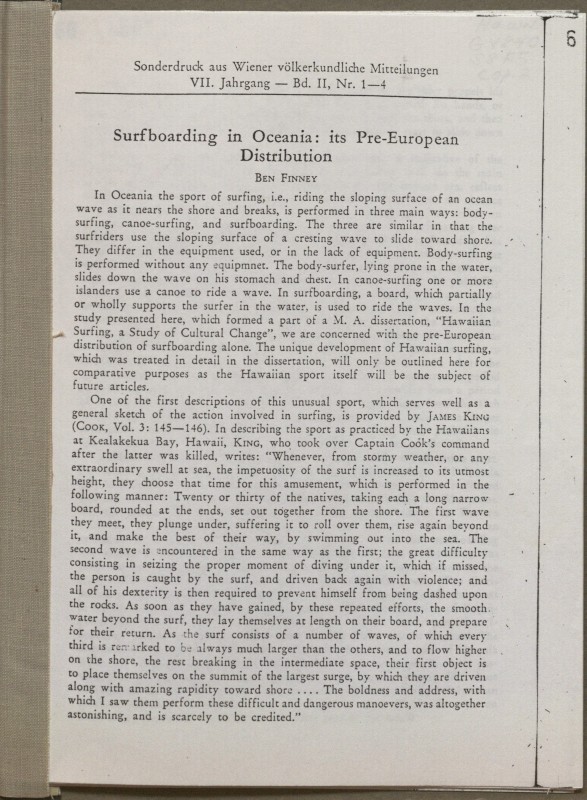 |
"The
summer after I received my M.A. I was studying German in Vienna, in
preparation for my PhD studies which required that I be able to read at
least two other scientific languages besides English. Anyway the
editors of the "Viennese Ethnological Bulletin" asked me for an article
from my thesis, so I wrote this one about the distribution of surfing
around the entire Pacific, not just Hawai'i and Polynesia." |
|
| Ch. 9, pp. 130-133, Body Surfng and Bellyboarding | xxx Of
the four
pages devoted to body surfing and bellyboarding, 2.5 pages cover body
surfing and 1.5 pages are on bellyboarding. No section covers hand
boarding or kneeboarding. Key passages include:
|
||
| Overall observation | xxx Although published in 1970, the first edition is mostly written in a mid-1960s flavor with a longboard orientation except in the chapter "The Boards." There are tons of photos but none of bellyboarder/paipo riders. The terms bellyboard and paipo ("as they are called in Hawaii) are both used. In the glossary defines paipo, but not bellyboard, "Paipo: the Hawaiian term for a bellyboard. See Chapter 9." There is no real discussion of board lengths, widths, thickness or plan shapes. | ||
|
Finney, Ben R. 1959. Surfing in ancient Hawaii. Wellington, N.Z.: Polynesian Society. |
|||
|
Finney, Ben R., and James D. Houston. (1966). Surfing, the Sport of Hawaiian Kings. Rutland, Vt: C.E. Tuttle Co. |
|||||||||
| Title
& Contents (200KB) pp.23-25 pp.32-34 |
 |
Just for the
record. (Note: most of the scanned PDF files below range from 60KB to
420KB.) "No one knows who first realized the possibilities of riding the swells that had always been so much a part of island life. It may have been a weary swimmer bounced all the way to the beach in a white boil, or a canoe full of fishermen straining to make shore in heavy seas, who first knew the thrill of racing across the rising slopes. As for when it happened, we can only guess. Simple surfing with a body-board may be several thousand years old, as old perhaps as the settling of the Pacific islands." Terms cited from early European observors included, "wave riding," "surf-riding," or "surf boarding." |
|||||||
| chapter 2, Pacific Origins | "With one exception, moreover, it is doubtful that wave-riding as a
popular recreation existed anywhere beyond Oceania before the 19th
Century. That one exception is the West Coast of Africa, in areas of
Senegal, the Ivory Coast and Ghana. Near Dakar, Senegal, for example,
African youths and young fishermen regularly body-surf, ride
body-boards and catch waves while standing erect on boards about six
feet long. These Atlantic skills seem in no way connected with the
Pacific, either historically or prehistorically. Evidently it's an old
pastime in west Africa; young Africans were seen riding waves while
lying prone on light wooden planks, as long ago as 1838, long before
surfing began to spread from Hawaii." "Two basic board types are used in the surf. A bodyboard or belly-board is usually from two to four feet long and used as an auxiliary aid in sliding across a wave. The surfer is actually swimming and holding the board in front of him as a planing surface. This is commonly a children's pastime, not an adult sport. True surfing requires a full-sized board, usually eight feet or longer, that can support the rider entirely, allowing him to ride prone, kneeling or standing. Early accounts mention long boards specifically in only two island groups-New Zealand and Hawaii. Some New Zealand boards were six feet long, but because they were only nine inches wide they probably didn't support an erect rider and were ridden prone. Morrison says boards of "any length" were used in Tahiti. Four-foot boards were known in the Marquesas. In early accounts of surfing in Melanesia, Micronesia and western Polynesia, all boards which were mentioned are only a few feet long." |
||||||||
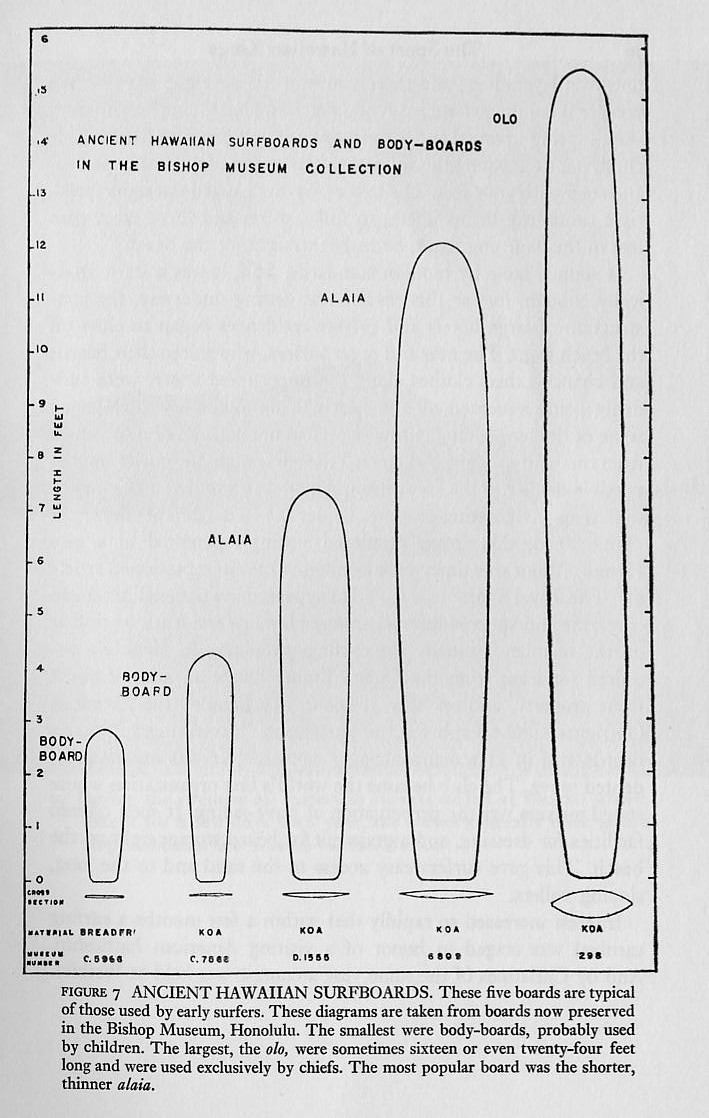
| Some figures from ch.3, Ali`i, Olo & Alaia and ch.5, The Revival | 1- Tahitian boy
surfing on a belly board (click
here) 2- Ancient Hawaiian surfboards on display at the Bishop Museum (click here) 3- The Bishop Museum has the world's largest collection of ancient Hawaiian surfboards (click here) 4- Diagram of surfboards since 1907, arranged chronologically (click here) 5- Diagram of five ancient Hawaiian surfboards (bodyboards, alaias and an olo) (click here)
|
||||||||
| pp.63-64 from ch.4, The Touch of Civilization | "Today
all that remains is an occasional youngster skimming through small
waves on a body-board. Not a surfboard is seen on the waves that break
around this fabled south sea island. The changes wrought by western
civilization virtually eliminated a once popular recreation. In recent
years a few surfers have travelled there with modern boards and have
discovered good waves on many beaches. Tahitians are often encouraged
to try a board or to build their own, but their reaction is almost
always the same. It is a children's pastime, they say. No one seems
interested." |
||||||||
| p.82 from ch.5, The Revival | The author espouses a certain superior air of stand-up surfing over riding prone, "During the ride itself the technique of lala, angling, is still the most skillful, and standing is of course the only acceptable way to ride. Although sitting, kneeling and prone riding positions were all popular formerly, such postures are now used only for novelty, amusement or by those who cannot stand." And, "From nineteenth century reports, early surfers seemed content to paddle, catch the wave, stand up and then speed ahead in one direction. New boards and modern imagination have changed this. ... An experienced surfer can thus play the wave as he rides it-speed up, slow down, turn, swerve, change direction, ride in the trough or shoot along its thin crest. He can turn to the left by shifting right foot behind left. He can swerve to the right by placing his foot on the board's right edge and lean in that direction. He can stall by stepping back on the board, or speed forward by walking tothe nose. " Funny that these examples espoused as superior were shortly thereafter trumpted by people riding prone or on their knees, riding tightly in the curl, inside the tube, spinning 360s and el rollos, moving faster across wave faces and performing other more radical maneuvers. Oh well, this was the page that I call the "paipo slam" (a play on words for the Zuma Slam). | ||||||||
| pp.96-98 from ch.6, Surfing Goes International | "In
New Zealand, for instance, the revival of a long-dead pastime was due
to Australia's influence. As we have seen, surf sports were known to
early Maoris. Canoe surfing, body-board surfing and body-surfing, known
collectively as whakarerere, were all popular pastimes. They
declined and have virtually disappeared, however; and modern surfing in
New Zealand dates from the 1930's when Australian Surf Lifesavers
arrived with skis and cigar boxes." "In 1953 the surf-lifesaving movement was established in England, and, with the unique safety methods came the surfboard, surf-ski and all the oceanic skills developed on Australia's beaches. With its time-honored reputation for fog, foul weather and the frigid English Channel, England seems an unlikely spot for a traditionally warm weather sport like surfing. But the southwest coasts of Devon and Cornwall boast the mildest summer climates in the British Isles... Body-board surfing has been known there since the early years of this century." |
||||||||
| Glossary, Endnote Citations and Bibliography (500KB) | The appendix is
a glossary of ancient Hawaiian surfing terms. Of direct interest are
the following terms:
|
||||||||
| Overall observation | The
book is written in a "scholarly-style" for a wide audience. Finney's
academic research credentials are clearly evident as he broke ground in
becoming a "surfer surfing scholar dude" and collaborated with several
noted scholars and researchers in Hawaii. Although Finney demonstrates
a clear bias towards stand-up surfing this doesn't interfere with
documenting the genesis of prone style riding and its dispersion
throughout the world. What is absent however is any mention of the term
"paipo" (or any of the derivatives of the word such as paepo) despite a
number of adults practicing the sport during the 1950s and early 1960s
in Hawaii (e.g., Wally Froiseth making Pai Po boards in the 1950s). Editor's Note: These PDF files were scanned at 150 dpi resulting in smaller file sizes but also of lesser quality. |
||||||||

|
Margan, Frank, and Ben R. Finney. 1970. A pictorial history of surfing. Sydney: Hamlyn. (see entry under Margan, F., & Finney, B.R.) |
|
Finney, Ben R. and James D. Houston. Surfing: A History of the Ancient Hawaiian Sport. San Francisco: Pomegranate Artbooks, 1996. |
|||||||||
| Contents and excerpt from the Forward |  |
From the Forward, "This was the first book to chart surfing's Pacific origins in the context of Polynesian culture. Its main outline was conceived and developed by Ben Finney as his master's thesis in anthropology at the University of Hawai'i. Much of the material was revised by James D. Houston, who also added new details and interpretations. For this thirtieth anniversary edition, a number of seldom seen drawings and early photos have been added, along with appendixes of vintage writings on the subject," including Lt. James King (Capt. Cook voyages), Jack London, Mark Twain and others. "A few historical and cultural details have been updated (e.g., pronunciation marks for Hawaiian terms and the use of Polynesian place names, such as Rapa Nui and Aotearoa in lieu of Easter Island and New Zealand)." | |||||||
| pp.13, from ch. 1, The Wave, the Board, and the Surfer | "Hawai`i's
gift to the world of sport is surfing-sliding down the slope of a
breaking wave on a surfboard. Long before Captain Cook sailed into
Kealakekua Bay, Hawaiians had mastered the art of standing erect while
speeding toward shore. Riding prone on a wave with the aid of a short
bodyboard was practiced throughout the Pacific Islands, primarily by
youngsters, and probably dates back thousands of years. The Hawaiians
took this ancestral habit, lengthened the boards, refined their shapes,
and developed techniques that moved Lt. James King, in the first
published account of surfing, to exclaim,"The boldness and address with which I saw them perform these difficult and dangerous manoeuvers was altogether astonishing and is scarcely to be believed." [quote is from Lt. James King in Cook 1784, 3: 147.] |
||||||||
| pp.21-25, from ch. 2, Pacific Origins | "No
one knows who first realized the possibilities of riding the swells
that had always been so much a part of island life. It may have been a
weary swimmer, bounced all the way to the beach in a white boil, or a
fisherman in a canoe, straining to make shore in heavy seas, or simply
a youngster playing in the waves who first knew the thrill of racing
across the rising slopes. Simple board-surfing -- in
which a swimmer uses a short plank or other aid to ride a wave just for
the fun of it -- was practiced throughout the Pacific Islands.
Recreational wave-riding was probably part of the general marine
adaptation pioneered by the first people to enter the open Pacific.
That would date the beginnings of the sport back to almost 2000 B.C.,
when the ancestors of the Polynesians and other Pacific islanders
started moving eastward from Southeast Asia to explore and colonize
this vast oceanic region. Recent archaeological finds suggest that the
first canoes reached Hawai'i by at least A.D. 400. Those first settlers
were probably already skilled in simple surfing, and perhaps after
several hundred years of riding Hawai`i's big waves they began to
develop the big boards, the art of standing up while riding diagonally
across a wave front, and other features of this uniquely Hawai`ian form
of the sport. A cautious guess would then date Hawaiian surfing back at
least a thousand years." "The other points of comparison -- board size and riding position -- are closely related, since a board's shape and length determine how one rides it. Two basic board types are used in the surf. A bodyboard (also known as a belly board or a paipo board) is usually from two to four feet long and is used as an auxiliary aid in sliding across a wave. Surfers using bodyboards actually swim, holding the boards in front of themselves as planing surfaces. This is commonly a children's pastime. True surfing requires a fullI-sized board, usually six feet or longer and at least around eighteen inches wide, that can support the rider entirely, allowing him or her to ride prone, kneeling or standing. Early accounts specifically mention long boards in only two island groups: Hawai`i and Aotearoa. Aotearoa boards are described as reaching six feet in length, but because they were only some nine inches wide they probably did not allow a rider to stand up. Morrison says boards of "any length" were used in Tahiti and that the more expert Tahitians could stand up while surfing, which implies that some of the Tahitian boards were approaching surfboard size. The next largest boards in Polynesia -- four-foot planks in the Marquesas and long reed bundles from Rapa Nui (where because of deforestation there was little wood available) -- apparently did not allow the riders to stand up. Elsewhere in Polynesia and the rest of the Pacific island region the boards were short bodyboards, and there is no mention of riders sitting, kneeling, or standing erect." 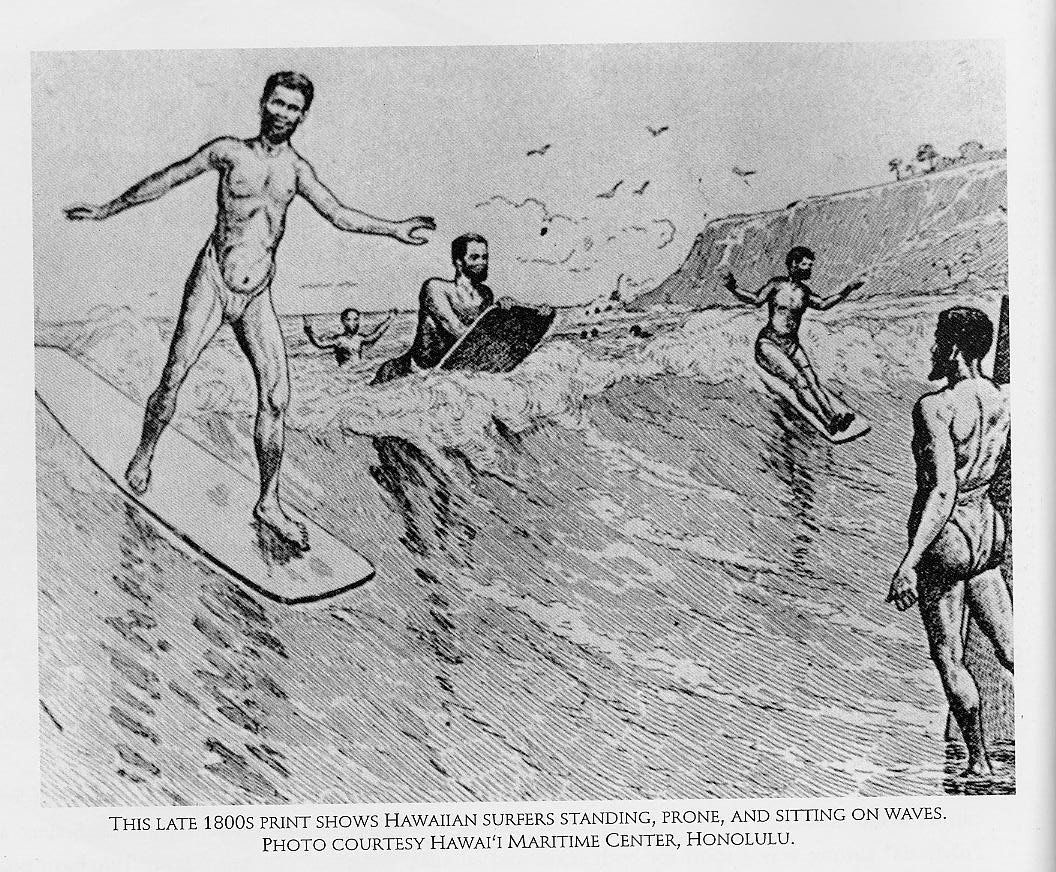 [Editor's Note: None of waveriders pictured appear to be youths.] "Was board-surfing limited to the Pacific islands? In all the world, we have found only two other places where surfing may have developed independently from the Pacific island sport: West Africa and northern Peru. From Senegal, Ivory Coast, and Ghana come reports of bodyboard surfing, which, particularly since they date back to the 1830s, may indicate that African youths along this coast independently hit upon the idea of using planks to ride the waves. From northern Peru there are descriptions of fishermen who fish offshore sitting on reed bundles, which they call caballitos (little horses). When done fishing, they paddle back to shore (using a wooden paddle) and catch a wave or two coming in through the surf, a practice that may be of great antiquity since fishermen sitting astride and paddling their cabaIlitos are featured in pre-Columbian pottery. However, in neither of these cases did surfing develop into anything like Hawaiian surfing." |
||||||||
| From ch.3, Ali`i, Olo & Alaia | "The alaia
boards are round-nosed with a squared-off tail and very thin. The
larger alaia boards in the Bishop's collection range from seven to
twelve feet long, average eighteen inches in width, and are from a half
inch to an inch and a half thick. (The museum's shorter alaia-shaped
boards, which can be classified as bodyboards because of their lack of
buoyancy, are similarly proportioned.) Most alaia boards that have
survived are made from koa (Acacia koa), a fine-grained Hawaiian
hardwood, although various writers state that alaia were also made from
such light woods as breadfruit( Artocarpus altila) and wiliwili
(Erythrina sandwicensis)." |
||||||||
| pp.52, from ch.4, The Touch of Civilization | This photograph below is often times incorrectly captioned as
a "surfer with a paipo board." The photograph is correctly captioned
in Finney's book as a surfer with an alaia board. The surfer may have ridden the
board in the prone, kneeling, sitting or standing positions. |
||||||||
| pp.60-61, from ch.5, The Revival |
|
||||||||
| pp.85-86 from ch.6, Surfing Goes International | Notes from
various countries:
|
||||||||
| Glossary, Endnotes, and Bibliography | Appendix
A is a list of Hawaiian Surfing Terms
that includes some new entries, uses diacritical marks and includes
word sources. A couple of words relevant to prone board riding:
The Bibliography lists the books and articles cited in the text, along with research publications on surfing by Ben Finney, which include more extensive documentation than given here. Several new citations have been added in this 30th anniversary update of the earlier book. |
||||||||
| Overall observation | The
book is an updated, coffee table style version of the Finney and
Houston book of 30 years earlier. It maintains its easy reading
scholarly approach in a wide page, glossy format. On special interest is the introduction of the term "paipo" although there is no mention of 20th century prone board riding despite a number of adults practicing the sport during the 1950s and early 1960s in Hawaii (e.g., Wally Froiseth making Pai Po boards in the 1950s). Several observations in the book would seem to limit the riding of bodyboards (paipo boards) to youngsters. However, the general writings and sketches of the period would seem to indicate widespread use of men and women of all ages (e.g., see sketching earlier in this section). The authors provide an excellent discussion on the decline of surfing early in the 19th century and the rebirth of surfing at in the early 20th century, in Hawai`i and elsewhere. The discussion does a good job of discussing the evolution of stand-up surf boards used during this 100 years and into the 1960s. Absent, however, is a record of bodyboarding. Did bodyboarding disappear for a hundred years only to reapper in the mid-1950s? Many thanks to Finney and Houston for their scholarly contributions to the surfing world. |
||||||||
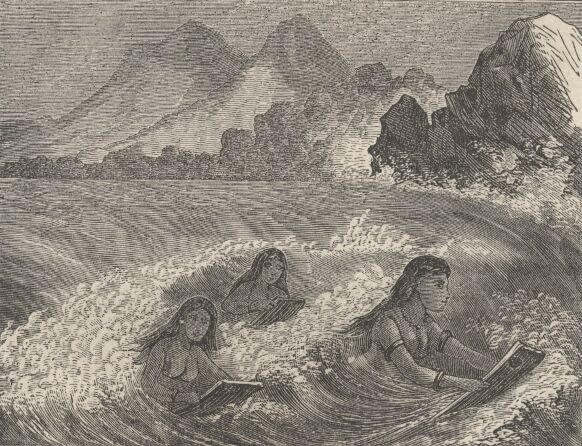
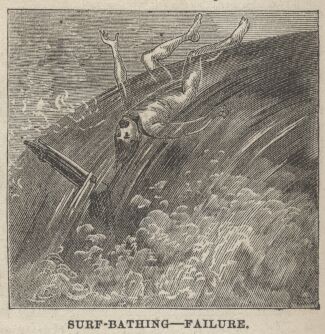
|
Funderburg, Joseph. 2008. Surfing on the Cape Fear Coast. Carolina Beach, N.C.: SlapDash Publishing, LLC. |
|||||||||||
| Title page and Contents [PDF] |
 |
The
author is a renown Cape Fear Coast pioneer surfer and waterman. He grew
up on the Cape Fear Coast, started his apprenticeship in surfing in the
mid-1950s, played around with balsa surfboards in the late-1950s, and
then helped popularize stand-up surfing by the early-1960s. He has been
writing about surfing for over forty years and serves as the native
Cape Fear Coast's preeminent, surfing historian. He helped establish
and manages the Cape Fear Surfing Archive at the William Randall
Library, University of North Carolina Wilmington (see more here). See his book bio here. |
|||||||||
Introductory Section, pp. ii and iii (excerpts) |
The introductory section contains two photo collages each one containing a paipo-related image. (Clicking on the image will provide a larger focused view.)
|
||||||||||
| Chapter: History Buff, pp. 23-30 (excerpts) | Pictured
below is what appears to be a traditional paipo or bellyboard. In part
the board resembles the style of bellyboard popular in the United
Kingdom but with the rail lines and length of a traditional Hawaiian alaia. The board also has an interesting diamond-type tail. Likely ridden kipapa-style, but possibly lala-style.
|
||||||||||
| Chapter: The Beginning, pp. 31-35 (excerpts) |  |
According
to the
author during this period he learned to surf waves on a surf mat,
mastering technique from riding the foam straight in and then angling
and riding the face of the wave. He mentions that in the mid-1950s,
low-density styrofoam surfboards were available and "we rode them in
the prone position." [Paipo Note: I remember these boards being widely
available in beach stores in lengths of 3 to 5 ft long. The
were basically finless paipo boards for the masses during that
period--until the boogie board became available in the early-1970s.] |
|||||||||
|
Photo courtesy of the author and on p. 34, the Cape Fear Surfing Archive at the UNCW library. (NOTE: The https://library.uncw.edu/surf and The Cape Fear Surfing Archive is moving to: Surfing and Surf Culture in Southeast North Carolina and to Cape Fear Surfing Timeline.) |
|||||||||||
| Chapter: Early Years of Wave Riding, pp. 38-45 (excerpts of pp. 41-46, 49, 52-53. 59) | Funderburg
writes, "In the late 1800's Wrightsville Beach and Carolina Beach were
known for their excellent fishing, boating and surf bathing." [Paipo
Note: surf bathing was a common term for forms of wave riding ranging
from body surfing through stand-up board surfing.] Other excerpts from
the text (mostly direct quotes) providing information related to prone
surfriding on hard body structures:
 Image complements of author and the New Hanover County Public Library North Carolina Room (www.nhcgov.com). | ||||||||||
| Chapter: They Ride Surfboards, pp. 46-58 (excerpts of pp. 41-46, 49, 52-53. 59) |
Transitioning to the chapter, "They Ride
Surfboards," is where stand-up surfing emerges slowly with most wooden
board planks being ridden prone. It is easy to see why as the boards
were generally short, narrow and thin making stand-up waveriding
challenging. Excerpts follow:
|
||||||||||

Photo courtesy of author and the NC Dept. of Cultural Resources (www.ncculture.com) and ("News & Observer, Raleigh, NC).
|
|||||||||||
| Other Notes | See the Photo Credits page from the book. Many thanks to all the sources of information and the author's dedicated efforts. Description of the Cape Fear Surfing Archive located at the William Randall Library, University of North Carolina Wilmington. |
||||||||||
| Overall observation | This
publication describes the the Cape Fear coastal development of
surfriding. Although the authors generalize surfriding it isn't hard to
read between the lines that most waveriding until the
late-1950s/early-1960s was almost entirely bodysurfing, mat surfing and
paipo/bellyboarding surfriding. |
||||||||||


|
Funnell, Ronald Spencer. 1953. Surf-riding on the Atlantic Coast. R.S. Funnell. Funnell, Ronald Spencer. 1953. The Art of Surf-Riding on the Cornish Coast. R.S. Funnell. [Note: This is the same 1953 book by Funnell, titled on the title page as Surf-Riding on the Atlantic Coast.] |
|||||||
| Cover and Title pages Contents [PDF] and Introductory Chapters Source(s): SDSU. |
The term "surf-rider" and "surf board" in this booklet, and the other two, refer to belly boarding (and the distinct form of U.K. bellyboard at that -- narrow ply boards with a flipped up nose -- see photograph below from p. 35). 
|
||||||
| Introduction |
"This is an improved edition of a booklet compiled by the present author and which rapidly became a best seller, resulting in the first edition being quickly sold out. |
||||||
| Surf-Riding on the Atlantic Coast of Cornwall and Devon, pp. 5-8. |
Selected snippets-
|
||||||
| pp. 8-10, "The Right Type of Board." |
Here
the author describes the wrong kind of board (without nose rocker) and
the right kind of board (with pronounced flip up nose rocker as shown
in the above figures):It cannot be too strongly emphasised that the 'would-be surf-rider,' who wishes to become proficient quickly, should refrain from the temptation to purchase a cheap surf-board. The trouble with many so-called surf-boards, is that they are made of 6 in. widths of coarse wood, neither water-proofed, nor curved, and screwed together with battens; with a result that they are most unsuitable and not at all easy to manipulate. |
||||||
| pp. 11-18, excepts from "The Hold, and Control of the Surf-board" and "The Choice of a Breaker" and "Timing the Take Off." |
This section describes the proper and incorrect ways to hold the board when catching a wave in the breakers:"Turn to the artist's sketch on the cover of the book. Note that the young girl standing waist deep is getting her board into position to place into her groin. The correct hold of the board is so essential because if a novice were to badly time the "take-off" of an exceptionally powerful breaker, a loosely and wrongly held board might well give him or her a nasty jab in the pit of the stomach, or crack their knees." Rod's Note: In the description above of "surf-riding, or bellyboarding as we call it today, that neither swim fins are used nor is catching wave in deeper waters where the surf rider paddles for the wave by kicking one's feet and paddling with both arms. |
||||||
| Various | A list of surfing beaches in England on the Atlantic coast appear on pp. 21-22. The effects and potential dangers of tides on pp. 24-28. Bevy of surf-riders racing towards the beach from p. 31  |
||||||
| Some "surf-riding" advertisements appearing in the booklet |
Advertisement for “Solarbo Balsa Boards for Surfing” from p. 16 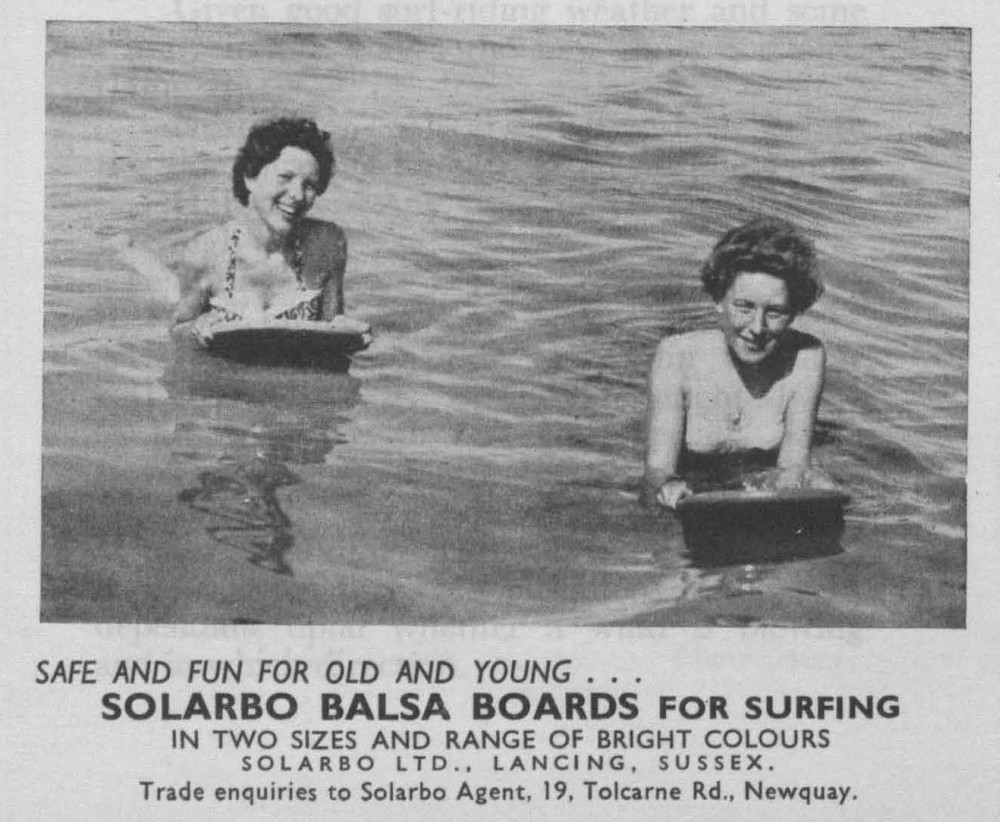 Advertisement for “Westlake's Surf-Board” or "New Solarbo Balsa Boards" from p. 30  Advertisement for "Solarbo Water Boards" that don't need a curved prow, from p. 32 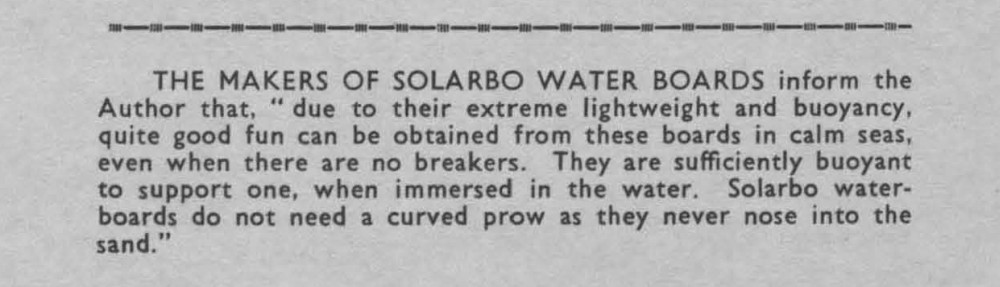 |
||||||
| Follow-up leads: | These items bear further research:
|
||||||
| Overall observation | An
interesting historical piece on U.K.-style bellyboarding, or what I
might call traditional European-style bellyboarding, or paipo boarding.
Of curious note are the three Solarbo advertisements that advertise the
adequacy of their "straight boards" made of balsa while the author
advocates "the right type of surf board" with a pronounced curvature in
the nose and of a wood from Gabon (the wood type is not identified) along with another make of board, theFeatherweight 'Crest Rider.'.
Also of note is the style of riding is close to shore where the riders
push themselves into waves from a standing positon and seldom, if ever,
paddle out into what contemporary paipo boarding considers the
"line-up." |
||||||
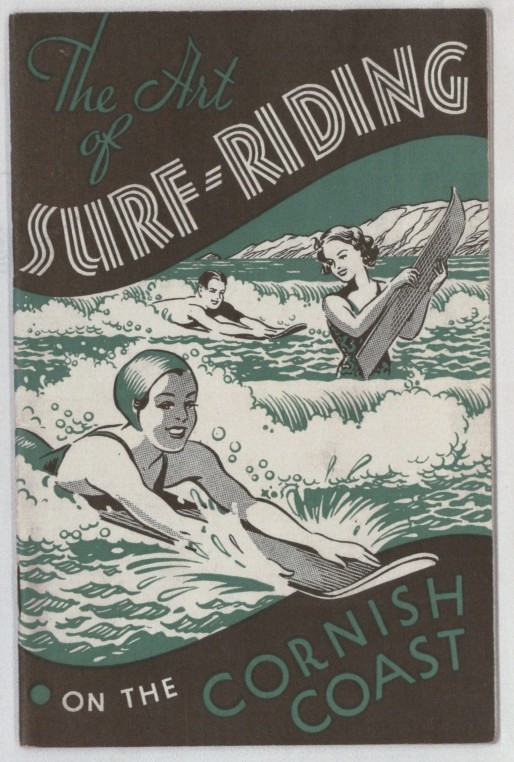


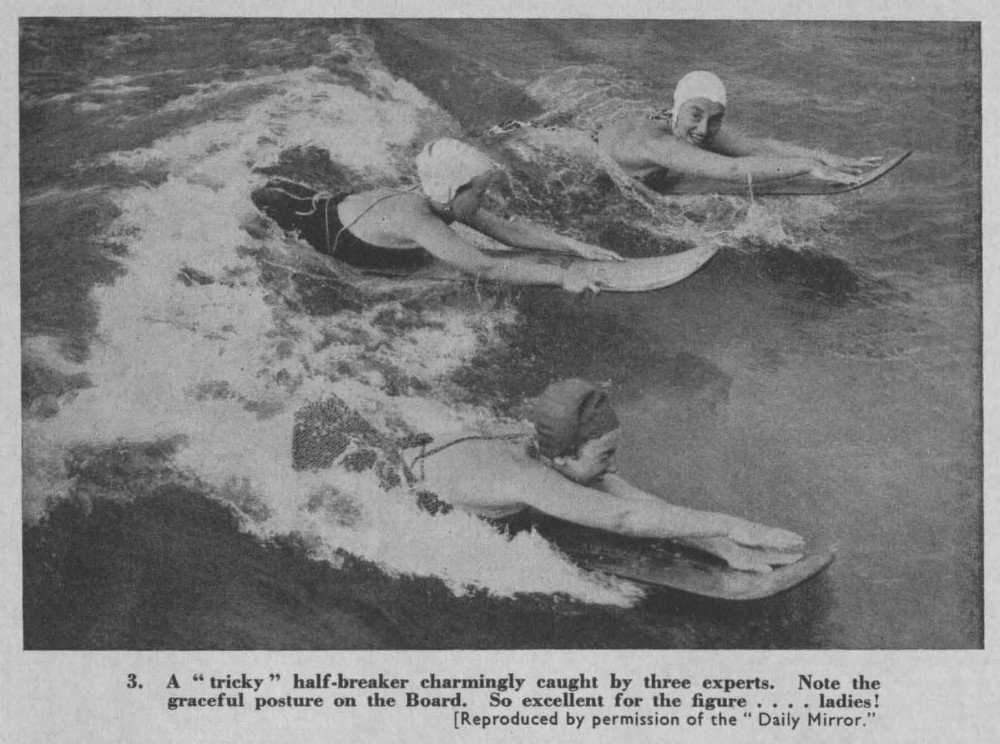
|
Gardner, Robert. 1972. The art of body surfing. Philadelphia: Chilton. |
|||
| Cover page, Contents and
Author Note and some history from Ch. 1, the "Reckless Breed" |
 |
From page
2:Let's get one thing clear immediately. Big surf body surfing is an art apart. People who go to the ocean in the summer number in the millions. Board surfers number in the hundreds of thousands. But there aren't a hundred proficient big surf body surfers in the world. They are a small , select world--a skilled, talented, and reckless breed of men. |
|
| Swim Fins | From
page 6:The history of body surfing falls into Ihree rather sharply defined parts, or periods -- pre·swim-fin, post-swim-fin, and the present.From page 11: It is not historically accurate to pick World War II as the advent of the swim fin. Fins had been developed several years before, and the body surfers had grabbed them instantly, realizing their great contribution to the art. But it was during World War II , and particularly through the use of fins by the Amphibious Scouts and Raiders and the underwater demolition teams of the United States Navy, that their popularity began to spread.From pages 24-25: Next, we come to the most important part of a body surfer's equipment -- his swim fins. The fin is here to stay. Its existence makes body surfing so much easier. |
||
| Overall observation | The discussion on swim fins was included because of its special relationship in riding paipo boards Note the reference to UDT (underwater demolition team). The belly board is mentioned as one means of bending the surf to the rider's will. | ||
|
James, Joseph Allston. 1972. Surfer magazine: a content analysis. |
|||
| Title page and Contents [PDF] and Introductory Chapter |
 |
An excerpt of the author's methodology and some definitions is spelled out in the introductory chapter on page 1:Before proceeding further, basic definitions of surfing and Surfer are necessary. Surfing is a sport in which the participant on a vehicle rides an ocean wave toward shore. Although there are several methods that can be used to ride a wave, the one this paper primarily is concerned with is surfboard riding, the most widely practiced method. Surfer occasionally deals with the body surfing and bellyboard methods, but its primary concern is with surfboard riding. |
|
| Ch. 3,
Findings, from pp. 45-6 |
The following section provides perspective on Sufer
Magazine editorial policies, a resulting boycott by the mainstream
surfboard manufacturers prior to January 1971, and the potential impact
of the economic on advertising purchased by the surf industry. [See pp. 45-6.]"With the development of new construction materials and the creation of improved surfboard designs, Surfer began to include more and more technical articles in its issues. See Table 3." |
||
| Overall observation | Caveat for Rod's analysis of Surfer Magazine:
check for related trends in drop-off of paipo/bellyboarding related
advertisements, stories, editorial content and other mentions. The author uses the term bellyboard, but none of the others. He also inaccurately describes surfing as riding a vehicle (unless one considers a person's body to be a vehicle ridden upon! No, the body rides the wave.). |
||

|
Hickenbottom, Thomas, Santa Cruz Surfing Club Preservation Society, and Santa Cruz Surfing Museum. (2009). Surfing in Santa Cruz. Charleston, SC: Arcadia Pub. |
|||
| N/A. | This book does not have any information relevant to paipo boarding. There is one pic of someone riding a matt with the following caption, "A mat rider braces for a hard landing at the bottom of a reeling Steamer Lane slot wave. Mat surfing was popular in the 1960s as an alternative to board surfing. Sometimes on huge high-tide Middle Peak days, the only takers in the water were mat surfers and bodysurfers." The book was 100 percent stand-up, mostly longboarding. Thanks to Kim Green of Santa Cruz for reviewing this book in a special room of Californiana. | ||
|
Jury, Mark. 1989. Surfing in southern Africa: including Mauritius and Reunion. Cape Town: Struik. |
|||
| Title page and Contents [JPG] |
 |
A description of the book adapted from the back cover: The book provides a guide to predicting surf conditions including the "when" and "where" details on more than 250 individual surf spots on the coasts of Southern Africa, Mauritius and Reunion. The book "will appeal to anybody who utilizes the waves along our coastline—surfers, boardsailors, bodyboarders, paddle-skiers, kneeboarders, bodysurfers—in fact, anybody who "surfs" in any way. Surfing In Southern Africa is for both the serious surfer and the recreational or weekend surfer—hotshot and grommet alike!" The book includes close on 100 great colour surfing photographs, as well as a couple of "collector's item" shots dating as far back as the late-1940s. See the Contents for a complete list of topics covered. |
|
| Historical notes from the following two chapters: History of Surfing and Western Cape-Surf Spots |
Published in 1989, the book presents the facts as they were generally understood at that time. In the chapter, History of Surfing, two historical notes of interest are made:
|
||
| Reference Map of the Cape |
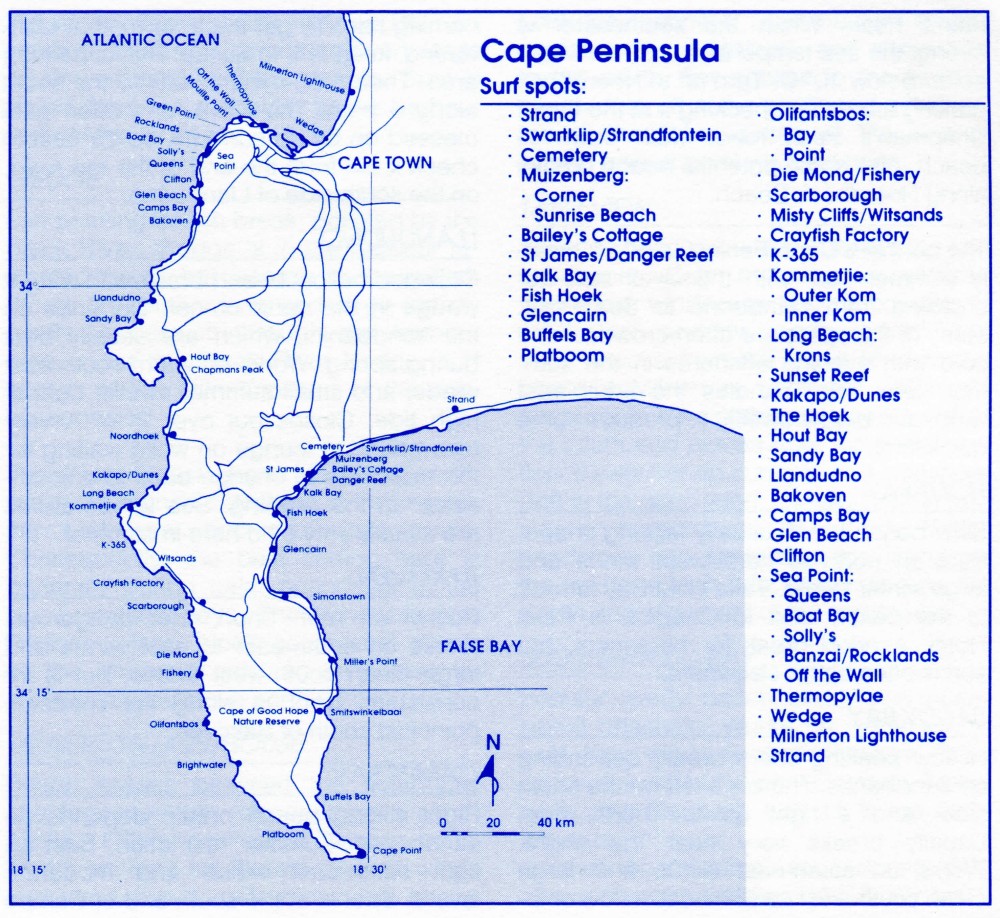 |
This map is a good reference point for understanding the Cape Peninsula geographically and in particular, False Bay. |
|
| Overall observation | Since
the book was published back in 1989, much more has been learned about
the early years of surfing in South Africa. In particular, the series
of historical books by Michael Walker on the False Cape communities of
Muizenberg, Kalk Bay and St. James, show that surfing (paipo/belly
board surfing on "surf-boards") began by 1910, and was introduced by
"an Australian whilst passing through Cape Town visited the "Sands of
Muizenberg". There he noticed a plank of wood on the beach, which he
picked up and showed the locals how to catch a wave." Overall the book is an easy read with tons of valuable wave forecasting tips, charts, site descriptions and other areas of interest to a surfer in general, especially if planning a trip or living in South Africa. |
||
|
Kahanamoku, Duke, and Joseph Brennan. 1968. Duke Kahanamoku's world of surfing. New York: Grosset & Dunlap. |
||||||
| Contents [PDF] |
 |
This book was written by the "Father of Modern Surfing" with the assistance of Joseph Brennan. |
||||
| Ch.1, pp. 17-26, Ancient Surfng |
|
|||||
| Ch. 3, New Horizons | In discussing the preference for solid redwood and balsa boards over the hollow paddleboard:The experiments were predicated on the belief that faster rides would be generated by heavier boards. But the turning problem became bigger with the size of the board; a prone surfer was compelled to drag one foot in the water on the inside of the turn, and this only contributed to loss of forward speed. If standing, he had to drag an arm over the side, and with the same result of diminishing momentum. [pp. 38-39]On the following page [p. 40], which continues a discussion of paddleboards, the figure below appears in the page margin. Note it is not called a paipo or a sand board. Skim or Belly Board  ues |
|||||
| Ch.8, On Selecting a Board |
In
this chapter are two items of interest: (1) bodysurfing & paipo
word affinity and (2) characterization of the preferred
bodysurfing/paipo wave.It isn't always that one can be lucky enough to find a surf with the fast breaking sections or steep. hollow peaks that board surfers most love. Too often there is only the body-surfing (paipo) type of wave, which is a rolling, cresting break that merges into a long, hopeless wall of water in the shorebreak. But it is the former type of surf we have in mind now while helping you to judge a board. [p. 82]Roughly unrelated to paipo surfing, but still of special interest: The light nine-foot boards with slim sterns will do well at famous Makaha Beach. They make for quick, responsive steering, and are sensitive to the rugged contour of the front Makaha wave slopes. The long olo board so popular at Waikiki can spell trouble on the bulky Makaha waves with their uneven front slopes. The strong cross currents which run at Makaha too often cause the nose of the board to pearl, sending the rider into the well-known sprawl. [p. 83] |
|||||
| Ch. 16, Body Surfing, pp. 159-167 |
Good discussion of body surfing, but silent on paipo surfing, | |||||
| Glossary (pp. 169-179) and Index |
Fins - Rubber or synthetic foot-flippers for swimming, skin-diving, etc. Often used in body surfing. [p. 172] Paipo board - Hawaiian Islander's term for bellyboard; a very short board. [p. 175, Note: paipo was not italicized] The terms bellyboard and paipo were not listed in the Index. No mention of kneeboarding in the book. |
|||||
| Overall observation | Good
enjoyable read and great expression of Hawaiian aloha and surfriding
emotion throughout the book. The kipapa-style content is minimal but
related references appear in a few places. It was odd that the figure
of the "guitar pic" paipo, a shaped popularized as the Paipo Nui, and
later as the Hawaii Paipo Designs (HPD), is labeled as a "skim or belly
board" and not as a paipo (or pae po`o). |
|||||
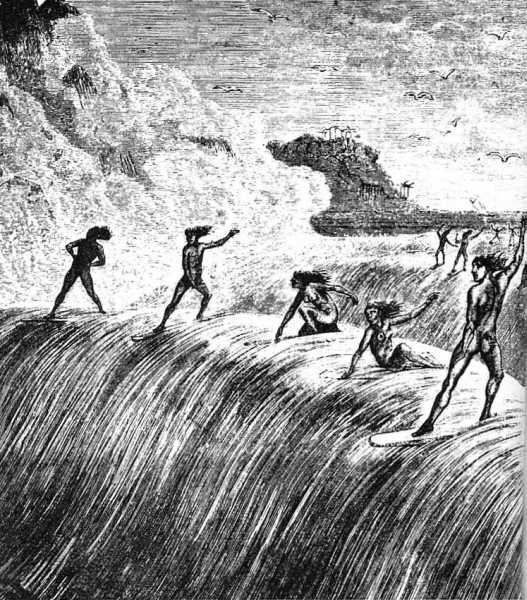
|
Kampion, Drew. 1997. Stoked: A History of Surf Culture. Santa Monica, CA: General Pub. Group. Kampion, Drew. 2003. Stoked!: A History of Surf Culture. Salt Lake City: G. Smith. |
|||
| Page 34 from the chapter, Seed Culture | 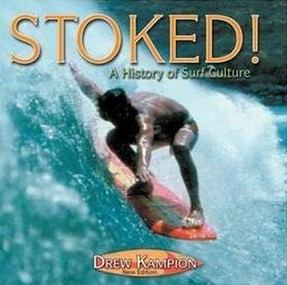 |
The second edition has a sidebar titled, "Olo, Alaia and Paipo" and a picture of olo, alaia, and paipo boards that are displayed in the Hawaiian Hall of the Bishop Museum in Honolulu. The first edition did not include the paipo or this picture. | |
| Pages 37, from the chapter, Seed Culture | One of the infamous historic pictures of a waverider holding a board in Waikiki gazing out to the surf with Diamondhead in the background. Part of the caption reads, "This turn-of-the-century photo of a lone surfer with his short paipo board at Waikiki speaks volumes." [Rod Note: Whether this board is a paipo or not could be a subject of debate. The two ancient forms of Hawaiian surfing boards were the olo and the alaia, classified as such based upon the shapes of the riding plank and the boards' cross-sections and their thickness. The alaia was usually a shorter board and for this reason is often called a paipo. Additionally, the alaia was much thinner than the olo and was the ancient day equivelent of a performance short board. The alaia was often times ridden prone style.] | ||
| Overall observation | A nice glossy,
coffee table survey of surfing history and culture through the ages.
Loaded with rich color pictures. There are a couple of short references to "soft belly board," "boogie board," and "volksurf board" usually accompanied with a discussion of Tom Morey's invention of the "boogie board," now commonly called a bodyboard.. |
||
|
Kelly, John M. 1965. Surf and Sea. New York: A.S. Barnes. (PDF files unless otherwide noted and range from 600KB to 2MB.) |
|||||
| Cover page, Forward
and Contents Chapter 2. |
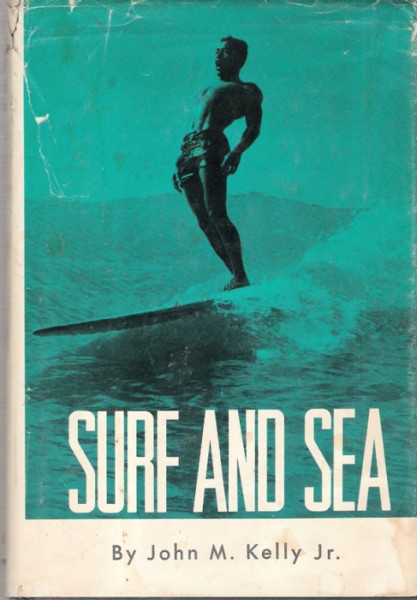 |
Credits include
paipo rider, Val Valentine. Note chapter titled, Body, Mat and
Belly Board Surfing. Page 18 from chapter 2, Riding Waves, sets the stage for what is to follow. |
|||
| Pages 50-53, from Chapter 4, Body, Mat and Belly Board Surfing | The chapter begins, "Tales of bodysurfing and belly board (paipo) surfing abound in the ancient legends of Oceania." Much of this section focuses on bodysurfing although a reference is made to using mom's halved wooden ironing board as a paipo for first-timers. | ||||
| Pages 62-66, from Chapter 4, Body, Mat and Belly Board Surfing |
|
||||
| Pages 152-153 and 156-157, from Chapter 7, Surfboards | These pages include excerpts on board design features. Page 157 includes the passage, "Support for this view was given when the fast skim boards of John Waidelich and Jim Growney began passing guns in Hawaii's big north shore surf in 1961-62." What has since evolved into the Hawaii Paipo Designs shape was referred to as a skim board. | ||||
| Page 193 photograph. Cher Pendarvis in a July 6, 2011 e-mail, confirmed the identity of the paipo rider as Uncle Val Ching, who she knows personally and wrote an article about in The Surfer's Journal 19(6), 38-47. |
Photo of Uncle Val Ching riding a paipo being standup style. Photo by Val Valentine.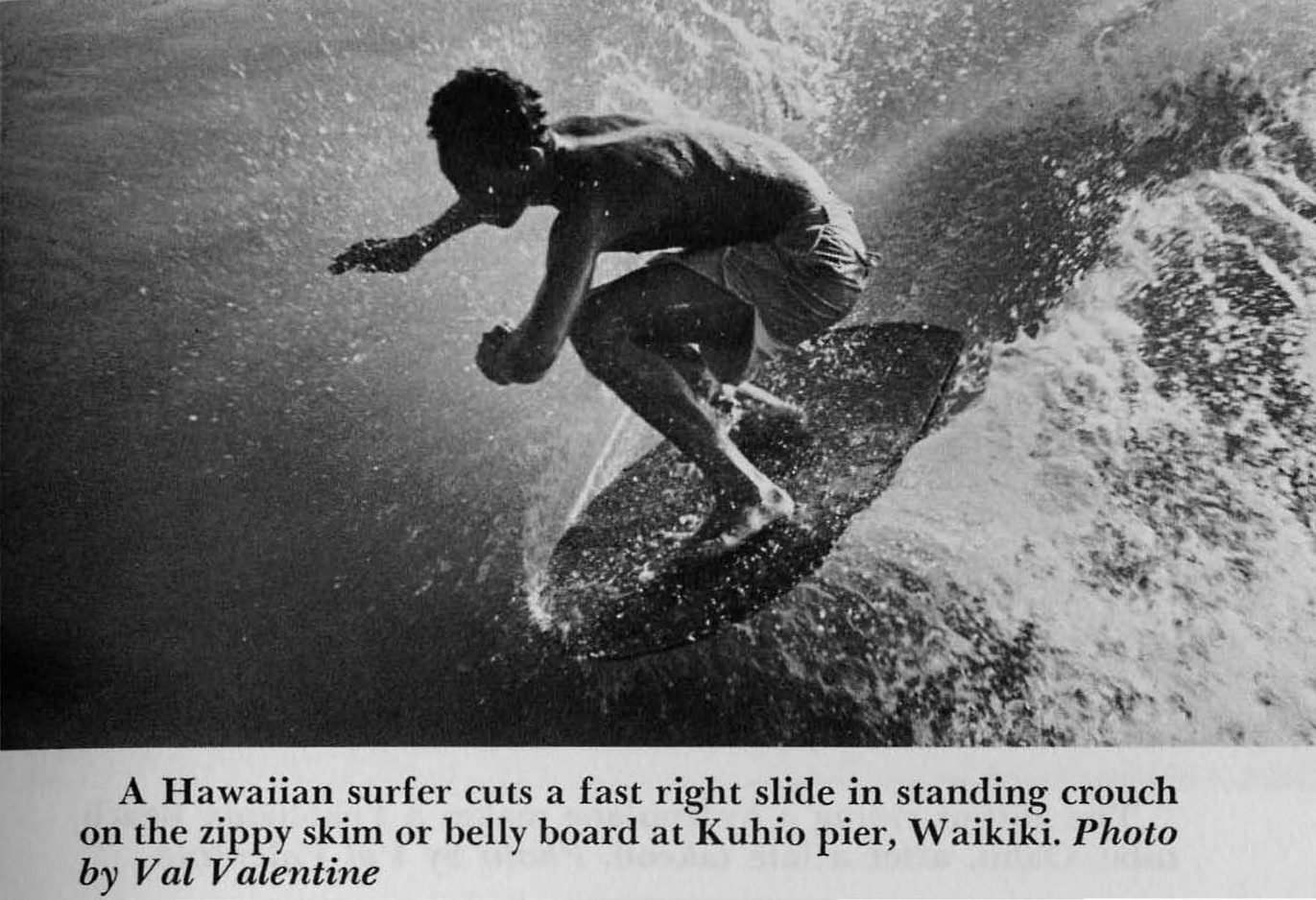 Val Ching's story about the above photograph as told to Cher Pendarvis, follows: The photo shoot was a last minute project organized by Clarence Maki. In early November 1963, a large south swell showed on the South Shore. Val had graduated that spring and was working construction, when one afternoon his dad came to the job site. He said the surf "was boiling" in Waikiki and Val Valentine and Clarence Maki wanted to shoot that afternoon.Source: Pendarvis, Cher. (2012, January 31). Story behind Val Ching's photo in John Kelly's book [E-mail to Rod Rodgers]. Information obtained in conversations between Val Ching and Cher Pendarvis in 2011. |
||||
| Glossary of Terms (excerpts) | Terms such as belloomer, board, paipo, skim or skitter board are defined. It notes that the term paipo is from popular usage but may stem from pae, to ride a wave to shore, and pu, the sea at midtide (Hawaiian). Several other treats are included in these pages such as bluebird, bone yard, box seat, sea pussy and surf chaser. | ||||
| Overall observation | This is a
well-written book
that includes two major parts, the sport and the sea. The chapter
titled "Surfboards" includes lots of good information on board design.
Well worth taking some time to read through this book. I loved the references to "catching a wave in the box seat," "edge takeoffs," and "catching a blue bird" (large wave). The box seat is the most critical part of the wave. "Catching the wave in the box seat enables the rider to develop his speed which he uses to beat the break and get into trim for sliding in the slot of the wave. But from the edge take-off, a rider risks, on his drop, a collision course with riders who have already caught the wave at the box seat and are on an angular course across the wave." Further research areas include Oceania history and culture for insights to the sport of paipo board wave riding. |
||||

|
Kirk, Cameron, and Zack Hanle. 1968. The surfer's handbook. New York: Dell Pub. Co. |
|||
| Cover page & Contents |
 |
p. 109.
Many forms of surfing are discussed, e.g., body surfing, dory racing
and catamaran surfing. However, there is no mention of bellyboarding,
paipo surfing or kneeboarding. Glossary:
|
|
|
Klein, H. Arthur. 1965. Surfing. Philadelphia: Lippincott. |
|||||||
| Cover page & Contents and Set I, Wave B, Brief Introduction |  |
"Surfing
includes every kind of surf-propelled motion, ranging from body-surfing
to group surf-riding in the largest outrigger canoes or surf boats." "Surfing for many has meant only "stand-up" surfing on boards. This kind is best known, and generally the most spectacular. For some readers it may continue to seem the only kind worth mentioning or learning. Those readers are urged especially to concentrate on the sections of the book leading up to board-surfing and to try in the surf what they learn there." "The book seeks to emphasize what seems likely to be lasting in surfing rather than that which may be temporary and faddish. It also stresses safety -- not as an unfortunate concession to integrity of life and limb but as an essential ingredient of sound, skillful surfing." |
|||||
| Rod's Note | Jim Growney has advised us about the cover shot on the book, "Makaha – 1962 – John Waidelich dropping in on an unidentified surfer. The surfer is being followed by Wally Froiseth and George Downing." A larger version of this photo is also inside the book and shown below. | ||||||
| Set II,
Reviewing the Past Wave F - Fins, Finders and Founders, pp. 41-46. |
|
||||||
| Set III, Know
Your Surf: Wave L - List of Swimming Skills for Surfers pp. 85-87. |
From Wave, L:
"This section
also introduces a most useful supplement to these basic swimming
abilities -- a supplement commonly called "swim fins." These can add
greatly to ease and enjoyment in mat-surfing, belly-board-surfing, and
body-surfing. (Fins are not suitable for full-board surfing.) What hind of fins for surfing? Anyone about to buy, beg, or borrow a pair of fins for surfing should try to get a pair suited not only to his foot size but also to actual surf conditions. Unless he is a very special case, he will probably do best with rubber fins that are fairly flexible and fairly short. Long, deeply ribbed, and rigid fins such as trained frogmen wear in TV productions are not suitable for surf. They are tiring because they impose a heavy strain on leg muscles; they are clumsy in a turbulent swash; and they are not suited to the short, sharp sprints the surfer will want to develop for wave take-offs. A pair of fins whose tips project no longer than 6-1/2 or 7 inches beyond the big toe are best. When checking fins for flexibility, the surfer should note whether or not the fins return to their original shape when releasef from tension. Good surfing fins may be quite "floppy" -- but they shouldn't be "sloppy" in the sense of remaining distorted or bent. And, of course, they should fit snugly but not tightly. The best all-around surfing fins, in the author's opinion and the opinion of many people he respects, were once made by the Voit Rubber Company and bore the identifying name of the designer, "Owen Churchill, Los Angeles." Regrettably, the past tense is necessary: for some reason this particular model is no longer offered. The same manufacturer makes other fin models, but none nearly so well suited to the surf." |
||||||
| Set IV, First Things First | This section
features three parts: Wave
M, Making the Most of Surf Mats and Floats; Wave N, Not-Quite-Full-Size
Boards; and Wave O,
Only a Body to Surf With - But It Suffices.
Interestingingly,
bodysurfing gets 21 pages of coverage, surf mats get 14 pages and paipo
boards get 11 pages. Wave M, Making the Most of Surf Mats and Floats (excerpts): "Real surf-ridding starts here on a modest but admirable "vehicle." It consists mostly of air, s lightly compressed and retained by a leakproof skin, usually of stout rubberized cotton fabric. Though its appearance probably is familiar, it is known by various names in different surf areas. Sometimes it is called a surf "mattress," sometimes merely a "mat." Along the Atlantic coast it is more likely to be known as a "float." In Australia the fancier name of "surfoplane" is used. And sometimes it is referred to as a "raft." Many of these mat maneuvers, including a genuine headstand, were shown in photographs taken at Redondo Beach in 1963. They illustrated an article appropriately entitled "Here Come the Matresses" in the first issue of Surfing magazine that year. Some truly stellar performers have spent substantial parts of their surfing apprenticeship on mats. One instance among many is Bud Browne, now known as the pioneer photographer and producer of major genuine surfing movies. Before he assembled his first cinematic surfing thriller, he had twice won the mat-surfing championship at famed Makaha Beach, on the western shore of the island of Oahu. Wave N, Not-Quite-Full-Size Boards (excerpts): "Board-surfing begins now in a form somewhat abbreviated but ancient, honorable, and admirable. For here we find the less-than-full-size boards. These are the surf vehicles that lack the size and buoyancy to enable a rider to float entirely free of the water when he paddles, or when he simply rests while waiting for a wave. Names for such boards differ according to size, shape, and the part of' the world in which they are used. Some common names are "arm boards," "belly boards," "half-boards," "paipo boards" (a Hawaiian name), "kneel boards," and so forth. The entire family could be called simply "semi-boards." This may be understood as applying to anything from the smallest arm board to the largest kneel board, which in everything but length may resemble rather closely a full-sized foam-plastic surfboard of modern design. Many readers, like the writer, grew up using the plain old name, "belly board." This can be confusing because some people think that " belly" is a rather vulgar way to refer to the abdomen. However, it means the front part of the human body, extending from the breastbone to the pelvic region. Therefore, it could be said that most riders do "belly" on such boards. A striking photograph by Dr. Don James, which appears on the jacket of this book and again on p. 56 (shown below), shows four surfers riding at Sunset Beach, on Oahu. Three stand on full boards. Above them rides the fourth, on a paipo semi-board. He is at the moment above and behind the full boards. Yet a few moments later he may be farther down the wave than his companions, for his board is small and, above all, swift. Surfers call a slow board "mushy." There's nothing mushy about a paipo or a modern belly board when it is handled by a master.  Another of' Dr. James' great surfing photographs on page 110 (see below) reveals a basic secret of paipo speed under big-wave conditions -- once again at Hawaii's famed Sunset Beach. The paipo rider's body is completely clear of the water. He has arched his body like a swan-diver, so that his legs and even the fins on his feet ride clear of the surface. The speed of his slide is marked by the wake of white foam leading all the way back to the peak.  Small as his board is -- and its thin forward edge is easily seen -- it is skimming so fast that not over two thirds of its undersurface is actually in contact with the water. It seems almost as though it might take off and fly fully free of the wave. The rider's reason for angling to his right is clear. The peak from which he shot downward lies to his left, and already the crest from that peak has spilled down the wave front a distance as great as the paipoboardsman has descended, but it is safely separated from him. (His gesture of exuberance -- lifting his left arm -- is not essential to his sliding form. It's more like the traditional hat-holding gesture of rodeo riders, who seem to be fanning the ears of their bucking steeds.) The weight of a modern belly or paipo semi-board thus may be held to as little as 7 to 10 pounds, and that of a larger kneel board to around 12 or 14 pounds. Here again we see the great lightness and buoyancy of new foam plastic materials. A 10-pound semi-board of such construction, including a protective fiberglass and resin jacket plus a fin of suitable size, should be capable of supporting about 75 or 80 pounds additional weight before it is forced under the surface of the sea. A 14-pound semiboard should support correspondingly greater added weight. Yet the board's inherent buoyancy is not the main factor that enables it to uphold most or even all the body weight of its rider during the swiftest part of his ride. The main factor is the hydroplaning effect created as the bottom of the board slides over the water. On page 113 (see below), this effect is seen again in another classic photograph by Dr. James, also taken at Sunset Beach. The paipo board (right) appears to be about three quarters out of the water as it and also the standard surfboard (left) slide in a race to escape the mountainous white water. 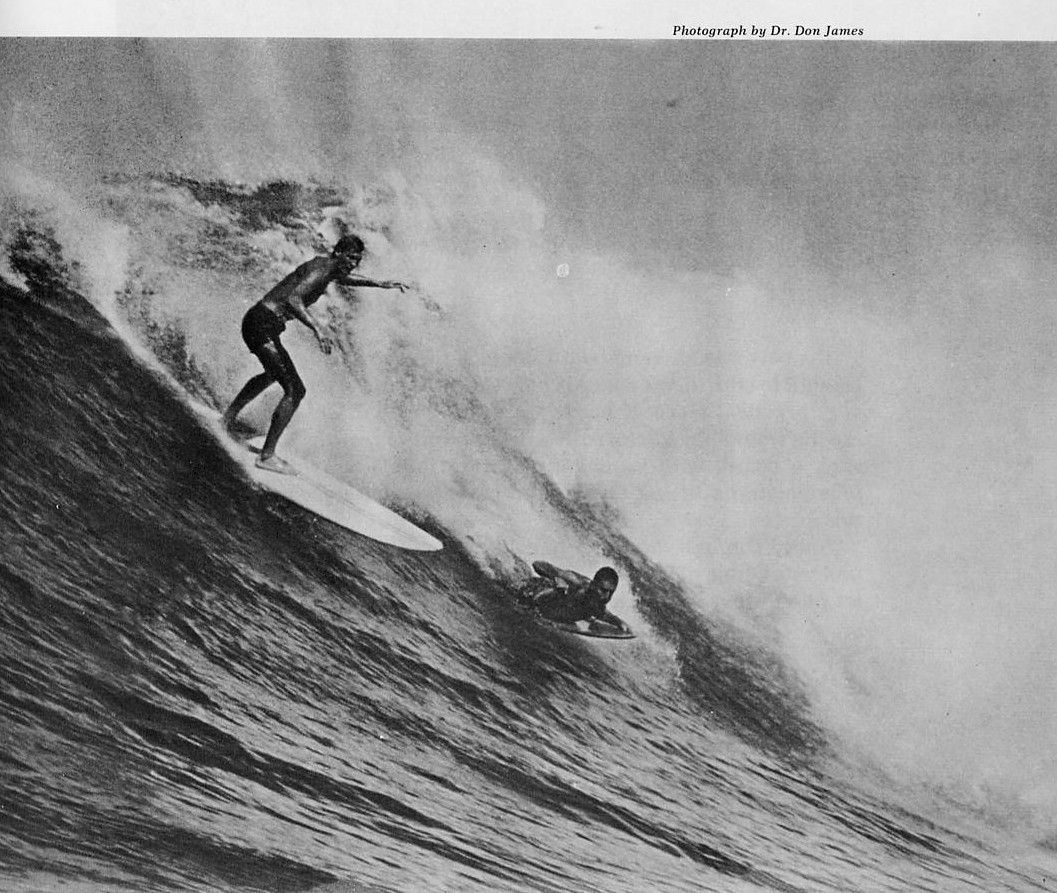 Since speed is so essential in surfing on big, steep waves, the subject of hydroplane action deserves closer consideration. Hydroplane action in board-surfing. Recent years have taught millions what wonders of weight-carrying can be accomplished by small wood or metal surfaces if they are forced to move fast enough through water. The swiftly growing sport of water-skiing supplies the best known instances. A heavy water skier, plus a "passenger" posing ornamentally on his shoulders, may ride on a single ski of moderate size, provided it and they are pulled along at sufficient speed. The ski may be formed of aluminum or iron. It need not float. In action, its hydroplane "lift," not its buoyancy, does the work. From Piraeus, the port of Athens, Greece, to Aegina, Ydra, and other history-rich islands of the Aegean Sea, passengers now ride a motor vessel with metal fins, or hydroplanes. mounted below its hull. At sufficient speed, the entire heavy vessel simply rises above the blue sea waters, supported entirely on these small hydroplane surfaces. Similar effects are at work when a semi-board moves fast enough over the water. The surf mat is, so to speak, the balloon of surfing vehicles. Thanks to its great buoyancy, it floats and bears weight, motionless or moving. The semi-board, however, is more like the airplane. It generates lift as a result of its motion. Conceivably, a semi-board could be built of a heavy solid, dense enough to sink in sea water if not otherwise supported. It would not be a very practical piece of hardware, for it would often be lost to its rider and he would have to turn diver in an effort to recover it. However, even such a board, with its negative rather than positive buoyancy, could provide strong lifting effect if properly handled during a swift surfing ride. Speed through the water is what makes the difference. For a deeper understanding of surfin g, both on semi-boards and full-sized boards, let us consider the subject of speed. [Editor's Note: see the text of the document to read more.] The modern paipo board and its somewhat larger cousin, the kneel board, show notably less surface friction in the water than do full-size boards. A full plastic-foam surfboard may have as much as 10 to 15 square feet wet at the slow start of a ride. Its fin, which has two sides in the water, may add to the total a full square foot or even a bit more. In contrast, a modern paipo or belly-style semi-board probably has no more than 5 square feet in the water, and its small fin presents not more than half a square foot additional surface. The somewhat larger kneel board is likely to tot al no more than about 7 square feet of surface in the water, including fin. When big surf runs and waves break fast, the smaller resistance of the semi-boards may give them that extra speed which makes the difference between a narrow escape, followed by a getaway -- or a wipeout. Considerations such as this make it ridiculous to regard all semiboards as if they were simply "kids tuff." It is a fact, however, that their use at this time is relatively limited on the beaches of the continental United States. They come into their own more definitely under conditions found especially at great surfing areas of the Hawaiian Islands. However, signs of a belly-board "revival" appear rather distinctly now on the surfing horizon. Many paipo or kneel boards are in important respects smaller examples of the construction used in full-size surfboards. Some of the best are even reinforced with a wooden stringer and are jacketed with as many as two layers of fiberglass fabric. However, any engineer knows that the breaking and twisting stresses are far smaller in boards 3-1/2 to 4-1/2 feet long than in those 8 to 10 feet long. Semi-boards of whatever material are relatively stronger (as well as lighter and smaller) than full boards of comparable proportions. |
||||||
| Overall observation | First,
it should be noted that the author is a mat rider. Klein does a great
job of covering the "world of surfing" organized in sets of waves,
e.g., Set I is Preliminaries and Set II is Reviewing the
Past. Set II includes 4 "waves" including Captain Cook
Encounters Surfing and Dark Days Almost Wipe Out Surfing.
Throughout the book the author emphasizes safety and fun. You have to love the term Klein uses for hard surface wave riding boards that are not meant to be ridden stand-up style: not-quite-full-size boards, less-than-full-size boards, semi-board or half-boards. Nonetheless, the most frequently used terms for these boards are belly board and paipo. It appears that whenever there is a reference to bellyboarding in Hawaii the term paipo is used. Klein makes an interesting use of mathematics in discussing board displacements and fin (skeg) surfaces. Of special note, Kleim mentions a hasake, an Israeli life guard's boat that is also used for waveriding but much smaller than a standard boat - more akin to an old style paddleboard or a stand-up paddleboard, but larger. |
||||||

|
Krauss, B. H. 1993. Plants in Hawaiian culture. Honolulu: University of Hawaii Press. |
|||
| Cover page and excerpt from Ch. 8, Games and Sports and an appendix, Description of Plants |  |
Chapter 8
contains a two page
discussion
of the role of plants, i.e., the two principal trees used in the
building of surfboards, the alaia and olo. Much of this section is
taken from Surfing, the sport of Hawaiian kings, by Finney and Houston (1966). See the Description of Plants for more information on the koa and wiliwili trees used in the building of the alaia and olo boards, respectively. |
|
|
Kreeft, P. 2008. I surf, therefore I am: A philosophy of surfing. South Bend, Ind: St. Augustine's Press. |
|||
| Click here for the Cover page & Contents and a Brief Introduction. |  |
This book makes many claims but for me comes across as a cross between pop culture and pseudo philosophy with a surfing connection. The advertisement reads something like this: "This is the first book about surfing ever written by a philosopher." and "It gives ten compelling existential reasons why everyone should surf: reasons from the great philosophers: Moses, Buddha, Confucius, Lao Tzu, Socrates, Plato, Aristotle, Jesus, Machiavelli, Freud, and George Morey. It explains how surfing is the easiest and most delightful way in the world to attain what you most deeply long for, for it can make you good, mystical, peaceful, wise, heavenly, happy, sexy, and even rich." Huh? The most intriguing aspect of this book is that it "contains a manifesto defending bodyboarding as true surfing, not “sponging.” Huh? Bodyboarding needs a manifesto defending the sport? Originally, I had read about "the bodyboarding manifesto" and thought this would be interesting, but a "defense?" NOT. The American Heritage® Dictionary of the English Language, Fourth Edition, defines manifesto as "a public declaration of principles, policies, or intentions, especially of a political nature." | |
No doubt the author is an
accomplished
scholar. Nonethelss this book comes up short except for a tidbit
quoting Jack London's experience with surfing. "Like love, stoke is
both indefinable and irresistible. Your first wave will hook you
forever, like a fish. Listen to the classic account of how it happened
to Jack London in Hawaii:
One after another they came, a mile long, with smoking crests ... these bull-mouthed monsters, and they weigh a thousand tons, and they charge into shore faster than a man can run . . .. I watched the little Kanaka boys. When a likely-looking breaker came along, they flopped upon their stomachs on their boards, kicked like mad with their feet, and rode the breaker into the beach. I tried to emulate them. I watched them, tried to do everything that they did, and failed utterly. The breaker swept past and I was not on it ... away the little rascals would scoot while I remained in disgust behind. I tried for a solid hour, and not one wave could I persuade to boost me shoreward.Then, finally, at the end of the day, Jack caught his first wave, and (in his own words) .. . from that moment I was lost." (See pages 16 and 17.)A Defense of Bodyboarding: A Manifesto. Read it yourself and draw your own conclusions. I could quote excerpts but that would not do justice. For me it is a mixed bag. |
|||
|
Kuhns, G. W. 1963. On surfing. Rutland, Vt: C.E. Tuttle Co. |
|||
| Title page and Contents |  |
In the
Foreward, Kuhns writes, "As a sport, surfing has no set of rules. In
fact, the term "surfing" is nebulous in the respect that it is never
quite clear as to what type of action constitutes the performance of
the sport. What is considered surfing by one person may not be
considered surfing by another. Perhaps it should be made clear to the non-surfer that surfing does, however, entail more than j ust riding a wave to shore while standing on a surfboard. To say that the object of surfing is merely to ride a wave to shore would be like saying the object of a bull fight is simply to kill the bull. If this were true, it would be difficult to understand why the matador does not use a rifle from the press box. Actually, the test of the matador is how he kills the bull; and the test of the surfer is how he rides the wave." |
|
| The author writes, "It is the author's intention that this book should not only furnish the general information through which the reader may become acquainted with a new and remarkable sport, but that it will help establish in the surfer the skill and knowledge through which he will gain the maxirnurn satisfaction from the sport by making the wavemore a servant than a master." | |||
| Ch. 1, An
Introduction to Surfing |
Kuhns treats
bodysurfing and paipo boarding as evolutionary steps to riding a
surfboard while standing erect: "We can only theorize as to how the
sport of sliding down a wave while standing on a somewhat buoyant
object developed. Perhaps the idea was first conceived by some obscure
islander as he watched driftwood being washed ashore; or, perhaps, the
idea evolved from swimming to body-surfing to belly-boarding until,
finally, the surfer was standing erect. It is quite understandable,
though, that such a sport would be conceivedby a fun-loving and
adventurous race of people such as the Polynesians." There are no other discussions or photographs of paipo/bellyboarding. |
||
| Glossary |
|
||
| Overall observation | An introductory book on surfing with scant mention of other forms of wave riding. The term "paipo" never appears throughout the book and the bellyboard and skim board are mostly treated as one and the same. | ||
|
Lord, Lindsay. 1963. Naval architecture of planing hulls. Cambridge, Md: Cornell Maritime Press. |
|||
| Cover page and Contents |  |
Various
comments and excerpts follow:
|
|

 [Rod's Note: My two Austin boards have an aspect ratio of roughly .39, within the broad optimal range of .30 and .50 shown in the figure above.]
|
|||
| Overall observation | An advanced, techical book on the theory and practice of designing high speed planing hulls. A hard-to-find book, which is unfortunate, since a novice like myself can not digest everything in one sitting and 2 weeks via InterLibrary Loan is simply not enough time to read, think, read again, think some more, talk... well, you get the picture. The book is available for $100 or more via Internet book buying/selling services. | ||
|
Margan, F., & Ben R. Finney. 1970. A pictorial history of surfing. Sydney: Hamlyn. |
||||||||||||
| Cover page, Note and Contents | 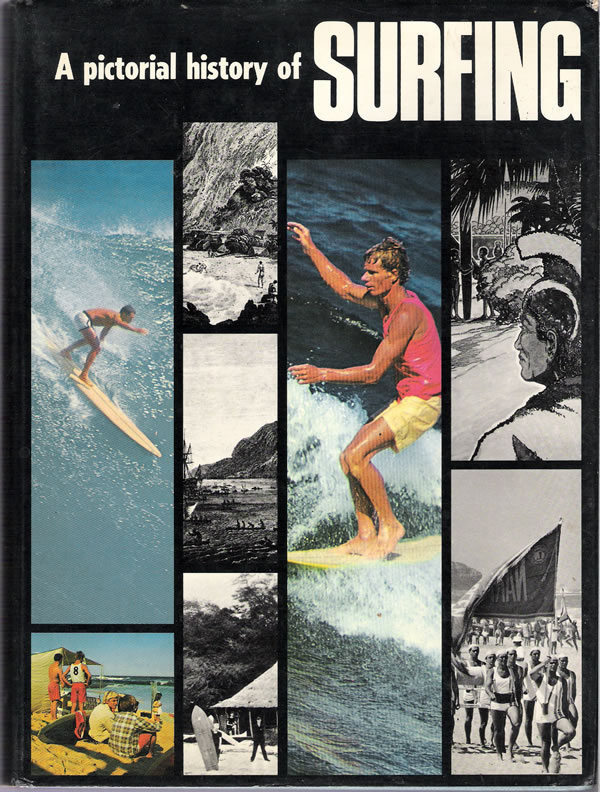 |
The title
is a bit misleading. The title should probably be something more like
this: A Pictorial and Narrative History of Australian Surfing, Its
Roots and Influences.
The book features tons of figures ranging from 18th century engravings
to modern color photographs, from bodysurfing and boat surfing to
modern shortboarding (ca 1970). The first couple of chapters cover the
early beginnings of the waveriding sport and throughout the remaining
chapters are bits and pieces of surfing from around the world [Finney].
However, this book is really a history of Australian surfing, and the
factors influencing its development and how Austrialia externally
influenced surfing, mostly countries of the former British empire
[Margan]. There is a considerable amount of narrative and photographs
dedicated to the documentation of the early beginnings of beach bathing
and the formation and spread of the surf life saving movement. The narrative and figures do not flow together (disjointed). Read the pictorial and narrative stories separately - you will never be able to match them up as you turn the pages. |
||||||||||
| Pages 13- 24 from ch. 1, Surfing's Hawaiian Past and ch. 2, and Surfing's 18th Century Peak. | "Three
main ways have been developed to surf such waves: body-surfing, canoe
surfing and surfboarding. Surfboarding was in ancient times and is
again today the most popular, spectacular and exciting of the three.
Kneeling or lying prone on a surfboard, the surfer uses his hands and
arms to paddle out to where the surf peaks. Just before it breaks. he
paddles before a moving wave until he has enough speed and the wave's
slope is steep enough for him to slide free. The surfer then stands and
manoeuvres the board with his body weight and footwork to stay at the
edge of the breaking wave, darting in and out of its curling edge as he
surfs toward shore. The first step in developing this form of surfing may have been the discovery by a swimmer that a wooden plank held before a breaking wave was a handy device for speedily returning to shore. Such a discovery could have led to the simplest form of surfing -- belly-board surfing -- using a short board held against the belly or chest to ride prone on a wave. Because of its simplicity, belly-boarding may easily have been invented many times and at many places around the world, but there are only two areas where it was widely practised before modern times: along the shores of West Africa from Senegal to Nigeria, and along the beaches and reefs fringing the many islands of the Pacific. African surfing seems to have been independently developed by the water-loving Africans living along the Atlantic shores of that continent, though it never seems to have evolved much further than belly-boarding, or to have spread to other peoples. Although it is impossible to say exactly when man first began to surf in the Pacific, the wide distribution of the sport throughout the islands of this vast ocean indicates a considerable antiquity for the sport. It probably dates as far back as three or four thousand years ago when the ancestors of the present-day Pacific Islanders were sailing from the shores of South Asia and surrounding archipelagos out into the Pacific to discover and settle new lands. Practically everywhere these maritime people settled -- from, for example, the north coast of New Guinea to tiny Easter Island off the South American coast -- there is evidence of a presumably ancient surfing tradition. Surfing skills varied among the Pacific Island populations, however. Along the shores of New Guinea and the other islands of Melanesia, and on the islands of Micronesia and those of the western half of Polynesia, surfing remained in the simple belly-boarding stage. Boards were usually just a few feet long -- only big enough to allow a surfer to ride prone -- and typically only children and youths surfed. It was among the main islands of East Polynesia -- New Zealand, Tahiti, the Marquesas and Hawaii -- that longer boards were developed and the sport became something more than just a casual recreation of the younger set. In Tahiti, for example, the first explorers found that Tahitians of all ages and social classes were enthusiastic and skilful surfers, and that mature men and women prided themselves on their surfing prowess. Captain William Bligh was able to watch Tahitian surfing first-hand when he anchored the Bounty at Matavai Bay on his ill-fated expedition to gather breadfruit in Tahiti, and wrote the following description of Tahitian surfing in his log: 'The heavy surf which has run on the shore for a few days past has given great amusement to many of the Natives, but is such as one would suppose would drown any European. The general plan of this diversion is for a number of them to advance with their paddles to where the Sea begins to break and placing the broad part under the Belly holding the other end with their Arms extended full length, they turn themselves to the surge and balancing themselves on the Paddles are carried to the shore with the greatest rapidity.'Although it is not clear from Bligh's description how large the Tahitian boards, or 'paddles' as he called them, were, or in which position the Tahitians rode their boards, another early observer indicates that Tahitian surfing was considerably advanced in terms of boards and riding positions. James Morrison, the boatswain's mate on the Bounty who was stranded for several years on Tahiti after the mutineers took over the ship and sailed away to exile on Pitcairn Island, makes it clear in his description of Tahitian surfing that boards might be longer than a few feet in length, and that a few of the Tahitian experts were able to stand at least momentarily on their boards. These Tahitian surfing experts had their counterparts among the men who excelled at surfing in New Zealand and the Marquesas island groups where a similar trend toward the development of larger boards and more sophisticated surfing techniques was evident. But none of the Polynesian surfers from south of the Equator could ever have challenged the surfing champions of Hawaii who rode standing up on full-size surfboards and mastered the waves as no othe Polynesians or other Pacific Islanders ever had." |
|||||||||||
| Selected figures from pp. 22-25, ch. 2, Surfing's 18th Century Peak. |
|
|||||||||||
| Pgs. 44, 47, on surfboard types from Hawaii's past. | "A surfboard was
a papa he`e nalu, a 'plank for wave-sliding', and the surfer
had two main types of board to choose from, the short, thin alaia,
and the long, narrow, olo. Each, as we shall see, was adapted
to a particular type of surf and demanded a particular style of surfing. As the first migrants to Hawaii, and their Hawaii-born descendants, began to concentrate their sporting energy on surfing, they developed boards that were larger and more finely designed than the short, simple bellyboards used elsewhere in Polynesia and the Pacific. They evolved the first true surfboards that allowed riders to stand and manoeuvre at will on the slope of a wave. The two main types of Hawaiian surfboards, the alaia and the olo, were thus the result of hundreds of years of experimentation and testing by generations of Hawaiians to develop boards suited for maximum performance in the surfing breaks around their islands. The alaia boards remained closest to the original belly-boards in that they were fairly short, thin and probably could not fully support a rider until the board was planing on a wave. An average alaia board was perhaps six to eight feet long, fourteen to eighteen inches wide and an inch or so thick. The nose was usually wide and rounded. and the sides tapered towards a squared-off tail. In cross-section, both decks were apparently convex, meeting with narrow and sometimes sharp siderails. Although some observers reported olo boards twenty-four feet in length, most were probably in the fourteen to eighteen-foot range." |
|||||||||||
| Selected figures from pp. 137 & 138. | Surf mats
were called "surf floats" in 1930s Australia.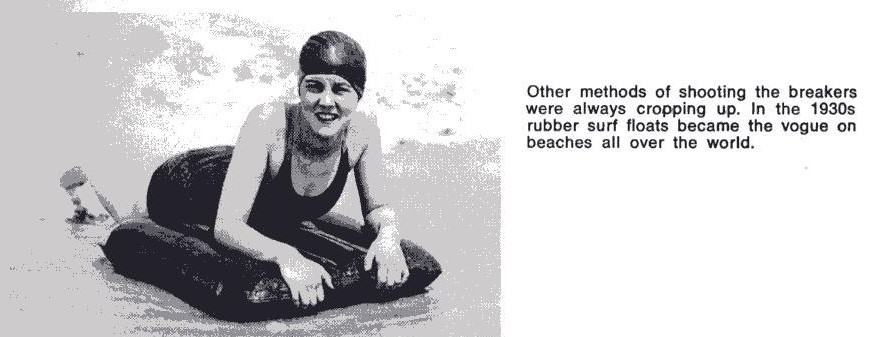 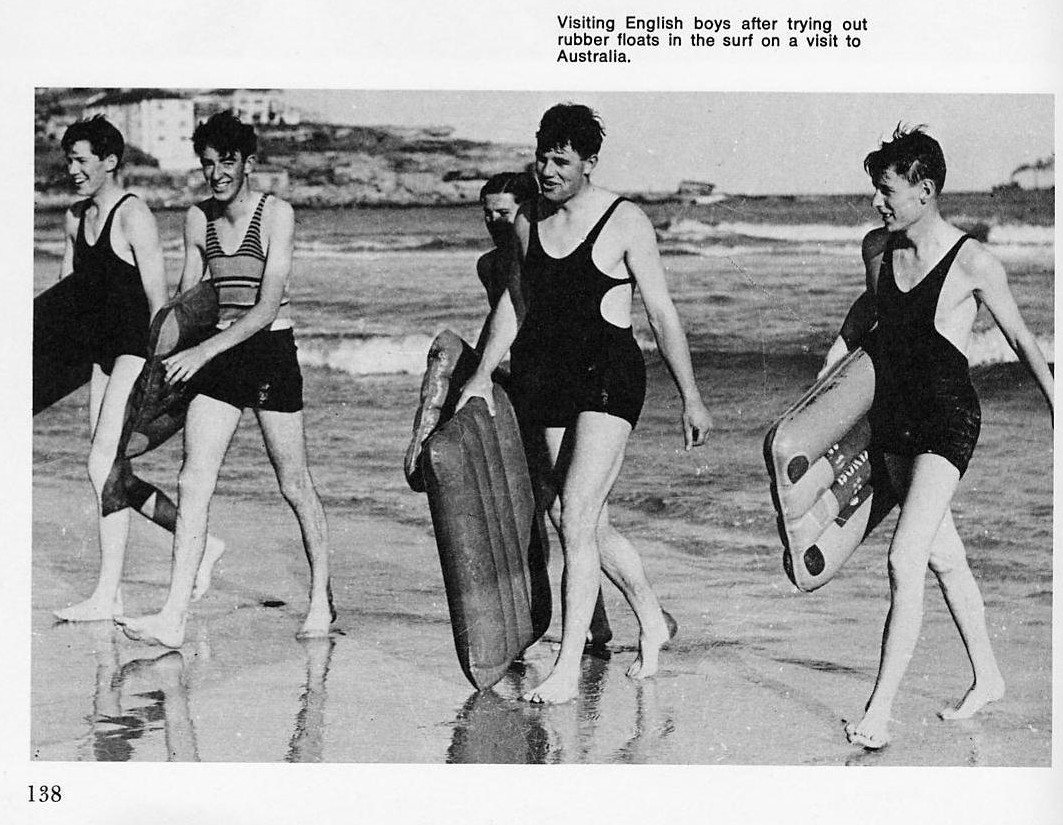 |
|||||||||||
| Selected figures
from pp. 152, 153, 154, 156, 224 and 309, looslely from the chapter, Styles
of Riding Machines |
The first board riders outside California to try out the Malibu took it easily.  With a flipper to get momentum, a belly board -- a very short version of the Malibu -- proves highly menoeuvreable in good surfs.  A sight not often seen, body surfer and belly board rider on the same wave. The beaches of the world have become so crowded, board riders and body surfers are today in separate areas. 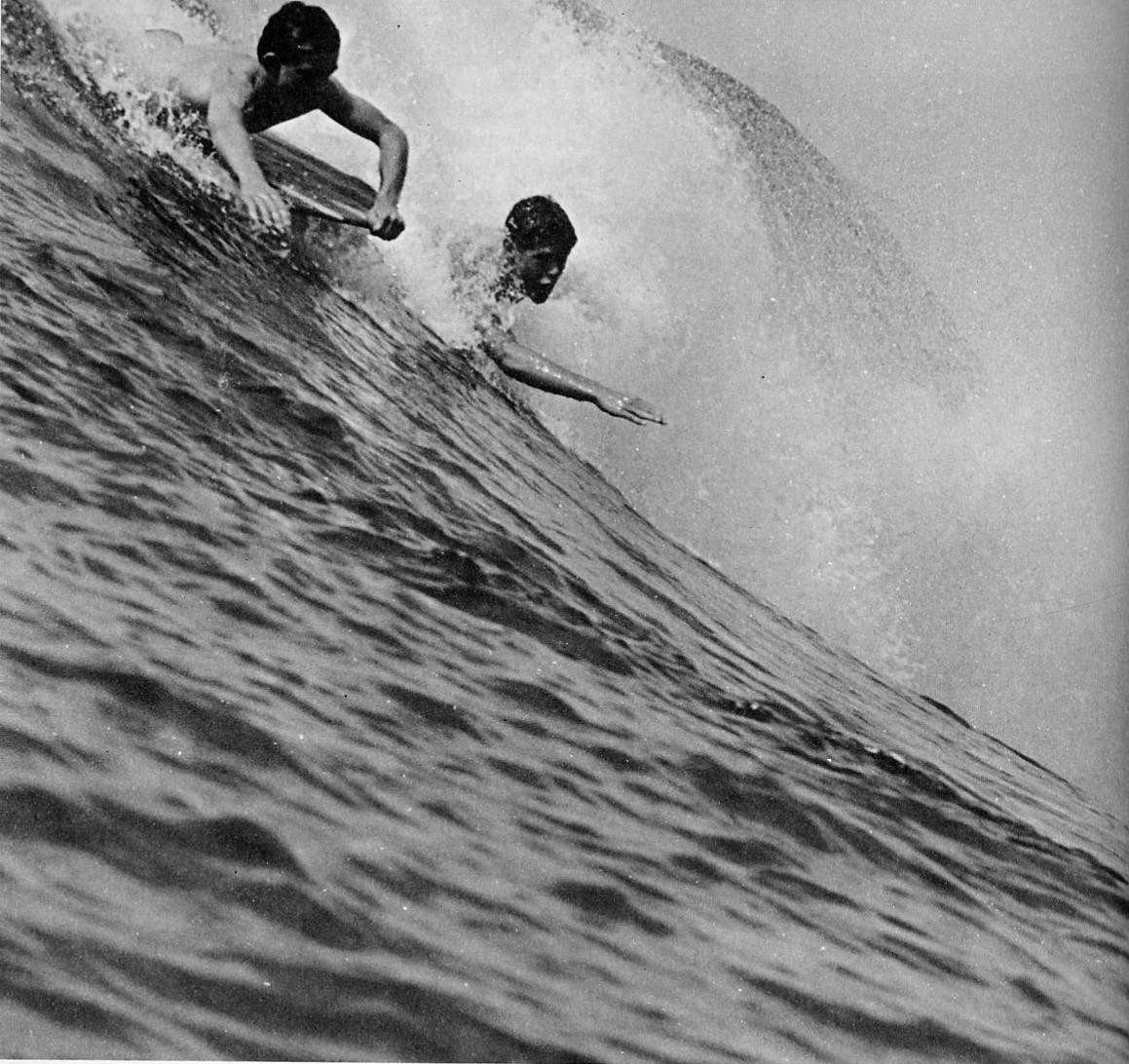 There's a crash coming, Two winter surfers get their lines crossed.  Screaming across the face of the wave on a belly board makes for exhilarating riding. [Rod's Note: This photo is also seen in Surfabout 2(6). The photo is of Leigh Tingle.]  Two belly board riders having fun as they skip down the face of a wave at Cronulla Point, N.S.W. 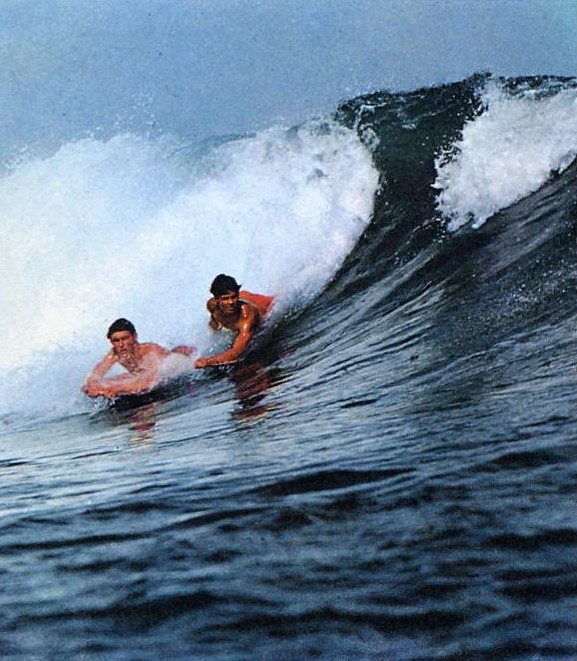 Trapped inside, a surfer about to go over the 'falls', while Ken Williams drops down the face of a big wave at Cronulla Point, N.S.W. [Editor: Looks like the paipo rider is in a critical position for a good ride if not for the longboarder dropping-in.] 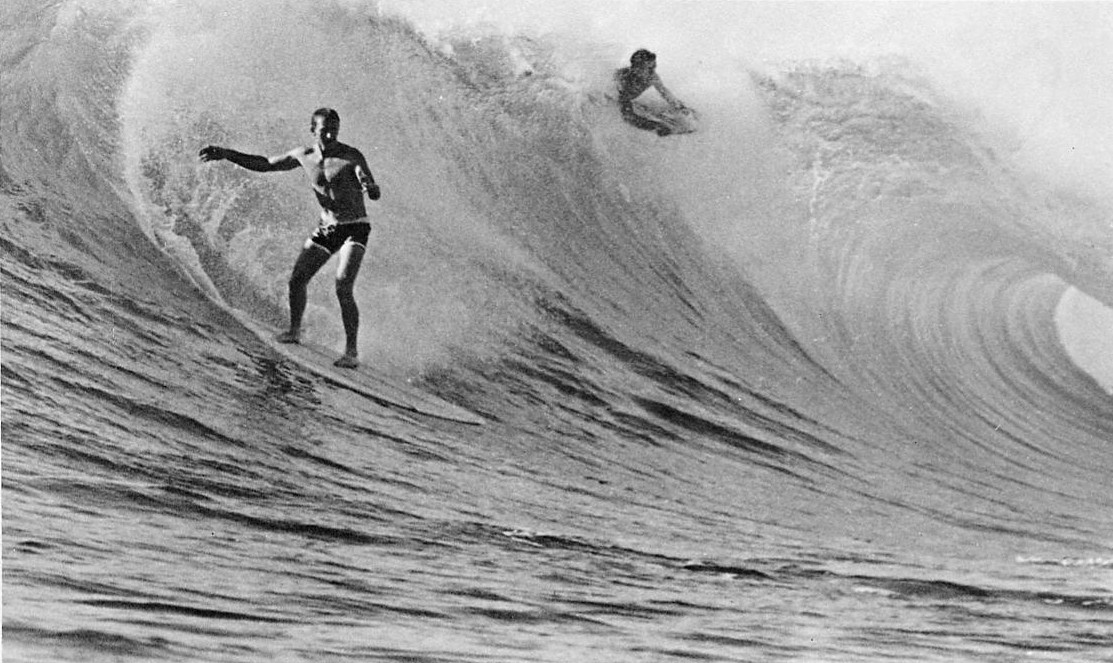 |
|||||||||||
| Bonus Figure, p 167. | You won't
find one of these on your paipo board!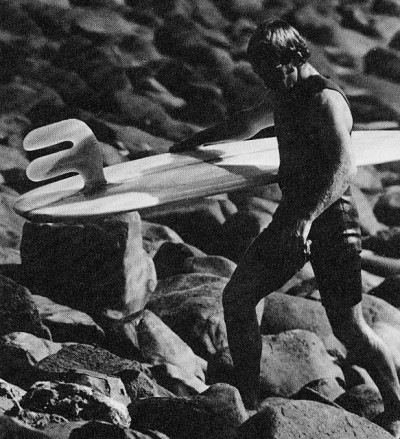 |
|||||||||||
| Glossary of Terms, pp. 313-319. [PDF, 3.5MB] | Interesting notes: The terms bellyboard and bodyboard are not listed. However, "paipo board" is listed -- although this term is not used anywhere else in the book -- and defined as "a small bellyboard used in theHawaiian Islands." | |||||||||||
| Overall observation | This is a well-written book that includes two major parts, a history of the ancient sport of surfing (Finney) and a history of surfing in Australia (Margan). The Australian history provides an in-depth description of the sport's early beginnings, including the groundbreaking surf bathing (swimming), previously taboo during daylight hours, the beginnings and evolution of the surf life saving movements and its spread to other areas of the British Empire. The book has a huge collection of pictures of surf dories, surf skis and surf shooters (bodysurfers). Although published in 1970, the book has scant coverage of the shortboard movement. | |||||||||||
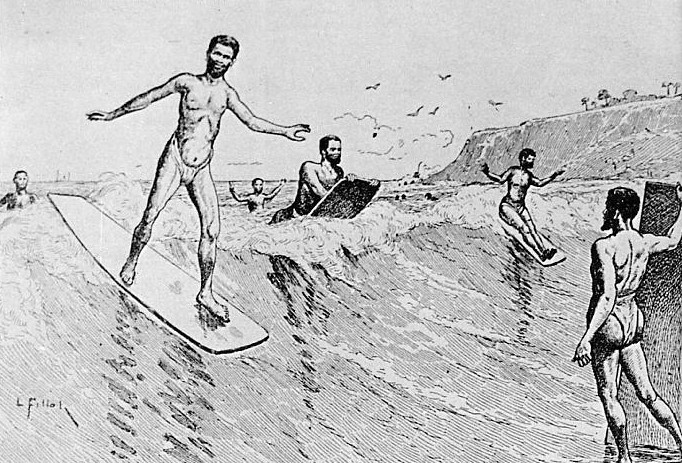

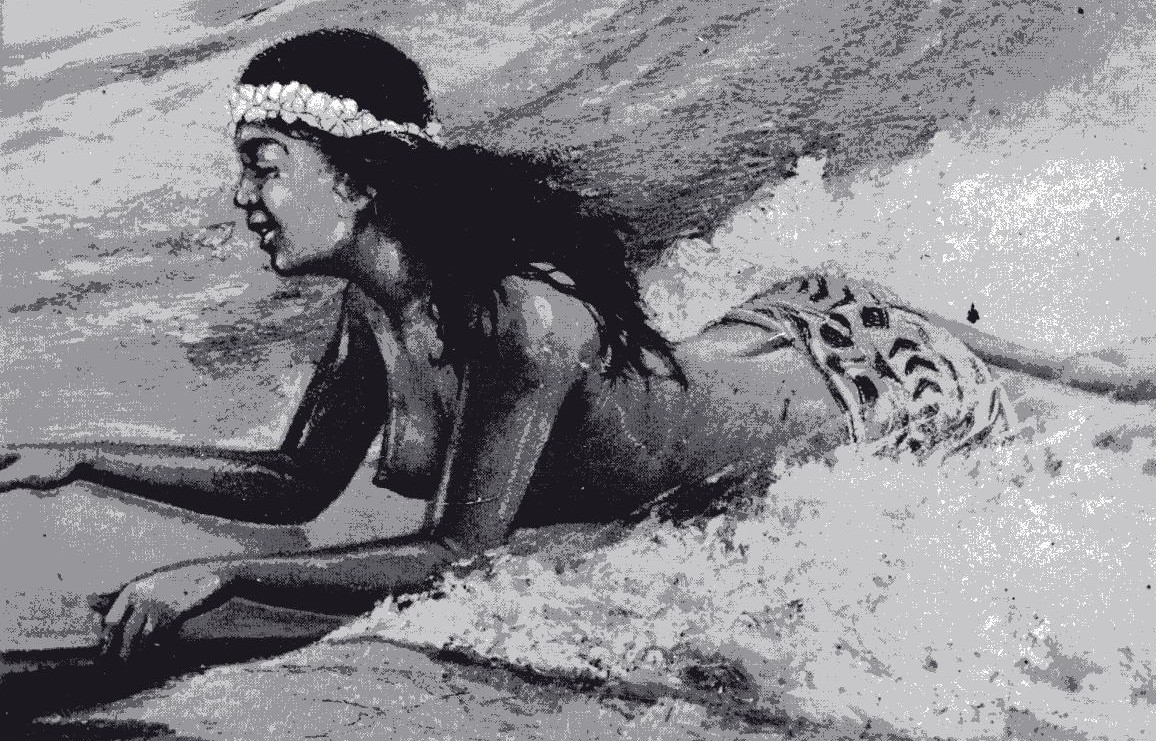
|
Martin, Mary L. 2008. The ultimate collector's guide to surfing postcards. Atglen, PA: Schiffer Pub. |
|||
| Title page and Contents [PDF] and Introductory Chapters |
 |
Of special interest on pp. 4 and 5 are narrative and figure examples for dating postcards. |
|
| From the collection of photographs |
Shown below is one example of the postcards related to paipo boarding. References to other figures follow below.
|
||
| Overall observation | Very nice collection of surfing postcards. |
||
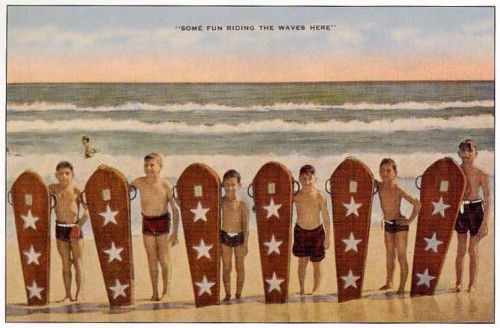
|
Motil, Guy. 2007. Surfboards. Guilford, Conn: Falcon Guides. |
|||
| Cover page and description |
 |
This
is a large format coffee table style book on surfing and surfboards.
The book features great photos of boards old and new, e.g., the hot
curl. It is a shame that cameos of paipo boards and bellyboards are not
included from the early days to the present. The book includes a
two-page spread on the George Greenough spoon. |
|
| p. 22, on the early start of Motils' surfing experience | "I set about trying to talk Mom and Dad into buying a new surfboard. I was lucky, my parents were pretty cool by early '60s standards and soon my brother Gary and I werethe proud owners of a surfboard and a belly-board." | ||
| Overall observation | Nice book of surfing boards and photos but nothing of driving interest for the paipo brotherhood. |
||
|
Muirhead, Desmond. 1962. Surfing in Hawaii: A personal memoir. Flagstaff, Az: Northland Press. |
|||
| Title and Table of Contents | 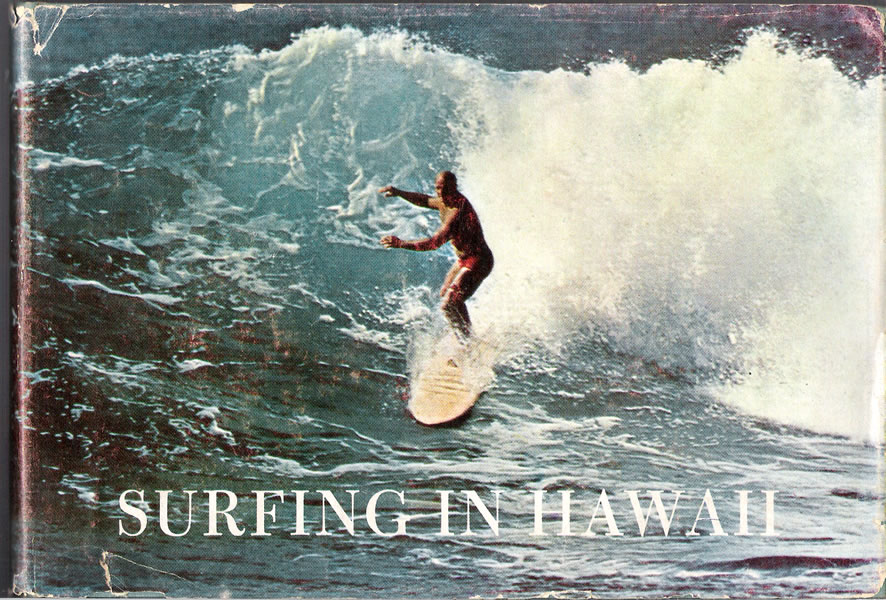 |
Book description: "First printing. This book interweaves a history of surfing on Hawaii with an account of his learning how to surf himself. While not a 'how-to" book, it includes a lot of helpful information on philosophy, technique, wipe-outs, choosing a board, and dealing with "The Big Surf." It also includes notes on Australia, California, Peru, and other surfing countries. Thirty-seven full-page black and white photographs, most by Dr. Don James , but a few by Muirhead himself. Small oblong format, measuring approximately 6 1/4 inches tall by 9 inches wide. Two appendices on California and Australian surfing beaches. Shortly after publishing this book, Muirhead went on to become one of the most influential and innovative golf course designers in the world; he is responsible for coining the term "golf course community" where the golf course shapes the development around it, and he emphasized the beauty and vistas which unfold on the golf course both for those using it, but also from the roads winding past it." | |
| Pages 1, 2 & 10, Ch. 1, History of Surfing in Hawaii | "Surfing is a
very old sport, so old that its actual beginning cannot be traced. In
ancient Polynesia there was no written language, since both history and
legend were handed down by word of mouth from parents to their
children. This exchange was usually in the form of chants which were
called meles in Hawaii. There is ample evidence, from the many
references in these chants, that the art of surf-riding was one of the
most widespread of the Polynesian sports, practiced in one form or
another throughout the Pacific region, from New Zealand to Hawaii, and
from Easter sland to New Guinea." "On most of the Islands of Oceania, the boards used for surfing were small, less than five feet long, and the modern practice indicates that these would not support a man other than in the prone position; they were merely a gradation above what we call body surfing boards today. It is significant that boards greater than five feet in length were found only in New Zealand, Tahiti, and Hawaii, and it is in Hawaiian chants alone that we find frequent reference to the positions of sitting, kneeling, and standing on the boards, as the surfers rode down the surfaces of the advancing waves." "Sophia Cracroft and Lady Franklyn, the widow of the famous Arctic explorer, visited the Kona coast with Kalakaua just before he ascended the throne. In her letters to her family in England, Miss Cracroft describes a surfing meet. It is obvious from the text that Kalakaua had already started his campaign to revive Hawaiian sports and customs." "At twelve we started in our litters to a bay a little way below this, to see some surf riding." And, "We alighted at a very nice native house belonging to a chief of the lower grade, a very good looking man whom Mr. Kalakaua had introduced to us yesterday. He is an excellent surf rider and joined in the succeeding sports, which was also witnessed by a great number of people belonging to the village, who clustered all round the house. I fear that I can hardly give you a correct idea of surf-riding but I will try." [Description of riding paipo and erect style.] "A man or woman swims out to the line of breakers, having before him a thin board from 4 to 6 feet long and about 15 inches wide; this in swimming he carries before him with one arm, swimming with the other.The curling waves are nothing·to these swimmers - they either dive under them or ride up the face of the liquid wall and appear on the top of, or behind it. They choose their wave according to its height and the direction it will take in reaching the shore, and then instead of facing it they turn about, place the surfboard immediately in front, rise to the crest of the wave, and literally ride upon it with extended limbs until it has spent itself upon the beach. But if they perceive that it will cast itself against the rocks, then they turn around again and stop short. It is a really wonderful sight, and some are so expert that during their flying progress they can spring upright on the surfboard and come in erect! We saw one man do this." |
||
| Page14, Ch. 2, Surfing in Modern Times | [Alaia and olo boards; alaia used for body surfing.] "The ancient Hawaiians used two types of boards, the alaia (thin) board and the olo (thick) board. The alaia was used for body surfing but the olo might be 20 feet long and weigh 180 pounds. Large boards were needed to hold 400 pound chieftains. Boards were made from koa, the sickle-leaved Hawaiian acacia, from the breadfruit and from other species. The chiefs often had boards of a light, balsa-like wood called wili-wili, a Pacific relative of the Tiger's Claw, the symbolic tree of India." | ||
| Page106, Ch. 10, Larry Goes Fishing and Pupukea | [Bodysurfing and paipo boarding affinity. Could also be a reference to a hand board.] "After wipe-outs at Pupukea and other big wave beaches you will get plenty of opportunity to body surf, a form of entertainment much practised at Makapuu on the other side of Hawaii Kai where many enthusiasts use a small board and swim finsto help them." | ||
| Overall observation | Use of the term, "body surfing boards." Alaia boards for riding prone-style aka "body surfing." The book made scant use of footnotes and did not contain a bibliography. | ||
|
Nelson, William Desmond. 1973. Surfing; a handbook. Philadelphia: Auerbach Publishers. |
|||
| Cover, Title and Contents Excerpt from Ch. 4, "The Surfboard," on displacement and planing hulls |
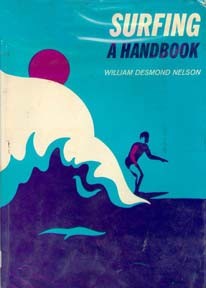 |
Special
interest to note: "This book is dedicated to the weekend surfer."
Despite this humble dedication this book provides quite a bit of
technical information that is useful to the everyday accomplished
waverider and the novice weekend warrior. In pages 29-35, there is a good discussion on displacement and planing hulls taken from the author's interpretation of Lord Lindsay's Naval Architecture of Planing Hulls. Snippets follow: "In the water, a surfboard has two different states, or personalities. It can be a displacement hull or a planing hull, or it can be a combination of the two. Most of the time it is a displacement hull... ." [p.29] "When a surfboard is a displacement hull it is like a tugboat or an ocean liner. As the board floats, or moves at paddling speed in the water, it supports itself and the surfer with its buoyancy." [p.29] |
|
|
"Neglecting the weight of the board, a surfboard with a volume of two
cubic feet can support a surfer weighing 120 pounds, and a board with a
volume of three cubic feet can support a surfer weighing 180 pounds. If
the 180-pound surfer lies on the two-cubic-foot board, the board will
sink until 60 pounds of the surfer is underwater, while the remaining
120 pounds stays above the surface... This is the reason why getting a
conventional, short knee board out to the break is such hard work You
really don't paddle it out; you swim it out." [pp.29-30] The Surfboard as a Planing Hull. "The other state, or personality, of a surfboard is that of a planing hull. Planing is something we see outboard motorboats, fast yachts, and Navy P.T. boats do when they are going fast. The hull of the boat rises out of the water, the bow sticks up more than the stern, and the boat seems to skim on top of the water. A water ski is a good example of a planing hull. A water skier is entirely supported by planing action." [p.32]Nelson makes the observation on page 35, "Surfboard buoyancy is the single most important factor for the average surfer." [Note: even moreso for the average East Coast surfer.] |
|||
| Excerpt from Ch. 13, "Technical Aspects of Surfing," on displacement and planing hulls | The importance
of size..."As I got into the writing of this book... Only two surfing publications show any understanding of the mechanics of planing. John Kelly's book, Surf and Sea, has an interesting chapter on the design of Hawaiian guns and semi-guns, in which he covers rail shapes and the use of a step. H. Arthur Klein's book on Surfing mentions hydroplaning in relation to paipos." [p.145] |
||
| Glossary |
|
||
| Overall observation | The index does not include entries for belly board or paipo. Excellent book for its time; the years and decades have not diminished its relevancy. Errata note: This book has information geared specifically to the East Coast USA surfer. Not surprising since Nelson is also from the East Coast. | ||
|
Nodaway, Max. 1908. Rollo in Hawaii. Chicago: Thompson & Thomas. |
|||
| Title page |
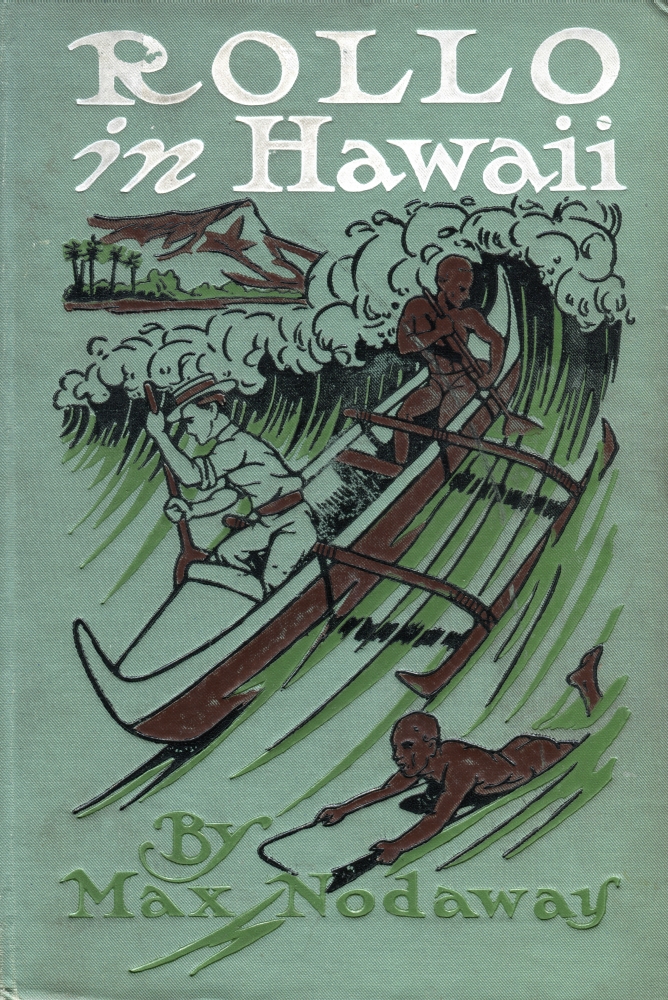 |
"A Tale of thrilling adventures, amid Volcanoes, fire fountains and
tropical wonderlands; into which is woven a vivid description of those
mystic Isles, where fire and water have built up a delirium of chaos
and beauty." -- t.p. Note the paipo rider on the bottom right of the cover for this book. Maybe the earliest book cover which features, or includes, a paipo rider? |
|
| pp. 30-32 | Some context for the cover appears on these pages:Now we're off for Waikiki and a surf ride. ... Now let us go surf-riding like the Kanakas. See, there's a heavy swell coming into the bay. [p.30]Notable takeaways include: (1) the board riders paddled out and caught waves in a good-sized swell in Waikiki sans swim fins, (2) the boards were ridden "breast down," or prone, and (3) boards were betweenn 4 to five feet long ("like my mother's ironing board"). |
||
p. 107 |
A surf--board and and outrigger canoe.  Note: The surfboard pictured above appears to be an alaia-style surfboard intended for foot, knee or prone riding. |
||
| Overall observation | Maybe the earliest book cover which features, or includes, a paipo rider? | ||
|
Nordhoff, Charles. (1873, August). Hawaii-Nei. Harper's New Monthly Magazine. 47(279), 382-402. |
|||
| Cover and Contents [PDF], first page of the article, and Introductory Chapters Source(s) |
 |
 There are two parts to this article, Hawaii-Nei and Hawaii-Nei II, published in successive months, August and September, 1873. Timothy DeLaVega notes in 200 Years of Surfing Literature, that only part one described surfing. DeLaVega also notes that the woodblock, "Surf Bathing," is attributed to Commander William Bainbridge Hoff, of the flagship California. Sources: http://digital.library.cornell.edu/ |
|
| p. 399 engraving |
The engraving clearly shows two
surf riders on alaia sized boards, one paddling beyond the breakers and
the other riding over the top of a wave in a prone position. It can not
be determined from the engraving alone whether the rider intended to
ride prone or stand-up. A third surf swimmer is showed separated from
his board in a position that would suggest he was pushing his board
through the wave while paddling out. |
||
| p. 402, surfing is described |
In the last page of the article, the
author describes surfing: "where you can see a truly royal sport--the surf-board." Continuing, "The surf-board is a tough plank about two feet wide and from six to twenty feet long..." [Rod's Note: Which would easily describe an alaia board and maybe an ono board.] "...muscular natives swim out to the first line of breakers, and, watching their chance to duck under this, make their way finally, by the help of the under-tow, into the smooth water far off beyond all the surf." [Rod's Note: Hence the use of the term "surf swimming." Also note the use of rip tides to aid in paddling out to what we now call the line-up position.] Continuing, "Here they bob up and down on the swell like so many ducks, watching their opportunity. What they seek is a very high swell, before which they place themselves, lying or kneeling on the surf-board. The great wave dashes onward, but as its bottom strikes the ground, the top, unretarded in its speed and force, breaks into a huge comber, and directly before this the surf-board swimmer is propelled with a speed which we timed and found to exceed forty miles per hour. In fact, he goes like lightning, always just ahead of the breaker, and apparently down hill, propelled by the vehement impulse of the roaring wave behind him, yet seeming to have a speed and motion of his own." [Emphasis added.] [Rod's Note: Also appears to describe an alaia-style board ridden at an angle to the face of the wave rather mostly straight in on a gradually sloping wave as an ono board would be ridden.] "They look, kneeling or lying on their long surf-boards, more like some curious and swift-swimming fish-like dolphins racing, as it seemed to me-than like men." "Occasionally a man would stand erect upon his surf-board, balancing himself in the boiling water without apparent difficulty." "The surf-board play is one of the ancient sports of Hawaii. I am told that few of the younger generation are capable of it, and that it is thought to require great nerve and coolness even among these admirable swimmers, and to be not without danger." |
||
| Overall observation | In
this article the author documents surf riders lying, kneeling, and
occasionally standing erect. The surf-boards are described as being
long (6 to 20 foot) and the riders are called "surf-board swimmers." Also note the engraving is titled, "Surf Bathing." [Is this article referred to in the YouTube comment about a white man?] |
||
|
Olivares, José de, and William Smith Bryan. 1899. Our islands and their people as seen with camera and pencil. St. Louis: N.D. Thompson Pub. Co. |
|||
| Title page
[JPG]. No Table of Contents seen. |
 |
Full title: Our islands and their people as seen with camera and pencil;
introduced by Major-General Joseph Wheeler. With special descriptive
matter and narratives by José de Olivares. Edited and arranged by
William S. Bryan. Photographs by Walter B. Townsend. Two volumes.
Issued in 24 parts. Number of pages: 776. Description: "Embracing perfect photographic and descriptive representations of the people and the islands lately acquired from Spain, including Hawaii and the Philippines; also their material resources and productions, homes of the people, their customs and general appearance, with many hundred views of landscapes, rivers, valleys, hills and mountains, so complete as to practically transfer the islands and their people to the pictured page." Other Islands include Cuba, Puerto Rico, Samoa, the U.S. Virgin Islands and Guam (?). A quite facinating read for myself having been raised in Puerto Rico, in addition to the coverage of Hawaii and the other island. |
|
|
p. 22. |
Did Cuba need the Surfrider Foundation? Read the following snippet regarding the Havana, Cuba, beach area:"The Prado has been aptly referred to as the Champs Elysées of Havana and on frequent occasions presents quite as brilliant an appearance as the celebrated Parisian promenade. On the beach near its terminus are located the Baños del Mar, a popular bathing resort. Surf bathing, however, in the immediate vicinity of Havana, is a decidedly perilous luxury. The reason for this is the pestilential condition of the water, rendered so by the refuse from the city's sewers, which empty into the harbor and gulf at various points. It is largely to this fact that the city owes its reputation for being one of the most unhealthy places in the world; and this it must continue to be until some modern plan is devised for a proper disposition of the city's sewage."It is not clear what the meaning of "surf bathing" in this context means. Swimming and wading at the beach and the ocean waters or does it include body surfing and surf board riding. |
||
p. 426 |
A NATIVE AND HIS SURF-BOARD: The native sits or stetches at full length on the board and rides the surf with perfect ease and safety. The mild climate makes sea-bathing a pleasant sport all the year round, and the natives become so expert in the use of these boards that they have been known to ride the surf for a distance of half a mile or more. 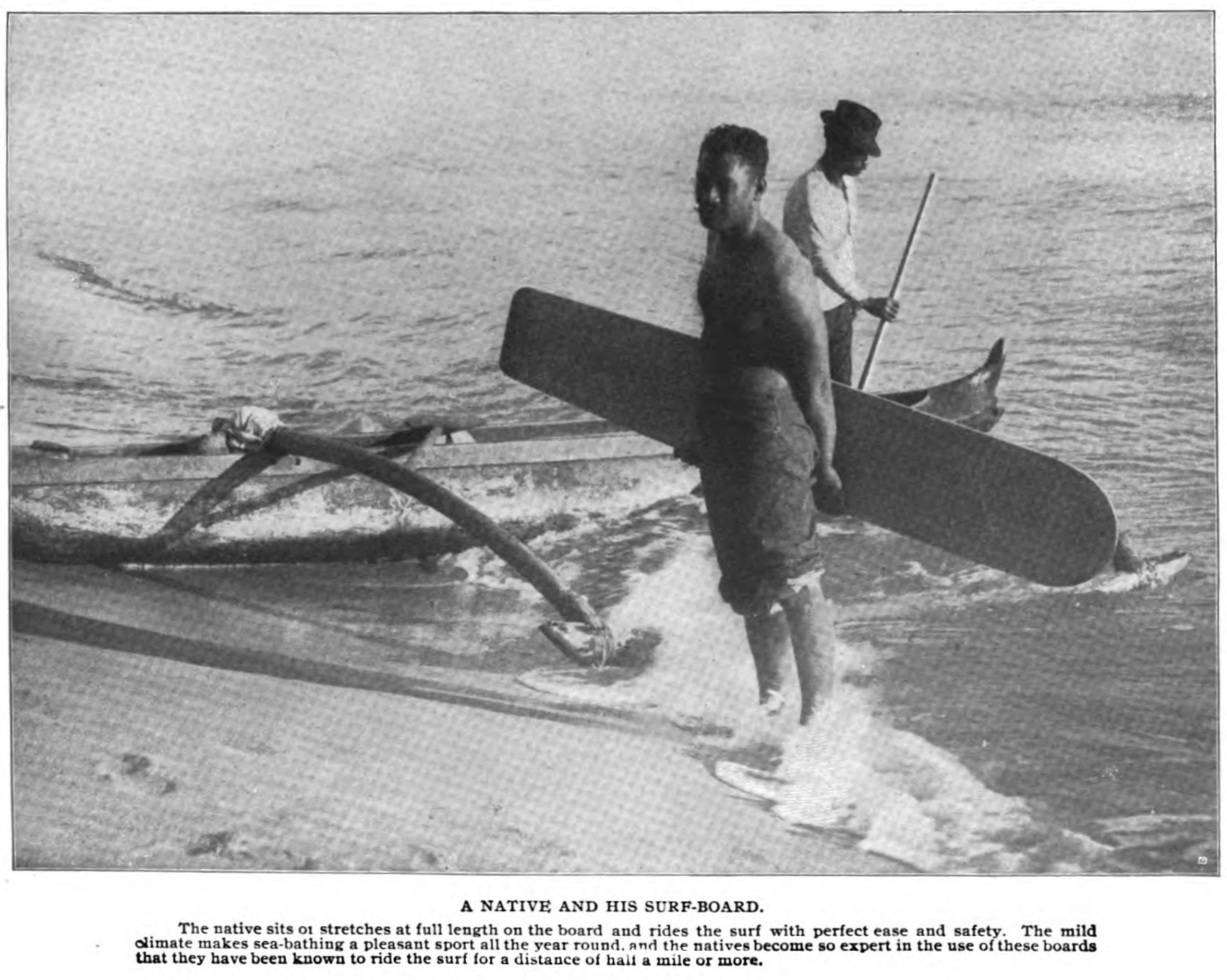 |
||
| p. 527 | In
a section on the love for gambling the text states, "Boxing was their
favorite national sport, and many thousands of intensely interested and
excited people attended its frequent exhibitions." Then the book
transitions to surf riding, or as it was called, surf-bathing and surf-riding:But the most popular of all their sports, and the one still practiced by all ages, sexes and conditions, is surf-bathing. This is performed by the use of a flat board, about eight feet long by one and a half wide, and polished until it is as glossy as the surface of a pane of glass. With these boards they boldly swim out to sea, diving under the incoming waves, until they reach the line of deep water; then lying flat down upon their boards, they balance themselves on the crest of a breaker and ride it shoreward with almost incredible speed. It would be impossible to conceive of a more inspiring or exciting sport, and it is apparently attended with but little risk. Surf-riding seems to be peculiar to the Hawaiians, and all visitors who witness it are charmed by the grace and daring of the performers. Some of the most beautiful native women of Hawaii are expert surf-riders, and may be seen disporting themselves in the waves at their popular seaside resorts any month in the year. Even little children, of both sexes, are passionately fond of these thrilling races in the surf of the sea, and, being affectionately guarded by their elders, rarely meet with accident or injury. All visitors are fascinated by the sport, but few have the courage to essay it, and it is not likely ever to become popular away from its native home.Comment: The best quote is, "...and it [surf-riding] is not likely ever to become popular away from its native home." |
||
| Overall observation | These alaia-style boards were used for riding kipapa-style (prone), kneeling and sitting and for standing and riding lala-style (diagonal to the wave). Notice the slightly upturned nose for preventing pearl diving. Many early descriptions of alaia-type boards have them flat, without rocker, such that either side is ridable. Note term used for the board, surf-board, used for riding prone or in a sitting position, as described by the author. No other mentions of surf-riding, except in very general passing, found via word search and skimming of many materials, although a more careful reading of oceanian islands other than Hawaii would be merited. |
||
|
Orbelian, George. 1987. Essential surfing. San Francisco, Calif: Orbelian Arts. |
|||
| Title page and Contents [PDF] and Introductory Chapters Source(s) |
 |
This
book has been described by some as "the Bible of Surfing." Author
George Orbelian, a proponent of measurement controlled shaping, created
the Design Forum while Surfboard Design Editor for Surfer Magazine. Review by Jeffrey Rosbrugh (Wilmington, NC, September 17, 2000, on Amazon.com). "Outstanding book. I have read it several times over. Although it is a bit dated technology wise (materials), the dynamics and mechanics involved in the physics behind the sport have remianed unchanged. The author explains how different designs (template, tails, bottoms, rails, etc.) affect a board's performance characteristics. I really enjoy reading the book. In fact, it was my companion in arms when I shaped my own surfboard recently and applied all the lamination. The board came out perfect, and I attribute most of the sucess to this book." George Orbelian's website, http://www.essentialsurfing.com/. |
|
| Preface |
The
author describes seven forms of surfing: bodysurfing,
belly/bodyboarding, kneeboardlng, surfing, tandem surfing, windsurfing,
and skimboarding. [Rod's Note: Not included here, probably in part due
to the year the book was written, are kite board surfing, stand-up
paddleboard surfing and canoe surfing.]Bodysurfing - Just a body and a wave. Usually bodysurfing is done with the aid of swim fins to help the bodysurfer generate the necessary speed to catch the wave. Once the wave has been caught the body actually becomes the planing surface. Skillful bodysurfers are capable of extraordinary rides and maneuvers. Some masters can actually ride the "energy" just beneath the face of the wave, without ever actually protruding out of the wave. You may come across seals or dolphins enjoying waves by bodysurfing with their uncanny skill. [p. 1][Rod's Note: This book was written after the ascendency of the Morey Boogie Board style bodyboard and virtual disappearance of the paipo/bellyboard, although this type of bodyboard continued to be ridden in the continental USA and elsewhere, and the wooden paepo-style board regularly ridden in Hawaii. Note the grouping of the handboard with the bellyboard rather than with the bodysurfing style of surfing. Comment on note: So, is bellyboarding "surfing" or "presurfing?" Funny because in my case I surfed a longboard before surfing a bellyboard, but found the paipo more adept than a longboard at wave breaks such as Gas Chambers, in Puerto Rico. So, my longboard was "presurfing" for my paipo!] Kneeboarding - A type of surfing where the surfer rides a specialized board on his knees. Most kneeboards are tri or quad fin designs between five and six feet in length. Padded chest or double knee wells are utilized on some knee boards to improve control and surfing performance. Swim fins are worn to help propel the small boards into waves. Kneeboarding allows the rider to get into a very compact and stable position. The small board and stance of the kneeboarder make this type of surfing very suitable for steep drops, quick radical maneuvers and tube riding. [pp. 1-2][Rod's Note: It isn't clear to this reader how the kneeboard is more specialized than the bellyboard. The only real differentiating characteristic in the description above appears to be the number of fins. However, bellyboard/paipo boards use anywhere from 0 to 4 fins and boards made of many different types of materials.] Surfing - Surfing is the sport of riding across the face of a wave while standing on a specialized board. Surfing takes place on waves from one foot to over thirty feet in height. [p. 2, excerpt][Rod's Note: Again we have the comment of the specialized board! And for the first time a range of wave heights. The only true differntiation in surfing is the stance -- standing while riding. The multi-paragraph section on "Surfing" ends with the most salient observation of them all: "Personal preference..."] |
||
| Chapters on Surfboard Design, pp. 5-63 Clark Foam Literature, pp. 164-199 |
The
board design section contains tons of good information on surfboard
design technical information and diagrams, e.g., templates/planshapes,
rails, rockers, thickness flow, tails, fins and more (see the table of
contents). Since publication of this book in 1987, the discussions on
any number of these topics has evolved but the basics contained in this
relatively brief 50+ pages are still relevant. Reading this section
will certainly help you in being on the same page as your shaper when
it is time for ordering a custom board. What is missing is a discussion
of the cores, coverings and adhesives (e.g., foams, glasses and resins)
being used widely in the 21st century. The remaining sections of the
book contain good information for the beginning and always
learning waverider (e.g., waves, winds, tides, wipeouts and much more).
All of this information can be adapted to the needs of the prone riding
surfer (albeit with some consideration to the unique waveriding
characteristics of the prone rider vs. the longboarder or
shortboarder). The chapter, Clark Foam Literature, also contains an informative discussion of board construction. The chapter also contains a section, Analysis of Future Trends in Surfboard / Sailboard Construction (see link, pp. 171-3). [Rod's Note: An interesting side note for the 1958 entry on the first molded polyurethane blank -- the first experiments were conducted using a blank for a bellyboard (see Pezman, Steve. (2009, August-September). Hobie's Story - Chapters from His Early Years. The Surfer’s Journal, 18(4), 54-55.), and Paipos in the Media.] |
||
| Overall observation | An excellent addition to a wave rider's library. No mention of prone boards other than in the introductory pages discussed above. Awkward phasing in the bellyboard description, "Both bodysurfing and bellyboarding are excellent presurfing interests." | ||
|
Patterson, Otto B. 1960 Surf-Riding, Its Thrills and Techniques. Rutland, Vt: C.E. Tuttle Co. |
|||
| Page 31 from chapter 2, Building Your Board |  |
In the first paragraph of the chapter: "In 1957, the Bishop Museum in Honolulu displayed fifteen surfboards covering a century of surfing in Hawaii. One of these collectors' items, probably the oldest surfboard in existence, was a small body-surfing board said to be several hundred years old." Also of note is the following, "In early times there were two types of surfboards generally made in Hawaii. The alaia (thin) board, made of koa or breadfruit wood was considered to be for body-surfing. The olo (thick) board, a log-type such as that used by Chief Paki were generally made of lightweight wood." [Rod Note: Other sources will show that the alaia was used for "performance" surfing, i.e., sliding sideways on the wave whereas the olo was hard to maneuver and usually ridden straight in towards the shore.] | |
| Pages 123-133 from the chapter, Ancient Surfing Legends | A couple of
stories. Of mystery are the references to two konane boards in the poem beginning on page 124 (konane is a game of Hawaiian checkers):The small konane board is at Hono-kau-pu,and on page 125: From the top of the tossing surf waves,In The Legend of Kelea, there are two references to what might now be called body boarding, or paipo riding, in surf-bathing and surf-swimmer: "...and enjoying the cool breezes of that district, and the pleasure of surf-bathing; and that with him was his sister Kelea, the most beautiful woman on Maui and the most accomplished surf-swimmer." and "...the messengers offered to ride the canoe through the surf--a sport as exciting as that of swimming on the surfboard." |
||
| Overall observation | Not a bad book to pick up and read. Sprinkled with Hawaiian terms such as malihini (newcomer, or beginner) and pukas (holes, or dings in the board). | ||
|
Pike, Steve. (2007). Surfing South Africa. Cape Town: Double Storey. |
|||
| Contents |
 |
This is a follow-up to the classic South African guide, Surfing in South Africa (see above). This book is packed with information on South African surf spots, lore, history and culture, and illustrated by excellent photos and art. There are over one hundred pages on surf spots covering almost 3,000 km of coast. Many sections are co-authored. Book also contains sections on travel, oceanography (very well done), and a Surfrican slang glossary. | |
| Ch. 1, History | Muizenberg was the birthplace of surfing in South Africa. The book recounts this story:One of the earliest memories of someone standing on a surfboard in South Africa was unearthed in the early 2000s. Cape Town surfer Ross Lindsay was in Zimbabwe visiting his wife's great aunt, Heather Price, who was almost 100 years old. The old lady's face lit up when he mentioned that he was a surfer. She hauled out photographs taken at Muizenberg during the First World War. The pictures showed her surfing with American marines, who had brought their boards with them on US Navy ships stopping off in Cape Town. There may be other sepia snaps, dog-eared and musty, buried beneath old papers in attics somewhere, but this is the first known experience of surfing in South Africa . [p. 12]The following page shows the photograph of Heather Price riding a longboard in the whitewater onto the sand [p. 13] Other information of interest: "Harry Bold became editor of the first surfing magazine, South African Surfer, which appeared in 1965. The magazine folded three years later, but it played a critical role in documenting the early days of modern surfing. Some of the older guys, like Derick Jardine (see his paipo interview) and Bold, are the proud owners of every issue - a valuable collection of memories." There are also a couple of photographs of Jardine. [p. 18] |
||
| Overall observation | Paipo
perspective: Stunningly missing are any mentions of the formative years
of waveriding in South Africa, mainly Muizenberg, where surf-boarding
on bellyboard type planks was popularized by 1910 (see series of books
by Michael Walker below). An otherwise fine book. |
||
|
Severson, John. 1967. Great surfing: photos, stories, essays, reminiscences, and poems. Garden City, N.Y.: Doubleday. [Note: many photographs were torn out of my review copy -- need to check another copy to see if there are any paipo-related ones.] |
|||||
| Title page Glossary |
 |
Glossary entries:
|
|||
| Photo array appearing after page 128 |
|
||||
| Overall observation | The
captions in the above photo array show how the terms kneeboarding and
bellyboarding were often used interchageably in the 1960s. No
bellyboarding/paipo-specific photos. Severson defines surfing as a wide
range of waveriding activities as portrayed in the photo array. Lord Byron is mentioned as an enthusiastic bodysurfer -- follow-up for future research as a potential UK-Style "bellyboarder." |
||||
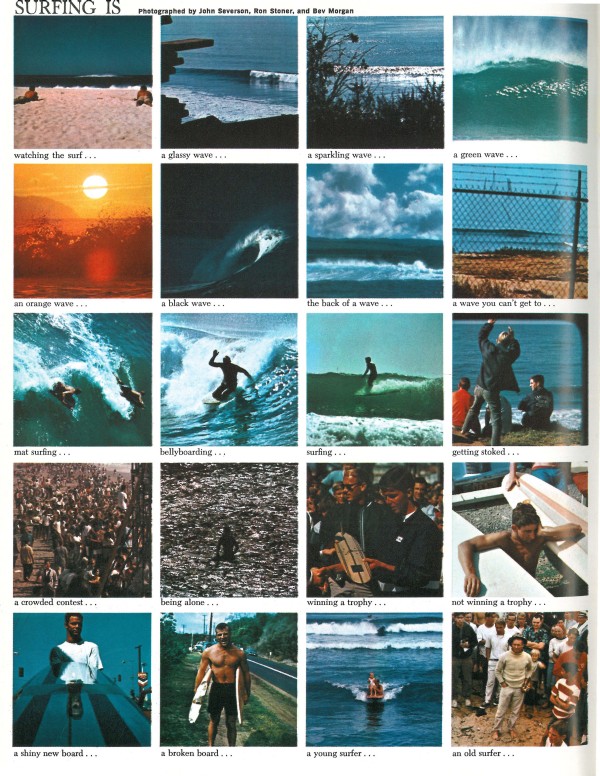

|
Severson, John Hugh. 1964. Modern Surfing Around the World. Garden City, New York: Doubleday. |
|||||||
| Title pp. 15-16 from chapter 1, Surfing Today p. 19 from chapter 2, How It All Started |
 |
Just for the
record. (Note: most of the scanned PDF files below range from 60KB to
420KB.) "Although surfing is considered a new sport, it's actually an old one experiencing a renaissance. It is generally believed that the ancient Polynesians were the first to surf and introduced surfng to the Hawaiian Islands. Peruvian artifacts show that the Incas were also surf-conscious and that they practiced the sport of surfing on reed mats in the surf of Miraflores, near Lima, where surfing was again introduced in the 1940s by Carlos Dogny, a Peruvian, uponhis return from a visit to Hawaii." [pp. 15-16] "The fraternity of surfboard riders and surfers is growing each year and what used to be a desolate beach is now someone's favorite surf spot. An even closer look will reveal that not all surfers ride surfboards. There are quite a number of different methods of riding the surf and each method has its own group of devoted followers who will swear and argue the point that their particular type of surfing is the only way. The popular ways of riding waves include surfboarding; mat surfing (with air-inflated rubber mattresses); bellyboarding, paipo boarding; riding kayaks, canoes, and low-powered craft; and body surfing." [p. 19] |
|||||
| pp. 130-131 from chapter 15, Different Kinds of Surfing and A Note on Equipment |
|
||||||
| pp. 165, 172,
175, Surfing Terminology (excerpts) |
|
||||||
| Overall observation | A concisely written book that covers a wide range of topics and does it fairly well. Severson apparently rode a paipo (see above photograph). | ||||||
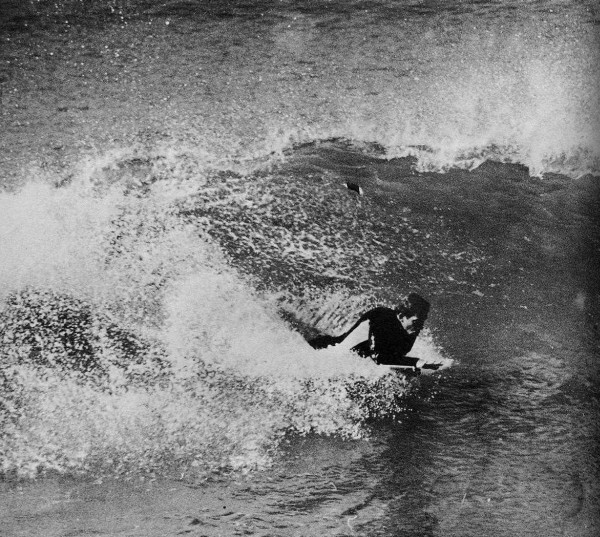
|
Skinner, Tina, Mary L. Martin, and Nathaniel Wolfgang-Price. 2004. Hawaii remembered: postcards from paradise. Atglen, PA: Schiffer Pub. |
|||
| See the Contents. |
 |
Of
reference note is a short history of the postcard in the United States
on pp. 222-223. On page 27 is a favorite post card, the "Aloha Poem." |
|
| Items showing paipo riding or boards |
References to paipo-related figures are referenced below:
|
||
| Overall observation | Note that the post card dates cited above are earlier than for the same postcards cited in the Mary Martin book of 2008. |
||
|
St. Pierre, Brian. 1969. The fantastic plastic voyage; across the South Pacific with surfers and a camera. New York: Coward-McCann. |
|||
| Title and Table of
Contents Discussion about George Greenough, pp. 177-185 |
 |
On George
Greenough in the chapter, "Australia," a comment about the board
Greenough rides -- is it a paipo/bellyboard or is it a kneeboard? Is it
surfing? Nat Young's comments follow. "Personally, I respect him as the most logical surf rider I have come in contact with. He is an extremely good surfer, although he has never stood up on a surfboard in his life. He rides a highly technical belly board with a flexible back, designed to bend with every contour of the wave. and it's hollowed on top. which virtually makes the board wrap up around him and gives the board a low center of gravity. It looks a little like a modified spoon." "To any surfer the name 'Greenough' is synonymous with a new fin design that has been appearing on surfboards more and more. This fin was designed specifically for George's new belly board. However, after modifications, he came up with a standard fin which is now being used on many surfboards around the world." |
|
Continuing,
"Where does he stand with regard to the evolution in design?"Then the question is asked about whether bellyboards are a part of surfing (and the answer focuses on function not the style of riding, prone, knee or standup) "Had you considered belly boards to be part of surfing up till two years ago, when you met George?"The dialogue continues "Yeah, he's working with something different from what I'm working with. I think we're both working toward a similar end result; it's just that George is a little closer to it than I am."The author then writes Nat, by the way, is wrong about one thing; George has stood up on a surfboard -- a couple of times; but he didn't think it was much fun. He prefers air mattresses and belly boards. Normally, this would get a guy laughed out of the water, but George is such a fantastic innovator and so committed out there in the water that he is respected by everyone. |
|||
| Mickey Muñoz rides a bellyboard, p. 238 | It isn't clear whether Muñoz was riding a bellyboard or what is now called a kneeboard or a Velo-style spoon kneeboard in this reference, "...and Mickey Munoz drew his usual share of amused attention when he took a bellyboard out and rode some waves, nearly acquiring a new nose a few times when he came too close to the rolling rocks." | ||
| Overall observation | Interesting
story about the making of a surf film that focused on the short board
revolution, Australians and their V-Bottom boards and effects on the
venturing Americans that brought back their experiences to California
in December 1967. From a research and semantics standpoint the interchangable use of the term bellyboarding leaves the reader unclear whether the writer was referring to a bellyboard/paipo board or a kneeboard, or whether the board was ridden prone or on the knees, absent photographs or a personal discussion with the writer. |
||
|
Thrum, Thomas G. [Compilation.] 2010. Hawaiian folk tales a collection of native legends. [S.l.]: General Books. [Note: Originally published in 1907. Reissued in various versions and editions.] |
|||
| Title page and Contents [PDF] |
 |
This
book consists of a number of native legends. In it are a couple
references to surf riding including the figure shown below. The
following passage appears in the chapter with the Surf-Riding figure,
but does not appear directly related to the figure:The surf on that day was in fine sporting condition, and a number of young women were surf-riding, and Kahalaopuna longed to be with them. Forgetting the warning, as soon as her mother fell asleep she slipped out with one of her maids and swam out on a surf-board. [p. 131]You may access various electronic versions of the Thrum compilation from The Internet Archives, at: http://archive.org/details/hawaiianfolktal00thrugoog. |
|
| p. 130, from Chapter XI. Kahalaopuna, Princess of Manoa. Mrs. E. M. Nakuina. |
Caption: The Favorite Sport of Surf-Riding. [Rod: Note how the surfrider on the right appears to be a kipapa-style paipo rider with his left leg bent up. The rider on the right side of this wave also appears to be a paipo rider as the board does not appear to be very long.] 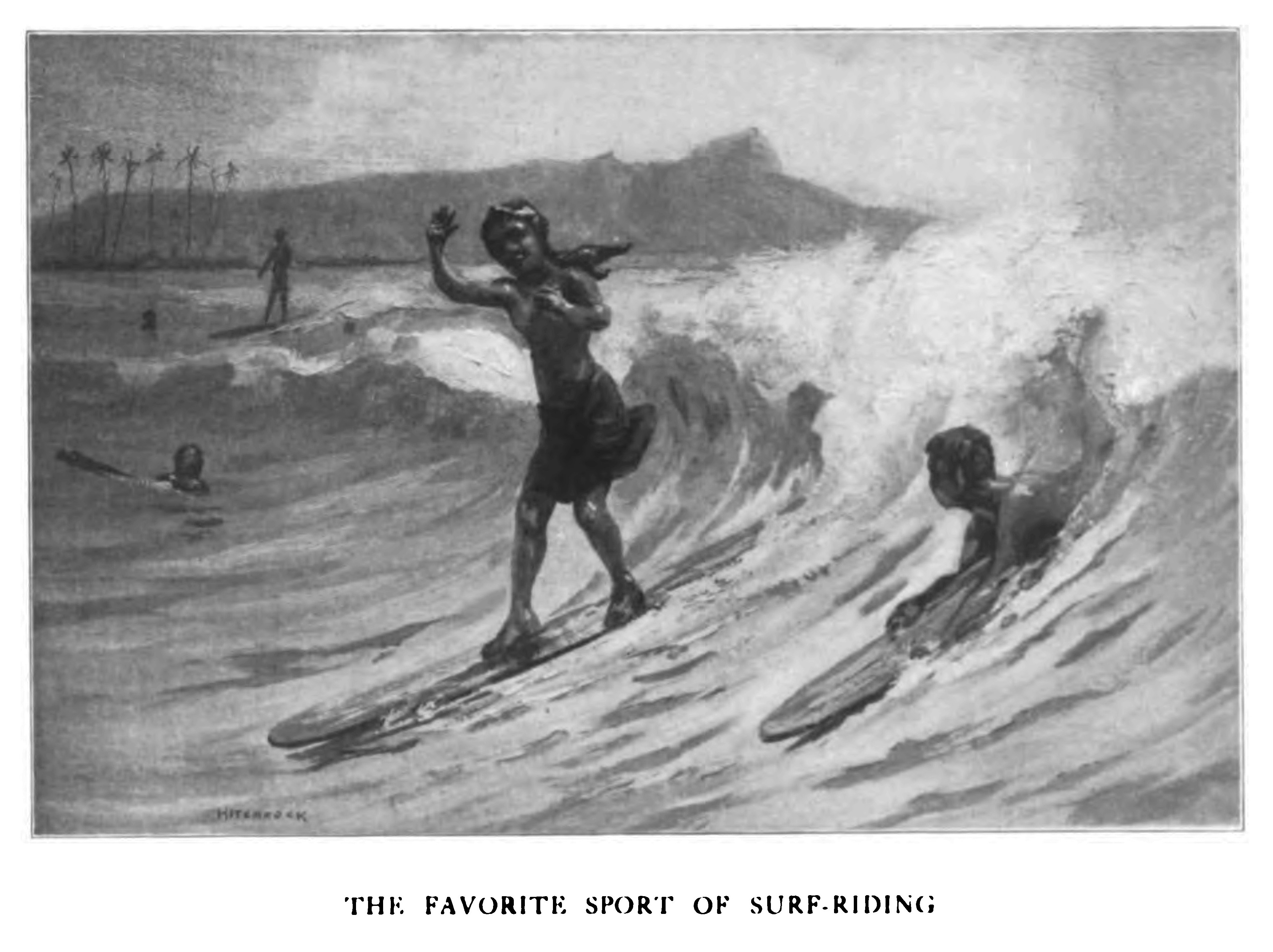 The figure is signed Hitchcock, possibly David Howard Hitchcock (1861–1943), an American painter of the Volcano School, known for his depictions of Hawaii, where he was born and died. Plan to follow-up by looking a figures in Maxon, Helen Hitchcock. 1987. D. Howard Hitchcock, islander. Honolulu, Hawaii: Topgallant Pub. Co. |
||
| Overall observation | The
figure does not appear to match up with the text of the story other
than to include a figure with a woman surfing. No shark chomping Princess Kahalaopuna in half! |
||
|
Torrens, Herb. 2003. Paraffin chronicles. Victoria, B.C.: Trafford. |
|||
| Title Page |  |
A few
passing, notable mentions of bellyboards are made in this book: "Since the transition to short boards, everyone was always trying to push the envelope in design. Herbie Fletcher was shaping reverse tear-drops, a guy named Vinnie Bryant was riding these belly-board like creations with square rails!" [p. 166] "As always, Hynson showed up that year with a quiver of new boards. And this time they were really new. By that I mean different. They were spear-like outline shapes, absolutely flat bottoms with the exception of a little V-line roundness in the tail. They also had the most radical rails anyone had ever seen. They were turned down hard all the way to the nose! No one had seen such a departure in surfboard design since Vinnie Bryant and Bunker Sprekles had made those square-railed belly-boards." [pp. 198-199] "Somebody even organized a Honolua Bay surf contest. Actually, they had held one in a previous winter. Vinnie Bryant had won on his belly-board creation. But, nobody from Maui paid much attention. That first contest was held on a bad day, and not many of us would have gone out anyway." [p. 204] |
|
| Overall observation | Sounds like
bellyboards simply couldn't garner much respect with this crowd despite
the revolution in surfboard designs and on-going experimentation! An
enjoyable read of surfing life as remembered by one of the accomplished
surfriders that lived it firsthand. Note terms used: bellyboard and not paipo. |
||
|
Michael Walker's series of historical books on the False Cape communities of Muizenberg, Kalk Bay and St. James, are shown below. Although the focus of the books is not on surfing but on the histories of the communities in False Bay, the books provide important surf history information. For information reference the map below from the Mark Jury book is included. |
||
| Reference Map of the Cape from p. 91 of Jury, Mark. 1989. Surfing in southern Africa: including Mauritius and Reunion. Cape Town: Struik. |
|
|
|
Walker, Michael. 1997. The golden years: a postcard memoir of the Kalk Bay- Muizenberg municipality, 1895-1913. Cape Town: M. Walker. [First Published 1996. Revised Publication: February 1997. Limited Edition.] |
|||
| Contents, Appendices and the back cover description of the book. |
 |
This
book contains several descriptions, mentions and figures of surf-board
riding, which by all appearances is prone surfing on a traditional
U.K.-style bellyboard, also called a surf-board in the U.K. The book
dates surf-board riding in Muizenberg to the year 1910. The Appendices include a section, Surf-Board riding at Muizenberg (pp. 150-152). |
|
Map and other mentions or references to surfing in the main body of the book. |
Map of Muizenberg and False Bay shows bellyboarding in the seas (p. 4). A zoomed view is on the right. 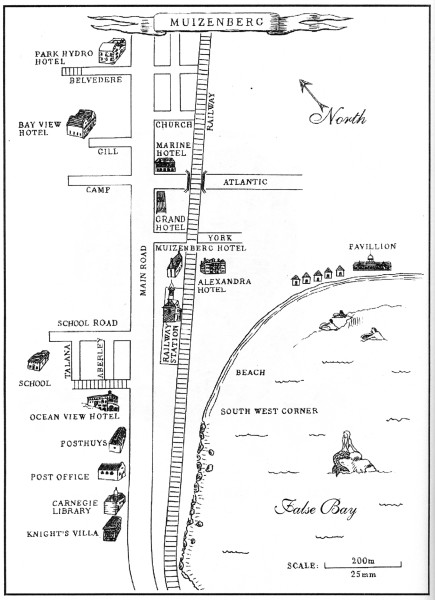 
A post card's caption reads, "Beach strolling was a regular pastime until surf-board riding became popular." The card is not dated nor does it provide a year when surf-board riding became popular. [p. 9] Safety modifications to a beach pavillion were required for protecting surf-board riders, but does not mention when the modifications were made. "The pavilion was opened on the 29th of October 1910 by the Administrator of the Cape, Sir Frederick De Waal. It was raised from the beach sands on stilts which allowed the high tide waters to carry up the beach. This proved to be a problem with board surfers and a fence had to be erected between the pillars to avoid accidents." [p. 11] The two postcards displayed on p. 12, show the popularity of surf-board riding. |
||
| Appendix, Surf-Board riding at Muizenberg | The appendix begins, "It is of interest to note that until about 1910, in spite of
the magnificent beaches, local Capetonians and holiday-makers were not
enthusiastic about sea bathing, let alone sun-tanning. Beach scenes
show men and ladies, dressed to the nines with suits and long dresses."
The first paragraph concludes, "Tidal rock pools were built for their
protection, but it was the open surf of Muizenberg that held thegreat attraction." [p. 150] Continuing, the beginning of surf-riding in Muizenberg and South Africa, is pegged at 1910: It is unrecorded history circa 1910, that an Australian whilst passing through Cape Town visited the "Sands of Muizenberg". There he noticed a plank of wood on the beach, which he picked up and showed the locals how to catch a wave. Soon small boys came riding in on the waves clutching logs of wood and planks. The carpenters of Cape Town were kept busy turning out flat planed boards. These they soon refined to have turned-up ends, which meant less chance of a nose dive and a stray jab in the solar plexus. [p. 150]Two postcards appear on p. 151. The captions on the postcards read,
|
||
| Overall observation | This book dates surf-board riding to 1910, but notes it is unrecorded history, at least the part of "an
Australian whilst passing through Cape
Town visited the "Sands of Muizenberg". There he noticed a plank of
wood on the beach, which he picked up and showed the locals how to
catch a wave." The dating of bellyboarding is later firmly dated to
1913 in a publicity association statement. The postcards displayed in
the book do not cite dates but do establish the popularity of in-shore
bellyboarding (aka surf bathing and surf-board riding). |
||
|
Walker, Michael. 1999. Coastal memories: Muizenberg, St. James, Kalk Bay, 1870-1920. [St. James, Cape Town]: M. Walker. |
|||
| Contents and Appendices and the back cover description of the book. |
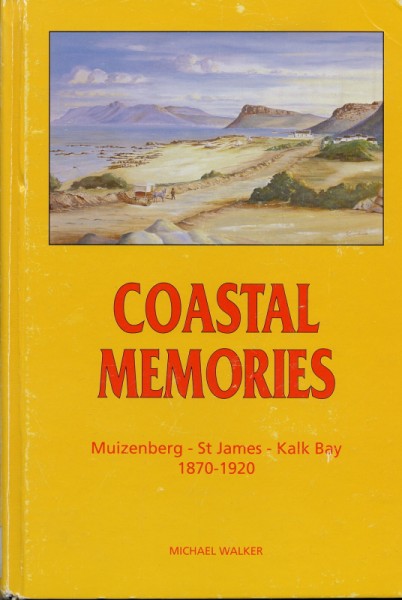 |
This
book contains several descriptions, mentions and figures of surf-board
riding, which by all appearances is prone surfing on a traditional
U.K.-style bellyboard, also called a surf-board in the U.K. The book
dates surf-board riding in Muizenberg to the year 1910 and provides
documentary evidence that surf-board riding was very popularized by
1911. The Appendices include two important sections, Surf-Board Riding at Muizenberg and A Chronology (1870-1920). |
|
Map and other mentions or references to surfing in the main body of the book. |
Map of Muizenberg and False Bay shows bellyboarding in the seas (p. 4). A zoomed view is on the right.  
This appears to be the same map that appears in Michael Walker's earlier book, The Golden Years (Walker, 1997). Two postcards appear on page 9. In the upper postcard there are faint images of people carrying surf-boards and a couple of people mounting or riding the crest of the waves. The lower postcard contains the caption, "Beach strolling was a regular pastime until surf-board riding became popular." The postcards are not dated. Two more postcards appear on page 12, both featuring surfing. The lower postcard shows people carrying their surf-boards—the image below shows part of the postcard. The boards appear to be flat rockerless planks (without a nose scoop) and approximately 48 inches long and 12 to 14 inches wide. 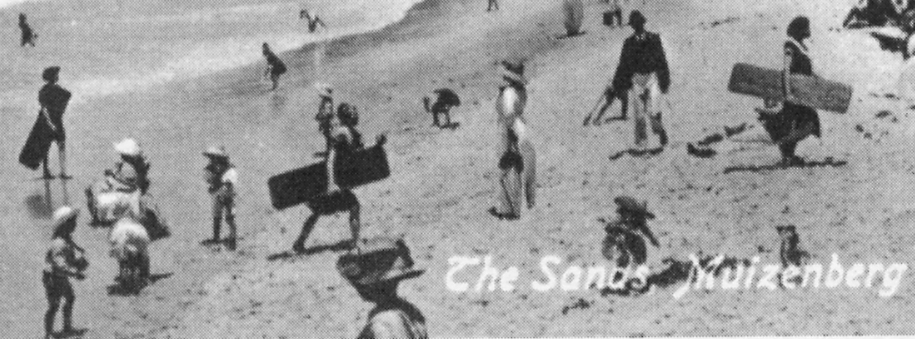 At the bottom of p. 13, is a postcard titled, "The popularity of donkey-rides never waned." In the background at the water's edge and in the near shore ocean are faint images of surfing-boards and surfing. The cards are not dated. |
||
| Appendix, Surf-Board Riding at Muizenberg, pp. 208-210. | The first paragraph is the same as in Michael Walker's earlier book, The Golden Years (Walker, 1997). [p. 208] The paragraphs that follow are unchaged from The Golden Years appendix from a surf-board riding perspective: It is unrecorded history, that an Australian while passing through Cape Town, circa 1910, visited the "Sands of Muizenberg". There he noticed a plank of wood on the beach, which he picked up and showed the locals how to catch a wave. Soon small boys came riding in on the waves clutching logs of wood and planks. The carpenters of Cape Town were kept busy turning out flat planed boards. These they soon refined to have turned-up ends, which meant less chance of a nose dive and a stray jab in the solar plexus.Two postcards appear on p. 209. The captions on the postcards read,
 The appendix concludes with two paragraphs that are unchaged from The Golden Years appendix from a surf-board riding perspective (the text clarifies that The Great War is the First World War): "This new thrill of surf-board riding should bring many more visitors from up-country, if they only knew about it", the publicity association considered. In the Cape Times of June 1913 they exhorted surfers to turn out in great numbers one Sunday at Muizenberg so that they could make a film of them, "bring this fascinating sport to the notice of up-country people who may not have visited Muizenberg". It was mid-winter so some encouragement was needed, and the annotation "It should be noted that the temperature of the water at present is quite high," was added.This appendix is functionally unchaged from the appendix in The Golden Years except for the improved postcard reproductions which more clearly show the crossbars on the surfing-board shown above. |
||
| Appendix, A Chronology (1870-1920), pp 235-260. |
In the Muizenberg section of the chronology, in 1911:
|
||
| Overall observation | As in the 1997 publication, The Golden Years, this book dates surf-board riding to 1910, but notes it is unrecorded history, at least the part of "an Australian while passing through Cape Town, circa 1910, visited the "Sands of Muizenberg". There he noticed a plank of wood on the beach, which he picked up and showed the locals how to catch a wave." However, the Chronology
provides documentary evidence that surf-board riding existed to a
sufficient extent in 1911, that the Council implemented strict rules. The postcard images are much improved in this edition with increased clarity. |
||
|
Walker, Michael. 2004. Kalk Bay, St. James: a brief history illustrated with postcards of a bygone era. St. James [South Africa]: M.J. Walker. [First edition.] |
|||
|
|
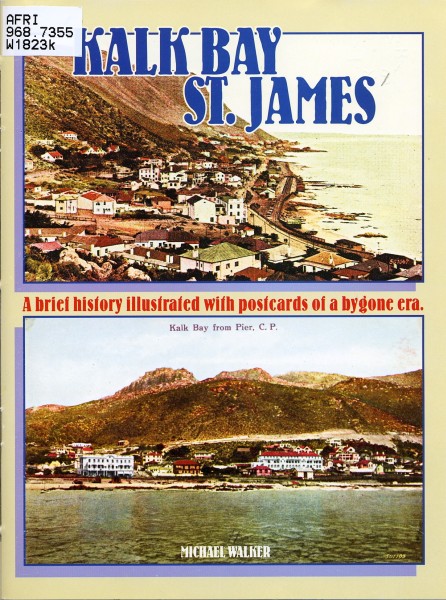 |
This
book contains one discussion of surf-board riding but no postcard
figures of surfing. In a discussion of tidal pools in Kalk Bay
municipality, the book states the following: Safe bathing was in public demand especially for children and the St. James tidal pool offered just that. Tidal pool bathing was very popular until c.1914 when as legend has it, an Australian troopship docked in Table Bay and a few of the soldiers ventured down to Muizenberg. Here they taught locals the art of surf-board riding and it was not long before it caught the fancy of many locals and visitors who now flocked to Muizenberg beach with a great variety of surf-boards. [p. 43]The timeline of this story differs from the one conveyed above but the "legend" is similar (Michael Walker, 1997). Nonetheless, the 1997 book does cite a 1913 article in the Cape Times where the publicity association "exhorted surfers to tum out in great numbers one Sunday at Muizenberg." |
|
p. 2 |
Map of Kalk Bay and False Bay may show bellyboarders in the seas in the area labeled "beach." A zoomed view is on the right. 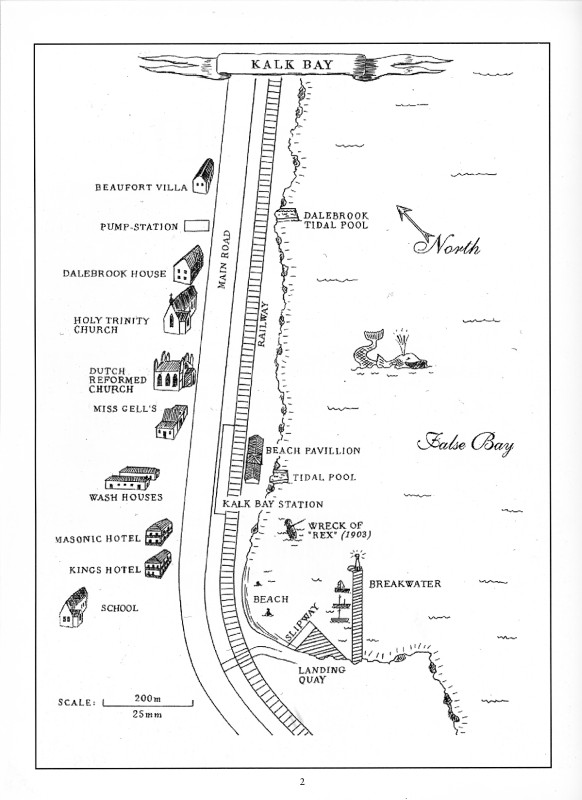 
|
||
| Overall observation | Surf-board
riding is not prominently featured in the towns of Kalk Bay and St.
James. Based on my readings of the other Walker books the sport of
surfing was most prominent in Muizenberg. |
||
|
Walker, Michael. 2004. Muizenberg: the golden years. St. James: M.J. Walker. |
|||
| Cover and overview. |
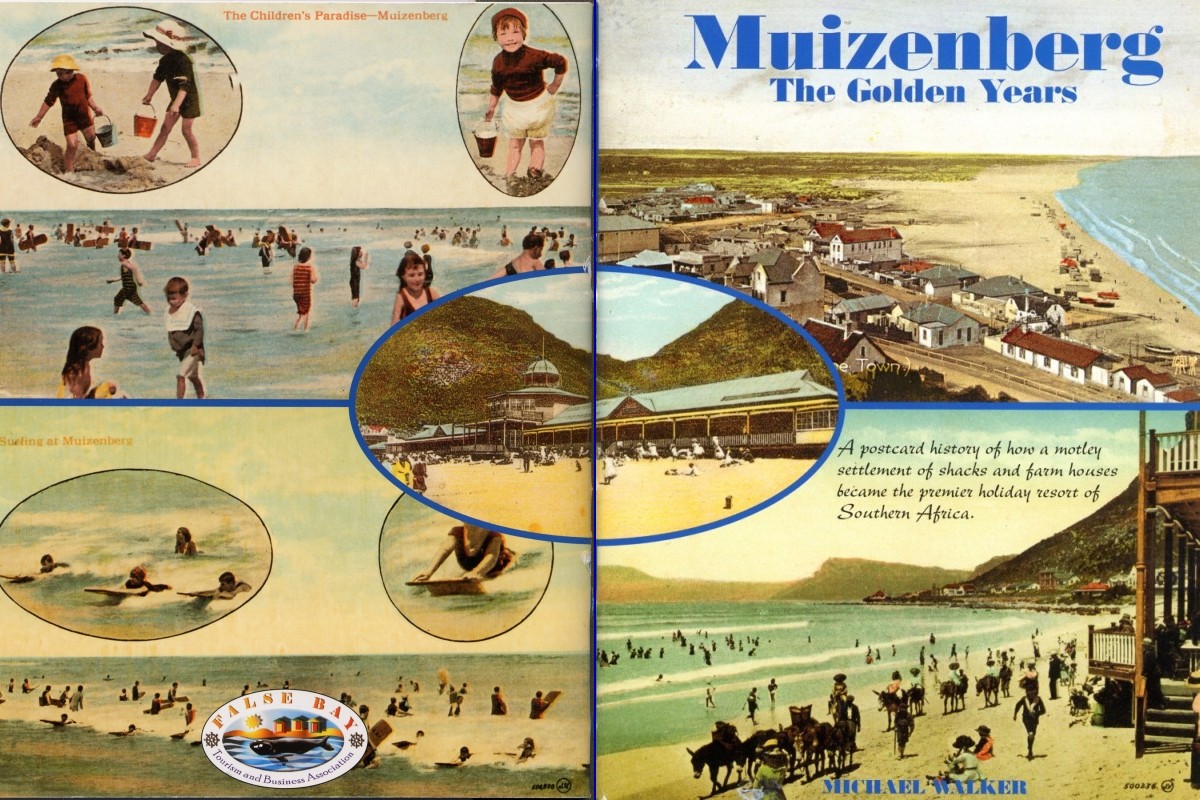 |
This
book contains several descriptions, mentions and figures of surf-board
riding, which by all appearances is prone surfing on a traditional
U.K.-style bellyboard, also called a surf-board in the U.K. The book dates surf-board riding in Muizenberg to the outbreak of WW I, but uses the qualifier "alleged." [The year would be 1914.] A zoomed-in picture of surf-boarders in the bottom image of the front cover. |
|
Map and other mentions or references to surfing in the main body of the book. |
Map of Muizenberg and False Bay shows bellyboarding in the seas (p. 2). A zoomed view is on the right.  
This map is very similar to the ones that appear in Michael Walker's earlier books (Walker, 1997 and 1999). Two postcards appear on page 9. The postcards feature the old and new pavilions at Muizenberg. The upper postcard is the older pavilion (in use from 1911-1929). The lower postcard is of the new pavilion (in use 1929-1971). The lower postcard also shows two people holding surfing-boards each of a slightly different design (see below). The cards in the book are not dated. Two postcards appear on p. 11. The book describes the images, "Beach fashions prior to the introduction of surfing were very formal as can be seen from the postcards." The cards in the book are not dated. Two postcards appear on p. 12. The upper card is divided into 4 rectangular sections with an oval inlay over them in the center. The two right rectangular sections each show surf-boarding. The upper right section, titled, "Surf Bathing," shows several board riders. The lower right section, titled "Sands" shows at least 3 people carrying surfing-boards. The cards in the book are not dated. The two postcards on p. 13 are captioned, "Trek-fishing boats and surf-board riders were a regular attraction at the beach." The lower postcard, Surfing at Muizenberg, shows scores of surf-boarders including some close-up insets. This postcard may be seen on the MyPaipoBoards site, courtesy of Hilton Teper. The cards in the book are not dated. On the origins of surfing at Muizenberg the author writes, Surfing, it is alleged, was first introduced to the young folk on Muizenberg beach by an Australian who was stationed here at the outbreak of World War I. He shaped a wooden board and demonstrated the skills of wave-surfing to an appreciative audience who 'soon took to the waves' in great numbers.Note: This timeline does not square with the author's prior accounts. |
||
| Overall observation | Although
published five years later than this book the language on the origins
of surfing in Muizenberg are surrounded by uncertainty. However, the
author's 1999 book has documentary evidence that surfing started before
1914. There are some good postcard prints. |
||
|
Walker, Michael. 2009. Muizenberg - a forgotten story. St. James [South Africa]: M. Walker. |
|||
| Cover and overview Excerpt from the Preface |
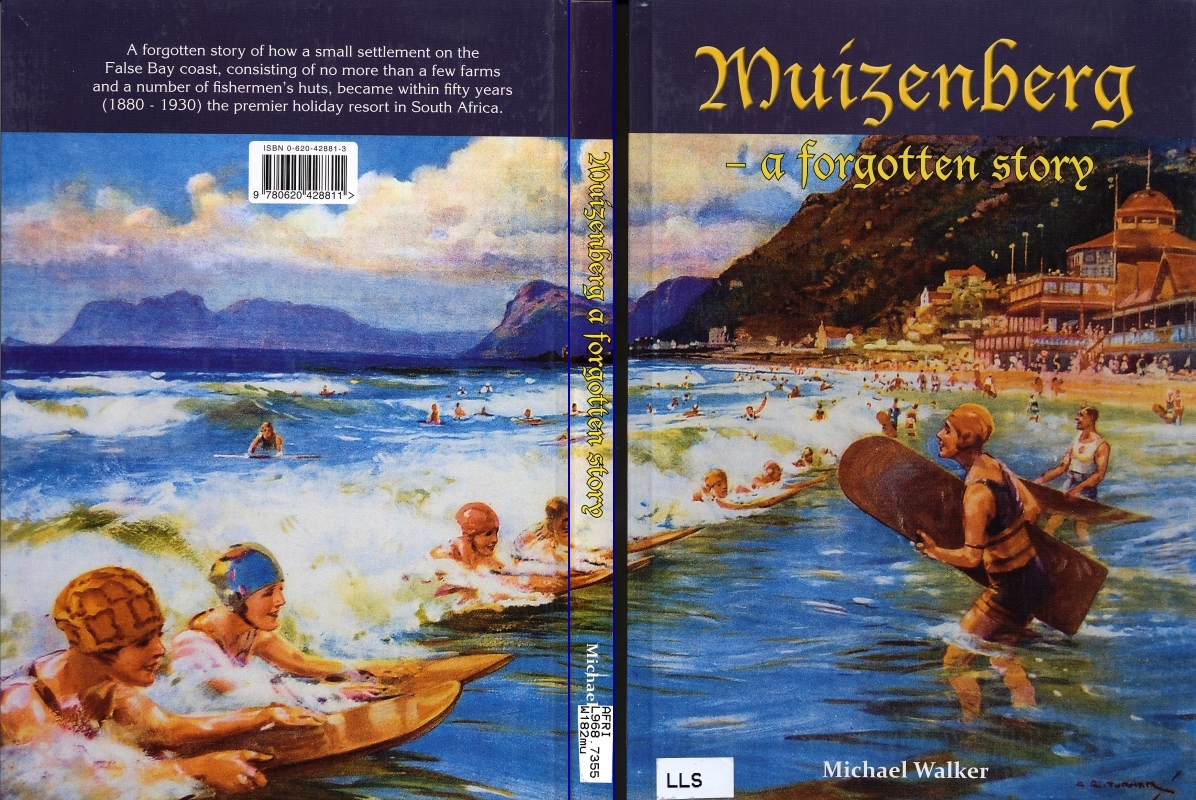 The cover is a painting of the First Pavilion and surfers, c. 1924 by G. Turner. (Courtesy of Muizenberg Historical and Conservation Society). |
This
book contains several descriptions, mentions and figures of surf-board
riding, which by all appearances is prone surfing on a traditional
U.K.-style bellyboard, also called a surf-board in the U.K. However,
the author cites an Australian with introducing surfing to the
Muizenberg & False Bay area around 1910, becoming very popular by
1911, and surging with popular after the Great War (1918). The boards were initally flat planned. In the Preface: In expressing the romance and delights of Muizenberg, the Cape Peninsula Holiday Haunts (1914), included a passage on surf-boarding, It is the only cure-of-all-aches, there is nothing so tonic as a dip, nothing so exhilarating as a spell upon the surf-boards, and nothing so calculated to revive the sense of well-being than, after enjoying the sea, to spend lazy hours on the Muizenberg sands, to saunter among the white-clad dunes or stroll along her perfect beach. [Preface, p. iv]The Cape Peninsula Publicity Association brochure of 1918 "emphasised the romance of Muizenberg with special focus on the benefits and joys of surfing." [p. v] |
|
Map and other mentions or references to surfing in the main body of the book. |
The Map of Muizenberg and False Bay no longer shows surf-board riding in the ocean (p. ix). 
This map is a departure from the maps in the Michael Walker's earlier books (Walker, 1997, 1999, and 2004). Map by Joan Stephens. In a discussing the pavillions' histories, the book noted this: The Pavilion was opened on 16 December 1911 by the Administrator of the Cape, the Honourable Sir Frederic de Waal. It was raised from the beach sands on stilts, which allowed the high tide waters to wash up on to the beach. This proved to be a problem for board surfers, so a fence had to be erected between the pillars to avoid accidents. [pp. 32-33]A Hillel College advertisement (Cape Times, May 29, 1931), "Educate and Build Sturdy, Healthy Boys at The College by the Sea," cites surfing as a special benefit: "Bathing, Surfing and the exhilirating Sea-breezes, combined with the liberal table of Hillen College, ensure sturdy, healthy boys with receptive brains for the high standard of education offered by Hillel College." [p. 115] Note that the term "surfing" and not "surf-board" or "surf bathing" is used in the advertisement. |
||
| Chapter 14. Sport and Recreation: Surf-board Riding at Muizenberg | The first section of this chapter is titled, Surf-board Riding at Muizenberg, covering four pages of the 12-page chapter. The chapter begins, It is interesting to note that until about 1910, in spite of the magnificent beaches, local Capetonians and holiday makers were not enthusiastic about sea bathing, let alone sun tanning. Beach scenes show men and ladies dressed to the nines with suits and long dresses. One has only to study the range of 'bathing gowns' then available at the local shops to appreciate this trend. The next generation founded Cape Town's sea-bathing tradition. Tidal rock pools had been built for their protection, but it was mainly the open surf of Muizenberg that attracted their attention. [p. 117]Continuing in the next paragraph, It is unrecorded history that an Australian, while passing through Cape Town, circa 1910, visited Muizenberg. He noticed a plank of wood on the beach, picked it up, and showed the locals how to catch a wave. Before long small boys came riding in on the waves, clutching logs of wood and planks. The carpenters of Cape Town were later kept busy turning out flat-planed boards. These they soon refined to have curved ends, which meant less chance of a nose-dive. [p. 117][Note: The curved ends must refer to the plan shape and not the bottom shape as very little, if any, rocker can be seen in the postcards featuring or including surf-boarding or surf-bathing. The one exception seems to be the 1924 painting on the book's cover where the surf-boarder in the foreground is riding a surf-board with a scooped nose.] One postcard appears on the bottom of p. 117, Surfing at Muizenberg. The postcard appears to feature the same scenes as the postcard provided courtesy of Hilton Teper: 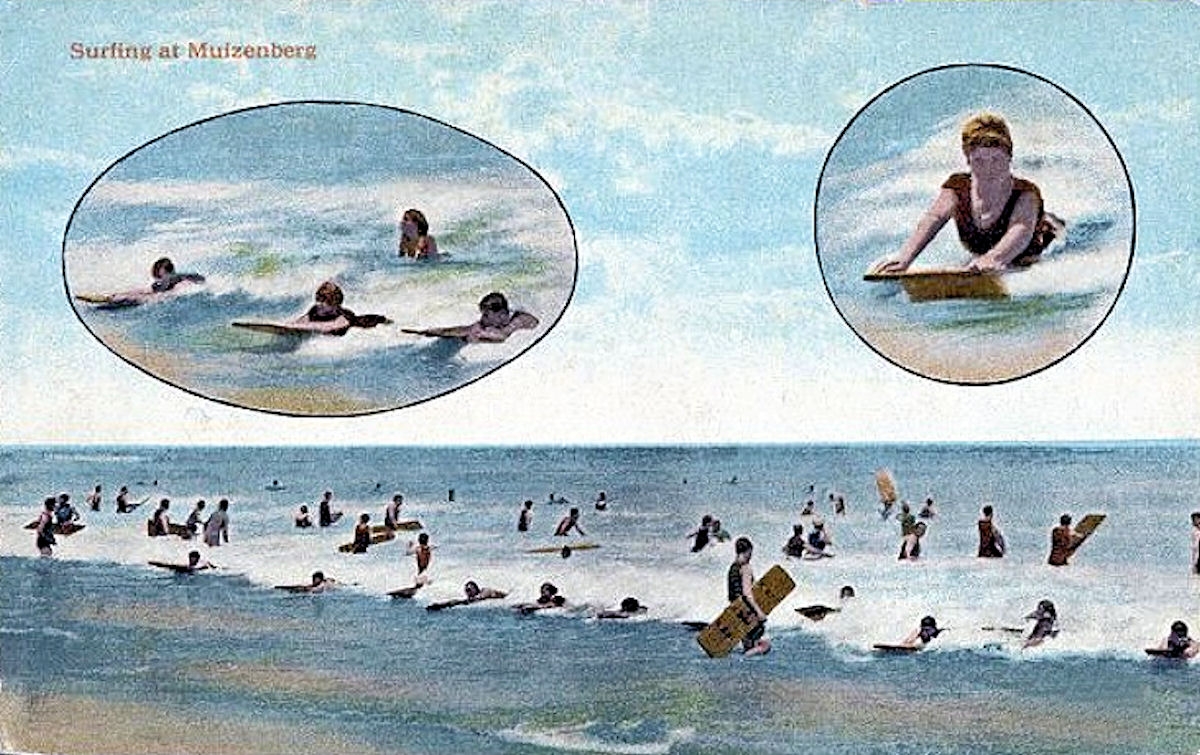 Other excerpts follow: Surf-boarding made Muizenberg the most popular holiday resort in South Africa. Special fencing was placed around the pavilion to prevent surf-boarders from being washed under the building at high tides. So popular did surf-boarding become that the Municipality became proprietor of several thousand surf-boards, which were hired out together with costumes, bathing caps, towels and later deck chairs. [p. 118] |
||
| Appendix, Chronology |
In the chronology, in 1911:
|
||
| Overall observation | This
is the fifth in a series of postcard-based history books on the False
Bay & Muizenberg area. Through the years the books expanded beyond
the postcard-based theme alone. Although not intended to be a history
of early surfing in South Africa these books provide a historical
foundation for the sport of surf-boarding near Cape Town. Although the
books vary on the starting date of surf riding there is documentary
evidence in a couple of the books that 1910 is when surf-boarding
captured the love and attention of people living in or visiting the
False Bay area. Postcards, photographs, newspaper accounts, council meeting recoreds and tourist association brochures provide the basis of the surf-boarding history. The painting gracing the covers and spine of this book captures the essense of surf-boarding in Muizenberg. |
||
|
Warwick, Wayne. 1968. Surfriding in New Zealand. Wellington: Seven Seas Pub. Pty. |
|||
| Title page |
 |
This
is the first edition of a series of "surfing in New Zealand" books
written by Warwick. There is no color except for the front and back
covers and no table of contents. Not even any page numbering! The book
contains a short introduction and a small glossary of surfing terms as
they are understood and used in New Zealand. In the section titled, "Early Days," there is no mention of Maori surfriding nor of prone (paipo & bellyboard) surfing. This history of surfing section describes surfing as it was understood in the mid-1960s, in New Zealand (the book dates some information to 1967). Note: A page appears to be missing in the "Stage Three of Learning Surfing" of the Surfing in General section. This section does have subsections discussing skegs, V-bottoms and pintail boards and other items. |
|
| Section on Surfing in General | The subsection on "Skegs" focuses on George Greenough, one of the innovators of "New Era Surfing," who developed what is now, known as the "Greenough Skeg," which is used on most boards built today. The ironical part of Greenough's design is that he built his skeg for a belly board which he rides more than a surfboard. [no page number]The subsection describing other forms of surfing includes "Bellyboard riding." This subsection notes that
At Noose Point, Australia, rider G. Greenough.  Photo: A. McAlpine. [Note: In an email to me, Apr. 22, 2016, Bob Green noted, "The photos are definitely not Noosa Heads. Noosa is a series of right points, even if reversed I doubt these could be Noosa."] |
||
| Overall observation | Not
much information on paipo/bellyboard surfing in this book. Seems like
surfriding was still much in its infancy in New Zealand but it must
have been an exciting time to be part of it. Kudos to G. Greenough --
he called his surfing style "bellyboarding" at that time even
though he was knee riding a spoon and Velo -- terminology is one of the
challenges in sifting
through older and historical texts. [Note: Bob Green suggested that the
two photos "At Noose Point," may be screen grabs from McAlpine's movie,
Children of the Sun.] |
||
|
Warwick, Wayne. 1978. A guide to surfriding in New Zealand. Wellington, N.Z.: Viking Sevenseas. |
|||
| Cover, Section on Kneeboard or Bellyboard riding in the chapter, Surfing Alternatives |  |
The guide does not contain a table of contents or page numbers. In the chapter named, "Surfing Alternatives," is a section named Kneeboard or Bellyboard riding. The section is virtually identical to the text in the 1968 edition except for the introduction of the term "kneeboard riding." For example, a 1968 excerpt reads, "George Greenough from California USA is regarded as the foremost exponent of bellyboard riding today..." The 1978 edition reads, "George Greenough from California USA is regarded as the foremost exponent of Kneeboard riding today..." No photos of paipo or kneeboard surfing noted. |
|
| Overall observation | The
term "kneeboarding" had come into mainstream use by the time of
publication distinguishing itself more clearly from bellyboard/paipo
surfing. No other reference to bellyboard/paipo surfing. |
||
|
Warwick, Wayne. 1995. A guide to surfriding in New Zealand. Paraparaumu, N.Z.: Viking Sevenseas NZ. |
|||
| Cover and comments |  |
This edition on surfriding in New Zealand does not contain any references to paipo/bellyboard surfing. The book is a good looking guide for the local or visiting surfrider. It has an extensive section on weather charts and surf breaks for the north and south islands. It also contains a short history of surfing in New Zealand. |
|
|
Unknown. (1950s?). Surf riding made easy - a sporting guide from the 1950s. Original publication date and location is unknown. Republished by The Original Surfboard Company, 2013. |
|||
| Title page and Contents [PDF] and Introductory Chapters Source(s) |
 |
Rare 1950’s book back in print by The Original Surfboard Company. The company owner, Sally Parkins,
states, "To give a vintage feel to the book the first 100 copies of
"Surf Riding made easy" have been printed on straw paper and are
individually numbered." This is the only original copy known—found by
Sally Parkins in her pursuit of short board material. |
|
| NOTE:
Due to limited availability of this publication any assistance in
characterizing the booklet would be welcome, including orignal author,
publication company, location and date, and content. |
|||
| Overall observation | This is one of about four early publications on early surf riding (paipo/bellyboard surfing) in the U.K. |
||
|
Also
see my Bibliography
for Paipo Research and
General Acknowledgments, Sources, Places, Citations, Contributors... |
Feel free to send me suggestions for additions to: A Bibliography for MyPaipoBoards.
|
MyPaipoBoards.org recommends EasyBib for easily generating citations EasyBib: the bibliography maker. |